
From Three Weeks to One Day: An OpenClaw Agent for an Education Research Team
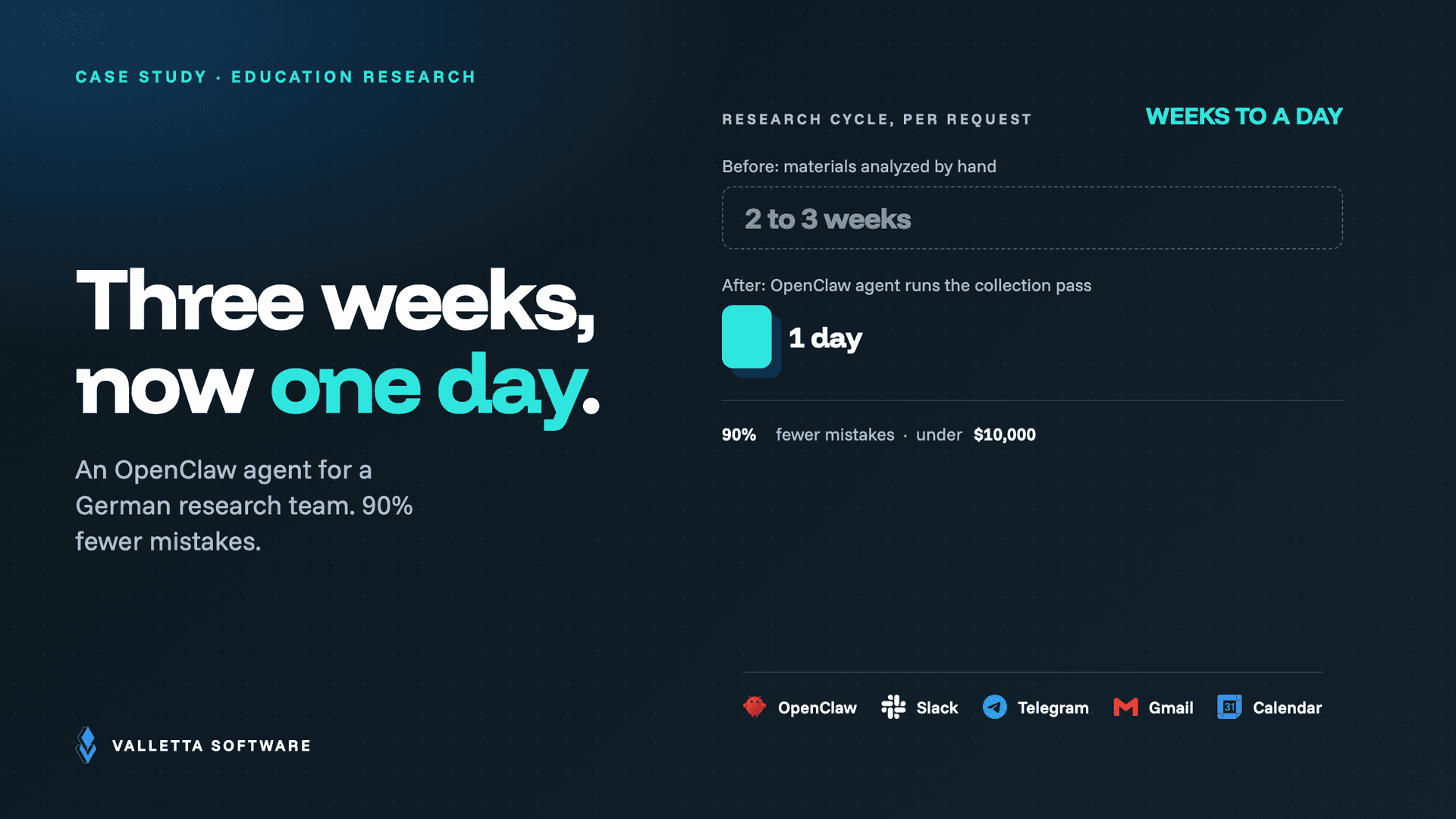
Helsingor, a German company that provides outsourced research services in the education sector, hired Valletta to set up an OpenClaw agent for a small team of researchers. The COO's own account: analysis, conclusions and presentation used to take two to three weeks and now take one day, with 90% fewer mistakes. The whole engagement came in under $10,000.
Key Takeaways
- One OpenClaw use case, measured by the client: research turnaround down from 2 to 3 weeks to one day
- 90% fewer mistakes in the delivered research, in the COO's words on a verified Clutch review
- The agent automates Slack, Telegram, Gmail and Google Calendar, runs deep-search jobs, and builds dashboards
- Investment under $10,000 with a Valletta team of two to five people; started March 2026, still growing
- The researchers kept the conclusions and the client presentation. The agent took the collection and the first pass
The client is Helsingor, a company with 11 to 50 employees, headquartered in Germany, that provides professional outsourced research services in the education field. Every fact and number in this story comes from the verified review its COO, Sonya Stefanovic, published on Clutch in April 2026. The narrative around the numbers is ours; the numbers are hers.
The Challenge: Three Weeks From Raw Material to a Finished Deck
Helsingor's product is a conclusion. A client asks a question about a market, a curriculum, an institution or a policy, and a small team of researchers collects the material, analyzes it, draws the conclusions and packages them into a presentation. Every step of that chain was manual.
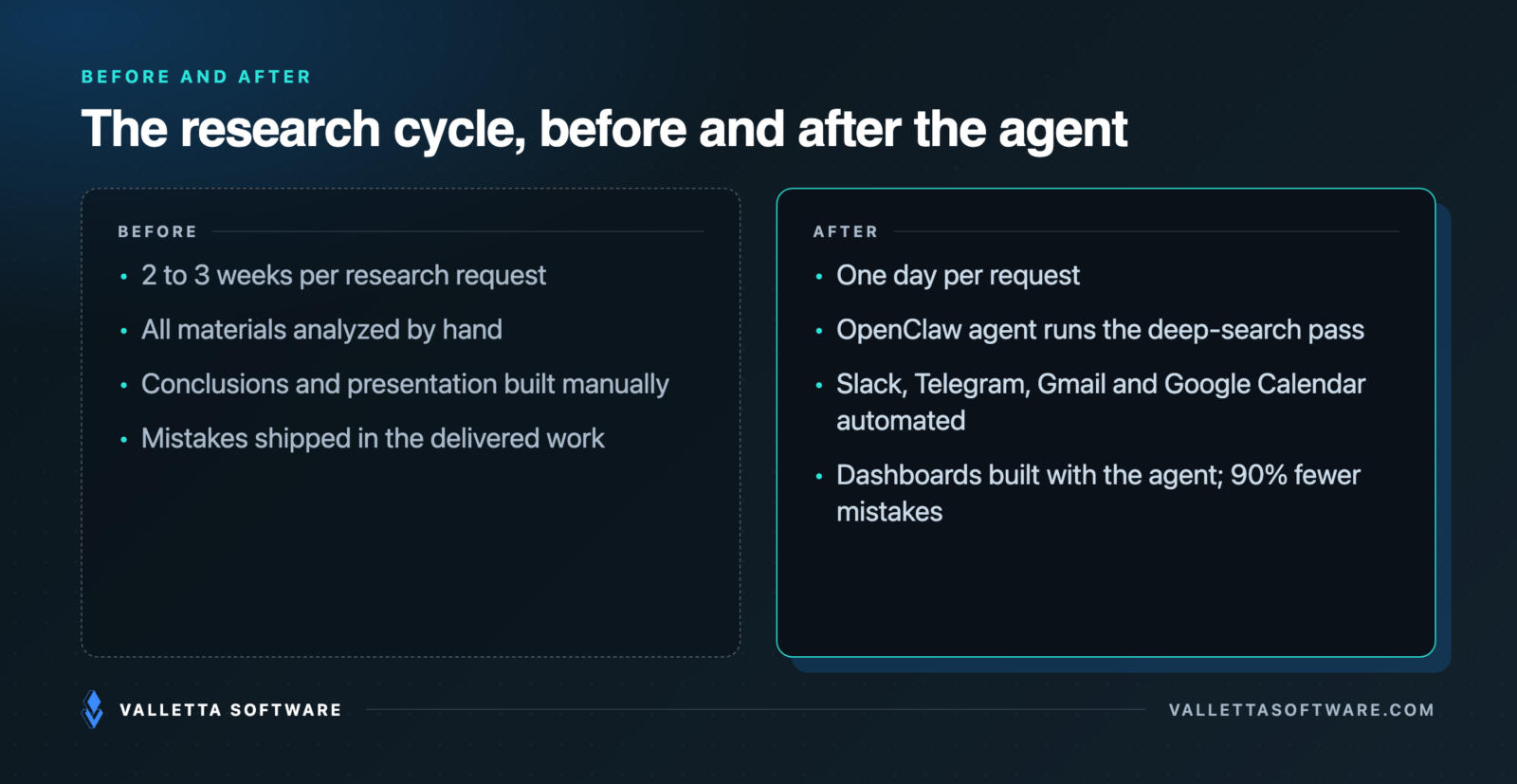
The COO's description of the before state is short and brutal: it took the team two to three weeks to analyze all the materials and make the conclusions and the presentation. Three problems sat inside those weeks, and the team's daily tools were the same four an agent can reach, Slack, Telegram, Gmail and Google Calendar:
- Two to three weeks per request to analyze all the materials, draw the conclusions and build the presentation
- Mistakes in the delivered work: the client reports 90% fewer after the agent, so the manual chain was producing them
- Time-to-market for a finished research deck measured in weeks, which capped how many clients the same team could serve
Helsingor found Valletta on Clutch and chose us for the rating and the value for cost. The budget was strict and stated up front: under $10,000.
The Approach: A Forward-Deployed Engineer Inside the Team's Own Tools
We did not start with an architecture deck. The engineer started inside the tools the researchers already used: Slack, Telegram, Gmail and Google Calendar. The question for the first week was not which model to run, it was which of the researchers' daily actions could be handed to an agent without changing how the team works.
That is the forward-deployed way of building. The person who hears the problem is the person who configures the agent, tests it with the researchers on real requests, and adjusts the next day. The client noticed the working style before the results. Asked what impressed her most, the COO answered in one word: patience.
The Solution: One OpenClaw Agent, Four Channels, Deep Search and Dashboards
Channels: Slack, Telegram, Gmail and Google Calendar
OpenClaw is a self-hosted, local-first agent with a gateway that connects one assistant to several messaging channels. For Helsingor the agent was wired into Slack and Telegram for the team's conversations, Gmail for the inbound requests and outbound follow-ups, and Google Calendar for scheduling around the research cycle. A researcher can hand the agent a task from whichever channel they are already in.
Deep-search automation
The largest time saver was a deep-search automation. Instead of a researcher opening sources one by one, the agent runs the collection pass across the material, structures what it finds and hands back a draft the researcher reviews. The judgment did not move. The re-keying disappeared, and with it most of the mistakes.
Dashboards built with the agent
The team also used the agent to prepare dashboards, so the state of a research request and its findings are visible without anyone assembling a status update by hand.
Cost control on a fixed budget
An agent that runs deep-search jobs all day can burn tokens. Model choice and heartbeat settings were tuned for cost from the start, the same discipline we describe in our OpenClaw cost-control guide. The COO's review is candid that the project ran slightly behind schedule because of its complexity, and that the Valletta project manager reorganized the work to land inside the budget. We would rather publish that sentence than pretend the schedule was perfect.
The Results: One Day, 90% Fewer Mistakes
The numbers below are the client's, quoted from the Clutch review, not our estimates.
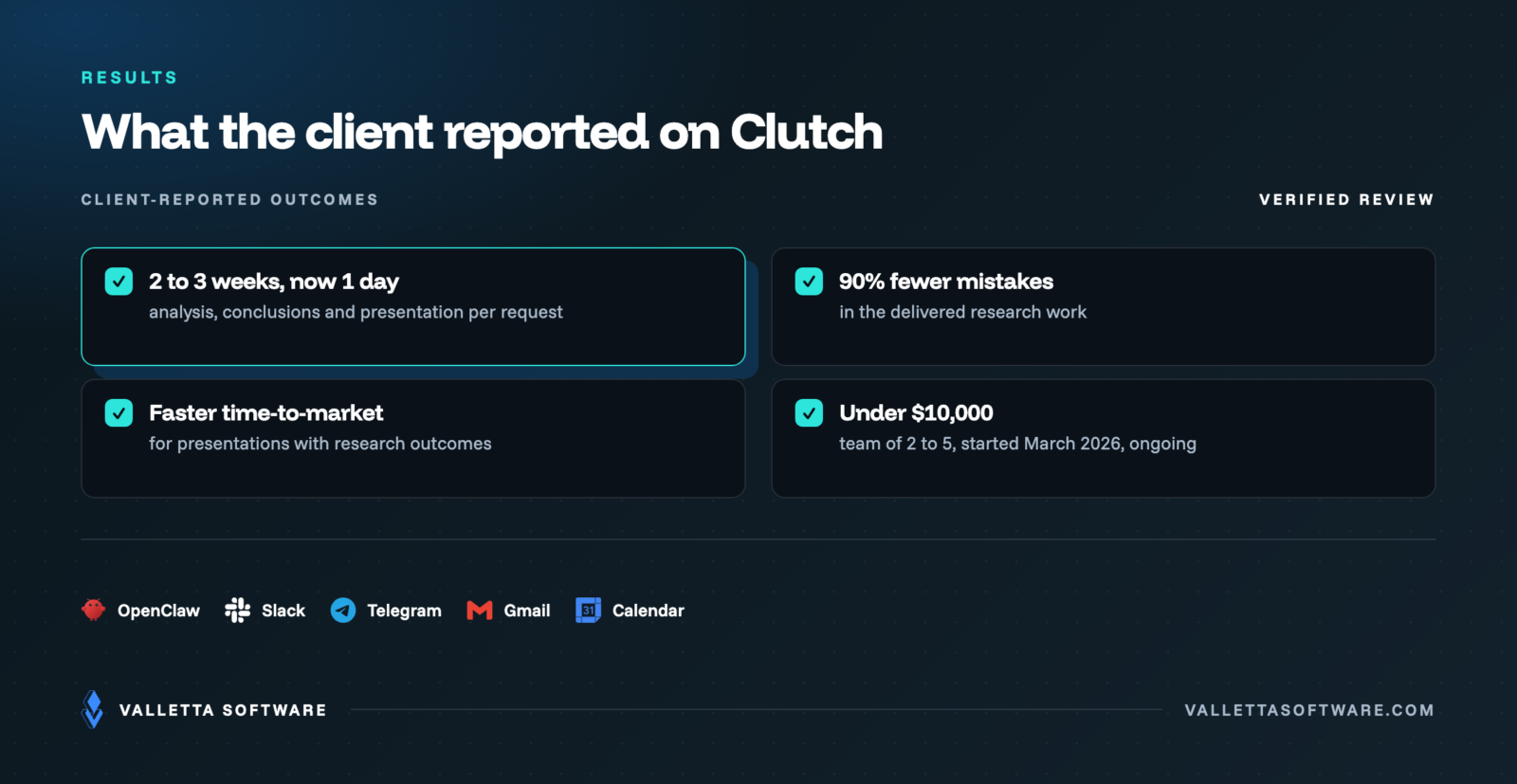
- Research analysis, conclusions and presentation: from two to three weeks to one day
- Quality: 90% fewer mistakes in the delivered work
- Faster time-to-market for presentations with research outcomes, which is what the client sells
- Investment under $10,000; the engagement started in March 2026 and is ongoing
- Rated 5.0 on Clutch for quality, schedule, cost and willingness to refer
Ask what changed in business terms and the answer is capacity. A research team whose cycle time falls from weeks to a day can take on more clients with the same headcount, and it stops shipping the small errors that erode a research firm's reputation.
We've seen a significant boost in quality, with 90% fewer mistakes, and in the speed of time-to-market of presentations with research outcomes. Previously, it took us 2 to 3 weeks to analyze all materials and make the conclusions and presentation. Now, it only takes us one day.
Sonya Stefanovic, COO, Helsingor, on Clutch
Why This Worked as an OpenClaw Use Case
Most failed agent projects start with a demo and end with a tool nobody opens. This one started inside the channels the researchers already lived in, took over one slow step at a time, and left the conclusions with the humans. The agent is not a chatbot the team consults; it is a colleague that does the collection pass before the researcher arrives.
If you are weighing your own deployment, the practical guides are here: how to install OpenClaw, how to harden it, and how enterprise agents are built. For a smaller, single-owner deployment, read how a non-technical owner runs OpenClaw on a Mac mini.
Frequently Asked Questions
What is a realistic OpenClaw use case for a small team?
Research and reporting work that is repetitive but judgment-heavy. Helsingor's researchers collect material across many sources, analyze it, draw conclusions and present them. The agent now does the collection, the first-pass analysis and the dashboards; the researchers keep the judgment. The client reports 90% fewer mistakes and a one-day turnaround where it used to take two to three weeks.
How much does an OpenClaw deployment like this cost?
The client states on Clutch that the investment was under $10,000, with a Valletta team of two to five people. The work started in March 2026 and is ongoing, because an agent that touches Slack, Telegram, Gmail and Google Calendar keeps growing new tasks once the team trusts it.
Does the AI make the research conclusions?
No. The agent gathers, structures and drafts. The conclusions and the client-facing presentation stay with the researchers. That split is what produced the accuracy gain: the humans review a structured draft instead of re-keying sources by hand under deadline.
Want an AI Agent That Your Team Actually Runs?
Helsingor's researchers did not learn a new tool. Their existing Slack, Telegram, Gmail and Calendar grew an agent, and the slowest three weeks of their process became a day.
Valletta works the forward-deployed way: the engineer who hears your problem is the engineer who configures the agent inside your own tools, tests it with you, and leaves only when you can run it without us. Read what a forward deployed engineer is, or skip the reading.
Tell us what your team is doing by hand: vallettasoftware.com/contact-us