

Forward Deployed Engineer: The Job, The Pay, The Catch

A forward deployed engineer (FDE) is a customer-facing software engineer who builds and ships production software inside a client's own environment, instead of working from a backlog behind a product team. The role was invented at Palantir, and in 2026 it is being hired hard by OpenAI, Anthropic, Google Cloud and Stripe, because getting AI to work in a real company turns out to be a deployment problem rather than a model problem.
Key takeaways
- FDE stands for forward deployed engineer. The short version: an engineer who writes and deploys code inside the customer's systems, on the customer's data, under the customer's security rules.
- Palantir pioneered the model. The earliest published use of the term traces to 2010, when Palantir sent engineers into government sites to work on secure, air-gapped networks.
- The 2026 surge is an AI story. Model demos are cheap now, and the expensive part moved to integration, data access and change management. That is exactly the gap an FDE fills.
- The difference from a consultant is step four: an FDE is expected to feed the pattern back into the core product. Without that, it is billable hours with a nicer title.
- Pay is high but the widely quoted frontier-lab numbers are estimates, not published bands. The one solidly sourced figure is Palantir's, where self-reported packages cluster around a $211K median.
- If you are buying rather than becoming, the FDE model only pays off when the customer relationship is long enough for the engineer to learn the domain. Under about a quarter, you are renting a contractor.
Published August 12, 2026. Updated September 8, 2026 with a section on which companies hire the title and how the reporting line differs between them, checked against live postings. Correction: an earlier version of this article said frontier AI labs do not publish compensation bands. That was wrong. US pay transparency law means Anthropic, OpenAI and Palantir all publish base bands on their US postings, and we now cite them. What none of them publishes is the equity component. Search-interest figures come from Google Trends for the twelve months to August 2026. Where a claim rests on a single source, that source is linked inline.
What is a forward deployed engineer?
The plainest definition available is the one on Wikipedia's Forward Deployed Engineer page: a customer-facing software engineer who develops and deploys software within or alongside a client organisation's operational environment. Every word in that sentence is doing work. Customer-facing means the engineer talks to the people using the software. Within the client's operational environment means the code runs on the customer's infrastructure, not in a vendor demo account.
Three properties separate the job from everything nearby:
The engineer is embedded, not visiting. An FDE spends weeks or months inside one customer's context: their data model, their permissions, their compliance officer, their two incompatible internal systems that nobody wants to talk about. This is the part that cannot be done from a Jira ticket.
The output is production software. Not a slide deck, not a proof of concept, not a recommendation. An FDE ships something that people use on Monday morning, and then it is their problem when it breaks.
The learning goes back into the product. This is the property most job descriptions leave out and the one that actually defines the role. The FDE is supposed to notice which parts of the custom work generalise, and push those upstream so the next deployment is cheaper. A team that skips this is a professional services arm wearing an engineering badge.
Where the FDE role came from
Palantir invented the practice. The company's software was too general to be useful out of the box, and its customers, initially government agencies, had problems too specific and too classified to describe in a requirements document. The answer was to send engineers to the customer's site, often onto secure, air-gapped networks, and let them build the last mile in place. The earliest published example of Palantir using the term dates to a 2010 TechCrunch report.
That constraint, air-gapped and on-premise, is worth holding onto, because it is coming back. A meaningful slice of 2026 enterprise AI work cannot send data to a vendor API at all, which pushes teams toward running models on their own hardware. We costed that scenario out in detail in what a self-hosted LLM actually costs. Somebody has to stand inside that network and make it work, and that somebody is an FDE.
The model spread quietly for a decade through enterprise software, mostly under other names: solutions engineer, implementation engineer, deployment strategist. What changed in 2026 was the volume, not the idea.
Why forward deployed engineers are suddenly everywhere
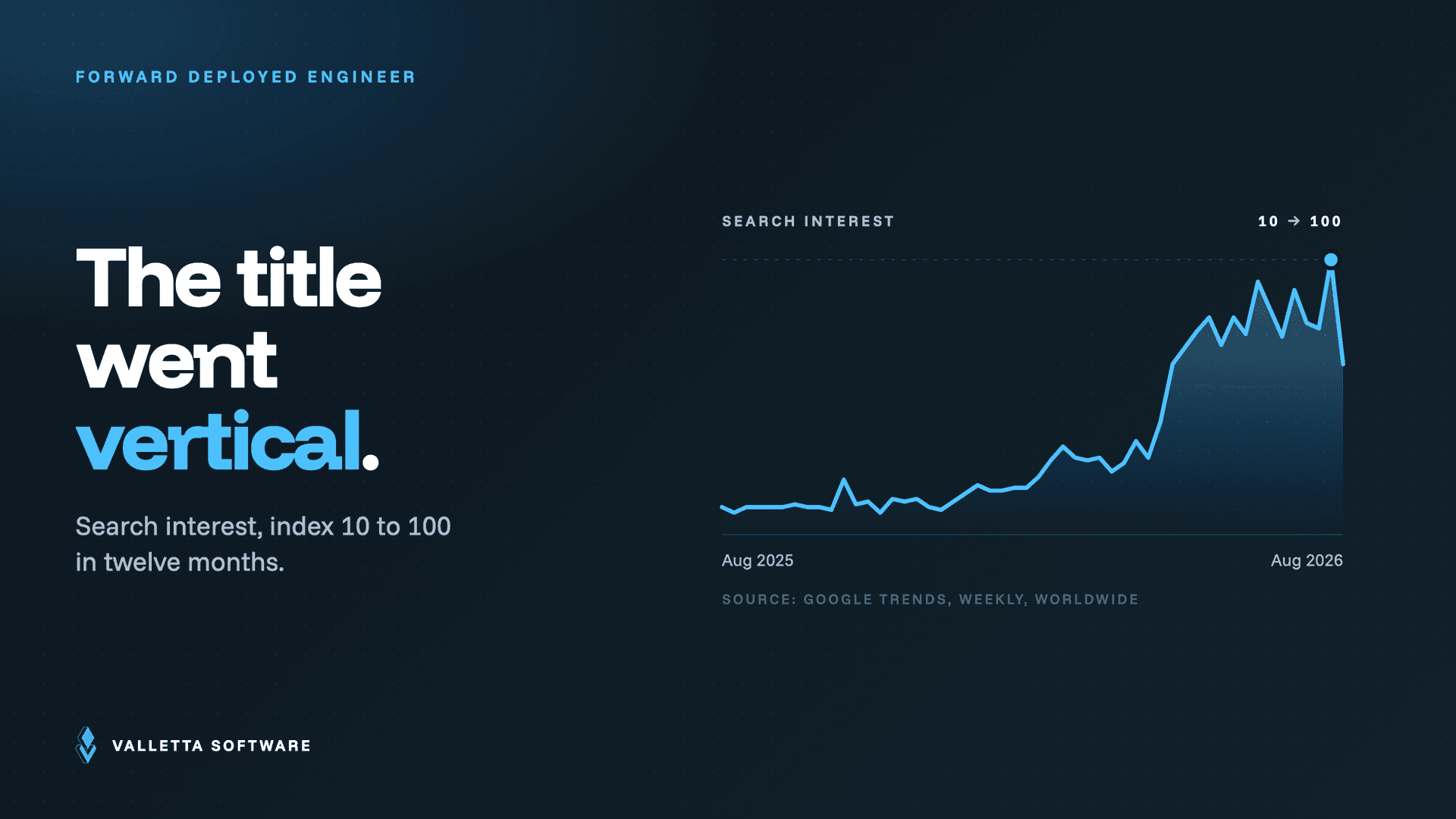
Search interest in the term rose more than 1,300% over the twelve months to August 2026, with related queries like "what is FDE" and "forward deployed engineer meaning" registering as breakout terms on Google Trends. Job listings moved with it: Business Insider, citing Indeed data, reported that advertised forward-deployed-engineering positions increased substantially between April 2025 and April 2026. As of 2026, OpenAI, Anthropic, Google Cloud and Stripe all hire for the title.
The reason is unglamorous. Two years ago, getting a language model to do something impressive was the hard part. It is now the easy part. The hard part is the forty unphotogenic steps between an impressive demo and a system a regulated company will actually run: which data can the model see, who approves an action, what happens when it is wrong, how does this connect to the ERP that was configured in 2011 by a contractor nobody can find.
None of that is model work. All of it is deployment work, and it cannot be done remotely from a product roadmap because the answers are different at every customer. So the labs started shipping engineers along with the software, exactly as Palantir did.
One caveat worth keeping, because it is the honest counterweight to the hype: Andrew Ng, writing publicly about the FDE career path after OpenAI and Anthropic began building these teams, argued that there will be far more AI engineer jobs than FDE jobs. The role is growing fast from a small base. It is not replacing normal engineering, and the Reddit threads asking whether this is just consulting with better branding are not entirely wrong to ask.
Who is hiring forward deployed engineers
The title now appears at three distinct kinds of company, and the job is meaningfully different in each. Anyone reading a posting should work out which of the three they are looking at before anything else.
Palantir still runs the original version and calls it forward deployed software engineer, or FDSE. It is the only place the role has existed long enough to have a real career ladder and a public compensation history, which is why nearly every salary figure quoted for this job anywhere traces back to Palantir data.
The frontier AI labs. OpenAI, Anthropic, Google Cloud and Stripe all hire for the title. Here the work is getting models into production inside somebody else's security boundary: data access, evaluation, guardrails, and the integration that a model demo never has to survive.
Data and platform vendors. Databricks was advertising a forward deployed engineer role in Berlin and Munich in September 2026, sitting inside its professional services and operations organisation. The posting asks for someone to own the architecture and implement end-to-end systems spanning data engineering, AI and application development for customers. That org placement is the detail worth noticing: at platform vendors the FDE often reports through services rather than product.
Which matters, because the reporting line decides who gets to say that a piece of custom work should become a product feature. An FDE inside the product organisation can push that decision. An FDE inside professional services usually has to persuade someone who is measured on billable delivery instead. Ask about it in the interview. The answer tells you whether the fourth step of the job is real at that company or decorative.
Forward deployed engineer vs software engineer
The question that comes up in every thread is what separates an FDE from a normal SWE, from a solutions architect, and from a consultant. The clean answer is: who they answer to, and what counts as done.
Read the last column top to bottom and the distinction stops being fuzzy. A product engineer's work is done when it merges. A consultant's is done when it is accepted. An FDE's is done when someone else's team depends on it and the vendor's roadmap changed as a result. That second half is the whole job.
What a forward deployed engineer actually does
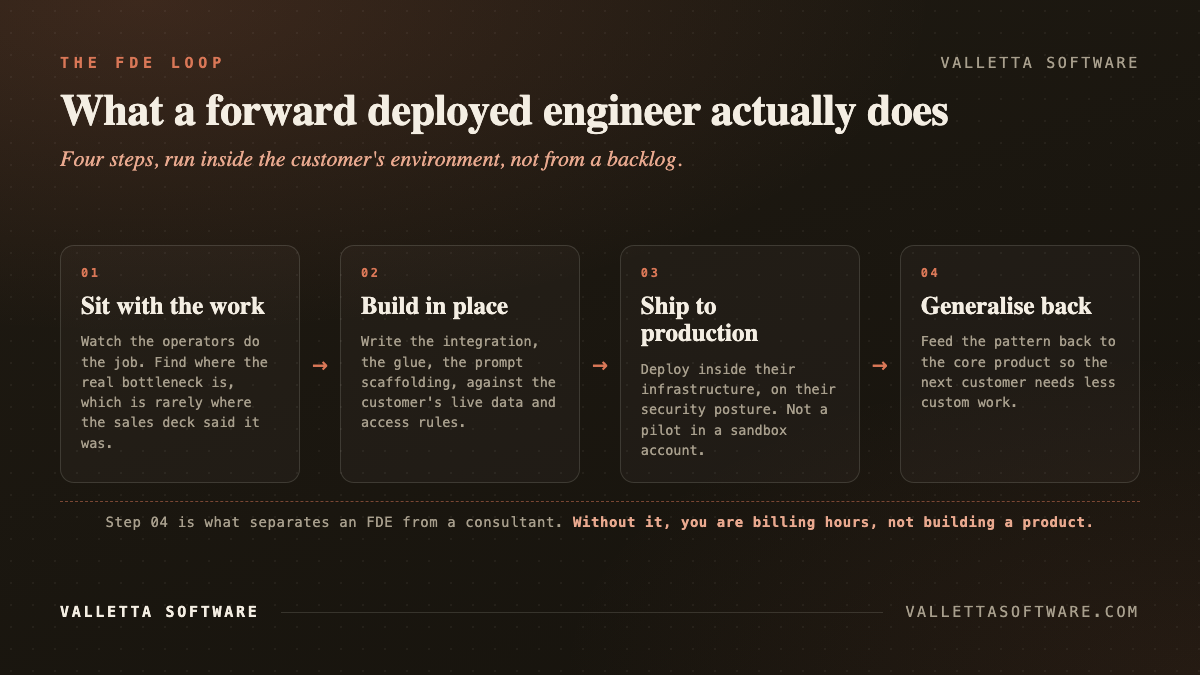
A typical engagement runs in four stages, and the ratio of time spent is not what engineers expect.
Sit with the work. Watch the operators do their job before proposing anything. The stated problem and the real bottleneck are different roughly as often as they are the same, and the sales deck is not a reliable guide to either. Experienced FDEs describe this as the highest-leverage phase and the one everyone tries to skip.
Build in place. Integrations, data plumbing, evaluation harnesses, prompt and tool scaffolding, all written against live customer data with real access controls. In 2026 that usually means retrieval augmented generation over documents nobody has curated, agentic workflows that have to fail safely, and a connection into a legacy system whose only documentation is the person who has been there longest. This is ordinary engineering done in an unusually hostile environment: no clean staging, unfamiliar systems, and a security team that has to approve things.
Ship to production. Deploy inside the customer's infrastructure and security posture. For AI work this is where most pilots die, because the demo ran on a permissive sandbox and production does not have one. The discipline that survives contact with this stage is a real process rather than improvisation, which is why we wrote up agentic coding as a process rather than disconnected chats.
Generalise back. Write down what was custom and why, and push the reusable half into the core product. Skipping this is how vendors end up maintaining forty bespoke forks and calling it a platform.
The uncomfortable part for engineers considering the move: a large share of the week is not code. It is explaining, negotiating access, and sitting with people whose job you are changing. Andrew Ng's summary of the skill mix, that FDEs need strong technical skills plus communication and sometimes business skills, is accurate and is also the reason many strong engineers dislike the role.
Forward deployed engineer salary in 2026
Be careful with the numbers circulating on this topic. Most pages quoting precise total-compensation bands for OpenAI and Anthropic FDEs are aggregating self-reported figures and small samples, then presenting them with a precision the underlying data does not support. Frontier labs publish base bands on their US postings where pay transparency law requires it (Anthropic listed $280,000 to $320,000 and OpenAI $185,000 to $300,000 when we checked in September 2026), but private-company equity, which is where most of the package sits, cannot be valued the way public stock can.
The one figure with a solid public source is Palantir's, where the role has existed long enough for the data to be real. Levels.fyi reports US total compensation for a Palantir forward deployed software engineer ranging from roughly $171K to $295K, with a median package around $211K, as of August 2026. That is self-reported data, but it is a large sample over many years.
For everything else, the defensible statements are directional:
FDE compensation at frontier AI labs runs above traditional enterprise-software equivalents, and the gap sits almost entirely in equity rather than base. US base salaries advertised on AI-lab careers pages for the role span a wide band, roughly $150K to $385K depending on level and location, which is a range wide enough that quoting a midpoint is close to meaningless. Anyone telling you the average FDE earns a specific six-figure number across the industry is extrapolating.
If you are evaluating an offer, the practical advice is to ignore the aggregate figures entirely and price the equity component yourself, because at these companies that is where most of the number lives and where most of the risk lives too.
How to become a forward deployed engineer
The role is unusually accessible from adjacent backgrounds, because the scarce skill is not algorithmic depth. Companies hiring FDEs are screening for four things:
Full-stack range over depth. You will touch data pipelines, APIs, a frontend, and infrastructure in the same week. Nobody is going to hand you a narrow ticket.
Comfort in ambiguity. The most common interview signal is a story where you were given an unclear problem in someone else's system and shipped something anyway. Have two of those ready with specifics.
Communication with non-engineers. Being able to explain a technical constraint to an operations manager, and hear a business constraint back without dismissing it, is the actual bottleneck skill.
Deployment literacy. Auth, networking, secrets, compliance boundaries, and what happens when a model output is wrong in a way that matters. For AI-focused FDE roles, hands-on experience running models in restricted environments is a differentiator.
The most useful portfolio piece is not another chatbot demo. It is a small system you deployed into an environment you did not control, with the constraints written down. That is the job, in miniature. On the broader question of where engineering careers are heading as tooling absorbs more of the typing, we argued the case in what happens to developers in the Claude Code era: the work that survives is the work that touches the messy edges, and forward deployment is almost entirely messy edges.
Should you hire an FDE, or rent one?
Most writing on this topic addresses people who want the job. Far less addresses the companies deciding whether to fund the model, which is the harder question because it fails in predictable ways.
Forward deployment is expensive by construction. You are assigning senior engineers to one customer's problems, and Wikipedia's own criticism section names the two structural tensions honestly: the cost of dedicating engineers to client-specific work, and the pull between solving one customer's problem and building a standard product. Both are real and neither goes away with better process.
Three failure modes worth screening for before you commit:
The engagement is too short. An FDE's value comes from domain knowledge accumulated inside the customer's context. Under about a quarter, there is no time to accumulate it, and you have paid senior rates for contractor output.
Nobody owns step four. If no one is accountable for pushing learnings back into the product, the custom work compounds instead of the product. Two years of this and every customer is on a different fork.
The customer will not give access. An FDE with no production access, no real data, and no line to the operators is a very expensive consultant. Settle this before the engagement, not during it.
If you have cleared those three and decided to hire, we published the job description template and interview loop we actually use, including the four signals that predict success and the standard req lines worth deleting. The wider business case, what forward deployment costs against the two alternatives and why it only pays back through generalisation, is in our breakdown of the FDE model.
If the model fits but full-time headcount does not, the middle path is an embedded team you do not have to hire. That is the same trade-off we mapped for AI work specifically in our AI development agency vs dedicated AI developers decision matrix, and the sourcing question is covered in our roundup of ways to hire vetted engineers. The decision hinges on one thing: how long the relationship will last. Long engagements justify embedding. Short ones do not, whatever you call the role.
FAQ
What is a forward deployment engineer?
It is the same role as a forward deployed engineer, usually a phrasing slip. A forward deployed engineer is a customer-facing software engineer who builds and deploys production software inside a client organisation's own operational environment, then feeds the reusable parts back into the vendor's core product.
What does FDE stand for?
FDE stands for forward deployed engineer. You will also see FDSE, forward deployed software engineer, which is Palantir's internal title for the same job, and forward deployed AI engineer, which is the 2026 variant focused on getting AI systems into production at a customer.
What is the difference between FDE and SWE?
A software engineer works inside the vendor's codebase and is done when the feature merges and ships to everyone. An FDE works inside one customer's environment and is done when that customer's team relies on the system in production. The FDE also carries a second obligation a normal SWE does not: identifying which custom work should become a product feature.
How much do FDEs get paid?
At Palantir, where the role is oldest, Levels.fyi reports US total compensation between roughly $171K and $295K with a median around $211K, self-reported, as of August 2026. Frontier AI labs pay more, with the difference concentrated in equity, but they do not publish bands, so any precise industry-wide average you see is an estimate rather than a measurement.
Is a forward deployed engineer a good job?
It suits engineers who like shipping things people use immediately and do not mind spending half their week talking to non-engineers. It suits people who want deep algorithmic work or a stable codebase considerably less. The compensation is strong, the feedback loop is short, and the common complaint is travel plus the feeling of rebuilding similar things for different customers.
Which companies hire forward deployed engineers?
Palantir, which invented the role and calls it forward deployed software engineer; the frontier AI labs including OpenAI, Anthropic, Google Cloud and Stripe; and data and platform vendors such as Databricks, which was advertising the title in Berlin and Munich in September 2026. The job differs by company mainly in where it reports. At labs and product companies the FDE usually sits near product; at platform vendors it frequently sits in professional services, which changes how much influence the role has over the roadmap.
Do forward deployed engineers travel a lot?
It depends on the customer's security posture. Palantir's original model required physical presence because the networks were air-gapped. Many 2026 AI deployments run remote or hybrid, with periodic onsite visits, but roles touching classified, regulated or on-premise-only environments still require being in the building.