
From Zero to a Self-Hosted AI Assistant: OpenClaw on a Mac Mini for a Non-Technical Owner
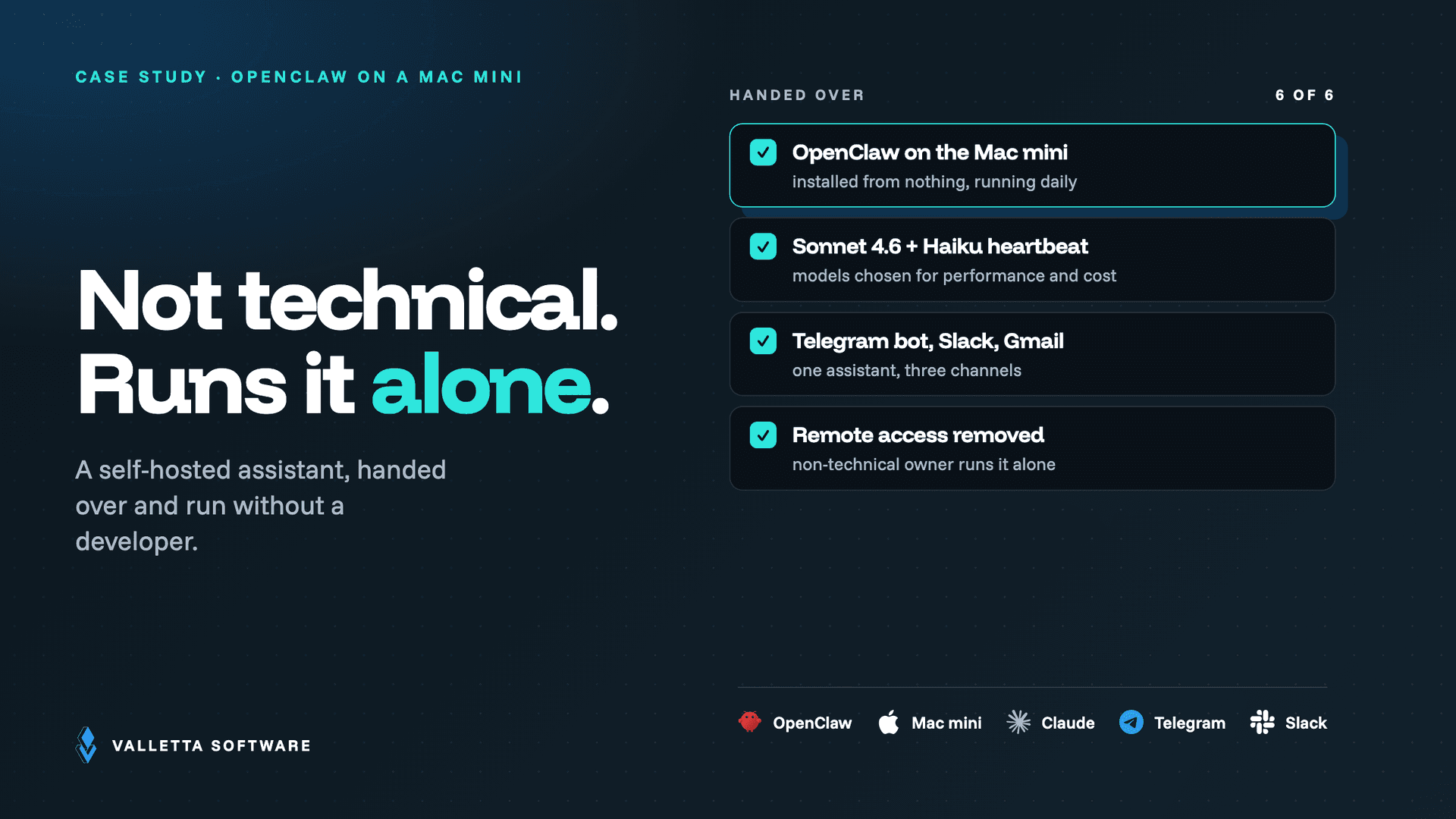
An independent operator in the manufacturing sector, with no technical background, wanted a self-hosted AI assistant that would run on a Mac mini and answer from Telegram, Slack and Gmail. Valletta installed OpenClaw, set Claude Sonnet 4.6 as the default model with Claude Haiku as the heartbeat, connected the channels, then handed over a documented system the owner now runs without a developer. Under $10,000, March to April 2026.
Key Takeaways
- OpenClaw installed on the owner's Mac mini from scratch and running as a daily-use, self-hosted assistant
- Claude Sonnet 4.6 as the default model, Claude Haiku as the heartbeat model, tuned for cost
- OpenClaw Telegram bot live for chatting with the assistant from a phone; Slack and Gmail connected
- Remote access removed at handover; the non-technical owner operates the system alone
- Investment under $10,000, March to April 2026, rated 5.0 on Clutch
The client is Solenis, a small independent operator in the manufacturing industry in Atlanta, Georgia, with one to ten employees. The director, Alan Copeland, published a verified review of the engagement on Clutch in April 2026. Everything below is drawn from that review; where the review gives no number, this story gives none either.
The Challenge: A Reliable Assistant, Without Becoming a Developer
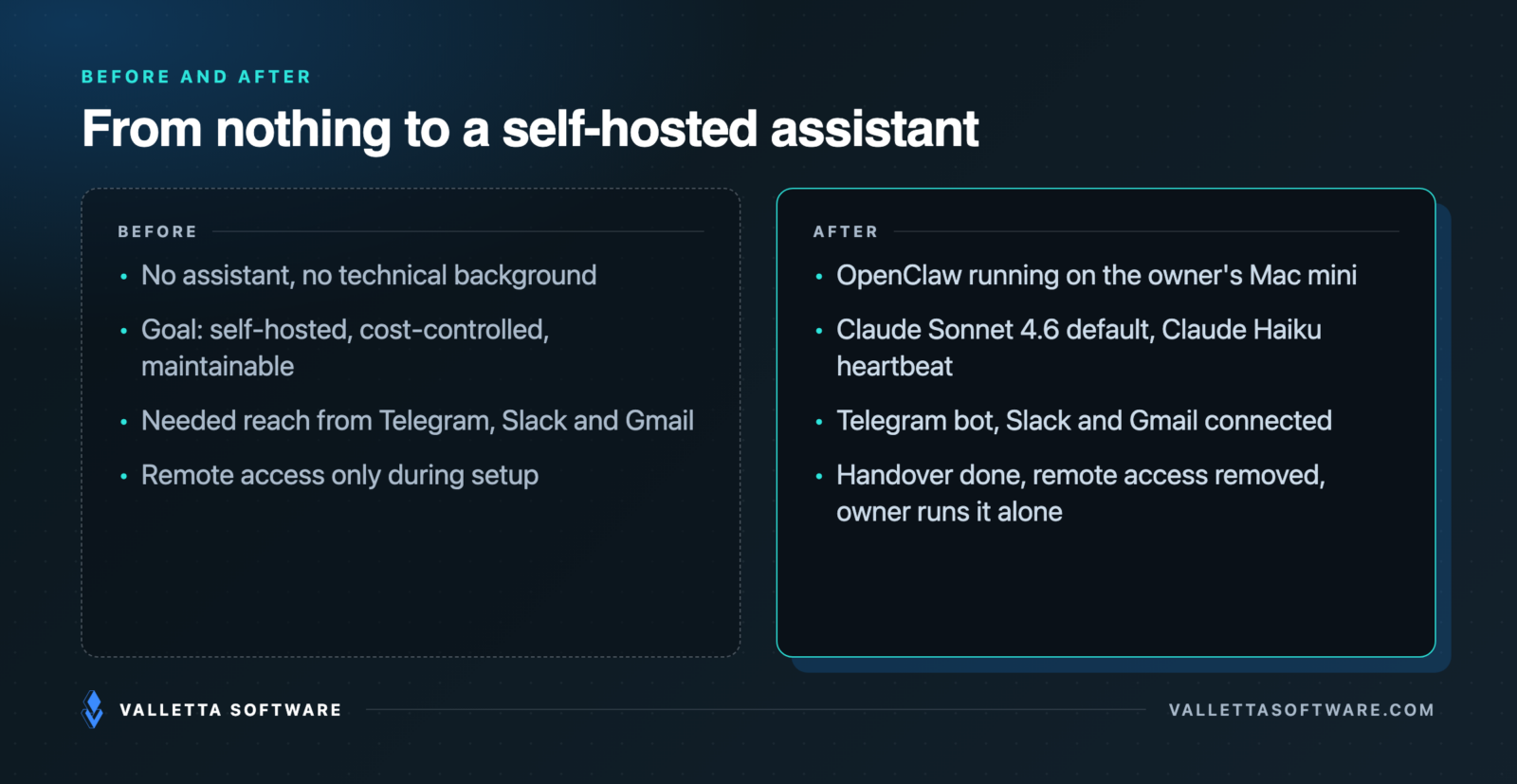
The owner had a clear picture of the end state and no path to it. The goal was a self-hosted AI assistant on a Mac mini, reachable from the tools already in daily use, with the running cost under control. In the owner's words, they are not a technical person, so the setup had to be done for them and then explained well enough to be kept alive without a standing developer.
The three goals the client set out are worth quoting closely, because they are the goals most small owners have and rarely write down:
- Deploy a reliable self-hosted AI assistant: OpenClaw fully configured on the Mac mini as a dependable daily-use tool, with the right models for both performance and cost
- Integrate messaging and workflow tools: connect OpenClaw with Telegram, Slack and other services so the assistant handles communication and tasks across platforms
- Establish a cost-efficient, maintainable setup: stable, documented, and easy to manage independently after the development phase ends and remote access is removed
That third goal is the one most agencies quietly skip. It defined how we worked.
The Approach: Do the Hard Parts Remotely, Explain Every Step in Plain Language
A forward-deployed engagement means the engineer works inside the client's own environment, not on a staging box somewhere else. Here that was literal: the Valletta team connected remotely to the owner's Mac mini when the work needed it, and walked the owner through everything step by step the rest of the time. The review describes it plainly: the team handled the complicated parts themselves and explained things in plain language.
Two habits mattered more than any technical decision. First, every account, API key and setting was created with the owner, so nothing in the finished system was a mystery. Second, when the owner hit error messages and API rate limits during testing, the team explained what was happening and fixed it, rather than fixing it silently.
The Solution: OpenClaw on a Mac Mini With Telegram, Slack and Gmail
Install and model setup
OpenClaw was installed on the Mac mini from nothing, following the same path we document in our OpenClaw Mac mini install guide. The models were chosen for the two jobs an assistant actually has. Claude Sonnet 4.6 is the default model for the work that needs judgment. Claude Haiku is the heartbeat model, the always-on loop that checks channels and keeps the assistant responsive, where a cheap fast model is the right choice. That split is what keeps a self-hosted assistant affordable to run every day.
Anthropic account and credits
The assistant is connected to the owner's own Anthropic account through a dedicated API key, labelled for the Mac mini, with account credits in place. The owner sees the spend, owns the key, and can revoke it without asking anyone.
The OpenClaw Telegram bot, Slack and Gmail
A Telegram bot was set up so the owner can chat with the assistant from a phone, anywhere. Slack was connected for communication, and the owner's Gmail account was created and linked so the assistant is ready for email workflows. One assistant, one machine, three channels into it.
Testing, rate limits and handover
The initial testing phase surfaced the normal early issues, chiefly API rate-limit messages, and they were resolved with the owner watching. The system was then declared stable enough for regular use, remote access was removed, and a clear handover path left a self-managed setup behind. The owner's own summary: able to operate and interact with the system without needing developer help for day-to-day use. For what to lock down before you do this yourself, see our OpenClaw security guide.
The Results: A Working Assistant the Owner Runs Alone
This client did not publish percentages, so we will not invent any. What the review does list is a complete set of outcomes, and for a small owner they are the ones that matter:
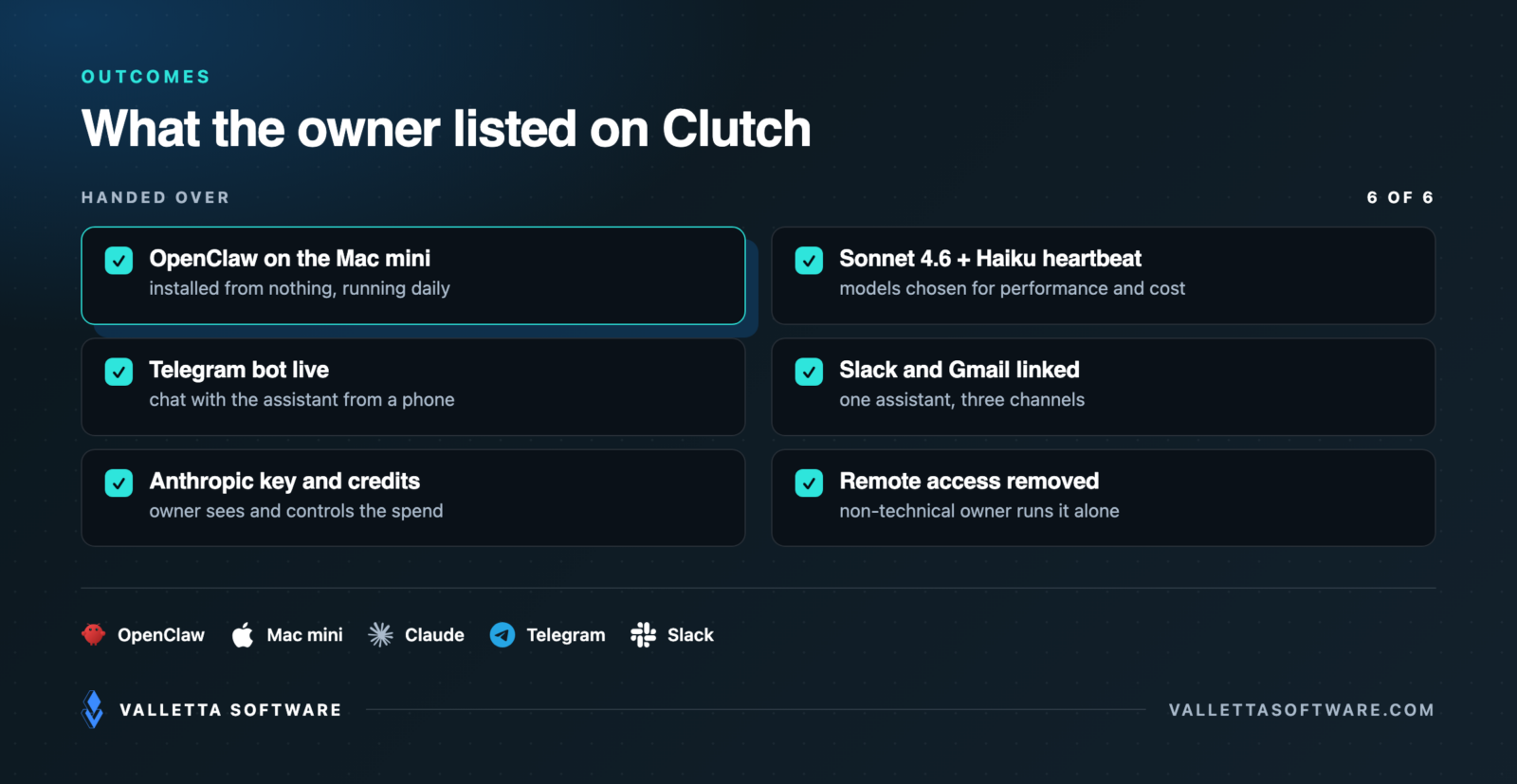
- OpenClaw installed and running on the Mac mini, from nothing to a fully operational AI assistant
- Claude Sonnet 4.6 default and Claude Haiku heartbeat configured, balancing performance with cost
- Anthropic API connected with a dedicated key and credits, unblocking testing and daily use
- Telegram bot live for remote interaction from a phone; Slack working; Gmail set up and linked
- Testing completed, rate-limit issues resolved, system stable for regular use
- Remote access removed, clear handover, non-technical owner operating the system independently
The review scores Valletta 5.0 for quality, 5.0 for cost, 5.0 for willingness to refer and 4.5 for schedule. The one improvement the owner asked for is fair and we have adopted it: say up front that rate-limit messages during testing are normal, so they do not cause worry.
What really stood out to me was how patient and down-to-earth they were with a non-technical client like me. A lot of dev teams can make you feel lost in jargon, but these guys took the time to explain things in plain language.
Alan Copeland, Director, Solenis, on Clutch
Why a Self-Hosted Assistant, and Why a Mac Mini
A hosted chatbot subscription would have been cheaper on day one. It would also have meant the owner's Slack, Gmail and Telegram conversations flowing through a third party, and a monthly fee that rises with use. A self-hosted OpenClaw instance on a Mac mini keeps the data and the gateway on a machine the owner physically owns, and the only variable cost is the model API, which the owner controls through their own key. It is the small-business version of the reasoning behind the on-prem LLM we built for a DACH insurer.
It is also, honestly, the smallest engagement in this section. We publish it because it is the most common shape of request we get in 2026, and because the owner's review answers the question every non-technical buyer asks first: will I be able to run this myself afterwards? For a team-scale deployment of the same tool, read how a research team took its cycle from three weeks to one day.
Frequently Asked Questions
Can a non-technical person run OpenClaw on a Mac mini?
Yes, if someone technical sets it up and hands it over properly. In this engagement the owner describes themself as not a technical person. Valletta installed OpenClaw on the Mac mini, configured the models, connected the Anthropic account, the Telegram bot, Slack and Gmail, then removed remote access and left a documented, self-managed system the owner operates alone day to day.
Which models does OpenClaw use, and how do you keep the cost down?
For this client, Claude Sonnet 4.6 is the default model and Claude Haiku is the heartbeat model. The heartbeat runs constantly, so putting it on the cheapest capable model is the single biggest cost lever. The Anthropic API is connected through a dedicated key with credits in place, so usage is visible and capped.
What does an OpenClaw Telegram bot let you do?
Talk to your own assistant from your phone. The Telegram bot is a channel into the same OpenClaw instance that runs on the Mac mini at home or in the office, so a task typed into Telegram is handled by the assistant with access to the owner's Slack and Gmail.
Want an AI Agent That Your Team Actually Runs?
This owner went from nothing to a self-hosted assistant they run alone, in weeks, for under $10,000, without learning to code.
Valletta works the forward-deployed way: the engineer who hears your problem is the engineer who configures the agent inside your own tools, tests it with you, and leaves only when you can run it without us. Read what a forward deployed engineer is, or skip the reading.
Tell us what your team is doing by hand: vallettasoftware.com/contact-us