
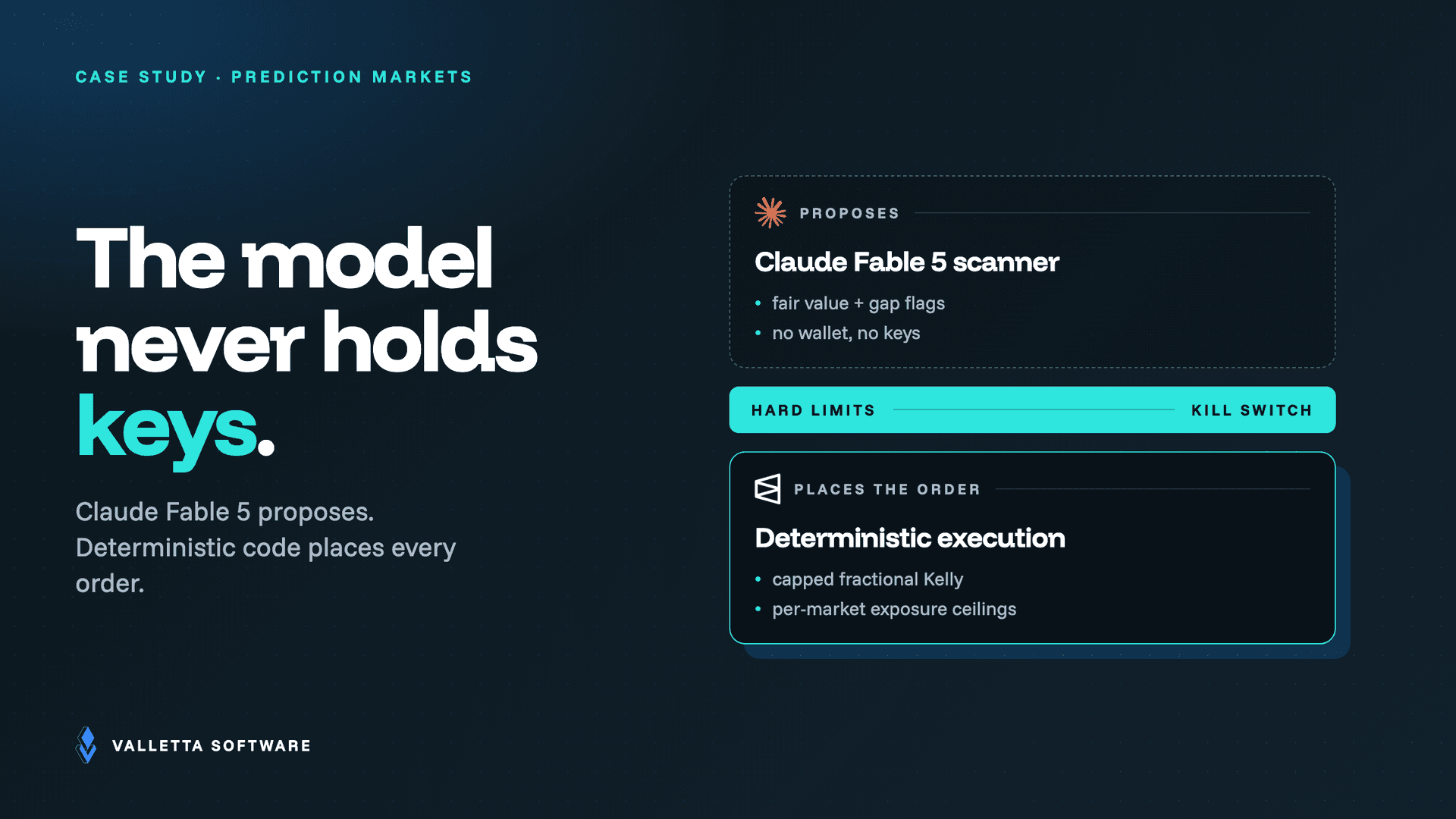
Polymarket Trading Bot with Claude Fable 5: A Client Case Study
A private trader in the EU had a backlog of Polymarket strategy ideas and no fast way to test them: validating one hypothesis meant weeks of hand-pulled prices and one-off scripts. Valletta built a Polymarket trading bot on Claude Fable 5, done properly: a backtest harness, a market scanner with fair-value estimation, execution behind hard limits, and monitoring. The idea-to-verdict cycle now runs in days, and the trader's own team operates the system.
Key Takeaways
- Strategy validation went from weeks per idea to days
- Every strategy is a declarative spec, tested by one harness that models fees, spread and order book depth
- Claude Fable 5 powers the fair-value and scanning layer; deterministic, hard-limited code places every order
- The system is operated by the client's own small team through dashboards and drift alerts
The client is a private trader in the EU, working with a small team on prediction market strategies. All strategy thinking was and remains theirs; this engagement was about engineering speed, not trading advice. No client financial results are disclosed in this case study, by agreement.
The Challenge: Ideas Arriving Faster Than Verdicts
The trader followed short-horizon crypto markets and news-driven event markets on Polymarket and kept a growing list of strategy hypotheses: accumulation patterns across Up and Down sides, fair-value gaps rooted in resolution wording, category watchlists. The bottleneck was never ideas. It was verdicts.
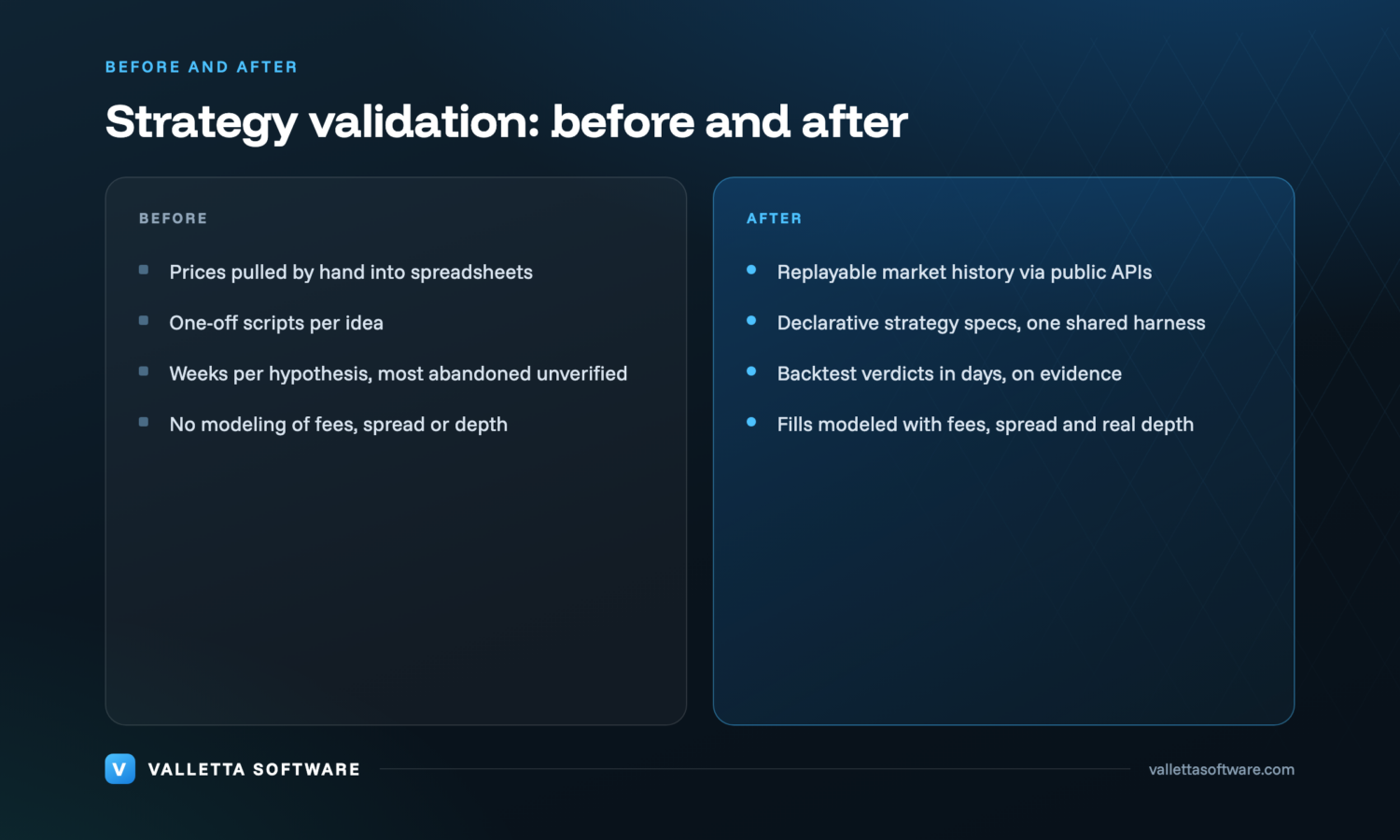
- Historical prices pulled by hand into spreadsheets
- A new one-off script for every idea
- Weeks per hypothesis, so most ideas were abandoned unverified rather than disproven
- No consistent modeling of fees, spread or available depth, the three things that quietly kill paper edges
The Approach: Backtests First, Execution Last
The engagement started with a short discovery pass over the trader's actual workflow: where the hours went, which ideas had stalled, and what data the strategies really needed. Two principles were fixed before any code: every idea gets the same evidence standard, and nothing the AI model outputs touches money directly. The viral "give Claude a wallet" posts circulating on X are exactly the architecture we refused to build.
The Solution: Four Components, One System
Backtest harness
Market history, order book snapshots and resolution outcomes are ingested through Polymarket's public APIs into a replayable store. A strategy is a small declarative spec: entry, exit, sizing. The harness replays it with realistic fills, modeling fees, spread and the depth actually available, and returns a standard report. Ideas compete on evidence.
Market scanner and fair value, on Claude Fable 5
On a schedule, the scanner batches active markets to Claude Fable 5 with resolution criteria, pricing and retrieved context. The model returns structured fair-value estimates with named inputs and flags gaps that clear the client's threshold. Fable 5's long context lets one pass reason across a whole family of related markets, where correlated mispricings live.
Execution behind hard limits
Execution is deterministic, tested code. It consumes scanner flags and applies the client's rules: capped fractional Kelly sizing, per-market and per-category exposure ceilings, and a kill switch that halts trading when live fills drift from backtest assumptions. The model proposes; code disposes. The model never holds keys.
Monitoring and alerts
Dashboards track exposure, fill quality, API health and model spend. Drift alerts compare live behavior with backtest assumptions and page the team when they diverge. This is what makes the system operable without Valletta in the loop.
The Results: Verdicts in Days, Operated In-House
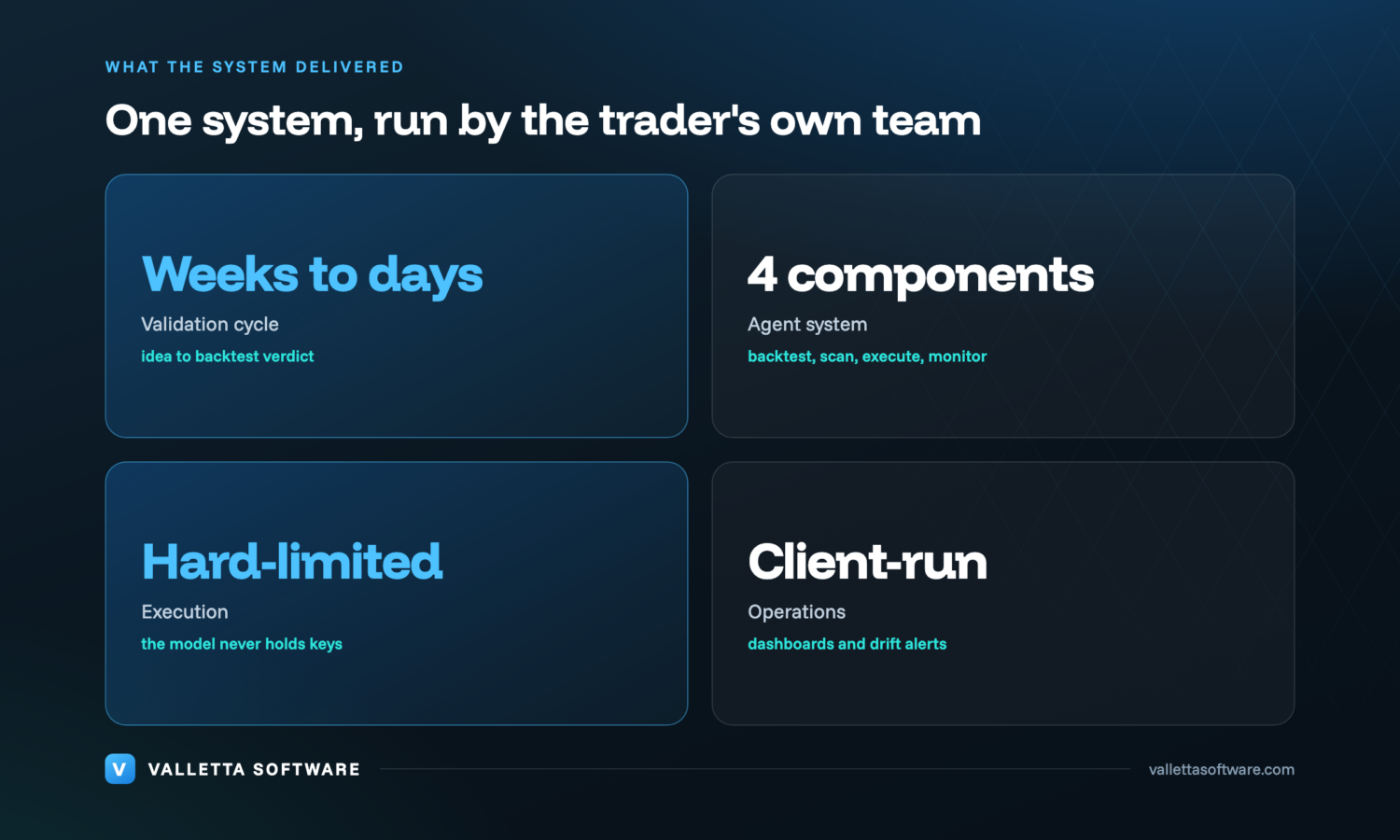
- The idea-to-verdict cycle went from weeks of manual work to days
- Strategy hypotheses queue up, run against history overnight, and return decision-grade reports
- Ideas that fail, fail cheaply on historical data before any capital moves; survivors graduate to small live positions under exposure caps
- The trader's own team runs day-to-day operations through dashboards and alerts
We wrote up the engineering story, including the viral claims that prompted the project and why we checked them, in the companion article: We Built a Polymarket Trading Bot with Claude Fable 5.
Nothing in this case study is financial, investment, or legal advice. Prediction market access depends on your jurisdiction, and past backtest results do not guarantee future performance.
Frequently Asked Questions
Did Claude come up with the trading strategies?
No. Every strategy hypothesis came from the client. Claude Fable 5 powers the fair-value and scanning layer, and the backtest harness decides which ideas survive.
Does the AI place trades directly?
No. Execution is deterministic, tested code with hard exposure limits and a kill switch. The model proposes; code validates and places every order, and the model never holds keys.
Do you guarantee trading profits?
No, and nobody honestly can. The system's job is to make strategy validation fast and cheap, so bad ideas fail on historical data instead of live capital.
Start With a Five-Day Discovery Audit
Trading and automation projects fail for a predictable reason: the build starts before anyone has measured where the time and the edge actually are. The fastest way to find out what your workflow really needs is the same way this engagement started: a five-day Discovery audit that maps your real process before any build begins.
In five working days, for a fixed fee of €2,000, two of our engineers map your workflow, measure where the manual hours and the risks actually sit, and hand you a costed, prioritized automation plan, whether or not you build it with us.
Book your five-day Discovery audit: vallettasoftware.com/discovery-audit