

The Forward Deployed AI Engineer Model, and What It Costs
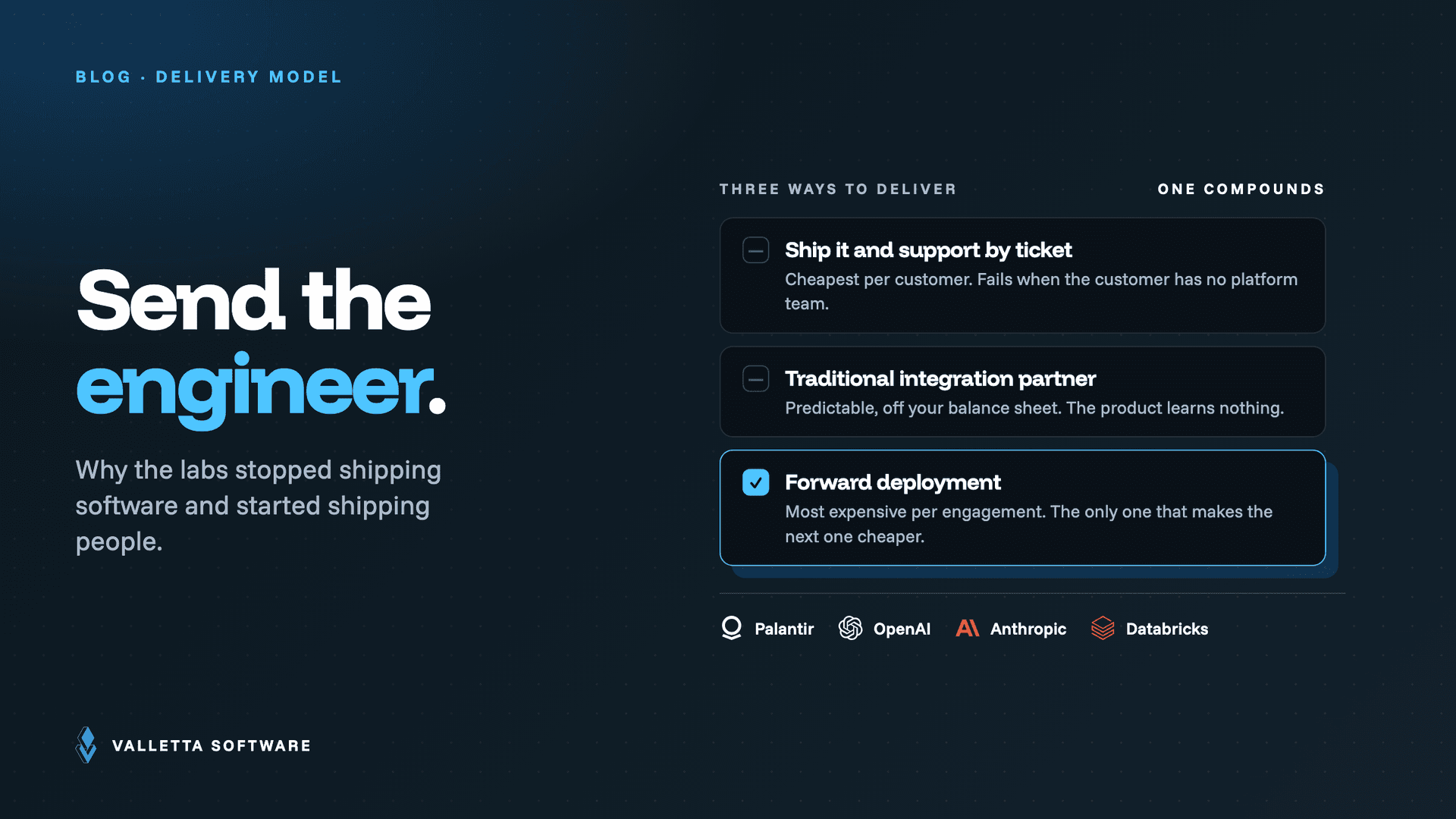

The forward deployed AI engineer model is a delivery decision, not a job title: instead of shipping software and hoping the customer can install it, you send engineers into the customer's environment to build the last mile in place, then push whatever generalises back into the product. Palantir invented it. In 2026 every frontier lab is running some version of it, for a reason that has nothing to do with models and everything to do with what it costs to get one working inside a real company.
Key takeaways
- The FDE model exists because the expensive part of enterprise AI moved from building the model to deploying it, and deployment cannot be done remotely from a roadmap.
- It is structurally expensive. You are assigning senior engineers to one customer. It only pays back when the engagement runs long enough for domain knowledge to accumulate, which in practice means more than a quarter.
- What separates it from consulting is a single obligation: somebody is accountable for turning custom work into product. Without that, the custom work compounds and the product does not.
- The failure modes are predictable: engagements too short to learn anything, nobody owning generalisation, and a customer who will not grant real access.
- You can rent the model instead of building it. Three of our own engagements ran this shape with teams of two to five people and budgets under $10,000, with outcomes the clients published themselves.
- It is not universal. If your product installs cleanly and your customers have competent platform teams, forward deployment is an expensive answer to a question you do not have.
Published September 7, 2026. Corrected September 8, 2026. Client outcomes in this article come from verified reviews the clients published on Clutch, quoted rather than estimated. Where a client published no number, none appears here. Correction: an earlier version said frontier AI labs publish no compensation bands. They publish base bands on US postings; only the equity component is unpublished.
What the FDE model actually is
Strip away the job-description language and the model is three commitments made at once.
Engineers work inside the customer's environment. Not a vendor sandbox, not a demo tenant. Their code runs on the customer's infrastructure, against the customer's data, under the customer's access controls and their security team's approval.
The output is production software, not advice. The engagement is not done when a recommendation is accepted. It is done when somebody else's team depends on the thing on a Monday morning.
The vendor's product is expected to change as a result. This is the commitment that makes it a model rather than a staffing arrangement. Every deployment is supposed to reveal which custom work generalises, and that half is supposed to move upstream so the next deployment is cheaper.
Drop the third commitment and the whole thing collapses into professional services with better titles. That is the honest core of the criticism you will find in the role's own Wikipedia entry, which names the two structural tensions plainly: the cost of dedicating engineers to client-specific work, and the constant pull between solving one customer's problem and building a standard product. Neither goes away with better process. They are the price of the model.
Why the model came back in 2026
Palantir's original constraint was physical. Its customers were government agencies with air-gapped networks and problems too specific to put in a requirements document, so the company sent engineers to the site and let them build in place. That was 2010, and for a decade the pattern spread quietly through enterprise software under other names: implementation engineer, deployment strategist, solutions engineer.
What changed is the shape of the work. Two years ago, getting a language model to do something impressive was the hard part. It is now close to free. The expensive part moved to the forty unphotogenic steps between a working demo and a system a regulated company will actually run: which data can the model see, who approves an action it takes, what happens when it is wrong, how does any of this reach the ERP that a contractor configured in 2011 and nobody has touched since.
None of that is model work. All of it is deployment work, and the answers are different at every single customer, which is precisely why it cannot be solved from a product roadmap. So the labs did what Palantir did.
The old constraint is also returning literally. A meaningful share of 2026 enterprise AI work cannot send data to a vendor API at all, which pushes teams toward running models on hardware they control. We costed that out in detail in what a self-hosted LLM actually costs. Somebody has to stand inside that network and make it work.
One counterweight worth keeping, because the hype around this is thick: Andrew Ng, writing publicly about the career path after OpenAI and Anthropic began building these teams, argued there will be far more AI engineer jobs than forward deployed ones. The model is growing quickly from a small base. It is not replacing normal software engineering, and the recurring question on engineering forums about whether this is consulting with better branding is a fair one to ask of any specific team.
What the model costs
Forward deployment is expensive by construction, and the comparison that matters is not FDE against nothing. It is FDE against the two alternatives you actually have.
Read the last column and the economics resolve. Forward deployment is not competing on cost per engagement, because it will lose that comparison every time. It is competing on the second derivative: whether deployment number ten is cheaper than deployment number one. A model that does not deliver that is simply the most expensive option on the table.
On the headcount side, the one compensation figure with a solid public source is Palantir's, where the title has existed long enough for the sample to mean something. Levels.fyi reports US total compensation for a Palantir forward deployed software engineer between roughly $171K and $295K, median near $211K, as of August 2026, self-reported. Frontier labs pay more and concentrate the difference in equity. They do publish base bands on US postings, but not the equity, so any precise industry-wide total-comp average you encounter is still an estimate wearing the clothes of a measurement.
The three ways it fails
The engagement is too short. An FDE's value is domain knowledge accumulated inside one customer's context: their data model, their exceptions, the process everyone works around. Under roughly a quarter there is no time to accumulate any, and you have paid senior rates for contractor output. This is the most common failure and it is visible before you start, which makes it the cheapest one to avoid.
Nobody owns generalisation. If no named person is accountable for pushing learnings into the core product, custom work compounds instead of the product. Two years of that and every customer sits on a different fork, each requiring the specific engineer who built it. Companies rarely notice this until the maintenance load makes new deployments impossible.
The customer will not grant real access. An engineer with no production access, no real data and no line to the operators is a very expensive consultant writing very confident guesses. Settle this in the contract, not in week three, because a customer who will not grant access in negotiation will not grant it under delivery pressure either.
What the model looks like at small scale
Most writing about forward deployment describes frontier labs sending engineers to Fortune 500 customers. The mechanism works at a much smaller scale, and because our own clients published their outcomes on Clutch, the numbers here are theirs rather than ours.
An education research firm in Germany. Helsingor sells research conclusions, and its cycle from raw material to a finished client presentation ran two to three weeks. Working inside the team's own tools rather than delivering a product for them to adopt, we built an agent that handles collection and the first pass across Slack, Telegram, Gmail and Google Calendar, runs deep-search jobs and builds dashboards. The researchers kept the conclusions. In the COO's own words on a verified review, the cycle now takes one day, with 90% fewer mistakes. Investment under $10,000, a team of two to five, started March 2026 and still running. The full account is in the Helsingor case study.
A financial advisory firm in Spain. Fin-Craft delivers judgment as written reports. Rather than sell them a reporting tool, the work went in order: a CMS first, then accounting automation so the numbers came from the system, and only then LLM-written smart reports on top of data that was already trustworthy. The CFO reports reduced site support costs, increased sales and increased client retention. No percentages, because the client published none. The engagement has run since January 2021. Details in the Fin-Craft case study.
A manufacturing owner in Atlanta. Solenis wanted a self-hosted assistant on a Mac mini and no path to building one. The deployment was done remotely, every step explained in plain language, with Claude Sonnet as the default model and Haiku as the heartbeat to hold running costs down. The detail that matters for the model: at handover, remote access was removed and a non-technical owner now runs the system alone. That is the generalisation obligation in miniature, discharged as documentation rather than dependency. Written up in the Solenis case study.
The common thread is not the technology. It is that in all three the engineer worked inside the customer's context and left behind something the customer operates without us. That is the test, and it is the same test at $10,000 as at $10 million.
Renting the model instead of building it
If the model fits your delivery problem but full-time headcount does not, the middle path is an embedded team you do not have to recruit, onboard or bench between engagements. That is the arrangement in all three engagements above, and it removes the two costs that make forward deployment hard to start: the hiring lead time for a scarce profile, and the utilisation risk when an engagement ends.
It is not free of trade-offs. An external team accumulates domain knowledge that walks out at the end of the contract unless you insist on the documentation obligation, and it has less leverage to change your product than an internal team does. Both are manageable, and both should be settled in writing before the engagement rather than discovered during it.
If you have decided the model fits and want to hire directly, we published the job description template and interview loop we use, including the four signals that predict success and the standard req lines worth deleting. If you are still deciding between building the capability and buying it, the AI development agency versus dedicated developers matrix covers the general case, and the background on the role itself is in our guide to what a forward deployed engineer is.
FAQ
What is the FDE model?
It is a software delivery model in which the vendor embeds engineers inside the customer's operational environment to build and ship the last mile in place, then feeds the reusable half of that work back into the core product. It originated at Palantir around 2010 and returned to prominence in 2026 as enterprise AI proved to be a deployment problem rather than a model problem.
What is a forward deployed AI engineer?
It is the 2026 variant of the role, focused on getting AI systems into production at a specific customer: data access, evaluation, guardrails, integration with existing systems, and clearing the security review. The distinguishing skill is not model work. It is knowing what to do when the demo ran on a permissive sandbox and production does not have one.
How is the FDE model different from consulting?
A consultant is done when the deliverable is accepted and the hours are billed. An FDE is done when the customer's team depends on the system in production and the vendor's product changed as a result. That second obligation is the whole difference, and a team that does not carry it is running a consultancy regardless of the titles on the org chart.
What does FDE as a service mean?
It means renting the delivery model rather than hiring for it: an external team works inside your customer's environment, or inside yours, on the embedded pattern, without you carrying the recruitment lead time or the bench cost between engagements. The trade-off is that domain knowledge leaves with the team unless the documentation and handover obligations are written into the contract.
When is forward deployment the wrong choice?
When your product installs cleanly, your customers have competent platform teams, and your integration surface is standard. In that situation forward deployment is an expensive answer to a question you do not have. It is also wrong when engagements are short, because the model's entire return comes from knowledge accumulated over time inside one context.
Does the FDE model scale?
Only through the generalisation step. Deployment headcount grows linearly with customers unless each deployment makes the next one cheaper, which is why the accountability for pushing custom work upstream is not a nice-to-have. A forward deployment team without that obligation has built a professional services business and should price it like one.