

Forward Deployed Engineer Job Description (2026 Template)

A forward deployed engineer job description has to describe a role where the code is only half the work, and most of them fail at exactly that. Below is a template you can copy, the four signals worth interviewing for, the loop that tests them, and the standard-issue lines that quietly repel the people you actually want.
Key takeaways
- An FDE job description that reads like a normal backend req will fill the role with someone who wants a normal backend job, and they will leave.
- Name the customer contact explicitly. Half the week is spent with people who do not write code. Candidates who dislike that need to self-select out before your first screen, not after month three.
- The four predictive signals are full-stack range, shipping under ambiguity, translating between technical and business constraints, and deployment literacy in environments you do not control.
- Drop the algorithm screen. It filters for the wrong thing and costs you the strongest FDE candidates, who are usually senior generalists with unusual backgrounds.
- Write down who owns generalisation. If nobody is accountable for pushing custom work back into the product, you have written a consulting req with an engineering title.
- Before you open the role at all, check the engagement length. Under a quarter per customer, the model does not pay back the ramp, and hiring is the wrong instrument.
Published September 7, 2026. Corrected September 8, 2026. The template is ours, drawn from running embedded engagements rather than from any single employer's posting. Correction: an earlier version said frontier AI labs do not publish compensation bands. They do publish base bands on US postings, where pay transparency law requires it. Only the equity component is unpublished.
The forward deployed engineer job description template
Copy the block below and replace the bracketed parts. It is deliberately shorter than a typical engineering req, because the useful signal in a job description is what it refuses to be vague about.
Template
Forward Deployed Engineer, [product or customer segment]
The role
You will be embedded with [one to three] of our customers, working inside their systems and on their data, to get [product] running in production. You will write code that their team depends on. You will also be responsible for telling our product team which parts of what you built should stop being custom.
What the work actually looks like
- Roughly [40 to 60]% of your time in the customer's context: their operators, their data model, their security review, their two systems that do not talk to each other.
- Building integrations, data pipelines, evaluation harnesses and application code against live customer data with real access controls.
- Deploying into the customer's infrastructure and clearing their security posture, not a sandbox we control.
- Writing up what was custom and why, and pushing the reusable half into the core product with [named team].
- Travel: [X] days per quarter, [onsite required / remote with periodic visits], driven by the customer's security requirements.
What we are looking for
- You have shipped production software across the stack: data, API, interface, deployment. Range matters here more than depth in any one layer.
- You have delivered something useful inside a system you did not design and could not fully see.
- You can explain a technical constraint to an operations manager and hear a business constraint back without dismissing it.
- You are comfortable with auth, networking, secrets and compliance boundaries in environments where you are a guest.
What this role is not
- It is not a presales role. You own production, not the demo.
- It is not a research role. If the interesting part of a problem is the model, this is the wrong job.
- It is not a pure IC coding role. Expect [several] hours a week in rooms with people whose job you are changing.
Compensation and level
[Band], [equity], [location policy]. We publish the band because the market for this title is noisy and we would rather you know now.
Two lines in that template do the heavy lifting, and both are the ones companies cut first. The percentage of time in the customer's context is the single most useful number you can publish, because it is the thing candidates most often discover too late. And the sentence about pushing work back into the core product is what separates the role from consulting. If you cannot name the team on the receiving end of that, you have not designed the job yet.
What to cut from a generic engineering JD
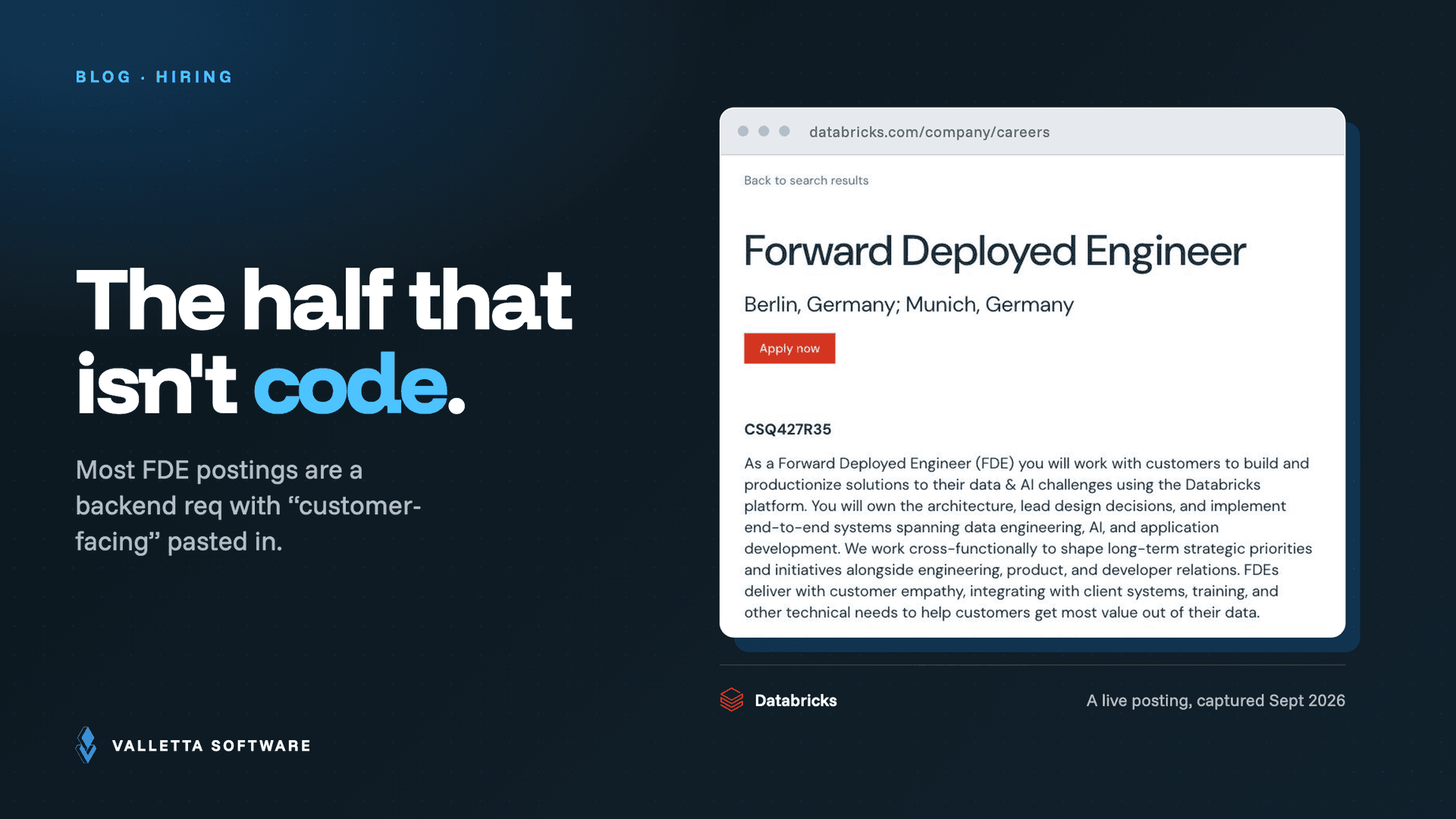
Most FDE postings are a backend req with the word "customer-facing" pasted in. That produces a candidate pool optimised for the wrong job. Four things are worth deleting outright.
The algorithm screen. Nothing in forward deployment is bottlenecked on whether someone can invert a binary tree under time pressure. The strongest FDE candidates are frequently senior generalists with unusual paths: former founders, solutions architects who kept coding, platform engineers who got tired of the abstraction layer. A LeetCode gate filters exactly those people out and keeps the ones who have been optimising for the gate.
The technology shopping list. Twelve required frameworks signals that you do not know what the job needs, and it caps your pool at people who happen to have your stack. The relevant question is whether someone can pick up an unfamiliar system quickly, which is the entire job, and a list of named tools tests the opposite trait.
"Fast-paced environment" and its relatives. Every posting says it, so it carries no information. Replace it with the specific thing you mean: an eight-week deployment cycle, three concurrent customers, a security review that takes six weeks and cannot be hurried.
Any suggestion that travel is negligible when it is not. This is the most common source of first-year attrition in the role. If the customer's network is air-gapped, the engineer is going to be in the building, and saying so in the posting costs you nothing except the candidates who were going to quit anyway.
The four signals that predict success
Across the engagements we have run, the same four traits separate the engineers who thrive in an embedded role from the ones who are miserable in it. They are worth structuring the whole loop around.
Notice that three of the four are behavioural and none of them is a puzzle. That is not a softening of the bar. It is a different bar, and in our experience it is harder to fake than a technical screen, because the specifics of a real deployment story are difficult to invent under follow-up questions.
The interview loop
Four stages, and the third one is where the decision actually gets made.
Screen, 30 minutes. One question: walk me through a system you deployed into an environment you did not control. Everything you need is in the follow-ups. Who gave you access, how long did that take, what broke, who told you it broke.
Technical, 60 minutes. A realistic integration problem against a messy schema, ideally one drawn from a real engagement with the identifying parts removed. No algorithms. The candidate should be allowed to use their normal tooling, including AI assistance, because that is how the job is done now. We described the discipline that separates useful AI-assisted engineering from the other kind in agentic coding as a process rather than disconnected chats.
Customer simulation, 60 minutes. Someone on your team plays a frustrated operations lead with a badly specified request and a hard constraint they have not mentioned yet. You are watching for whether the candidate finds the unstated constraint by asking, and whether they can say no without the room getting cold. This stage predicts first-year retention better than the technical round, and most companies do not run it.
Product feedback, 30 minutes. Give them a description of a custom build and ask which parts should become product and which should stay bespoke. There is no correct answer. You are testing whether they think about generalisation at all, because that instinct is the difference between an FDE and a well-paid contractor.
What to pay a forward deployed engineer
Be careful with the numbers circulating on this role. Frontier AI labs do publish base bands on US postings, and those are the numbers worth using. What they do not publish is the equity component, which is where most of the package sits, so total-compensation figures quoted for them remain estimates.
The one figure with a solid public source is Palantir's, where the title has existed long enough for the sample to be meaningful. Levels.fyi reports US total compensation for a Palantir forward deployed software engineer between roughly $171K and $295K, with a median package near $211K, as of August 2026. That is self-reported, but it is a large sample accumulated over many years.
For your own band, the defensible approach is to price the role against your senior product engineers rather than against the frontier-lab figures in circulation. The premium, where one exists, is compensating for travel and customer exposure rather than for a higher engineering bar. Publishing the band in the posting is worth more than getting it exactly right, because the noise around this title means candidates are currently anchoring on numbers nobody can substantiate.
Hire an FDE, or embed a team you do not have to hire
The question underneath the job description is whether hiring is the right instrument at all, and it turns on one variable: how long each customer relationship runs.
An FDE's value is domain knowledge accumulated inside a specific customer's context. Under roughly a quarter per engagement, there is no time to accumulate any, and you have paid senior salary for contractor output. Above that, embedding compounds, and the case for headcount is strong. We take this apart properly in the forward deployed engineer model, including what it costs and when a traditional integration partner is the better answer.
The middle path, when the model fits but the headcount does not, is an embedded team you do not have to recruit, onboard or bench between engagements. Three of our own engagements are shaped exactly like this and the clients published the outcomes themselves: an education research firm in Germany whose research cycle went from two to three weeks down to one day with 90% fewer mistakes, and a Spanish financial advisory firm where LLM-written client reports lowered support costs and raised retention. Both ran with a team of two to five people. Neither required the client to hire an engineer.
If you are weighing that trade-off in general rather than for this specific role, our AI development agency versus dedicated developers matrix lays out the decision, and the background on the role itself is in our guide to what a forward deployed engineer is.
FAQ
What does a forward deployed engineer job description need that a normal one does not?
Three things: the percentage of time spent in the customer's environment, the travel expectation stated honestly, and a named owner for pushing custom work back into the core product. Those three lines are what make the posting describe the actual job rather than a backend role with customer contact bolted on.
What should a forward deployed engineer's responsibilities be?
Building and shipping production software inside the customer's infrastructure, clearing that customer's security review, working directly with the operators who will use the system, and identifying which parts of the custom work should become standard product features. The last one is frequently omitted and is the responsibility that defines the role.
Should the job description require AI experience?
For an AI deployment role, require experience getting models into production under real access controls rather than experience with any particular framework. The scarce skill in 2026 is not prompting, it is knowing what to do when the demo ran on a permissive sandbox and production does not have one. Hands-on experience with restricted or on-premise environments is a genuine differentiator.
How long does it take to hire a forward deployed engineer?
Longer than an equivalent product engineering role, because the pool is smaller and the strongest candidates are usually employed and not looking. Budget for a longer search, and expect the customer simulation stage rather than the technical stage to be where most candidates fall out.
Is a forward deployed engineer the same as a solutions engineer?
No. A solutions engineer usually works alongside sales across many accounts and is done when the design is handed over or the deal closes. An FDE works inside one customer's environment and is done when that customer's team depends on the system in production. The titles overlap in practice and job descriptions frequently confuse them, which is one reason to be specific about what done means in your posting.