
LLM-Written Client Reports for a Financial Advisory Firm: Lower Support Costs, Higher Retention
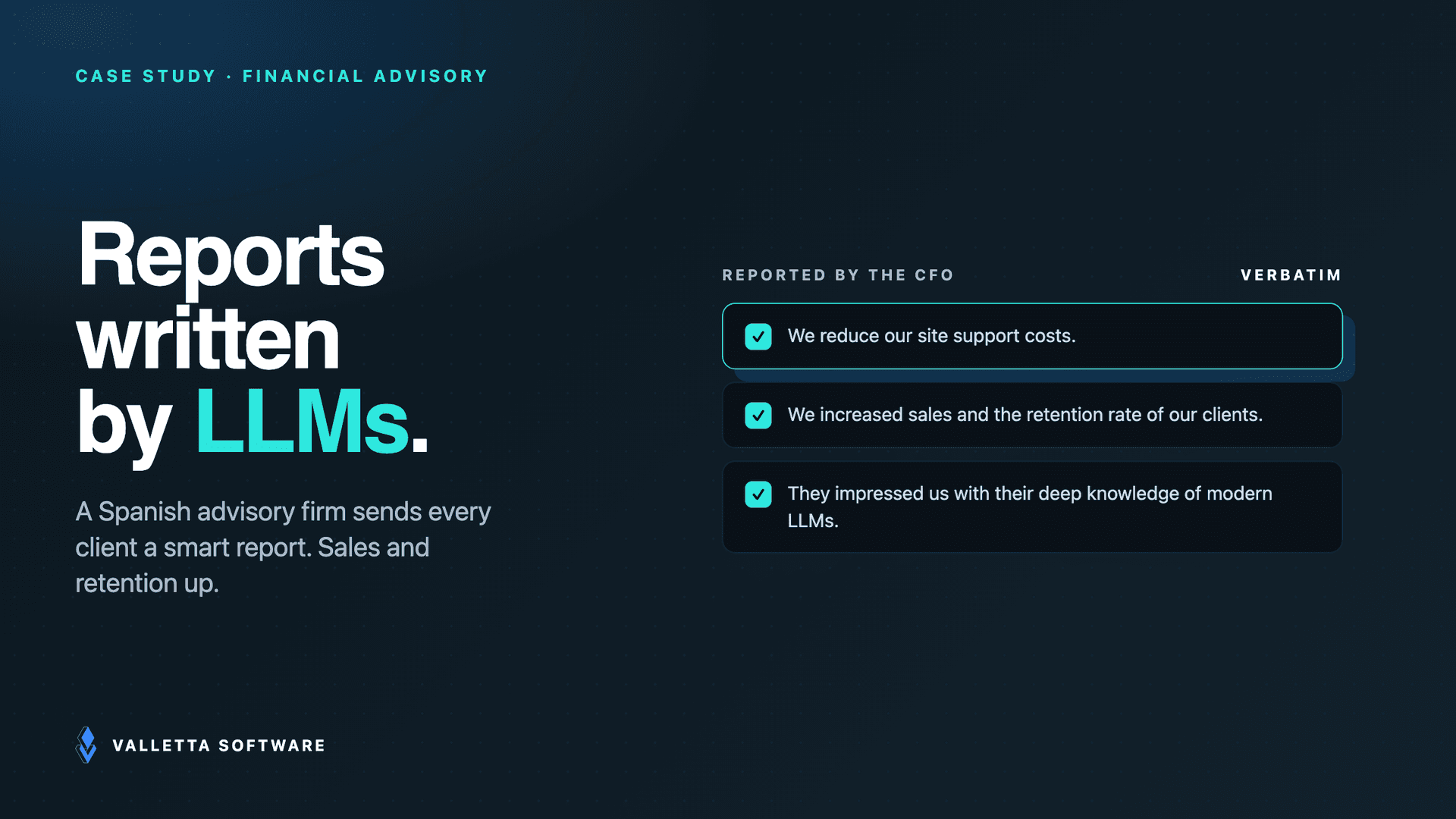
Fin-Craft, a Spanish financial advisory firm serving small businesses, needed a CMS for its site and automation for its financial accounting. Valletta built and deployed the CMS, automated the accounting flows, and used LLM models to generate the smart reports Fin-Craft now provides to its clients. The CFO's verdict on Clutch: lower site support costs, higher sales, higher client retention. This is what AI financial reporting looks like at a firm of under ten people.
Key Takeaways
- A CMS built, deployed and handed over quickly, with the team shown how to run it
- LLM models write the smart reports Fin-Craft delivers to its own clients: AI financial reporting as a product, not a demo
- Financial accounting automation feeds those reports, so the numbers come from the system and the model only writes around them
- Outcomes reported by the CFO: reduced site support costs, increased sales, increased client retention
- Budget $10,000 to $49,999, a Valletta team of two to five, engagement running since January 2021 and ongoing
The client is Fin-Craft, a financial advisory firm for small businesses, based in Spain, with one to ten employees. Maksim Kukorenko, its CFO and co-founder, published a verified review of the engagement on Clutch in August 2025. The review contains no percentages, so this story contains none. What it does contain is the shape of the work and the CFO's own assessment of it.
The Challenge: A Small Advisory Firm With Enterprise-Sized Reporting Needs
A financial advisory firm sells judgment, and delivers it as reports. For a firm with fewer than ten people, every client report is hours of an advisor's time: pull the numbers, structure them, write the commentary, format it, send it. The larger the client list grows, the more of the firm's capacity goes into producing documents rather than advice.
Fin-Craft came to Valletta through a referral with two asks, stated plainly in the CFO's review:
- Create a CMS for the site, so the firm could run its own web presence without paying for every change
- Build automation systems for the financial accounting, so the data behind client work stopped being assembled by hand
The firm chose Valletta because the pricing fit its budget and the culture fit. Both matter more than they sound: a firm this size cannot absorb an agency that bills for every question.
The Approach: Ship the CMS Fast, Then Let the Data Decide the Next Step
The order of work followed the order of pain. The CMS came first, because a site the firm could not edit was costing money every month. The review's description is short: the team created the CMS very quickly, deployed it, and showed the firm how to work with it. That handover sentence is the forward-deployed habit in one line: the engineer builds it, then makes sure the owner can run it.
The accounting automation came next, and it is what made the third piece possible. Once the firm's financial data was flowing through a system instead of spreadsheets, there was a clean, structured source that a language model could write from.
The Solution: A CMS, Accounting Automation, and LLM Smart Reports
The CMS
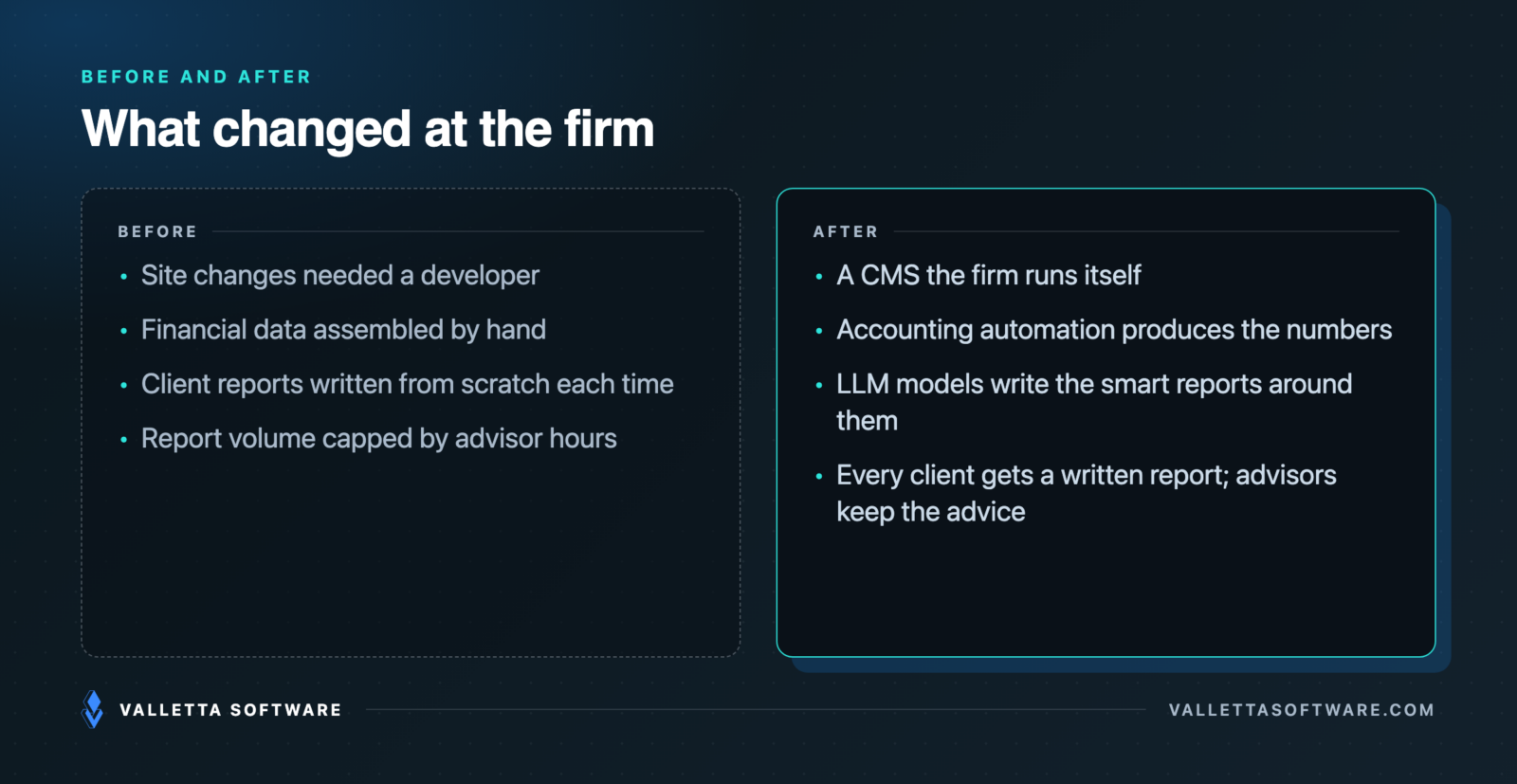
A content management system for the firm's site, built and deployed quickly, with the team trained to use it. The immediate business effect the CFO reports is reduced site support costs: changes that used to need a developer now do not.
Financial accounting automation
Automation systems for the firm's financial accounting, so the numbers behind client work are produced by the system rather than re-keyed. For a firm whose product is financial advice, this is the layer everything else stands on: if the inputs are wrong, no amount of clever writing helps.
Smart reports written by LLM models
This is the part the CFO singles out. Valletta used LLM models to create the smart reports Fin-Craft provides to its clients. The model writes around the numbers the automation produces; the advisor reviews and sends. The result is AI financial reporting that a small firm can actually sell: every client gets a written report, and the advisors spend their hours on the advice inside it rather than the document around it. The CFO's phrase for the team behind it: deep knowledge of modern LLMs.
Ongoing support since 2021
The engagement started in January 2021 and is still running. The review describes the support as very close, with the team explaining every little thing the firm did not understand. That is the difference between a delivered project and a working system four years later.
The Results: What the CFO Reported
Fin-Craft did not publish percentages, and we will not invent them. The outcomes below are the CFO's, in the order the review states them:
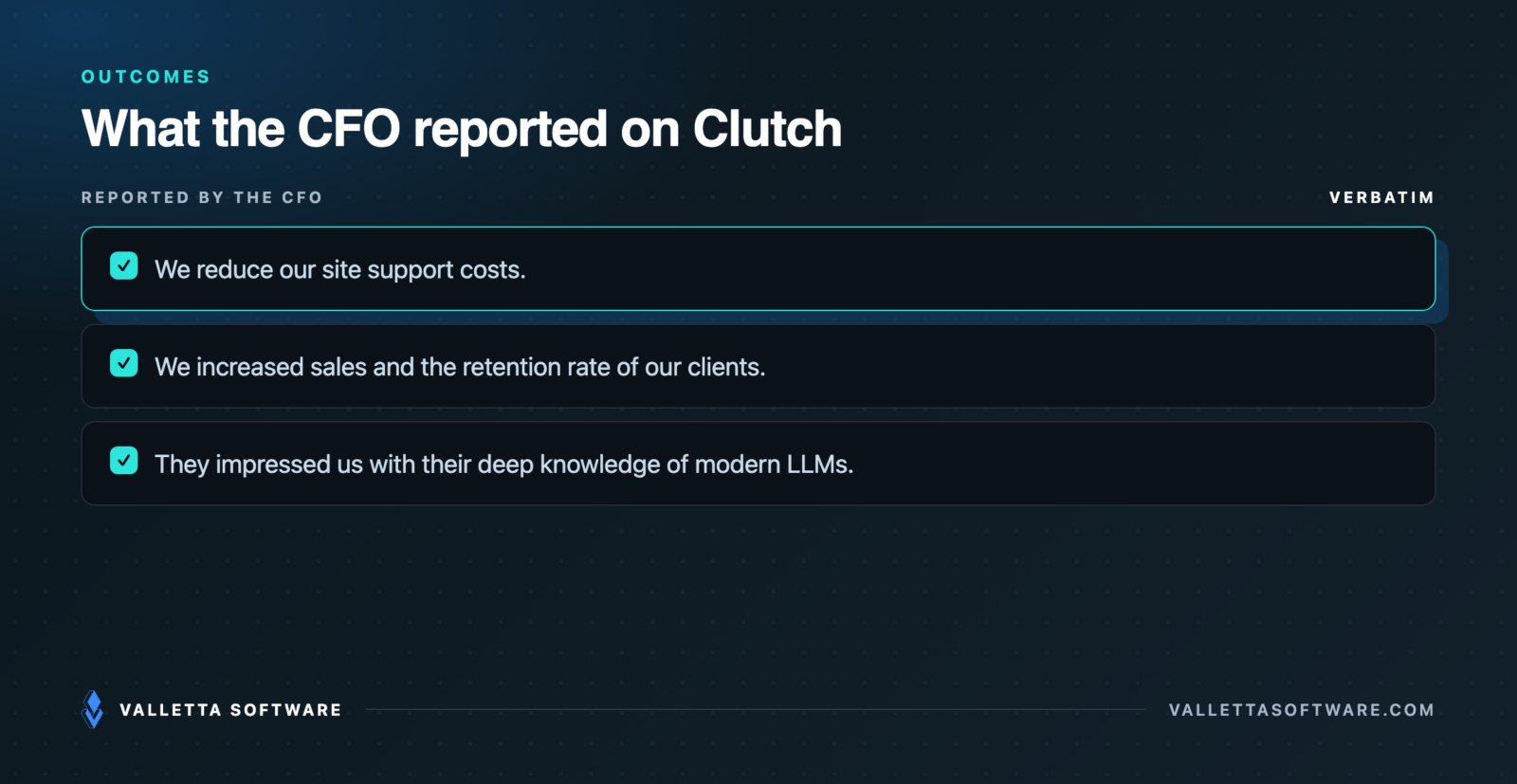
- Reduced site support costs, because the firm runs its own CMS
- Increased sales
- Increased client retention rate
- Rated 5.0 on Clutch for quality, schedule, cost and willingness to refer, with nothing listed to improve
Read those three outcomes together and they describe one mechanism. Reports that used to be a cost became a product feature. Clients who receive a clear written report every period stay, and prospects who see one buy. For a small advisory firm, that is the whole growth model.
Their AI software engineers are very smart, and they're involved in clients needs. They impressed us with their deep knowledge of modern LLMs.
Maksim Kukorenko, CFO and Co-Founder, Fin-Craft, on Clutch
Why This Is the Right Shape for AI in a Small Financial Firm
Most AI financial reporting pitches start with the model. This engagement started with a CMS and a set of accounting automations, and the model arrived last, once there was trustworthy data for it to write from. That ordering is why the reports are usable: the LLM explains figures the system produced, rather than producing figures itself.
It is also the pattern behind our other AI engagements. The DACH insurer in our on-prem LLM case study needed the model inside its own building for compliance; Fin-Craft needed it inside its own reporting flow for the business to feel it. For a broader view of where agents pay off, see our review of enterprise AI agent case studies and how enterprise AI agents are built. If you are a firm of Fin-Craft's size, the two OpenClaw stories are closer to home: a research team that went from three weeks to one day and a non-technical owner running a self-hosted assistant.
Frequently Asked Questions
What does AI financial reporting look like for a small advisory firm?
For Fin-Craft it is a smart report: the firm's own client data, structured by its accounting automation, written up by LLM models into a report the client receives. The advisor still owns the advice. The model does the drafting, so a small team can send every client a report that used to be affordable only for the largest accounts.
Is it safe to let an LLM write financial reports for clients?
It is safe when the numbers come from the accounting system and the model only writes around them, and when a human signs off before the report goes out. That is how Fin-Craft's reports work. The model never invents a figure; it explains the figures the automation already produced.
How long has the engagement run, and what did it cost?
The CFO's review states a budget of $10,000 to $49,999, a Valletta team of two to five people, and a relationship that started in January 2021 and is still ongoing, with what the review calls very close ongoing support.
Want an AI Agent That Your Team Actually Runs?
Fin-Craft did not hire an AI team. It hired the engineers who built its CMS, automated its accounting, and then put LLM-written reports in front of its clients, and it is still working with them four years later.
Valletta works the forward-deployed way: the engineer who hears your problem is the engineer who configures the agent inside your own tools, tests it with you, and leaves only when you can run it without us. Read what a forward deployed engineer is, or skip the reading.
Tell us what your team is doing by hand: vallettasoftware.com/contact-us