

AI Development Agency vs Dedicated AI Developers: A Global Decision Matrix for 2026
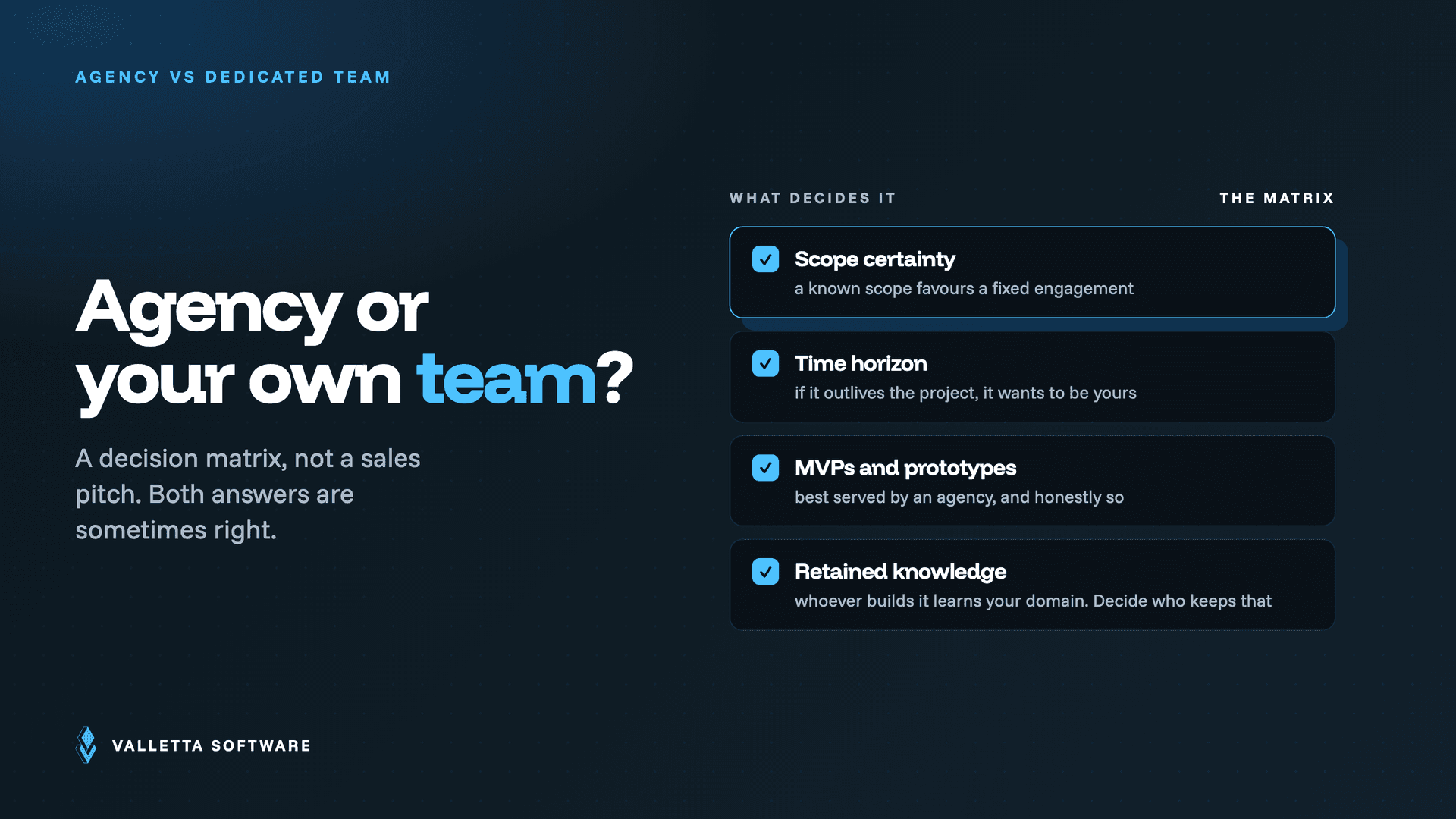

Artificial intelligence is no longer a future promise; it is the operational backbone of competitive enterprises in 2026. But success with AI depends far less on the technology itself and far more on the delivery model an organization selects. The central question facing IT leaders today is whether to engage an AI development agency or to hire dedicated AI developers embedded within their teams. Each path offers distinct advantages in scope, control, speed, and risk, and the right choice hinges on project context, organizational maturity, and strategic goals. Valletta Software offers both models. To pick the right one for your scope, talk to an AI development team.
Related: before you decide, see our guide to hiring AI developers (screening, trials, pricing) or meet the vetted developers on the Valletta bench.
According to Gartner's 2025 enterprise AI research, 40% of enterprise applications will integrate task-specific AI agents by the end of 2026, up from less than 5% in 2025. The race to operationalize AI is accelerating, and making the wrong build-vs-partner decision can cost organizations quarters of lost momentum. This article provides a structured decision matrix grounded in recognized frameworks: ITIL 4 for service management, ISO/IEC 12207 for software lifecycle processes, the Scrum Guide for agile development, the PMBOK Guide for project governance, and DORA metrics for software delivery performance.
Understanding the Core Delivery Models
Before evaluating trade-offs, the two models need precise definition. An AI development agency is an external firm that delivers end-to-end AI project services through multi-disciplinary teams with mature DevOps pipelines, process frameworks, and cross-domain expertise. Agencies typically handle consulting, prototyping, MVP delivery, production deployment, and post-launch support. They bring pre-built toolchains, established CI/CD infrastructure, and codified quality assurance practices aligned with standards like ISO/IEC 12207 and ITIL 4.
Dedicated AI developers, by contrast, are individual specialists hired as full-time employees or long-term contractors who work exclusively on one organization's AI initiatives. They become embedded in the company's culture, knowledge base, and technical ecosystem. Their strength lies in sustained focus, deep institutional knowledge, and direct alignment with long-term strategy.
Organizations like Valletta Software Development operate within the agency model but apply a distinctive AI-first development methodology that compresses delivery timelines by 40 to 70% compared to traditional approaches. This hybrid capability, combining agency speed with structured AI-native workflows, represents an evolution beyond the classic agency model that IT leaders should consider when evaluating their options.
The Decision Matrix: Four Critical Factors
The following matrix breaks down each model across four evaluation dimensions. Decision-makers should weight each factor based on their organization's strategic priorities, risk tolerance, and operational maturity.
| Factor | AI Development Agency | Dedicated AI Developers |
|---|---|---|
| Scope | Broad: end-to-end, multi-project, cross-domain delivery | Narrow: focused on internal initiatives and long-term platform work |
| Control | Moderate: governed by agency processes and methodologies | High: direct oversight, full cultural and process alignment |
| Speed | Fast start: leverages existing frameworks, infrastructure, and talent | Slower kick-off: requires recruitment, onboarding, and ramp-up |
| Risk | Lower execution risk; higher IP/confidentiality exposure | Higher delivery risk; stronger IP protection and institutional control |
Scope: Project Breadth and Organizational Flexibility
AI development agencies excel when projects span multiple domains, integrate diverse technology stacks, or require rapid deployment across unfamiliar territory. Drawing from ITIL 4's service management principles and ISO/IEC 12207's lifecycle rigor, agencies bring pre-established frameworks for execution, quality assurance, and change management. An agency with cross-industry experience in fintech, logistics, healthcare, and e-commerce can apply pattern recognition across domains, reusing architectural decisions and avoiding pitfalls that a narrowly focused team might encounter for the first time.
For example, Valletta Software Development maintains active delivery experience across agritech, climatetech, fintech, e-commerce, and logistics, with completed projects ranging from NLP-driven sales engagement platforms to computer vision-based industrial safety monitoring systems. This breadth allows the agency to apply proven architectural patterns (geospatial data pipelines, real-time GPS tracking, regulatory compliance frameworks) to new client contexts without a steep learning curve.
Dedicated AI developers, by contrast, deliver their greatest value where sustained, focused effort is needed: evolving a proprietary model, maintaining an internal ML platform, or building deep domain expertise that compounds over time. The PMBOK Guide emphasizes stakeholder engagement and continuous value delivery, both of which benefit from developers who share the organization's context and priorities over months or years.
Key consideration: If your roadmap includes experimental, cross-functional, or rapidly scaling AI projects, agencies offer breadth and repeatable process. For platform longevity, research-intensive work, or building a moat around proprietary AI capabilities, embedding dedicated talent yields greater organizational learning.
Control: Oversight, Customization, and Process Alignment
Control divides along process boundaries. Agencies operate within mature, codified methodologies: Agile sprints, DevOps pipelines, and continuous delivery practices aligned with the Scrum Guide and DORA performance benchmarks. These processes provide reliability and predictability, but clients must adapt to the agency's workflow conventions. For organizations without robust internal engineering processes, this can be a significant advantage rather than a constraint.
AI-first agencies take this further. Valletta Software Development's AI-first methodology, for instance, enforces deterministic workflows, project-specific code style, reproducible context chains, and defined architectural patterns across the entire codebase. This means generated code follows consistent standards regardless of which team members are involved, addressing the classic agency concern of inconsistent output quality. The 2025 DORA research confirms that teams with higher process standardization consistently achieve better deployment frequency and lower change failure rates.
Dedicated AI developers provide full process customization and deeper collaboration with cross-functional teams. With direct control, organizations can tailor execution to internal audit, compliance, and security requirements aligned with ISO/IEC 12207 and ITIL 4 service monitoring. This customization becomes critical in regulated or security-sensitive environments where process flexibility is non-negotiable.
Important trade-off: High control offers greater security and alignment but places greater demand on the organization's management capability and process maturity. Organizations without a strong engineering management layer often underestimate the overhead of directing dedicated developers effectively.
Speed: Time-to-Value and Delivery Efficiency
Speed is where the agency model presents its most compelling argument. Agencies eliminate ramp-up time by deploying pre-built toolchains, cloud infrastructure, and experienced multi-role teams from day one. They accelerate prototyping, proof-of-concept development, and MVP launches. DORA metrics emphasize deployment frequency and lead time for changes, both of which benefit from an agency's pre-optimized delivery pipeline. The 2025 DORA State of AI-assisted Software Development report found that teams leveraging AI in their workflows see measurable gains in individual task completion, though organizational performance depends on having the right foundational practices in place.
AI-first agencies push this advantage further. Valletta Software Development's AI-native approach delivers projects at 30 to 35% of traditional development cost, with delivery timelines compressed by 40 to 70%. The methodology uses AI agents to automate requirement clarification, functional specification generation, database schema design, backlog creation, API specification, code generation, and test automation. Each stage builds on structured context chains rather than ad-hoc developer interpretation, producing production-grade output with zero technical debt and automatic documentation.
Hiring and integrating dedicated AI developers is inherently slower. Time is consumed by talent acquisition (often 2 to 4 months in competitive markets), onboarding, and team cohesion building. However, once established, an embedded team can optimize workflows for sustained internal velocity and continuous improvement following Scrum and Lean principles. The efficiency compounding effect of a dedicated team typically begins to materialize after 3 to 6 months of stable operation.
Critical insight: If a project requires proof-of-concept delivery within weeks or a production MVP within a quarter, agencies offer a significant head start. For enduring initiatives where long-term velocity matters more than initial speed, the investment in building an embedded team can pay dividends over time.
Risk: Execution Gaps, IP Protection, and Vendor Dependencies
Risk manifests differently in each model and must be evaluated across execution, intellectual property, and dependency dimensions. Agencies de-risk delivery through mature QA processes, comprehensive documentation, and compliance workflows aligned with ISO/IEC 12207 and PMBOK. Yet externalizing critical data or proprietary models introduces legitimate concerns about IP protection, data security, and confidentiality. Contractual clarity, robust NDA frameworks, and clear IP assignment clauses are non-negotiable prerequisites.
Modern AI-first agencies mitigate several traditional agency risks. When code is generated through deterministic AI workflows with reproducible context chains, the risk of opaque, developer-dependent logic is substantially reduced. The client receives a codebase that any senior developer can read, modify, and extend as if it were written manually, eliminating the lock-in effect that often accompanies traditional agency engagements. Valletta Software Development structures its delivery so that all generated code follows industry best practices with unified architecture across the entire codebase, making the transition to internal teams straightforward.
Dedicated developers, while offering stronger IP protection and institutional control, present their own risk profile: talent churn in competitive AI hiring markets, single-point-of-failure knowledge concentration, skill gaps as technology evolves, and the management overhead of sustaining pace and quality. The PMBOK Guide's emphasis on organizational process assets and knowledge management is particularly relevant here, as organizations must invest continuously in retention, upskilling, and documentation to maintain delivery assurance.
Best practice: For agency engagements, audit processes for data security compliance and enforce IP assignment contractually. For dedicated teams, invest in knowledge distribution, retention incentives, and cross-training to avoid critical person dependencies.
The Hybrid Model: Combining Agency Speed with Embedded Depth
In practice, many high-performing organizations blend both models. The hybrid approach uses an AI development agency for rapid, modular delivery (MVPs, new feature verticals, specialized AI/ML components) while maintaining dedicated developers for core IP, continuous platform evolution, and domain-specific optimization. This pattern is particularly effective when the agency's delivery methodology produces clean, standards-compliant code that internal teams can maintain and extend without friction.
Valletta Software Development's engagement model supports this pattern through a structured Discovery phase that produces comprehensive documentation (technical specifications, ERDs, system processes, user flows, wireframes, and roadmaps) usable by any development team. Discovery deliverables are prepared to internal standards, and the Discovery phase cost is deducted from the final project estimate, functioning as the first development sprint. This means clients can engage the agency for initial delivery and transition to internal teams with complete documentation and a maintainable codebase.
The agency's team composition model is also designed for flexibility, providing AI Agent Architects, ML engineers, AI Operator developers, full-stack developers (.NET, Node.js, Python, React, Angular, Flutter), and cloud infrastructure specialists (AWS, Azure, GCP) at $60/hour. This allows organizations to scale specific capabilities up or down without the fixed cost commitment of full-time hires.
Practitioner-Level Recommendations
Define scope before selecting a model. Use ITIL 4's service strategy stage to specify desired business outcomes and map them to capability requirements. Scope clarity determines whether breadth (agency) or depth (dedicated) will generate more value.
Benchmark with DORA metrics. Use deployment frequency, lead time for changes, change failure rate, and failed deployment recovery time to compare agency and in-house performance objectively. The DORA framework now includes a fifth metric, Rework Rate, and a quasi-metric for Reliability, providing a more complete picture of delivery health in 2026.
Enforce robust contracts for agency engagements. Strengthen NDAs, IP assignment clauses, and data handling agreements with reference to ISO/IEC 12207 governance requirements. Ensure that all generated code and documentation is contractually the client's property upon delivery.
Plan for hybrid from the start. Even if beginning with an agency, design the engagement so that internal teams can absorb delivery responsibility over time. Require standards-compliant code, comprehensive documentation, and a structured handoff plan as part of the contract.
Invest in change management. The PMBOK Guide's change control recommendations help minimize disruption during transitions between agency and internal delivery. Factor in knowledge transfer sprints and parallel operation periods when planning transitions.
Frequently Asked Questions
When should an organization choose an AI development agency over dedicated AI developers?
Organizations should select an agency when they need rapid, cross-domain project delivery, lack in-house AI/ML expertise, or face tight deadlines for MVP or proof-of-concept work. Agencies are particularly valuable when the project scope includes standard flows, CRUD operations, dashboards, APIs, and component-based architectures that benefit from AI-accelerated delivery. Dedicated developers are preferable when direct oversight, cultural integration, long-term platform ownership, or deep research work is the priority.
How do costs compare between the two models?
Agencies carry structured per-hour or per-project costs with predictable pricing and faster results. AI-first agencies like Valletta Software Development deliver at 30 to 35% of traditional development cost for AI-suitable modules, making the total engagement cost significantly lower than building and maintaining an equivalent in-house team. Dedicated developers require a longer-term investment encompassing recruitment, benefits, equipment, management overhead, and ongoing training, but can become more cost-effective for continuous, multi-year initiatives where utilization remains consistently high.
What frameworks best manage risk in AI projects?
ISO/IEC 12207 provides the lifecycle process framework for defining project controls, change management, and quality assurance. ITIL 4 governs service management and operational monitoring. The Scrum Guide structures iterative delivery, and DORA metrics offer objective benchmarks for delivery performance. Agencies typically implement these frameworks rigorously as part of their operational DNA. For dedicated teams, organizations must enforce these standards internally, which requires process maturity and management investment.
How do organizations balance speed and control?
Agencies accelerate start-up and delivery through reusable assets and pre-built infrastructure but operate within their own process conventions. Dedicated developers deliver fully customized solutions with slower ramp-up but complete process alignment. A hybrid approach, starting with an agency for initial delivery and transitioning to internal talent for ongoing evolution, is the most common strategy among organizations that successfully balance both priorities.
What metrics should measure AI software delivery performance in 2026?
The current DORA framework includes five formal metrics grouped into throughput (deployment frequency, lead time for changes, failed deployment recovery time) and stability (change failure rate, rework rate), plus Reliability as a quasi-metric. Comparing these metrics between agency and in-house delivery provides an objective basis for evaluating performance and informing process improvements. Organizations should also track business outcome metrics like time-to-market and customer impact alongside delivery performance indicators.
Conclusion
Choosing between an AI development agency and dedicated AI developers in 2026 requires a structured, evidence-based approach. By evaluating scope, control, speed, and risk within recognized frameworks like ITIL 4, ISO/IEC 12207, the Scrum Guide, PMBOK, and DORA, organizations can make decisions aligned with their strategic goals rather than defaulting to habit or convenience. The emergence of AI-first delivery methodologies has shifted the calculus meaningfully in favor of agency engagement for initial delivery, while the compounding value of embedded expertise remains critical for long-term platform ownership. Establish your decision criteria early, measure delivery outcomes rigorously, and design for flexibility, whether you pursue agency partnership, build internal teams, or combine both approaches to achieve sustainable AI-driven competitive advantage.
Looking for an AI-first engineering partner? Valletta Software Development delivers specialized AI engineering teams at $60/hour, with delivery timelines 40 to 70% faster than traditional approaches. Explore our success stories or get in touch to discuss your project.
Frequently asked questions
- Agency or dedicated AI developers: which one should I pick?
- Pick an agency for scope clarity, fixed delivery and one-throat-to-choke management. Pick dedicated AI developers for long-running products that need continuous iteration and tighter integration with your team.
- Is dedicated cheaper than an agency?
- Hourly rates are similar; total cost depends on duration. Dedicated wins for engagements longer than 4 months. Agency wins for short, well-scoped projects with hard deadlines.
- Can I switch from agency to dedicated mid-project?
- Yes if the contract reserves the right and IP ownership is clear. The common path is agency-led delivery for an MVP, then a dedicated team for v2 and operations.
- Which model fits a regulated industry?
- Dedicated developers under a single EU contract, with named individuals, security training and compliance reps. Agencies still work but require deeper vendor management.
- What does Valletta Software offer?
- Both models. Valletta runs dedicated AI development teams for product companies and structured project-based engagements for time-boxed builds and audits.
Pick the Right Model for Your AI Build
Valletta Software runs both dedicated AI teams and project-based AI builds. Tell us the scope and we'll recommend the model that fits.
Key takeaways
- Agency wins on: bounded scope, fixed timeline, deliverable handoff. Best for MVPs and prototypes.
- Dedicated developers win on: long-term roadmap, deep domain context, ongoing iteration.
- Cost comparison: agency typically 1.5 to 2.5x the hourly rate of dedicated; trade-off is project-management overhead.
- Decision pivot: if work continues beyond 6 months and changes direction, dedicated is right. Otherwise agency.