

Agentic Coding as a Process, Not Disconnected Chats
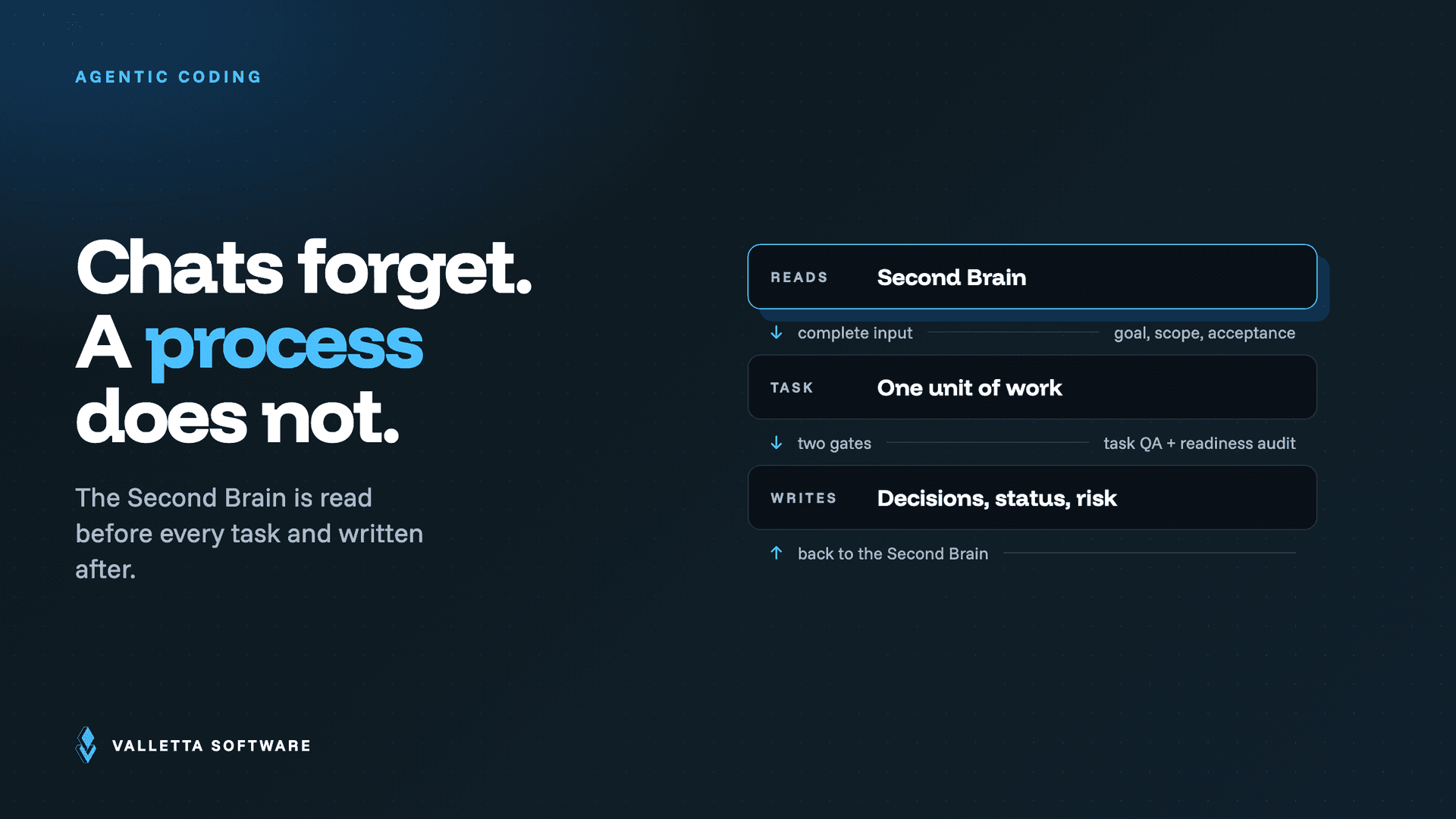

Agentic coding works when AI runs through a managed process instead of a pile of disconnected chats. A task enters a defined workflow: it pulls context from a persistent project memory called the Second Brain, moves through analysis, planning, implementation, and review, then writes the result back so the next task starts from an up to date picture of the project. The chat is just the surface. The process is what actually ships software.
Key takeaways
- Ad hoc chatting fails because context dies between sessions. Agentic coding succeeds when it is a repeatable process with memory, gates, and a clear definition of done.
- The Second Brain is a live, connected model of the project: requirements, architecture, decisions, risks, and current statuses. The agent reads it before every task and writes to it after.
- Every task carries complete input (goal, scope, acceptance criteria, context) and returns complete output (work log, decisions, status changes, readiness impact).
- Two gates, not one: a project level readiness audit governs launch, while task QA and code review gate each unit of work. They answer different questions.
- Bundles and parallel agents (workspace copies or git worktrees) scale the work without losing a single source of truth.
- Skills and slash commands run the process. The human starts the work and reviews it; the automation does the heavy lifting in between.
Why disconnected chats fail
Most people meet AI coding as a chat window. You describe a change, the model writes some code, you paste an error, it tries again. For a one file script that loop is fine. On a real product it quietly falls apart, because each new chat starts from zero. The model does not remember your architecture, the decision you made last week, the three edge cases that already bit you, or which repository owns which responsibility.
The result is familiar: code that looks finished and is not, the same bug reintroduced twice, and a slow accumulation of AI-generated technical debt nobody chose on purpose. The problem is not the model. The problem is that a chat has no memory and no gates, so every session relearns the project from scratch and no session is accountable for what it leaves behind.
Agentic coding fixes this by wrapping the model in a process. The same capable model that flails in a bare chat becomes reliable once it always knows where the rules, the memory, and the acceptance criteria live. That shift, from chatting to running a process, is the whole story of what changes in the developer's role in the Claude Code era.
The Second Brain: a live model of the project
The center of the process is a persistent project memory we call the Second Brain. It is not a folder of stale notes. It is a connected working model of the product that stays current: a glossary and object ontology, product requirements, use cases and user stories, screen and form details, architecture and operations, decisions, risks, open questions, work logs, and readiness findings. In practice it lives in a linked knowledge base such as Obsidian, where every entity can reference every other.
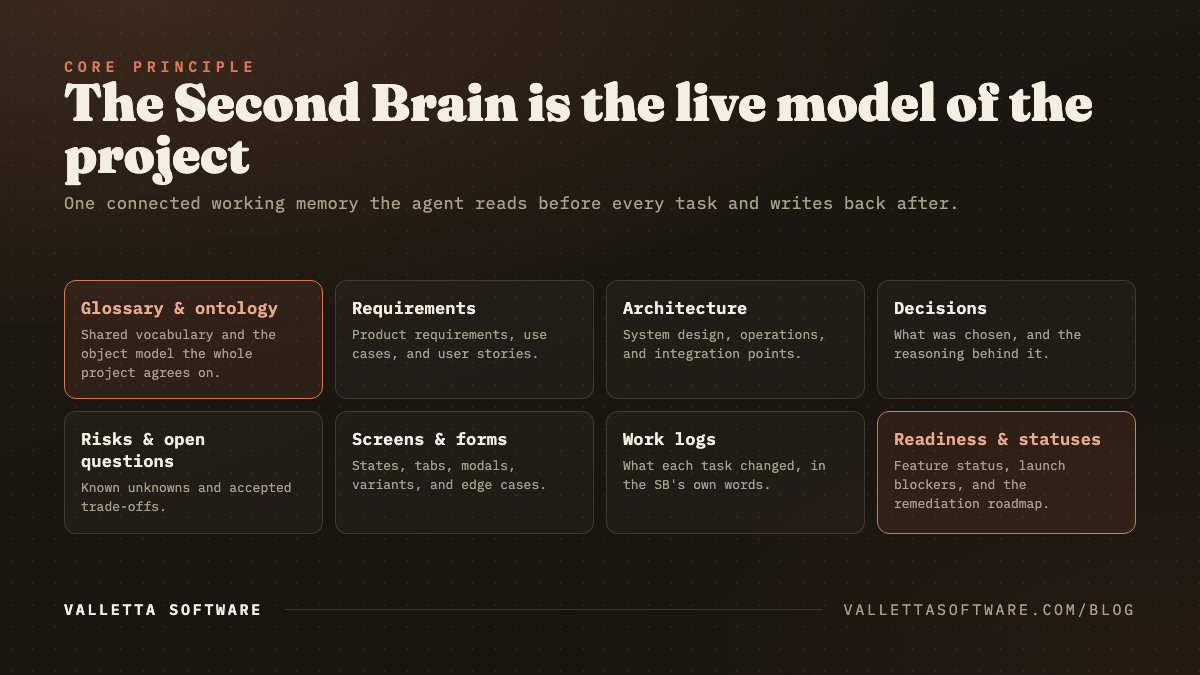
Because the memory is always current, the work products fall out of it almost for free. Work logs, feature statuses, readiness views, remediation roadmaps, and even progress presentations are generated from a Second Brain that is already up to date, rather than assembled by hand at the end of a sprint. Keeping the memory honest is the price of admission; everything else is downstream of it.
One project root the agent can always navigate
Stable memory needs stable navigation. The environment is organized around a single project root that holds every repository plus the rules the AI follows. Three things must always be findable from that root: an AGENTS.md file that states the rules, paths, and workflow; a link to the Second Brain; and a link to the skills that automate the process. The individual code repositories sit alongside them.
The point is not the exact file names. The point is that the agent never has to guess. It always knows where the rules are, where the code is, where project memory lives, and which automated flows it can call. That predictability is what lets you hand an agent a task and trust it to gather its own context instead of hallucinating the shape of your project.
Every task: complete input, complete output
Inside the process, the unit of work is a single task, and every task has two hard requirements. It must arrive with complete input, and it must leave with complete output written back to the Second Brain. A task is not done when the code compiles. It is done when project memory reflects what changed.
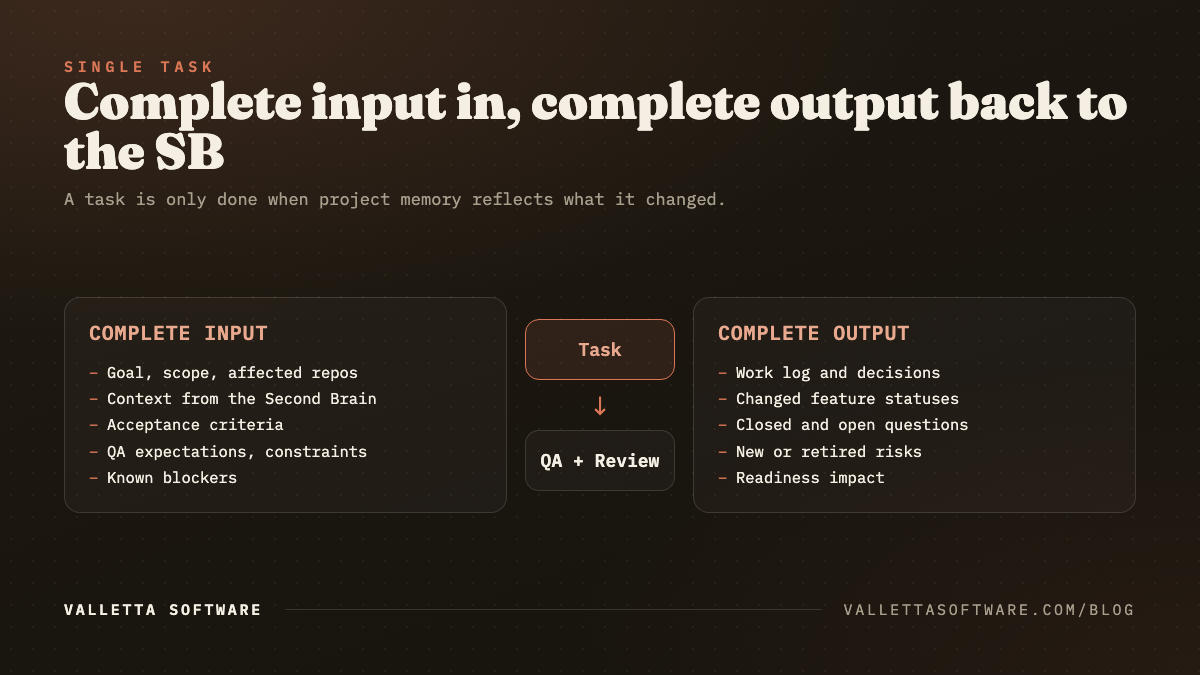
Complete input means an ID and source, the context and goal, the scope and affected repositories, supporting materials, acceptance criteria, QA expectations, constraints, known blockers, and any additions to the definition of done. For UI and UX work the materials have to include all screens, states, tabs, modals, variants, and edge cases, because an agent will faithfully build only what you described and silently skip what you left out.
Complete output means a work log, the decisions taken, changed feature and screen statuses, closed and newly opened questions, updated risks, readiness impact, and any remaining work. This is the loop that makes the process compound: each task hands the next one a cleaner, truer model of the project than it inherited.
Readiness audits and QA: two different gates
A common mistake is to collapse quality into a single check at the end. The process keeps two separate gates because they answer different questions. One asks whether the whole product can launch. The other asks whether this specific task is correct.
Production readiness audit
The readiness audit is a management level view. It runs a baseline audit, produces findings, routes the important decisions to a human, and turns accepted findings into a roadmap and into tasks. Later a delta audit re measures, produces a readiness score, and folds the outcome back into the Second Brain. It answers the questions leadership actually asks: can we launch, what blocks launch, which risks have we accepted, and which findings became work.
Task QA and code review
Task QA is narrower and per task. It is not always end to end first; the checks are chosen from the project, its risk, its architecture, and the available tools. A typical flow runs the implementation against test data, checks it against the design, produces an issue list, adds a fix plan when there are many issues, re checks, and only then goes to review. Code review is mandatory: serious findings are either fixed or explicitly accepted, never silently ignored. Tooling like an AI code review pass that red-teams changes before commit fits exactly here, as the gate before delivery. When the task is closed, the QA summary and any readiness impact are recorded back into memory.
Scaling up: task bundles and parallel agents
Single tasks are the base case. Real projects also have bundles: groups of related fixes or features handled together. Bundles run through a slightly heavier flow, a bundle artifact, root cause grouping, a batch plan, parallel execution, independent review, and a memory update, and for a bundle the separate preparation, implementation, and code review chats cannot be skipped. For a small or medium single task that split can be dropped when the context is clean.
Parallel work is where the process earns its keep. Several agents run at once against a shared Second Brain, each in its own isolated workspace, either a managed copy of the workspace or a git worktree. One agent builds feature A, another builds feature B, a third clears a fix bundle. They share the same source of truth but never step on each other's files, and an independent review with real merge discipline keeps the parallel streams from colliding.
The automation layer: skills and slash commands
None of this requires the human to run each step by hand. Reusable skills carry the heavy work, and slash commands trigger the process at the points where a person starts or closes a unit of work.
| Automation | What it does |
|---|---|
| Project Second Brain | Builds and maintains the memory: glossary, ontology, requirements, use cases, screens, traceability, risks, decisions, work logs, and readiness integration. |
| Production Readiness Audit | Runs the audit only baseline and delta, findings, scoring, the remediation roadmap, launch notes, and risk updates. |
| Public Progress Presentation | Generates readable progress materials from the Second Brain and readiness data when a public facing layer is needed. |
/task-start and /task-end |
Open a tracked unit of work, then close it with a QA checkpoint, review reminder, push or PR, summary, and status and documentation sync. |
/sync-documentation |
Runs the Audit, Second Brain, and Public Progress skills, individually or all at once. |
/task-artifacts and /code-review |
Keep temporary plans and analyses for the current task, and run the review gate before delivery. |
The commands are not tied to any one tracker. A tool like Jira, wired in over an integration, is one possible target, not a requirement. The division of labor stays the same regardless of stack: the human starts and reviews, the skills do the work, and the slash commands mark the boundaries.
One source of truth, many views
The payoff of keeping a single, current model of the project is that different people can read it differently without anyone writing a separate report. The engineering team gets less context loss, one source of truth, clear tasks, traceability, and repeatable QA. A product manager, a marketer, or a CEO gets transparent progress on the same data: feature statuses, launch blockers, risks, decisions, the roadmap, and the evidence behind each, all without a manual status meeting.
That is the difference between using AI as a faster autocomplete and running agentic coding as a process. The model still writes most of the code. But the memory, the gates, and the definition of done are what turn a clever chat into software you can actually launch, and into a project a whole organization can see. Choosing a capable model matters too, and you can compare the best AI models for coding separately, but the process is what makes any of them dependable.
Frequently asked questions
What is agentic coding?
Agentic coding is using AI agents that plan, write, test, and revise code across multiple steps, rather than autocompleting a single line. The developer assigns goals, provides context, runs agents through a defined workflow, and reviews their output like pull requests. The defining trait is process and memory, not a bigger autocomplete.
What is a Second Brain in AI development?
It is a persistent, connected project memory that holds the live model of the product: requirements, architecture, decisions, risks, and current statuses. The agent reads it before a task to gather context and writes to it after a task to record what changed, so knowledge does not die between sessions.
How is a readiness audit different from task QA?
A readiness audit is a project level gate that answers whether the whole product can launch and what blocks it. Task QA and code review are per task gates that answer whether one specific change is correct. Keeping them separate prevents a green build on one task from being mistaken for a launch decision.
Can multiple AI agents work on the same project at once?
Yes. Several agents can run in parallel against a shared Second Brain, each in an isolated workspace copy or a git worktree, so they share one source of truth without overwriting each other. An independent review step and clear merge discipline keep the parallel streams from colliding.
Do I need special tools to run this process?
You need a persistent knowledge base for the Second Brain, a stable project root with clear rules, and some automation for the repetitive steps. Skills and slash commands handle the workflow, and integrations such as an issue tracker are optional. The method matters more than any single product.