

What Happens to Developers in the Claude Code Era?
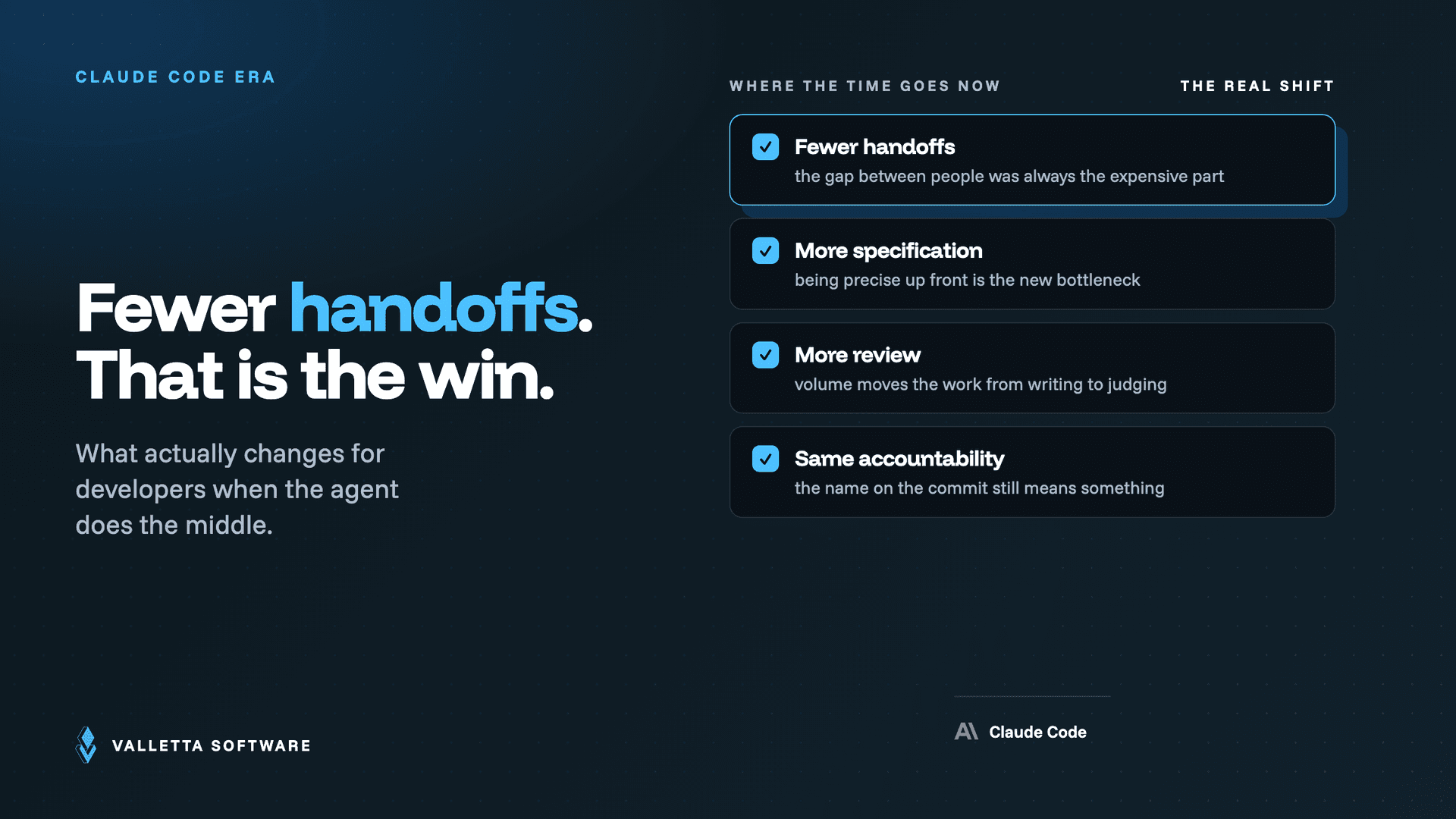

The future of software developers in the Claude Code era is not unemployment, it is promotion. As AI agents take over the line-by-line typing, the developer moves up a level and becomes a technical project manager: one person who owns a feature from the first client call to deploy and conducts a fleet of AI agents to get there. The job stops being write this function and starts being own this outcome.
Key takeaways
- AI does not delete the developer role, it raises its altitude: from typing code to owning features and directing agents.
- The biggest win is fewer handoffs. Every handoff between roles leaks context, and one owner end to end keeps that context intact.
- The result is faster delivery, a single point of accountability, and lower coordination cost.
- The honest catch: AI often reports code as secure when it is not, so critical paths still need an independent human review.
- The skill that pays shifts from writing code to taste, judgment, and review.
Will AI replace software developers?
No. It replaces a large share of the typing, not the thinking. The clearest signal comes from inside the tools themselves. Boris Cherny, the creator of Claude Code, has said that the title software engineer will start to go away, and that everyone is going to be a product manager, and everyone codes. That is not a layoff prediction, it is a job-description change. His point is that the human keeps the intent and the judgment while the machine handles the mechanical part.
The market data points the same way. VentureBeat reports that Claude Code effectively turned one engineer into three, and that the ratio of product thinkers to engineers is shifting from roughly 1 to 8 toward an effective 1 to 20. When one person can produce what three used to, companies do not need fewer humans who think about the product. They need more of them, and they need each engineer to think like an owner.
What does the freed-up time buy? It moves up the value chain. The hours an engineer used to spend hand-writing boilerplate, wiring up forms, and chasing small bugs now go into deciding what is worth building, how it should behave, and whether it is safe to ship. That is product thinking, and it is why the people who used to be measured purely on output are now expected to carry intent. The machine took the part that was easy to measure and left the part that was always the hard, human core of the job.
So the question is not whether developers survive. It is what they become. The answer is a role we call the orchestra developer.
What is an orchestra developer?
An orchestra developer is a single point of ownership for a feature. Instead of a developer sitting in a team next to a separate product manager, a designer, and an analyst, one person carries the feature the whole way: they talk to the client, design it, build the frontend and the backend, stand up the infrastructure, and deploy it. They do not do all of this by hand. They amplify themselves with AI agents, the way a one-person band plays every instrument at once.
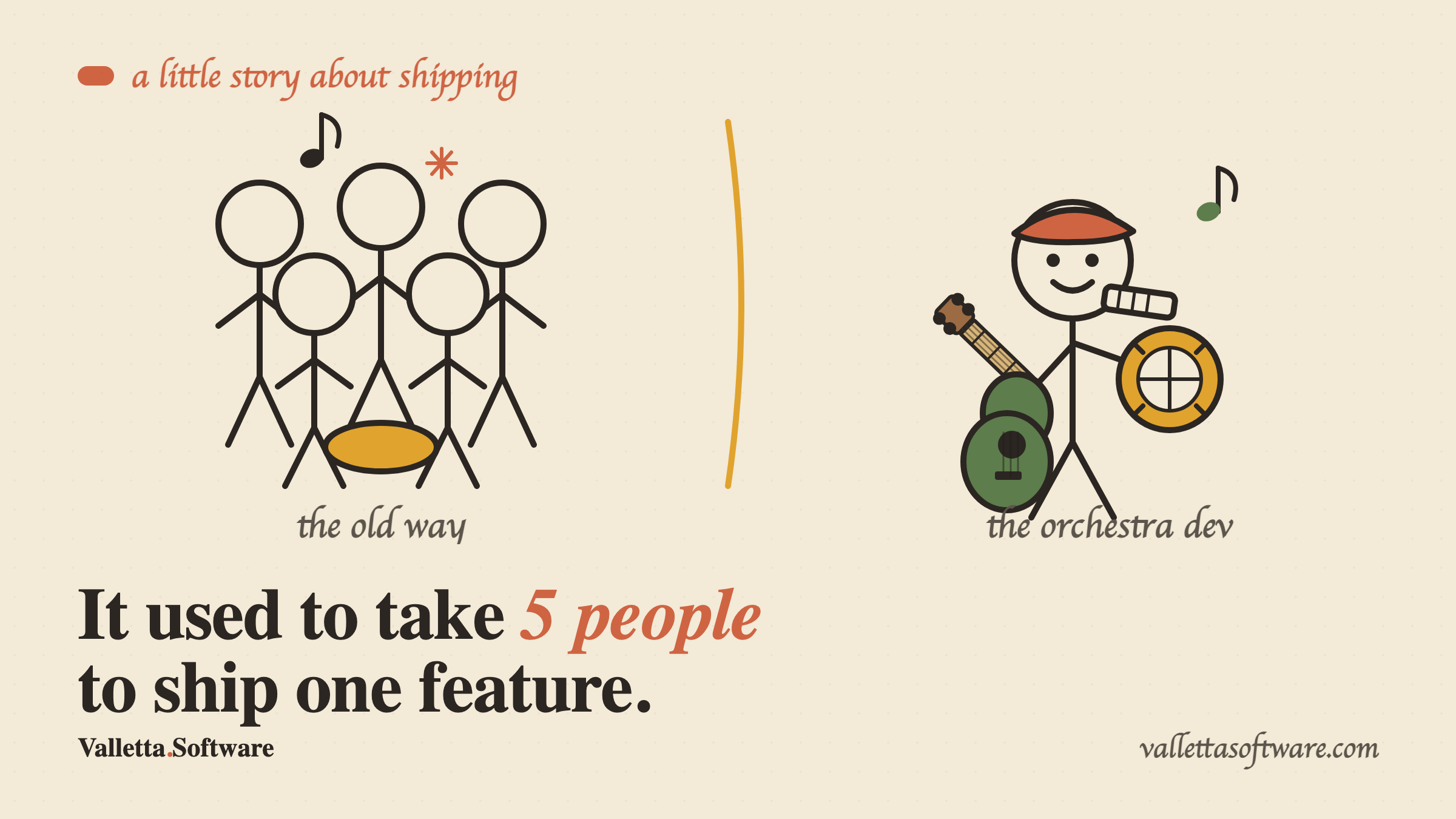
This is the same shift the O'Reilly team describes as moving from conductors to orchestrators. The developer stops playing one instrument in a section and starts directing the whole arrangement. The craft is no longer how fast you can type a loop. It is how clearly you can describe an outcome, split it across agents, and judge whether what comes back is actually good.
There are two flavors of this role, and it helps to keep them separate:
- The product type. Give them a goal, not a spec. They have the taste and the agents to take a rough description and turn it into a polished product, filling in functionality from an understanding of what the client actually needs.
- The deep-technical type. Architecture, cross-system and hardware integrations, personal data, and testing. They also work with agents, but they go deeper into the hard technical uncertainty and close it themselves.
For a metrics-driven engineering leader, the second type is usually the more relevant one, because the value is in the integrations, the architecture, and the security, not in making something look nice.
How does an orchestra developer work day to day?
The day does not look like heads-down typing. It looks like a conductor moving between sections. A single feature tends to run like this:
- Talk to the client. The owner takes the goal directly, not a pre-chewed ticket. Because they will build it, they ask the questions that actually matter for implementation.
- Shape the design. They sketch the user flow and the data model, then have an agent turn that into a first interface and schema to react to.
- Run agents in parallel. One agent drafts the frontend, another the backend, a third writes tests. The owner reviews each like a pull request, rejecting what is wrong and steering the next pass.
- Stand up the infrastructure. Infrastructure as code, a deploy pipeline, and the cloud resources go up through the same agent-and-review loop, with the owner making the calls on anything sensitive.
- Ship and own it. They deploy, watch it in production, and fix what breaks. There is no handoff to an ops team that has never seen the feature.
Notice where the human time goes. Very little of it is spent producing characters. Most of it is spent deciding what to build, splitting the work into agent-sized pieces, and judging the output. That orchestration is the part that does not get automated away.
Why do handoffs slow software teams down?
Because every handoff leaks context. When a designer, an analyst, and a product owner each pass a feature to the next pair of hands, a little of the original idea smudges off at each step. By the time it reaches implementation, what gets built is a faint copy of what was first imagined. It is the office version of the telephone game, and it is the single largest source of friction in normal team delivery.
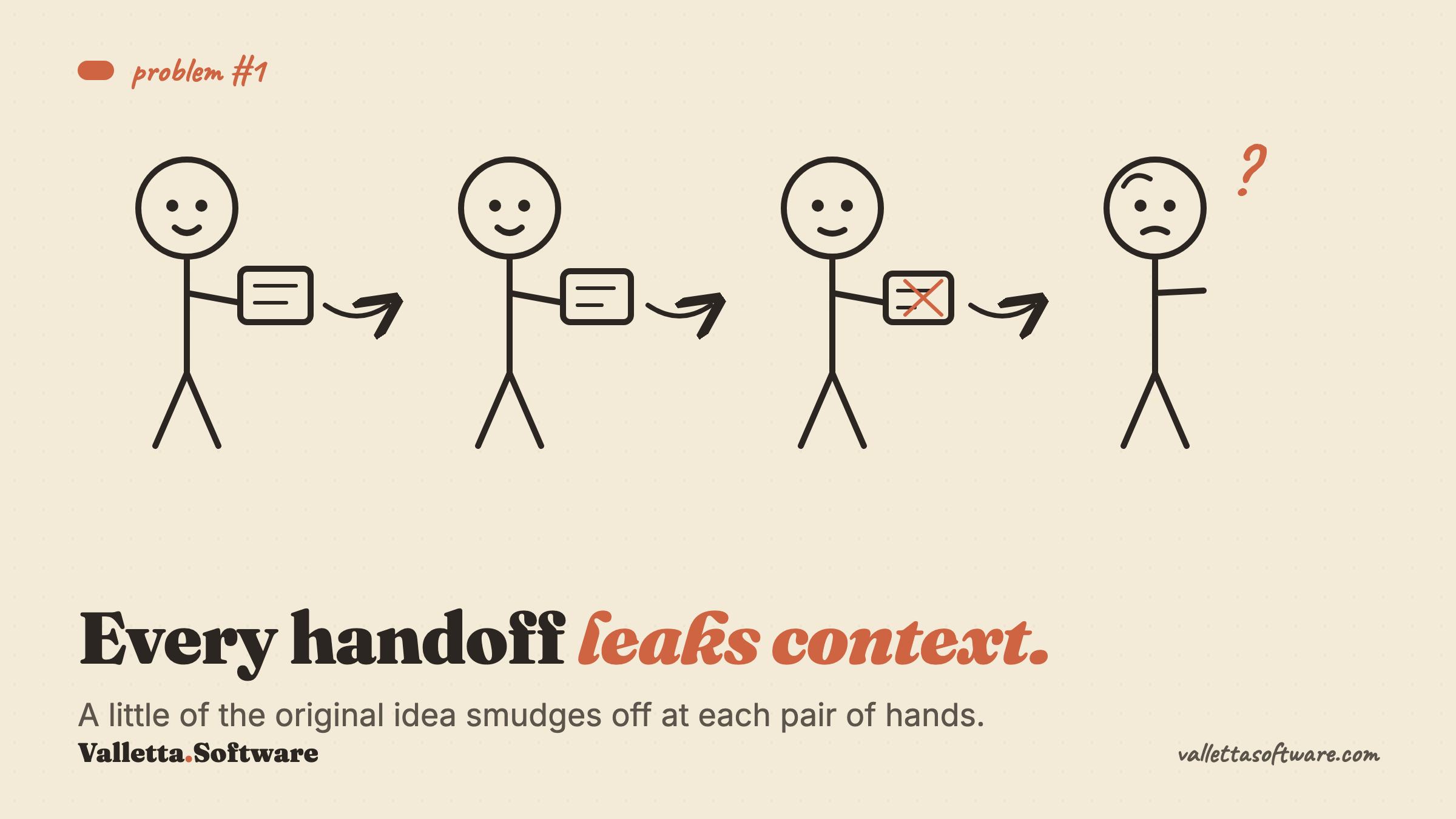
An orchestra developer has almost no one to hand off to. The same person who spoke with the client designs the feature and writes it, so they hold the full context the whole time. Remove the handoffs and several good things follow at once:
- Shorter time to delivery. There is no waiting in the gaps between roles.
- Lower coordination cost. There is almost no one to coordinate with, so the meetings and status updates mostly disappear.
- A single point of accountability. It is always clear who owns the result. No more that was not me, someone else reviewed it wrong.
- More direct decisions. Calls about what is feasible get made on the spot, instead of being bounced back as we cannot do that, I will build it differently.
A small example makes it concrete. A product owner imagines a clean onboarding flow. The designer interprets it and adds a step. The analyst writes a spec that flattens a nuance. The backend developer, missing the original intent, makes a reasonable but different choice. Four well-meaning people, and the shipped feature is a cousin of the idea, not the idea. None of them did anything wrong. The loss happened in the gaps between them. When one person holds the whole feature, those gaps do not exist, so the thing that ships is the thing that was meant.
How is the orchestra developer faster than a team?
The speed does not come only from AI writing code quickly. It comes from collapsing the calendar. While a traditional team is still in the daily standup deciding who does what, the single owner has already shipped. There is no queue, no ticket grooming, and no cross-team dependency to wait on.
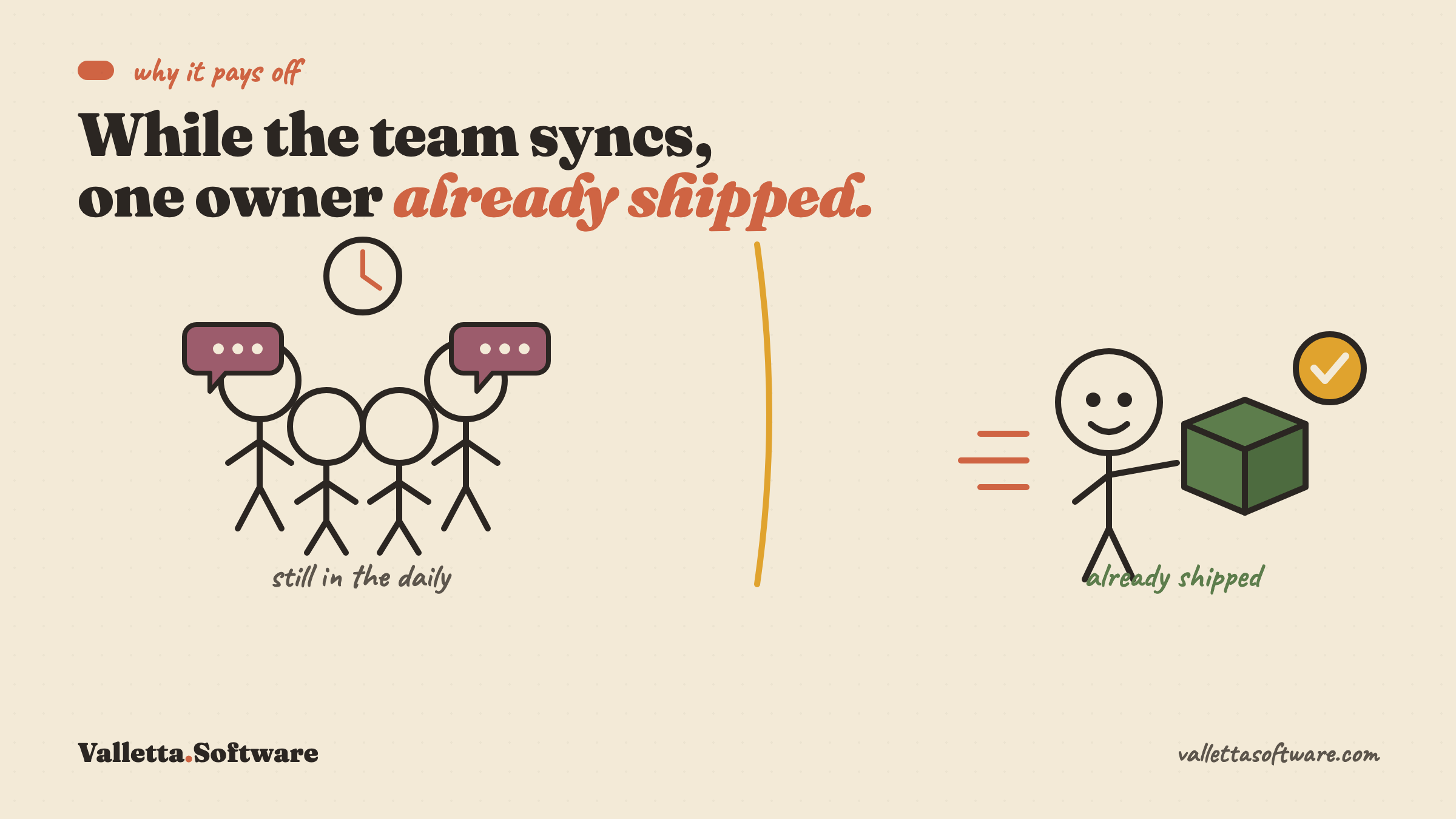
This is also why agentic coding feels different from earlier autocomplete. The developer can spin up several agents, send each one down a different path, and review the results like pull requests. The bottleneck moves from how much can I type to how much can I direct and check. That is a much higher ceiling, and it is exactly why one capable person can now cover ground that used to need a small team. If you want the ground-level view of how the newest models handle this, see our hands-on review of Claude Opus 4.8.
What changes for junior developers?
This is the hardest part of the transition, and it deserves honesty. The traditional on-ramp, where a junior developer learns by writing many small, low-risk functions, is exactly the work agents now absorb. If the entry-level tasks disappear, the path to senior judgment gets steeper.
The way through is to push juniors up the same ladder the role itself is climbing. Instead of measuring them on lines written, give them small features to own end to end, with a senior reviewing the critical paths. Have them read and critique AI output early, so they build the taste to spot when it is wrong. The skill to develop is not raw coding speed, which is now cheap, but the judgment to direct and verify, which is now scarce. A junior who learns to own outcomes and review agents will compound faster than one who only learns to type code an agent could have written.
Is AI-generated code safe for production?
This is the honest part, and it is where most of the hype falls apart. AI often says a piece of code is handled and secure when it is not. It will write a comment that reads fully validated and protected over logic that quietly is not. Worse, there is a false-confidence paradox at work: developers tend to feel more confident while shipping less secure code. Research has found that roughly 40 percent of AI-generated code contains security flaws, and a normal code review often will not catch them.
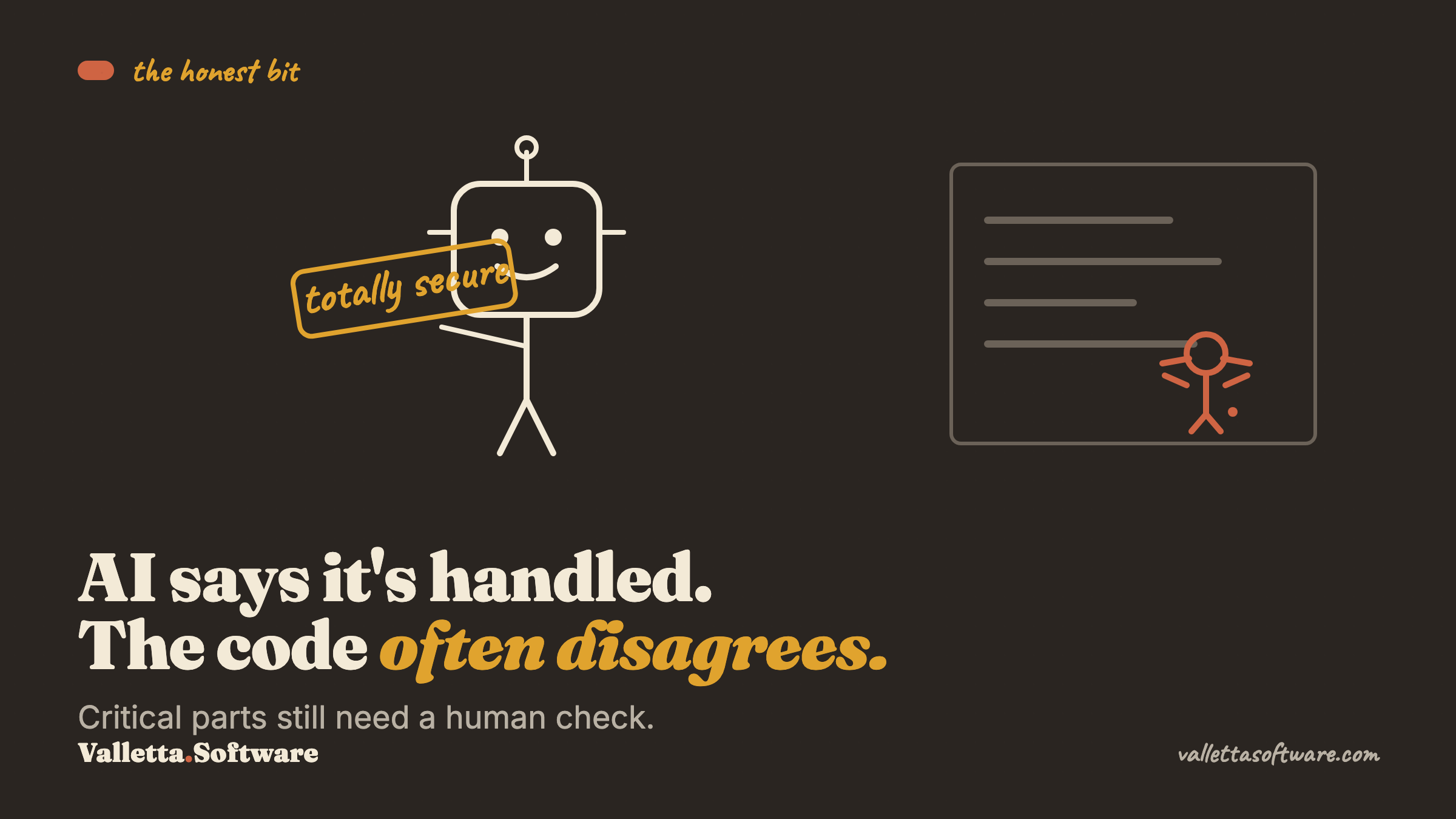
We treat this as a strength of the model, not a thing to hide. The speed of one person only works when the critical paths get an independent human check. Deployment, security, and anything touching personal data should never ride on the AI's own confidence. This is the same lesson we keep relearning when teams push AI-built apps to production. We wrote about it in detail in what vibe coding actually is, the security risks of vibe coding, and how to review a vibe-coded app before it ships.
This is why the skill that gets rewarded is shifting. Writing a function is now the cheap part. The valuable part is knowing what good looks like and seeing the moment the AI is lying to you. Taste, judgment, and disciplined review become the actual work. The Pragmatic Engineer reached a similar conclusion in when AI writes almost all the code: the human's leverage moves up the stack, toward design and verification.
In practice, the review discipline is specific. Before anything reaches production, a human signs off on a short, non-negotiable list:
- Authentication and authorization. Who can reach what, checked by hand, not taken on faith.
- Data handling. Anything touching personal or regulated data gets read line by line.
- Deployment and secrets. Pipelines, credentials, and access scopes reviewed before they go live.
- Edge cases. The unhappy paths the AI loves to skip while it celebrates the happy path.
We have watched a careful review of confident-looking, AI-written code reveal holes the person who shipped it genuinely believed were covered. That is not a knock on the developer. It is the false-confidence paradox doing exactly what it does. The fix is structural: never let the author and the AI be the only reviewers of the parts that can hurt you.
What does this mean for engineering teams and hiring?
If you lead an engineering team, the practical move is not to fire half of it and hope agents fill the gap. It is to restructure around ownership. Fewer, stronger people, each owning features end to end, supported by agents and held to a hard review discipline on the parts that matter. You trade a large group that coordinates a lot for a small group that ships a lot.
The goal is the speed of one with the reliability of a team. You get the time-to-delivery of a single owner, plus the safety net of independent review on the critical paths. For most growing companies, that combination beats both a slow committee and a reckless solo vibe-coder. If you are weighing whether to split a feature across a team or hand it to one AI-augmented owner, that is the conversation worth having, and it is the one we have with engineering leaders every week.
Who is this model for? It fits growing companies best: teams that have raised money, have more work than hands, and need a lot done at once without months of hiring. Many of them do not yet have AI-native generalists in house, because those people are getting scarce and snapped up fast. An embedded orchestra developer, or a small pod of them, lets such a company move at AI speed while keeping the human review that protects the business.
It also changes what you screen for when you hire. You are not looking for the fastest typist or the deepest knowledge of one framework. You are looking for judgment: can this person describe an outcome clearly, direct agents toward it, and reliably catch the moment the output is wrong? Those traits hold up as the tooling keeps improving, which is more than can be said for any single framework on a resume.
Frequently asked questions
Will software engineering die as a career?
No. The title and the day-to-day change, but the demand for people who can turn intent into working, trustworthy software goes up. The work moves from writing code toward owning outcomes, directing agents, and reviewing what they produce.
What is agentic coding?
Agentic coding is using AI agents that can plan, write, test, and revise code across multiple steps, rather than just autocompleting a line. The developer assigns goals, runs several agents in parallel, and reviews their output like pull requests.
Can one developer really replace a five-person team?
For many features, one orchestra developer plus AI agents can match what a small team used to ship, mainly by removing handoffs and wait time. The catch is that critical paths still need an independent human review, so it is replacement of coordination overhead, not of all judgment.
Is vibe coding production ready?
It can be, but only with guardrails. AI-generated code frequently looks finished while hiding security and edge-case flaws, so production use requires human review on deployment, security, and anything touching personal data.
What skills should developers build for the Claude Code era?
System design, clear written specification, security judgment, and code review. The differentiator is no longer typing speed, it is the taste to recognize good work and the discipline to catch when an AI is confidently wrong.
Is the orchestra developer the same as a full-stack developer?
It is broader. A full-stack developer writes both frontend and backend. An orchestra developer owns the whole feature, from the client conversation through design, build, infrastructure, deployment, and the AI agents that help at each step. Ownership and orchestration, not just stack coverage, are the difference.
Does this mean companies need fewer product managers?
The opposite. As each engineer produces more, the constraint moves to deciding what to build. That is why the ratio of product thinkers to engineers is rising, and why many orchestra developers carry product responsibility themselves.