

Toptal Alternatives in 2026: 7 Ways to Hire Vetted Devs

The best Toptal alternatives in 2026 give you what a premium vetted network sometimes does not: clearer pricing, flexible engagement types, and the option to integrate talent directly into your own team. Toptal built its brand on curated, high-end freelancers, and it works well for that. But if you want more transparent rates, month-to-month flexibility, a specific region, or a managed team rather than a single contractor, several strong platforms and agencies now cover those needs. This guide compares seven of them, what each one is, how it works, and when it fits, so you can match the model to your project instead of your project to the model.
Key takeaways
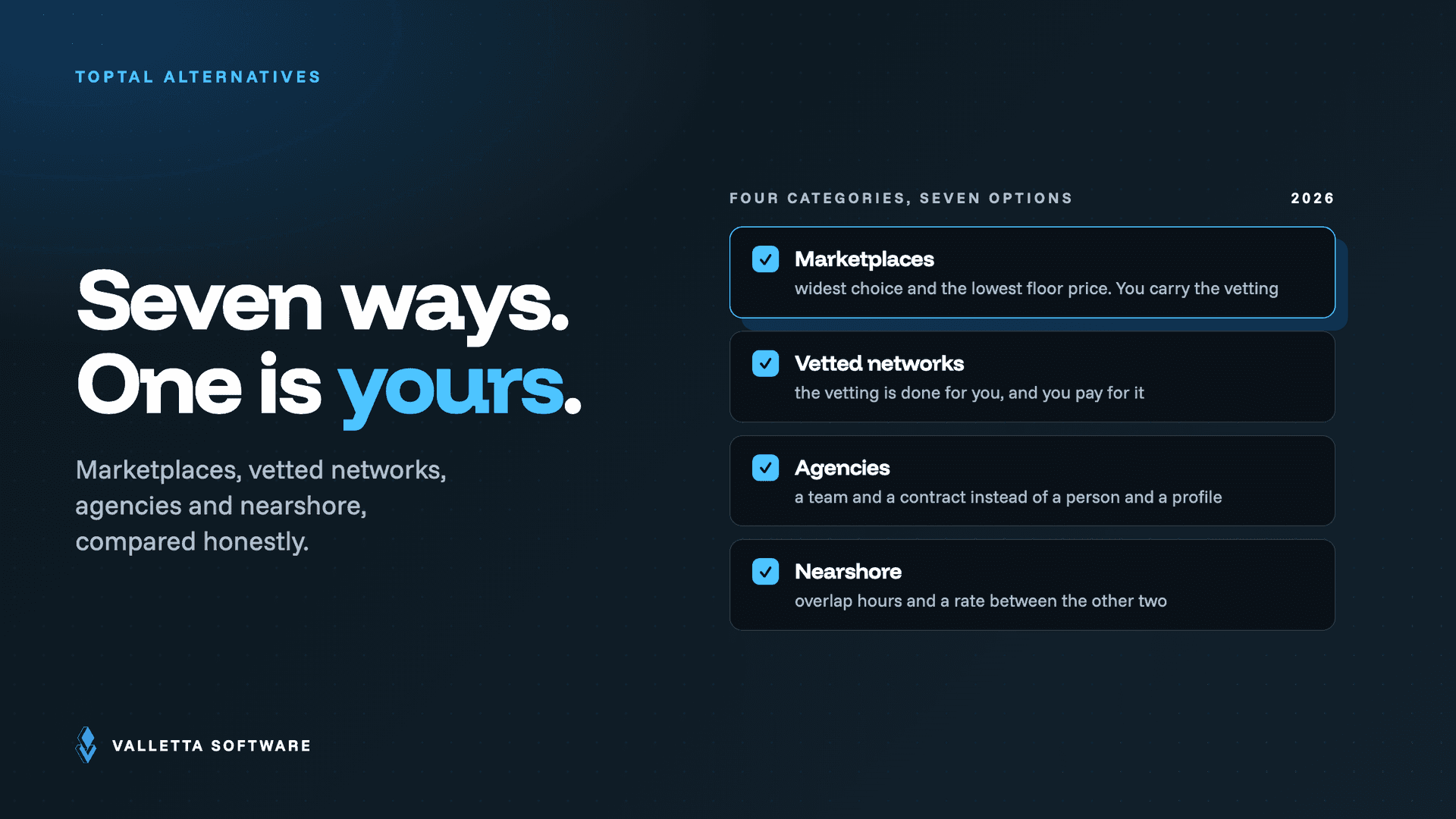
- Toptal alternatives fall into three broad camps: open marketplaces, curated vetted networks, and staff augmentation or nearshore agencies.
- Marketplaces like Upwork give the widest choice and lowest floor price, but you carry the vetting yourself.
- Vetted networks such as Arc.dev, Lemon.io, and Turing pre-screen talent and match fast, at a premium over open marketplaces.
- Agencies and nearshore firms suit teams that want a managed, integrated group rather than a single freelancer to manage.
What to look for in a Toptal alternative
Before comparing platforms, get clear on what you are optimizing for. A few criteria separate a good fit from an expensive mismatch:
- Pricing transparency: can you see rates up front, or do you have to book a call to learn the number.
- Engagement flexibility: hourly, month-to-month, dedicated team, or fixed-scope project, and how easy it is to scale up or stop.
- Vetting model: who screens the talent, how deeply, and whether the burden falls on you or the platform.
- Team integration: a single freelancer you manage, or a managed group that owns delivery and plugs into your workflow.
- Region and timezone: overlap with your working hours, language fit, and data-handling rules that matter for your industry.
No single option wins on all five. A marketplace maximizes choice but pushes vetting onto you; a curated network trades some choice for speed and pre-screening; an agency trades the lowest possible rate for a managed team that owns delivery. The seven options below cover that full spread, grouped loosely from open marketplace to managed agency. Where a figure is a company's own marketing claim, it is attributed as such rather than presented as independent fact.
1. Upwork
What it is: the largest open freelance marketplace, where clients post jobs or browse profiles and freelancers submit proposals. Model: self-service. Standard marketplace vetting is mostly self-reported and reputation-driven through reviews and work history, so the screening burden sits with you. Upwork also runs an Expert-Vetted program that it describes as highlighting the top 1% of talent in select categories, and it charges clients a marketplace fee (up to 7.99% per payment, per Upwork's own terms). Scale: Upwork reports millions of freelancers and businesses across more than 180 countries, so choice is effectively unlimited. When it fits: you want the widest possible choice, a low floor price, and you are comfortable running your own screening. When it does not: you want pre-vetted senior talent without doing the filtering yourself, or you want a single accountable partner rather than a pool of individuals.
2. Arc.dev
What it is: a curated network for hiring remote developers, both freelance and full-time. Model: Arc.dev pre-screens talent through profile review, a communication check, and a technical interview or pair-programming session, and markets access to what it calls the top 2% of applicants (Arc's own claim). It matches you with vetted candidates and offers a trial period. When it fits: you want vetted remote developers faster than running your own funnel, with the option to convert freelance to full-time. When it does not: you want a fully managed team rather than individual hires you still direct.
3. Lemon.io
What it is: a boutique talent marketplace focused on matching startups with vetted developers, drawing largely from Eastern Europe, the EU, and Latin America. Model: Lemon.io runs a multi-step vetting process (communication, technical assessment, and background checks) with month-to-month engagements, so you can start and stop as needs change. Developers join free and Lemon.io adds a margin on the developer rate. When it fits: a startup that needs a vetted engineer quickly, on flexible terms, without a long commitment. When it does not: you need a large multi-role team or deep enterprise compliance support.
4. Turing
What it is: a global, AI-matched talent platform. Turing says it draws from a network of more than three million developers across 150-plus countries (Turing's own figures) and uses machine-learning signals plus multi-hour technical testing to vet and match. Model: AI-driven matching into individual roles or embedded pods, with matches often proposed within days and technical testing that runs several hours per candidate. When it fits: you want a very large global talent pool and fast, data-driven matching for hard-to-fill roles. When it does not: you prefer a smaller, regionally concentrated team with heavy timezone overlap and a single accountable partner.
5. Andela
What it is: a global talent marketplace connecting companies with vetted engineers, data scientists, and AI specialists, drawn largely from emerging markets across Africa, Latin America, Eastern Europe, and South Asia. Model: with Andela you post a role, receive AI-matched profiles, review assessments, interview through the platform, and engage a contractor, typically for longer-term engagements. When it fits: enterprises that want a compliant, platform-managed way to hire distributed talent across many jurisdictions. When it does not: you want a short, lightweight engagement or a single tightly integrated regional team.
6. BairesDev
What it is: a large nearshore software development and staff augmentation firm, US-headquartered with engineers across Latin America. Model: BairesDev offers staff augmentation, dedicated teams, and end-to-end outsourcing, and markets access to what it calls the top 1% of LATAM tech talent (BairesDev's own claim). Nearshore delivery gives US clients real-time working-hour overlap. When it fits: a US company that wants nearshore timezone alignment and the ability to scale a team quickly. When it does not: you need European timezone overlap or a smaller, senior-only boutique partner.
7. Valletta Software
What it is: an EU-based custom software agency that provides vetted senior engineers as staff augmentation, dedicated teams, or fixed-scope project builds. Model: the agency model rather than a self-service marketplace. You get senior EU engineers as a team on demand, with AI-empowered delivery where engineers use modern AI tooling for speed while senior humans stay accountable for architecture, security, and correctness. Engagements integrate directly into your workflow, and the team can own a roadmap rather than just fill a seat. Valletta is EU-based, which means strong European timezone overlap, workable hours for much of the US East Coast, and GDPR-aware data handling. When it fits: you want a managed, senior team that plugs into your product and owns outcomes, not a freelancer you manage yourself. See how the engagement works for a specific role in our guides to hiring backend developers and hiring AI developers. When it does not: you only need a few hours of ad hoc freelance work or the absolute lowest possible rate. If a managed EU team fits, tell us what you are building on the Valletta Software contact page.
Frequently asked questions
Is Toptal worth it?
Toptal is a solid choice when you want a curated, pre-vetted senior freelancer fast and are comfortable paying a premium. It markets itself on accepting the top 3% of applicants (Toptal's own claim) and offers a trial period. It is less ideal if you want transparent up-front pricing, a fully managed team, or a specific region and budget, which is exactly where the alternatives in this list differ. Whether it is worth it depends on which of those you value most.
What is cheaper than Toptal?
Open marketplaces like Upwork usually have the lowest floor price because you can hire across the full range of experience levels and do the screening yourself. Vetted networks and nearshore firms sit in the middle, and premium curated networks sit at the top. Remember that the cheapest hourly rate is not always the lowest total cost: rework, missed deadlines, and turnover can make a low headline rate expensive.
How do agencies differ from talent marketplaces?
A talent marketplace connects you with individual freelancers whom you screen (or who a platform pre-vets) and then manage yourself. An agency like Valletta Software supplies a managed team: senior engineers, often a lead, and shared accountability for delivery, integrated into your workflow. Marketplaces maximize flexibility and choice; agencies reduce management overhead and own outcomes. The right pick depends on whether you want more hands or more delivery ownership.
How do I choose the right Toptal alternative?
Start from your constraints: budget, how defined the scope is, the region and timezone you need, and how much management you can take on. If you want the widest choice and lowest floor, use a marketplace. If you want vetted individuals fast, use a curated network. If you want a senior team that owns delivery, use an agency or nearshore firm. Match the engagement model to the job, then compare two or three options that fit that model.