

Forward Deployed Engineer vs Software Engineer
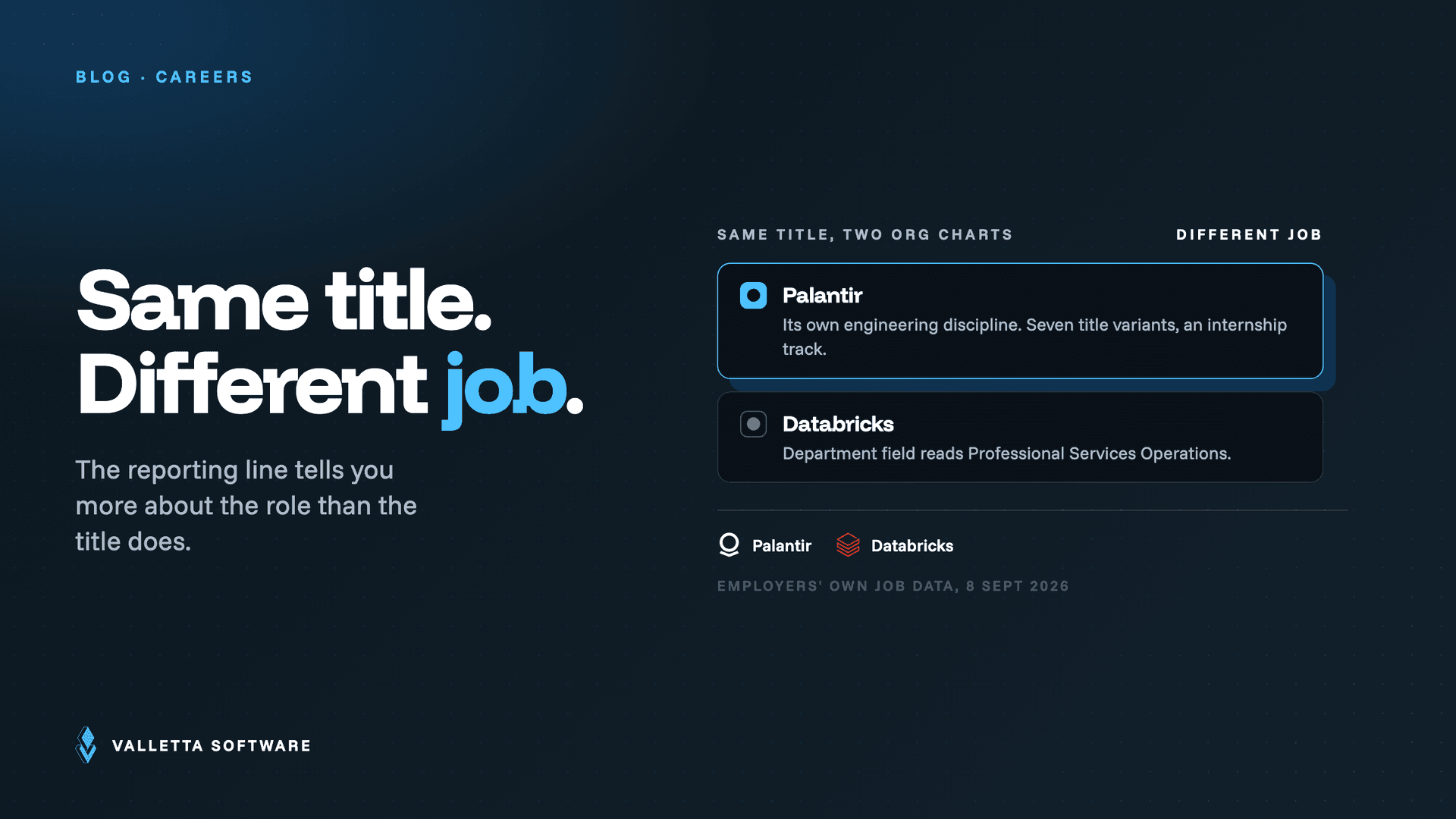

The difference between a forward deployed engineer vs software engineer comes down to one question: what has to be true before the work is finished. A software engineer is done when the feature merges and ships to everyone. A forward deployed engineer is done when one named customer's team depends on the system in production and the vendor's product changed as a result. Everything else, the travel, the customer meetings, the messy environments, follows from that difference.
Key takeaways
- The definition of done is the real boundary. Merged, accepted, closed and depended-on are four different finish lines, and they belong to four different jobs.
- An FDE writes production code in the customer's environment. A solutions engineer builds prototypes and designs across many accounts. A sales engineer supports a quota. A consultant delivers against a statement of work.
- Check the reporting line, not the title. The identical job title reports into engineering at Palantir and into Professional Services Operations at Databricks, and that changes the job more than the title does.
- The obligation that separates an FDE from a consultant is pushing custom work back into the product. Without a named owner for it, the distinction is branding.
- The title genuinely is abused. Some postings labelled forward deployed engineer are presales roles with a rebrand, which is why engineers on forums keep asking whether this is consulting with better marketing.
- Neither role is a promotion over the other. They select for different people, and the mismatch, not the difficulty, is what makes people quit in year one.
Published September 8, 2026. Organisational placements cited here were read from the employers' own live job data on 8 September 2026. The comparison itself is drawn from running embedded engagements, not from any single company's definition of the roles.
The five roles side by side
Most comparison pages stop at two. In practice the confusion is five-way, because the adjacent titles overlap with each other as much as they do with forward deployment.
Read the "done means" column top to bottom and the fog clears. Four of those five finish lines are about the vendor's internal state or a commercial event. Only one of them requires that somebody else's team is still using the thing next month.
FDE vs software engineer: the honest comparison
This is the pairing people actually search for, so it is worth doing properly rather than in a table row.
The code is similar. The context is not. A forward deployed engineer writes the same kind of software: services, pipelines, interfaces, integrations. What changes is that they write it without a clean staging environment, against data they have never seen, inside a network where they are a guest and a security team has to approve their access. The engineering is not easier. It is less controlled.
The feedback loop is shorter and louder. A product engineer might wait a quarter to learn whether a feature mattered. An FDE finds out at the next standup with the operators, because those are the people using it. Some engineers find that energising and some find it exhausting, and there is no correct answer.
A large share of the week is not code. This is the part that surprises people who move across. Explaining constraints, negotiating access, and sitting with people whose jobs are changing takes a substantial slice of the time. If the reason you became an engineer was to be left alone with a hard problem, forward deployment will feel like a demotion no matter what it pays.
Career risk runs in both directions. The worry engineers raise most often is that customer-specific work does not compound into a portfolio the way product work does. That is fair when the fourth step is missing. Where an FDE genuinely does push patterns into the core product, they end up with unusually broad system knowledge and a track record of shipping under real constraints, which is not a weak position.
FDE vs solutions engineer
These two get conflated more than any other pair, and the confusion is understandable because at some companies they are genuinely the same job with different letterhead.
The clean separation is production ownership. A solutions engineer or solutions architect designs, prototypes and advises across many accounts, and hands the design to someone else to build. A forward deployed engineer builds it, ships it into the customer's production environment, and is on the hook when it breaks at 2am. If the role you are looking at never touches production, it is a solutions role regardless of the title.
The second separation is account count. Solutions roles are spread across a portfolio, often supporting sales. Forward deployment is deep on one to three customers, because the value comes from domain knowledge that only accumulates with time in one context. A "forward deployed engineer" covering fifteen accounts is a solutions engineer.
Where the boundary genuinely blurs
The comparison above is cleaner than reality, and pretending otherwise is why so many of these articles are useless. Three real ambiguities:
The reporting line decides more than the title. We checked the live job data at two large employers on the same day. At Palantir, forward deployment is its own engineering discipline with seven title variants and an internship track feeding it. At Databricks, every forward deployed posting sits in a department the company's own data labels Professional Services Operations. Same title, same industry, materially different job: one is structurally positioned to change the product, the other has to persuade a product team that owes it nothing.
Small companies collapse the roles. At a fifty-person startup one person is the sales engineer, the solutions architect and the FDE, and the title is whatever was convenient when the job was posted. That is not dishonest, it is just what small teams look like, and the comparison table does not apply.
The AI wave scrambled the vocabulary. Titles like AI solutions engineer, applied AI architect and forward deployed AI engineer arrived faster than any shared definition of them. Anthropic, for instance, runs forward deployed engineers alongside applied AI architects and technical evangelists, which reads like an organisation still working out where the boundaries go. That is a normal stage, and it means you have to ask rather than infer.
Why the title gets abused
Ask on any engineering forum whether forward deployed engineer is a real discipline and you will get a thread arguing that it is presales with a rebrand. That criticism is wrong about the discipline and frequently right about a specific posting.
The rebrand is tempting because the title recruits better. "Forward deployed engineer" attracts engineers who would not open a listing for a sales engineer or an implementation consultant, and it carries the prestige of the companies that pioneered it. A company that wants presales headcount and cannot fill it has an obvious incentive.
Two questions separate the real thing from the rebrand, and both can be asked in a first screen. Who owns turning custom work into product features, by name? And does this role have write access to production in the customer's environment? A rebranded presales role fails both. We go deeper into that test in our breakdown of the forward deployed model, and into what a posting should say in the job description template.
Which one should you take?
Not a question of level. These roles select for different temperaments, and the failures we see are almost always mismatches rather than capability gaps.
Take the product engineering role if you want depth in one system, a stable codebase, long uninterrupted stretches, and colleagues who share your vocabulary.
Take the forward deployed role if you like shipping things people use on Monday, you would rather see the operator's face than a dashboard, and you can tolerate being the only engineer in a room full of people who are not.
On pay, the advertised bands currently favour forward deployment at the AI labs and not at the platform vendors, which is a reversal of the usual pattern. We collected the live numbers in the salary breakdown, and the picture of who is hiring at what volume is in who is hiring forward deployed engineers. For the role itself, start with what a forward deployed engineer is.
FAQ
What is the difference between FDE and SWE?
A software engineer works in the vendor's codebase and is finished when the feature merges and ships to every customer. A forward deployed engineer works inside one customer's environment and is finished when that customer's team relies on the system in production. The FDE also carries a second obligation a normal SWE does not: identifying which custom work should become a standard product feature and getting it there.
Is a forward deployed engineer a real software engineering role?
At companies that run the model properly, yes. The person writes and ships production code, owns architecture decisions and is on call for what they built. At companies that adopted the title for recruiting reasons, the role can be presales or implementation consulting with a rename. The test is whether the role has production access and a named owner for pushing work upstream.
Is forward deployed engineer better than solutions engineer?
Neither is better. A solutions engineer covers many accounts, works close to sales and hands designs over. A forward deployed engineer goes deep on a few accounts and owns what runs in production. If you want breadth and commercial exposure, solutions. If you want depth and ownership, forward deployment.
Can a software engineer become a forward deployed engineer?
Yes, and it is one of the more accessible lateral moves in engineering because the scarce skill is not algorithmic depth. What gets tested is full-stack range, shipping under ambiguity inside someone else's system, and being able to talk to non-engineers without either condescending or capitulating. The usual blocker is temperament rather than technical background.
Do forward deployed engineers write less code than software engineers?
Usually yes, measured in hours. A meaningful share of the week goes to customer context, access negotiation and explanation. The code that does get written tends to span more of the stack and run in a harder environment, so the reduction is in volume rather than in difficulty.
Does a forward deployed engineer carry a sales quota?
No. That is one of the cleaner tests against a rebranded presales role. Sales engineers carry a quota or a portion of one; forward deployed engineers are measured on delivery and adoption. If the compensation plan includes a commission component, the posting is describing a different job than the title suggests.