

Forward Deployed Engineer Salary in 2026
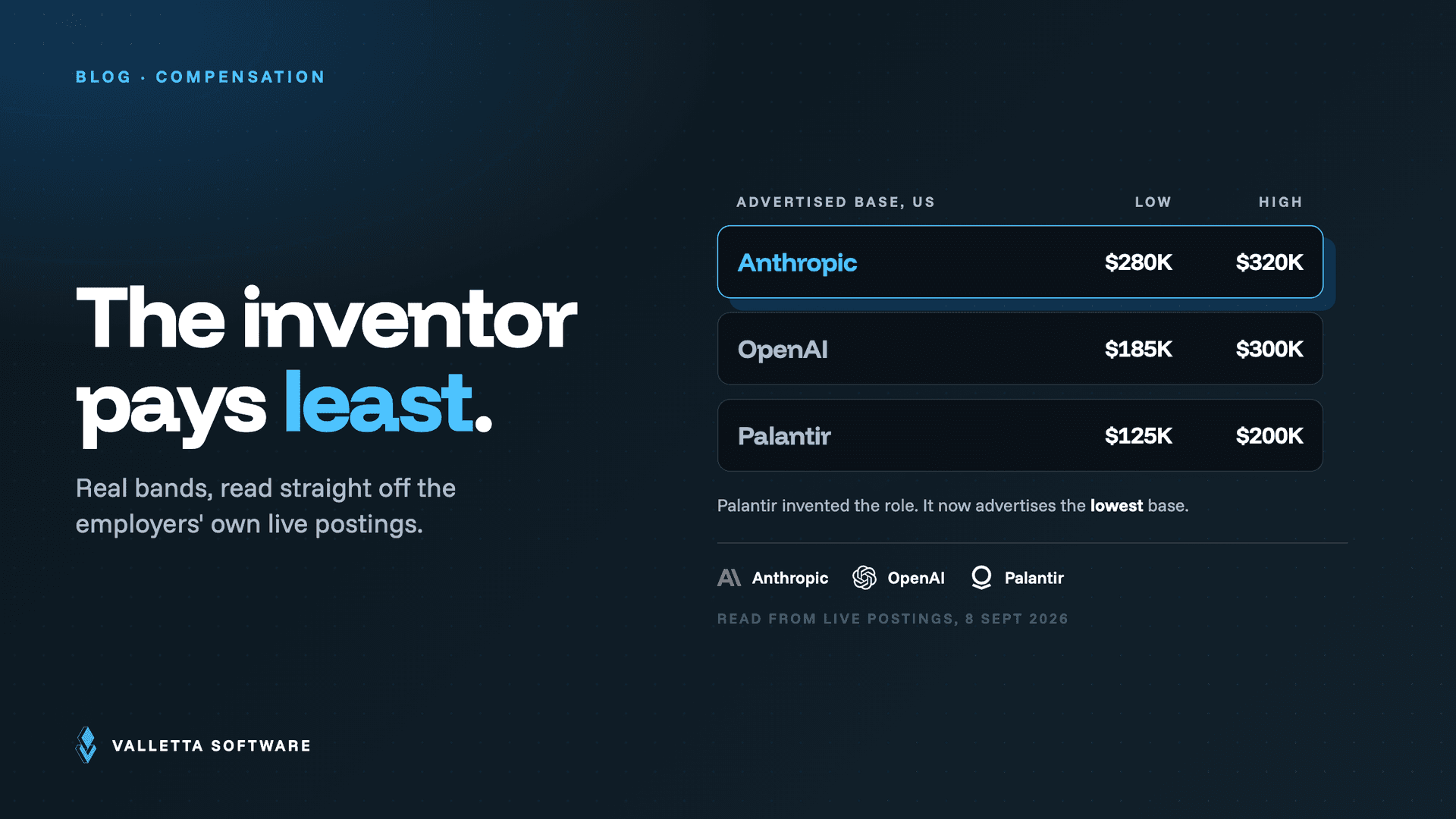

A forward deployed engineer salary in 2026 runs from about $90,000 to $320,000 in base pay in the United States, and the spread is not what most people expect: Palantir invented the role and now advertises the lowest base bands of the major employers, while Anthropic advertises the highest. Every number below was read directly from the employer's own live job posting on 8 September 2026, not from a salary aggregator.
Key takeaways
- The frontier labs do publish their bands. Anthropic lists $280,000 to $320,000 and OpenAI lists $185K to $300K plus equity. US pay transparency law makes this public, so there is no need to rely on self-reported estimates.
- Palantir, which created the role, advertises forward deployed software engineer at $125,000 to $200,000 base. That is roughly half Anthropic's top of band.
- Compare base to base or the comparison is meaningless. OpenAI's range is base plus equity on top. Anthropic's is listed as annual salary. Palantir's public total-comp medians are higher than its base bands because equity and bonus sit outside them.
- Government-facing work pays less than commercial. OpenAI's own Gov role is $145,800 to $280,000 against $185K to $300K for the commercial one.
- There is no single FDE salary. Inside Palantir alone the forward deployed titles span $90,000 to $200,000 depending on whether you are on the security, enablement, infrastructure or software track.
- Bands move. These were captured on one day, and a posting that closes takes its number with it, so treat any figure older than a quarter as a direction rather than a price.
Published September 8, 2026. Method: every band below was read from the employer's own live posting or public job-board feed on 8 September 2026, at Anthropic careers, OpenAI careers and Palantir careers. Where a company does not publish a band for a location, this page says so instead of estimating one. No figure here comes from a salary aggregator. We link the careers sites rather than individual listings because listings expire. This is a single collection window with no seasonality control, and a band is only what one employer advertised on one day, so treat the table as a set of verifiable data points rather than a market average.
What forward deployed engineers actually earn
These are advertised base ranges, taken from live postings on one day. US pay transparency laws in New York, Washington, California and Colorado are why they exist at all: a company hiring into those states has to publish a range.
One line was deliberately left out of that table. Palantir also runs a "Year at Palantir" forward deployed software engineer internship advertised at $5,900 to $10,500 per month. Annualising it would put a misleading number next to the salaried roles, and several salary pages covering this role appear to have made exactly that mistake.
Palantir invented the role and now pays the least for it
This is the finding that surprised us. Palantir has run forward deployment since around 2010, has the deepest bench in the discipline, and treats it as a core engineering track rather than a services function. Its advertised base for a forward deployed software engineer tops out at $200,000. Anthropic's forward deployed engineer band starts at $280,000.
Two things explain most of the gap, and neither is that Palantir undervalues the work.
Equity is doing different jobs. Palantir is a public company with a long-established compensation structure, and its stock grants sit outside the advertised base. Self-reported total-compensation data for Palantir forward deployed software engineers has historically landed well above the base band once equity and bonus are counted. The frontier labs are competing for a smaller pool with cash, because their equity is harder for a candidate to value.
Scarcity is priced differently. Palantir has been hiring this profile for fifteen years and has a pipeline, an internship track and an internal ladder feeding it. Anthropic and OpenAI started building these teams recently and are buying people who already know how to do the job, which is a much smaller market.
The practical consequence for a candidate is that a Palantir offer and an Anthropic offer are not comparable on the advertised numbers alone, in either direction. You have to price the equity yourself, and at a private lab that means forming a view on a valuation you cannot verify.
The spread inside one company is wider than the spread between companies
"Forward deployed engineer salary" implies a single number. Palantir's own postings show a family of tracks that pay quite differently:
$90,000 to $150,000 for forward deployed security engineer. $110,000 to $147,000 for enablement engineer, which sits closer to customer success. $125,000 to $200,000 for the core software engineer track. $135,000 to $200,000 for infrastructure and AI engineering.
The bottom of the security band and the top of the AI band differ by a factor of more than two, inside one company, under titles that all begin with the same two words. Anyone quoting an average across this family is averaging jobs that are not the same job.
The same pattern shows up between missions rather than tracks. OpenAI's government-facing forward deployed role advertises $145,800 to $280,000 while its commercial equivalent advertises $185,000 to $300,000. Government work usually carries clearance requirements, more onsite time and less flexibility, and it is still paid less. That is worth knowing before you take the interview, not after.
What the aggregator numbers get wrong
Most pages ranking for this query are built on self-reported submissions to salary aggregators. That data is useful for a company like Palantir where the title has existed long enough to accumulate a large sample over many years. It is close to useless for the frontier labs, where the role is new, the sample is small, and the equity component that dominates the package cannot be valued consistently by the people reporting it.
Three specific failure modes to watch for when reading any FDE salary page, including the ones that outrank this one:
Base and total compensation quoted in the same table. An employer band is usually base. An aggregator median is usually total. Putting them side by side makes the employer look stingy and the aggregator look authoritative, and neither conclusion follows.
Internship and new-grad rates folded into the average. Palantir's forward deployed new-grad infrastructure posting advertises $135,000 to $145,000, and the internship is monthly. Both are real numbers and neither belongs in a headline figure for the role.
Stale deep links. Job postings and aggregator pages move constantly. We found this the hard way: a salary URL we had cited on three of our own pages had 404ed by the time we came back to it, which is one reason this page cites the employer's careers site rather than a specific listing that will expire.
How to read a forward deployed engineer offer
Four questions decide what the number actually means.
Is the range base or on-target earnings? Anthropic's posting spells out that for sales roles the range is OTE including commission, and for others it is salary. If a range looks unusually wide, that is often why.
What fraction of the package is equity, and can you value it? At a public company you can. At a private lab you are accepting a number somebody else assigned to an illiquid asset. Price it at a discount, decide the discount before you see the offer, and do not let a headline total-comp figure do that work for you.
Which track is this, really? Ask whether the role sits in engineering or in professional services. That single fact predicts the band, the ladder and whether you get to influence the product. We explain why it matters in our breakdown of the forward deployed model.
How much travel, and is it in the posting? Travel is the most common cause of first-year attrition in this role and the least likely thing to be quantified in the advert. If it is missing, ask, because compensation that looks generous on paper reads differently at 40% travel. We put the honest version of this in the job description template we use.
If you are on the hiring side rather than the candidate side, the same numbers set your band. Our guide to what a forward deployed engineer is covers what the role is supposed to deliver, and who is hiring them right now shows how much competition you are pricing against.
FAQ
How much does a forward deployed engineer make?
In the United States, advertised base pay ranges from roughly $90,000 at the bottom of Palantir's forward deployed security engineer band to $320,000 at the top of Anthropic's forward deployed engineer band, as of September 2026. Most core engineering postings at the major employers sit between $125,000 and $300,000 base, with equity on top at every one of them.
Do OpenAI and Anthropic publish forward deployed engineer salaries?
Yes. Both publish ranges on their US postings, because pay transparency law in states including New York, Washington and California requires it. Anthropic lists $280,000 to $320,000 for its forward deployed engineer role in New York, San Francisco and Seattle. OpenAI lists $185,000 to $300,000 plus equity for its commercial FDE roles. European postings from the same companies generally carry no published band.
What is the Palantir forward deployed software engineer salary?
Palantir advertises $125,000 to $200,000 base for forward deployed software engineer on the US postings that carry a band, which was 21 of 52 such postings when we checked. Equity and bonus sit outside that range, so reported total compensation runs meaningfully higher than the base band suggests.
Why do forward deployed engineers get paid more than other engineers?
Where they do, the premium is compensating for customer exposure and travel rather than a higher engineering bar. The role requires someone who can ship production code and spend half the week with people who do not write any, and that combination is scarce. It is not universally true: Palantir's enablement and security tracks pay below what a strong product engineer would earn elsewhere.
Is a forward deployed engineer salary higher at a startup or a big company?
On advertised base, the AI labs currently pay more than the established platform vendors, which is the opposite of the usual pattern. The catch is that the labs concentrate the difference in equity you cannot easily value or sell, while a public company's stock is worth what the market says today. Which is better depends entirely on your view of the private valuation, and nobody can hand you that view.
How current are these numbers?
They were read from live postings on 8 September 2026. Job adverts close and bands are revised, so treat anything here that is more than a quarter old as a direction rather than a price, and check the employer's careers page for the figure that applies on the day you are negotiating.