

Forward Deployed Engineer Jobs: Who Is Really Hiring
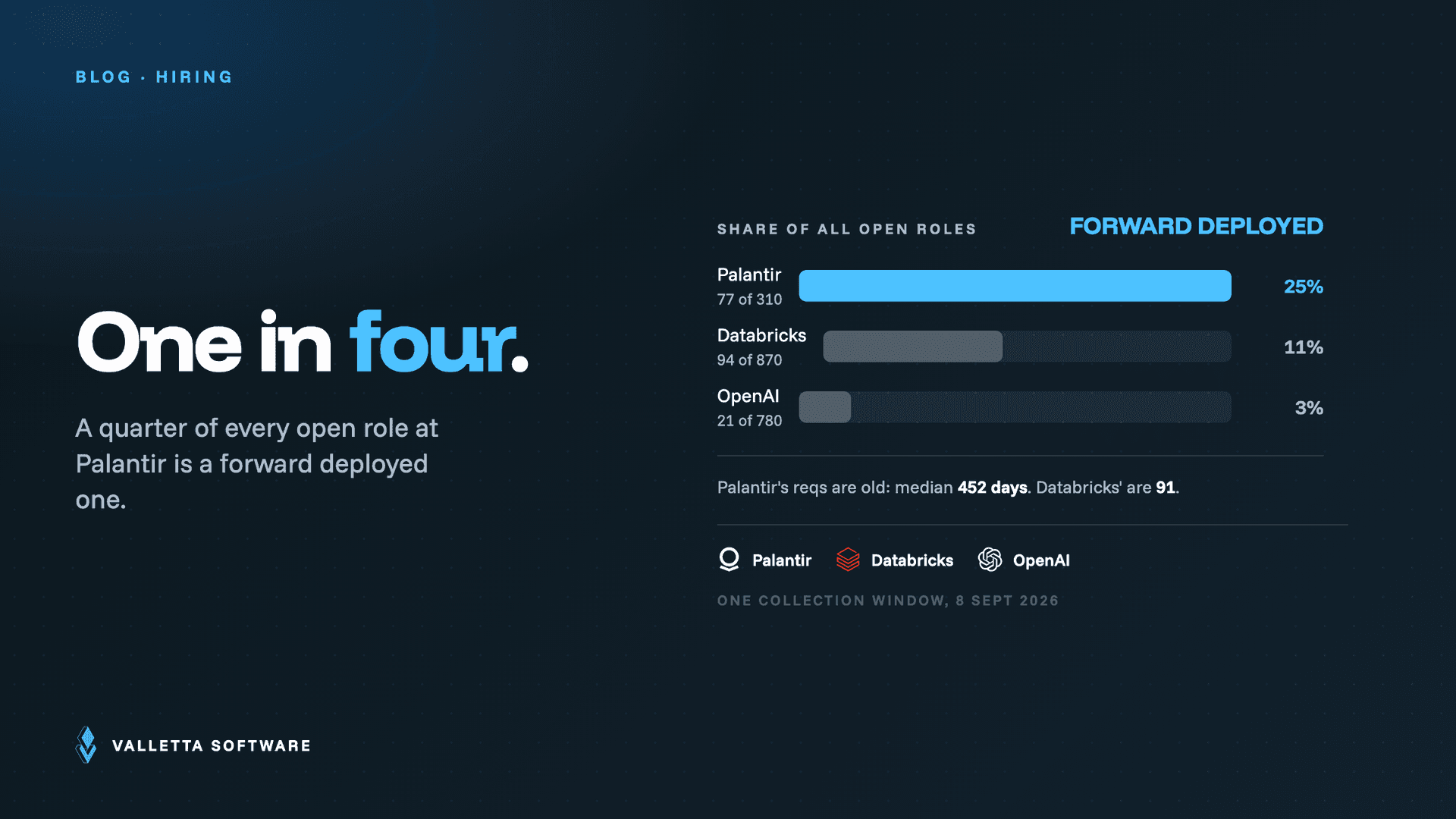

Forward deployed engineer jobs are concentrated in a much smaller set of companies than the hype suggests. When we counted live postings on 8 September 2026, a quarter of every open role at Palantir was a forward deployed one, 77 of 310, and at Databricks it was 94 of 870. But a count of open postings is a stock, not a flow, so we also checked how old each requisition was. That second number changes the story: Palantir's forward deployed reqs have a median age of 452 days, while Databricks' sit at 91. One company keeps standing pipelines open, the other is actively ramping.
Key takeaways
- Palantir is the most concentrated employer. 77 of its 310 open roles were forward deployed, about one in four. No other company in this survey comes close as a share of hiring.
- Read those reqs as a pipeline, not a hiring burst. 72% of Palantir's open forward deployed postings are older than six months and only four were opened in the last thirty days. The oldest carries a creation date of December 2009.
- Databricks posts the largest absolute number, 94 roles, they are far fresher (median 91 days), and they sit in a department the company itself labels Professional Services Operations.
- Read the org, not the title. The same job title reports into engineering at one company and services at another, and that single fact decides whether you can change the product or only the deployment.
- OpenAI has gone furthest on specialisation: a named Forward Deployed Engineering team with separate Healthcare, Legal and Government tracks.
- The title has fragmented. Palantir alone advertises software, infrastructure, AI, enablement, reliability, security and site reliability variants of forward deployed engineer.
- Europe is real but thin. Anthropic posts in Munich and Paris, Databricks in Berlin, Munich, Amsterdam and London, and almost none of those carry a published salary band.
Published September 8, 2026. Counts come from each employer's own live careers listing or public job-board feed, read on 8 September 2026: Palantir, Databricks, OpenAI and Anthropic. We also pulled the creation date on every posting, so the age analysis below comes from the same pass. Postings open and close daily: this is one collection window, and the section on what the data cannot tell you sets out the limits.
Who is hiring, by the numbers
Read the last two columns together and the picture is clearer than any headcount number. Palantir treats forward deployment as a way to build software. Databricks treats it as a way to deliver services. Both are legitimate, they are not the same job, and the job title does not tell you which one you are applying to.
Are these jobs real, or just old postings?
A list of open postings is a stock. It tells you what has accumulated, not what is happening now, and the two can point in opposite directions. A company that leaves standing requisitions open for years will look like it is hiring furiously when it is running a permanent application funnel. So we pulled the creation date on every posting.
Two things fall out of that table, and they pull in different directions.
Palantir's postings are a pipeline. 72% are older than six months and the oldest carries a creation date of December 2009. No company is still trying to fill a specific role from 2009. These are evergreen requisitions that collect applications continuously, which is a sensible way to hire a high-volume profile and a misleading thing to count as demand.
The headline share survives the check anyway. This is the part we expected to fall over and it did not. If you throw away everything older than 90 days and look only at recently opened requisitions, forward deployed roles are still 22% of what Palantir opened and 11% of what Databricks opened, almost exactly their share of all open postings. The concentration is real. It is just not a September spike.
Anthropic is the cleanest signal of the three because the team is new: a median age of 26 days, and four of its six forward deployed postings opened within the last month. That is a team being built right now rather than one being topped up.
Is the role still growing?
Job feeds cannot answer this, for a reason worth understanding: they expose only currently-open postings. Every role that was opened and then filled has vanished from the data, so a month-by-month history rebuilt from them is survivorship-biased and would show a fake surge, with older months looking empty purely because those postings have since closed. We built that series and are deliberately not publishing it.
Search demand does answer it, and the shape is clear. US monthly search volume for "forward deployed engineer" ran at roughly 280 to 450 through mid-2025. In July 2025 it jumped to 3,781 in a single month. It reached about 17,000 by September 2026, a rise of roughly sixtyfold in two years.
The more useful part is what happened recently. Volume peaked near 19,500 in May 2026 and has since settled between 15,800 and 17,100 for four straight months. The explosive phase is over and the term has levelled off at a high plateau, which is what an established job title looks like rather than a fad. For anyone deciding whether to build a career on this title, a plateau at sixty times the old baseline is a better signal than the spike was.
One footnote for anyone checking our numbers against a keyword tool: the widely quoted 9,600 a month for this term is a trailing twelve-month average, which includes the lower months. Current monthly demand is closer to 17,000.
Palantir
Palantir invented the practice and still runs the deepest version of it. Its titles are the most fragmented of any employer we looked at, which is what a discipline looks like after fifteen years of specialisation rather than a job title someone adopted last year.
The families it was advertising: forward deployed software engineer, by far the largest at 52 postings; forward deployed infrastructure engineer; forward deployed AI engineer; forward deployed enablement engineer, which sits closer to customer success; forward deployed reliability engineer; forward deployed security engineer; forward deployed site reliability engineer. It also runs a "Year at Palantir" internship on the forward deployed track, which is the clearest signal that this is a career ladder and not a staffing category.
Locations skew to Washington DC, New York and London, with a long international tail including Seoul, Amsterdam and Dubai. The government work is a large share, and it carries the clearance and onsite requirements you would expect.
Databricks
Databricks posts the largest absolute number of these roles of any company we counted, 94, and the interesting detail is structural. Every one of them sits in a department the company's own job data labels Professional Services Operations, grouped under a careers category called Forward Deployed Engineering.
That placement is the thing to notice. An engineer in a services org is measured on delivery to the customer in front of them. Getting a piece of custom work promoted into the product means persuading a product team that has its own roadmap and no obligation to you. It can be done, and at a company with a strong feedback culture it is done routinely, but the reporting line is working against it rather than for it.
Databricks also runs management structure on top of the discipline, with manager and lead engagement manager roles for forward deployed engineering across Tokyo, Amsterdam, Sydney, Singapore and the US. A vendor does not build that layer for a handful of people.
OpenAI
OpenAI has the most specialised version of the role. It runs a named Forward Deployed Engineering team, and rather than posting one generic FDE role it splits by vertical: healthcare in New York, Seattle and San Francisco, legal in New York and San Francisco, and a separate OpenAI for Gov track in Washington DC. There are also international postings in Seoul and Singapore.
Splitting by vertical this early says something about where the difficulty actually sits. If the hard part were the model, one team could serve every industry. Splitting into healthcare and legal means the binding constraint is domain knowledge, regulation and data access, which is the argument we make at length in our breakdown of the forward deployed model.
The government role is also the lowest paid of OpenAI's forward deployed postings, at $145,800 to $280,000 against $185,000 to $300,000 for the commercial equivalent.
Anthropic
Anthropic runs the smallest forward deployed footprint of the four and pays the most for it. Three engineer postings when we checked: one covering New York, San Francisco and Seattle, plus Munich and Paris. The US role advertises $280,000 to $320,000, the highest band we found anywhere for this title. Counting the function rather than the individual-contributor role takes it to six, adding two engineering managers and a pre-sales program lead.
That last detail is the interesting one. Hiring managers and a pre-sales lead alongside only three engineers is the shape of a team being stood up, not staffed, and the age data agrees: four of the six postings opened within thirty days of us looking, with a median age of 26 days across all of them. If you want to join this discipline early somewhere it is still being defined, this is where that is happening.
The roles sit alongside a broader Applied AI organisation that includes applied AI architects and technical evangelists, which suggests the company is still deciding how much of the work is engineering and how much is solutions architecture. That is a normal place to be for a team built recently, and it is worth asking about directly in an interview.
What to check before you apply
The counts above tell you where the jobs are. They do not tell you whether a given one is the job you want, and postings are close to identical in language while being very different in practice.
Which organisation does it report into? Engineering or services. This is the single highest-signal question and it is rarely in the advert. Databricks publishes the answer in its job data. Most companies do not.
Is there an owner for pushing custom work into the product? If nobody can name that person, the fourth step of the job is decorative and you are doing consulting with a better title.
How much travel, and is it written down? The government and defence roles in this survey carry real onsite requirements. Travel is the most common cause of first-year attrition in this role and the least likely thing to be quantified.
What is the band, and is it base or on-target earnings? The US postings publish a range because the law requires it. We collected the current ones in the forward deployed engineer salary breakdown, including why Palantir's look low next to Anthropic's.
If you are on the other side of this and writing the posting rather than answering it, our job description template covers the lines worth including and the standard ones worth deleting. If you are not yet sure what the role is supposed to deliver, start with what a forward deployed engineer actually is.
Method and limits
Stated because most articles quoting job-posting counts do not.
- Counts and creation dates were read in a single pass on 8 September 2026 from each employer's own careers listing or public job-board feed. A different week would give different numbers.
- No seasonality control. September sits in a normal post-summer hiring period, which plausibly inflates every count here, and these feeds give us no way to correct for it.
- Palantir's posting ages are directionally right and numerically shaky: some creation dates predate the founding of the job board its feed runs on, meaning they were carried over in a migration rather than set when the role opened.
- OpenAI publishes no dated feed, so it appears in the counts and not in the age analysis.
FAQ
Which companies hire forward deployed engineers?
Palantir, Databricks, OpenAI and Anthropic are the four largest and most established employers of the title. Google Cloud, Salesforce, Microsoft, IBM, C3.ai and Ramp also appear in searches for the role, and a growing number of AI startups use the title for their first customer-facing engineering hires. Palantir and Databricks between them were advertising 171 such roles when we counted on 8 September 2026.
Which company hires the most forward deployed engineers?
By absolute number, Databricks, with 94 open roles. By share of total hiring, Palantir, where 77 of 310 open positions, about one in four, were forward deployed. Palantir is the more concentrated bet on the model; Databricks is the larger employer overall.
Does Google hire forward deployed engineers?
Google Cloud hires for customer-facing engineering roles of this shape, and "google forward deployed engineer" is a common search. The title is used less consistently there than at Palantir or Databricks, so check the org and the responsibilities rather than the words in the headline, which is good advice for any employer in this space.
Are forward deployed engineer jobs remote?
Partly. Databricks posts remote roles in India and several US states, and much of the commercial work at the labs runs hybrid. Government, defence and other classified or on-premise work still requires being in the building, and that constraint is why the role existed in the first place.
Are job posting counts a reliable measure of hiring?
Only partly, and only if you check the age of the postings. A count of open roles is a stock that includes requisitions left open for years, which is why we found 72% of Palantir's forward deployed postings older than six months and one carrying a 2009 creation date. The check that matters is whether the share holds when you look only at recently opened roles. Here it did: 22% for Palantir and 11% for Databricks, close to their share of all open postings.
Is forward deployed engineer hiring still growing?
Search interest has flattened. US search volume for the term went from roughly 280 a month in late 2024 to about 17,000 by September 2026, but the last four months sit between 15,800 and 17,100 after a May 2026 peak near 19,500. That pattern, a steep rise followed by a high plateau, is what an established job title looks like rather than a fad. We cannot say the same about posting volume, because job feeds only show currently-open roles and give no reliable history.
Is it better to join a company where FDEs report to engineering or to services?
If you want to influence the product, engineering. If you want depth in a customer's domain and a clear delivery mandate, services can be the better environment. The mistake is not choosing one, it is failing to find out which one you joined until your first attempt to change the roadmap.