

How to Hire AI Developers in 2026: Screening, Interviews, and Trial Tasks

TL;DR: Finding AI developers for hire in 2026 requires a structured approach that combines automated screening (HackerRank, Codility, Kaggle), multi-stage technical interviews, and real-world take-home trial tasks. Organizations with formalized AI hiring pipelines fill roles up to 40% faster and report stronger retention, according to McKinsey's State of AI research. But there is a faster path: partnering with an AI-native engineering firm that already maintains vetted teams of AI Agent Architects, ML engineers, and AI Operator developers. This guide covers where to source, how to screen, the rubrics you need to evaluate top AI talent, and when it makes more sense to engage a dedicated AI development partner instead of building a team from scratch. If you're scoping a hire right now, hire vetted AI engineers through Valletta Software.
Artificial intelligence is reshaping every industry, from finance and healthcare to marketing, logistics, and beyond. Yet the demand for qualified AI developers for hire continues to far outpace supply. The Stanford HAI 2025 AI Index Report found that demand for AI-specialized talent has grown roughly 3.5x since 2020, and over 70% of technology leaders now cite AI talent shortages as a critical barrier to achieving their business goals. The McKinsey Global Institute's State of AI 2025 report further confirms that companies with structured AI hiring processes fill open positions 40% faster and report measurably higher retention rates than those relying on ad-hoc recruitment.
Hiring now? Skip ahead and browse our vetted developer bench or the dedicated generative AI engineers page: senior specialists, onboarded in about two weeks.
Updated 11 July 2026: added a section on hiring vetted AI developers through Valletta Software as a team on demand, plus two FAQ answers on how quickly we can staff an AI engineer and what agency-based AI hiring typically costs.
Key takeaways
- Hiring AI developers differs from general software hiring: you must verify practical machine learning, MLOps, and data engineering skills, not just coding ability.
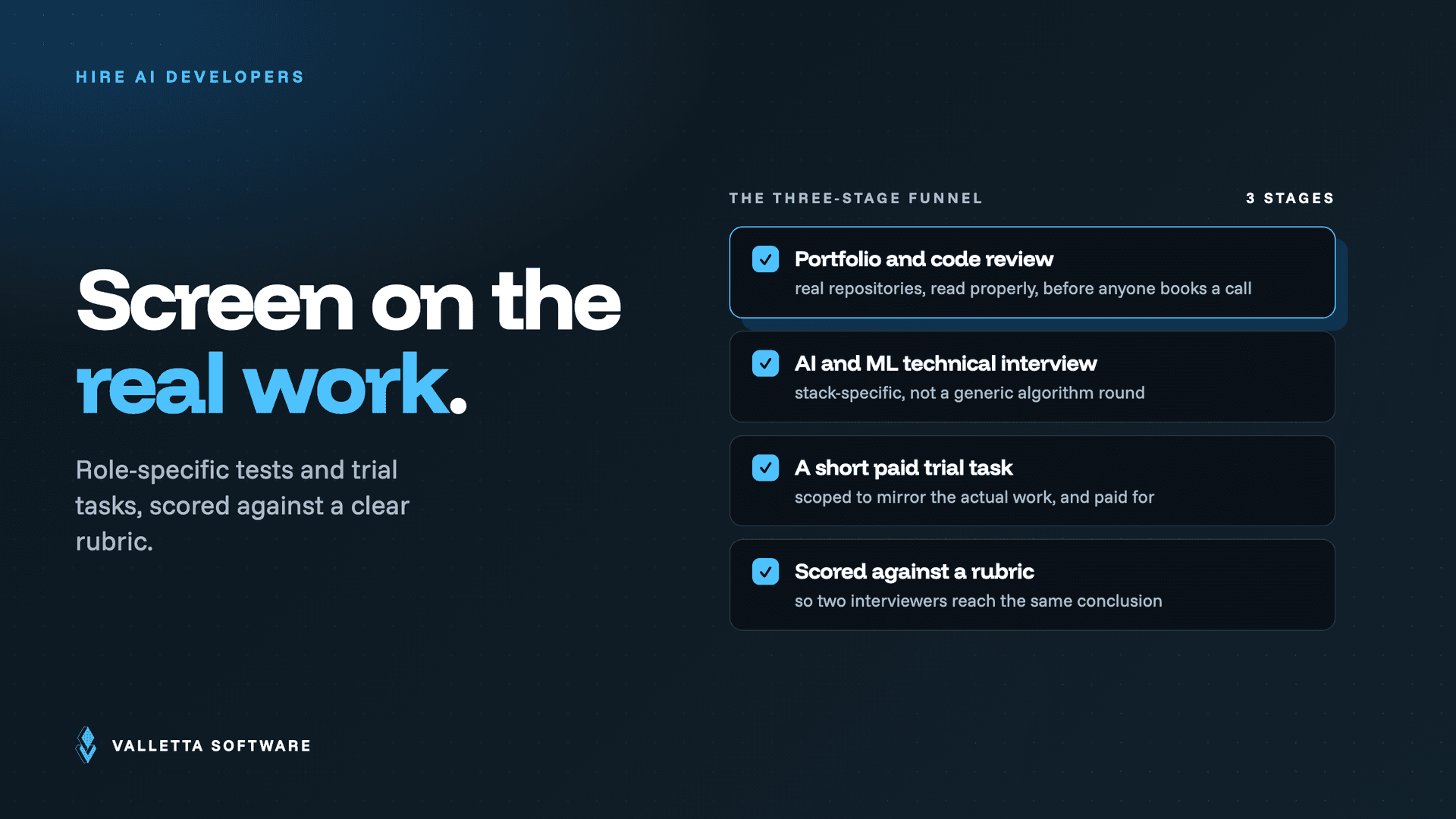
- Screen candidates with role-specific technical tests and take-home trial tasks that mirror real AI work, scored against a clear rubric.
- Structure interviews around applied ML scenarios, model evaluation, and production trade-offs rather than algorithm puzzles alone.
- AI developer rates in 2026 vary widely by seniority and region, so budget in pricing bands rather than a single number.
- If building an internal AI team is too slow or costly, a dedicated AI development partner is a faster route to production-ready talent.
Standard developer hiring processes are not enough for AI roles. These positions require deeper technical vetting, domain-specific assessments, and often a global talent search. This article is a complete, actionable guide to hiring AI developers in 2026, covering where to find candidates, how to screen them, what to ask in interviews, how to design take-home trial tasks that reveal true expertise, and how engaging a specialized AI development company can accelerate your path to production-grade AI solutions.
Why Hiring AI Developers Is Different from General Software Hiring
When you search for AI developers for hire, you are looking for a fundamentally different skill set than traditional software engineering. While proficiency in programming languages like Python, Java, or C++ is foundational, successful AI hires must also demonstrate deep expertise across several specialized domains. At Valletta Software Development, where we have built and deployed AI solutions across fintech, logistics, healthcare, computer vision, and SaaS platforms, we evaluate AI candidates on the following core competencies:
- Machine learning algorithms, regression, classification, clustering, deep learning, reinforcement learning, and transformer architectures
- AI frameworks and libraries, hands-on experience with TensorFlow, PyTorch, Scikit-learn, Hugging Face, BERT, DistilBERT, SpaCy, NLTK, and LangChain
- Data engineering skills, data preprocessing, feature engineering, pipeline orchestration with tools like AWS Glue and Kinesis, and model evaluation
- Cloud AI platforms, working knowledge of AWS SageMaker, Azure AI, Google Cloud Vertex AI, including multi-model endpoints, auto-scaling, and cost optimization
- LLM and generative AI proficiency, prompt engineering, fine-tuning GPT and open-source models (Llama, BERT), retrieval-augmented generation (RAG), vector databases (pgvector, Pinecone), and responsible AI practices
- Computer vision expertise, real-time object detection with YOLO-based models, image classification, and video processing for industrial and commercial applications
- MLOps and production deployment, CI/CD pipelines for ML models (AWS CodePipeline, GitHub Actions), experiment tracking with MLflow or Weights & Biases, SageMaker Pipelines, model monitoring with CloudWatch and SageMaker Model Monitor
Beyond technical skills, the best AI developers demonstrate strong problem-solving instincts, collaborative thinking, and adaptability. Organizations that explicitly map their AI technology stack to the role description attract better-matched candidates and reduce time-to-hire significantly. This is why companies like Valletta maintain detailed technology stack documentation covering 750+ technologies across backend, frontend, mobile, cloud, and AI/ML categories, ensuring precise role-to-project alignment for every engagement.
Where to Find AI Developers for Hire: Platforms and Talent Sources
One of the most common questions hiring managers ask is: where can I actually find qualified AI developers for hire? The answer depends on whether you need full-time employees, freelance specialists, a dedicated outsourced team, or a full AI engineering partner. Here are the most effective sourcing channels in 2026, ranked by the type of engagement they support best.
Freelance and Contract AI Talent Platforms
Toptal: Pre-screens the top 3% of freelance AI and ML engineers. Best for companies that need senior-level, vetted AI developers for hire on short-notice project engagements.
Turing: Uses its own AI-driven vetting to match companies with remote AI developers globally. Strong option for startups and mid-market companies scaling AI teams quickly.
Upwork: Offers the widest pool of AI freelancers at varied price points. Best for smaller, well-scoped tasks like building a proof-of-concept model or data labeling pipelines.
Community-Based Sourcing
Kaggle: Candidates with strong Kaggle competition rankings have demonstrable, hands-on experience solving real-world AI problems. Kaggle profiles serve as living portfolios, making this platform a goldmine for sourcing top AI developers for hire.
GitHub: Open-source contributions, starred repositories, and commit history reveal a candidate's coding habits, collaboration style, and depth of AI expertise more reliably than a resume alone.
LinkedIn Talent Solutions: Boolean and AI-assisted search filters let recruiters target candidates by specific skills (e.g., "PyTorch," "NLP," "computer vision") and location, making it the most scalable channel for outbound recruiting.
Dedicated AI Development Partners
For organizations that need production-grade AI solutions without the overhead of building an internal team from scratch, engaging a specialized AI software development company is often the most efficient path. Firms like Valletta Software Development provide pre-built teams with AI Agent Architects, ML engineers, AI Operator developers, and full DevOps/MLOps support. This model eliminates the months-long recruiting cycle and delivers AI expertise from day one, with project delivery that can be 40-70% faster than traditional approaches.
The key advantage of this approach is that a dedicated partner already maintains the infrastructure, evaluation frameworks, and multi-agent AI pipelines needed for production work, including structured context chains, prompt templates, and deterministic code generation workflows. Instead of hiring and training individual contributors, you get an integrated team that has already shipped AI solutions across fintech, e-commerce, healthcare, logistics, and industrial applications.
Screening AI Developer Candidates: Tools, Tests, and Strategies
Screening is where most AI hiring processes either succeed or break down. Unlike traditional developer roles, screening for AI talent requires purpose-built assessment platforms with domain-specific modules. Effective screening ensures only the most qualified candidates advance, saving valuable time for both recruiters and engineering leads.
Top Technical Screening Platforms for AI Roles
HackerRank: Offers dedicated AI and data science assessment modules alongside traditional coding challenges. Supports automated scoring and integrates with most applicant tracking systems (ATS), making it ideal for high-volume screening.
Codility: Provides timed, real-world coding tasks with AI/ML-specific categories. Strong automation features allow teams to screen hundreds of candidates consistently and at scale.
LeetCode: Widely recognized for algorithm challenges, LeetCode now features AI and data science problem sets. Its large global user base makes it useful for benchmark comparisons when evaluating AI developers for hire from different regions.
Screening Best Practices
The most effective AI screening processes follow three principles. First, design tests that mirror the real challenges your organization faces. Generic algorithm puzzles do not predict AI job performance. At Valletta, for example, we screen AI candidates against actual project patterns: building NLP classification pipelines, training YOLO-based object detection models, or constructing RAG architectures with vector similarity search. Second, set clear performance benchmarks and use timed assessments to simulate production-environment constraints. Third, automate initial screening stages to maintain consistency and scalability, especially when evaluating candidates across multiple time zones.
Comparison: AI Screening Platforms at a Glance
How to Interview AI Developers: Structure, Questions, and Rubrics
Once candidates pass initial screening, the technical interview becomes the most important tool for evaluating depth of expertise. A well-structured AI developer interview loop balances theoretical knowledge, hands-on coding, system-level thinking, and communication skills. According to the Society for Human Resource Management (SHRM), structured interviews are up to twice as predictive of job performance as unstructured ones, making this step critical for AI hiring success.
Recommended AI Developer Interview Structure
Stage 1, Technical Fundamentals (30 min): Evaluate core programming proficiency, algorithm design, and mathematical foundations including linear algebra, probability, and statistics. This stage filters for baseline engineering competence.
Stage 2, Machine Learning Deep Dive (45 min): Assess model selection reasoning, evaluation metrics (precision, recall, F1, AUC-ROC), error analysis, and debugging strategies. Use scenario-based questions tied to real-world business problems. For example: "How would you handle severe class imbalance in a fraud detection model?" This question reflects real production challenges, like those encountered in fintech AI projects where fraud prevention systems require real-time transaction monitoring with AI-driven detection across multiple payment processors.
Stage 3, System Design for AI (45 min): Ask the candidate to architect an end-to-end AI system, such as a recommendation engine, a real-time NLP pipeline, or an automated lead classification system that scores intent and routes to CRM workflows. Evaluate their ability to discuss scalability, latency trade-offs, data pipeline design using tools like AWS Glue and Kinesis, model serving with SageMaker multi-model endpoints, and ethical implications.
Stage 4, Live Coding Challenge (30 min): Use a live-coding platform like CoderPad or HackerRank CodePair to test hands-on implementation skills. For example, building a simple neural network, implementing a custom loss function in PyTorch, or constructing a RAG retrieval pipeline with vector embeddings and similarity search.
Stage 5, Behavioral and Collaboration (30 min): Focus on communication, teamwork, adaptability to new technologies, and experience working in cross-functional teams. AI projects are rarely solo efforts, so collaboration skills are a strong predictor of long-term success. In AI-first development environments, developers work alongside AI Agent Architects and AI Operator specialists, so the ability to operate within multi-role workflows is essential.
AI Developer Interview Scoring Rubric
Involving senior AI engineers or ML leads in panel interviews is a proven best practice. It ensures that assessments align with actual project needs and current industry standards, and it gives candidates a realistic preview of the team they would join.
Designing Take-Home Trial Tasks That Reveal True AI Expertise
Take-home trial tasks are one of the most reliable ways to evaluate an AI developer's real-world capabilities. Unlike timed coding challenges, trial tasks give candidates the space to demonstrate their full thought process, from data exploration and preprocessing to model selection, evaluation, and documentation. However, the effectiveness of a trial task depends entirely on how well it is designed.
Trial Task Design: Best Practice Guidelines
A well-designed AI trial task should clearly define the problem scope. For example: "Build and validate a sentiment analysis pipeline using the provided dataset," or "Create an automated lead classification system that assigns intent scores based on inquiry text." Limit the expected time commitment to 6-8 hours to respect candidates' availability, especially when hiring globally. Provide anonymized, realistic datasets that reflect actual business challenges rather than toy examples. Finally, establish clear evaluation criteria upfront so candidates know exactly how their work will be judged: accuracy, explainability, code modularity, and robust documentation.
At Valletta Software Development, we use a similar evaluation approach for our own AI team members. Every AI project begins with a mandatory evaluation sprint of 40-80 hours, during which AI Agent Architects validate the feasibility of the solution, convert client artifacts into structured context, and identify which modules are suitable for AI-driven generation versus classical manual development. This evaluation-first methodology mirrors the trial task philosophy: demonstrate capability on real constraints before committing to full delivery.
Trial Task Scoring Rubric for AI Developer Candidates
Providing transparent, constructive feedback to unsuccessful candidates is also a best practice. It reinforces your employer brand, supports future talent pipelines, and signals that your organization values the time AI developers invest in the hiring process.
The Alternative Path: Engaging a Dedicated AI Development Partner
Not every organization needs to build an internal AI team. In fact, for many companies, the most effective way to access top AI talent is to engage a specialized AI development partner that already has the team, processes, and production infrastructure in place. This is particularly true when project timelines are tight, when the AI workload is project-based rather than ongoing, or when the internal team lacks the ML engineering depth needed to ship production-grade models.
Valletta Software Development operates as this kind of partner. The company's AI-first development methodology delivers production-ready AI solutions at 30-35% of traditional development cost, with 40-70% faster delivery timelines. This is achieved through a structured process that includes dedicated AI Agent Architects who design multi-agent workflows and validate model performance across different LLM families (OpenAI GPT, Claude, BERT, Llama), AI Operator developers who execute generation pipelines at $60/hour, and full MLOps support including CI/CD for ML models, SageMaker-based deployment, and continuous model monitoring.
Real-World Case Study: AI-Driven Personalization for a Sales Engagement Platform
As an outsourced ML team, Valletta collaborated with Autobound.ai, a leading AI-driven sales engagement platform. The engagement involved building a custom NLP model using BERT and GPT fine-tuning for contextual email personalization, creating a dynamic content generation pipeline on AWS SageMaker with multi-model endpoints and AutoML via SageMaker Autopilot, implementing A/B testing frameworks to measure personalization performance by open and reply rates, and building scalable data pipelines using AWS Glue and Kinesis for real-time data ingestion and model retraining. The result: SDRs and AEs could generate hyper-personalized outreach emails almost instantaneously, with continuous model improvement through integrated feedback loops.
Real-World Case Study: Computer Vision for Industrial Safety Monitoring
Valletta developed a YOLO-based computer vision system for real-time monitoring of worker safety on industrial equipment. The system detects unauthorized personnel near machinery, verifies protective clothing compliance, monitors hand movement patterns for safe operation, and feeds all data into real-time dashboards with statistical visualization. This project demonstrates the kind of specialized AI expertise, from model training to production deployment with real-time camera input streams, that is extremely difficult to hire for on the open market but is readily available through a dedicated AI engineering partner.
Real-World Case Study: MLOps Cost Optimization on AWS
For a client with an existing ML project incurring high operational costs, Valletta's DevOps team performed a comprehensive audit and optimization of the entire ML infrastructure. The engagement included right-sizing EC2 instances, switching to Spot Instances for non-critical tasks, implementing SageMaker Pipelines with AWS Step Functions for scheduled training, deploying multi-model endpoints for efficient inference, and setting up automated CI/CD with AWS CodePipeline. The result was a 40%+ reduction in AWS costs while maintaining full model performance and enabling continuous improvement. You can explore more AI and engineering case studies on the Valletta success stories page.
Expert Tips: Actionable Advice for Hiring AI Developers in 2026
Drawing from industry best practices, the hiring patterns of leading AI-first companies, and our own experience building AI teams at Valletta Software Development, here are seven actionable tips for organizations looking to find and hire the best AI developers for hire in a competitive global market.
Prioritize practical skills over academic credentials. Real-world ML projects, open-source contributions, and Kaggle competition performance are often more predictive of on-the-job success than degrees alone. A candidate who has shipped a production model or contributed to a widely-used library is typically a stronger hire than one with only academic experience.
Test for reproducibility. Require trial task submissions to include clear setup instructions, dependency files (requirements.txt, Dockerfile), and version-pinned environments. If a reviewer cannot reproduce the results within 15 minutes of cloning the repo, the submission has a significant quality gap.
Leverage community signals. Review candidates' activity on Kaggle, GitHub, and Stack Overflow. Active contributors who answer ML questions, maintain popular repositories, or consistently rank in competitions demonstrate ongoing engagement with the field, which is a key indicator of long-term growth potential.
Standardize your rubrics across all stages. Use detailed, role-specific rubrics for screening, interviews, and trial tasks to minimize unconscious bias and ensure fairness. Share rubric criteria with your interviewer panel in advance to calibrate expectations.
Foster two-way communication throughout the process. Allow candidates to ask clarifying questions and propose alternative solutions. This often reveals creative thinking, initiative, and how well a candidate will collaborate with your existing team.
Evaluate MLOps maturity, not just model-building skills. The ability to deploy, monitor, retrain, and optimize models in production is what separates a researcher from a production AI engineer. Ask candidates about their experience with SageMaker, model monitoring tools, CI/CD pipelines for ML, and cost optimization strategies. These skills are increasingly table-stakes for AI roles in 2026.
Consider multiple hiring models. Not every AI project requires a full-time hire. For time-boxed projects, freelance AI developers via Toptal or Turing may deliver faster results. For long-term roadmap items, investing in a permanent hire or dedicated AI team is typically more cost-effective. For organizations that need production-grade AI capability without months of recruiting, engaging a dedicated AI software development partner with an established team of AI Agent Architects, ML engineers, and AI Operators provides the fastest path from concept to deployed solution.
Hire AI developers through Valletta Software
If you would rather skip the sourcing and screening entirely, Valletta Software Development supplies vetted senior AI engineers as a team on demand. Instead of running the full pipeline above yourself, you get engineers who have already passed structured screening on production AI experience: LLM integration, retrieval-augmented generation, MLOps, and the security and evaluation work that keeps AI features reliable once real users arrive.
Engagements are flexible. You can add one AI engineer to an existing team through staff augmentation, stand up a dedicated squad with a lead and QA for an owned roadmap, or scope a fixed project such as an MVP or a focused integration. Getting started is simple: you share the problem, the stack, and the outcome you are targeting, and we assemble a team and a realistic timeline around it, usually within days rather than months.
See the full offer and current availability on our AI developers for hire page, or tell us what you are building on the Valletta Software contact page. As an EU-based team, we offer strong European timezone overlap, workable hours for much of the US, and GDPR-aware handling of sensitive data, which matters when your AI features touch regulated or personal information.
Frequently Asked Questions About Hiring AI Developers
Where can I find qualified AI developers for hire?
The best sources include specialized talent platforms (Toptal, Turing), community platforms where AI developers showcase their work (Kaggle, GitHub), professional networks (LinkedIn Talent Solutions), traditional screening platforms adapted for AI roles (HackerRank, Codility, LeetCode), and dedicated AI development companies like Valletta Software Development that provide integrated AI engineering teams. Using a combination of these channels produces the strongest candidate pools.
What are the main challenges when trying to hire AI developers globally?
The three biggest challenges are intense competition for a small pool of qualified candidates, accurately assessing both technical and communication skills in remote settings, and managing time zone and cultural differences across distributed teams. Companies that adapt their processes for asynchronous evaluation and offer flexible working arrangements have a significant advantage. Alternatively, partnering with an established AI development firm that has already solved these challenges internally can bypass the recruiting bottleneck entirely.
How can we assess a candidate's practical machine learning experience?
Review completed projects on Kaggle and GitHub, assign a take-home trial task that mirrors a real business problem, and conduct a technical deep-dive interview covering model evaluation, tuning, and deployment. The most reliable signal comes from candidates who can walk you through a project from raw data to production-ready model and explain every decision along the way, including their MLOps setup, model monitoring approach, and cost optimization strategy.
Should we use automated screening platforms or manual assessments for AI roles?
A combination delivers the best results. Automated platforms like HackerRank and Codility efficiently filter for technical baseline at scale, while manual interviews and take-home tasks provide the nuanced evaluation needed to assess creativity, problem-solving depth, and communication skills. Neither approach alone is sufficient for AI hiring.
What should an AI developer take-home task include?
An effective take-home task covers the full ML workflow: data cleaning, exploratory analysis, feature engineering, model training, evaluation, and documentation. Provide a realistic dataset, set a 6-8 hour time limit, and establish a clear rubric that weights accuracy (40%), framework usage (20%), data engineering (20%), documentation (10%), and innovation (10%).
How much does it cost to hire an AI developer in 2026?
Compensation varies widely by region, seniority, and engagement model. In the United States, full-time senior AI/ML engineers typically command $180,000-$300,000+ in total compensation, according to levels.fyi and Glassdoor data. Freelance AI developers for hire on platforms like Toptal or Turing typically charge $80-$200+ per hour depending on specialization. Offshore and nearshore rates can be significantly lower while still delivering strong technical quality. Specialized AI Operator developers, such as those employed by AI-first development firms, typically operate at $60/hour while delivering significantly higher productivity through multi-agent AI pipeline execution.
How can we ensure fair and unbiased AI developer interviews?
Standardize your scoring rubric and share it with all interviewers before the process begins. Use diverse interviewer panels and avoid questions that are overly culture- or region-specific. Evaluate all candidates against the same criteria, and review aggregate scores rather than relying on any single interviewer's impression. Structured interviews are inherently more equitable than unstructured formats.
How quickly can Valletta staff an AI developer?
Because our AI engineers are pre-vetted and their availability is tracked, we can usually propose candidates within days and start an engagement in one to two weeks, rather than the several weeks or months a from-scratch hiring cycle takes. The exact timing depends on the stack, seniority, and whether you need a single engineer or a full team.
What does it cost to hire AI developers through an agency?
As typical 2026 market ranges, EU-based mid to senior AI engineers commonly run a mid four-figure to low five-figure monthly rate on a dedicated basis, with senior US contractors higher. Agency pricing bundles vetting, delivery management, and continuity, so compare it against total cost of a direct hire, including sourcing time, ramp-up, and retention risk.
What if we don't have the resources to build an internal AI team?
This is one of the most common scenarios in 2026. Many organizations need AI-powered features or products but cannot justify the time, cost, and risk of building a full internal AI team. In these cases, engaging a dedicated AI development partner is the most effective path. Companies like Valletta Software Development provide integrated teams that include AI Agent Architects, ML engineers, AI Operators, backend/frontend developers, QA, and DevOps, all operating under a proven AI-first methodology. This approach delivers production-grade AI solutions at 30-35% of traditional development cost with 40-70% faster timelines, eliminating the multi-month recruiting cycle and letting organizations focus on their core business.
Conclusion: Building a Repeatable AI Hiring Pipeline
Hiring AI developers in 2026 requires a structured, multi-stage approach. The most successful organizations combine automated screening tools (HackerRank, Codility, LeetCode), community-based sourcing (Kaggle, GitHub), and specialized talent platforms (Toptal, Turing) to build a diverse pipeline of qualified AI developers for hire. They run rigorous, rubric-driven interview loops that test both technical depth and collaboration skills, and they design take-home trial tasks that mirror real-world AI challenges.
According to McKinsey's State of AI 2025 report, organizations with formalized AI hiring processes fill roles 40% faster and report higher retention. According to Stanford HAI's 2025 AI Index, demand for AI talent has grown 3.5x since 2020 with no signs of slowing. The companies that build repeatable, transparent AI hiring pipelines today will have a durable competitive advantage in attracting the world-class talent that drives long-term innovation.
For organizations that need to move faster, the alternative is clear: partner with a firm that has already built, vetted, and operationalized an AI engineering team. Valletta Software Development has delivered AI-powered solutions across fintech (fraud detection, payment processing), computer vision (industrial safety monitoring, generative product imagery), NLP (sales personalization, legal document analysis, healthcare chatbots), and MLOps (40%+ AWS cost reduction). Whether you choose to hire AI developers for your internal team or engage a dedicated AI partner, the key is to move with structure, speed, and rigor. The talent gap is real, but with the right approach, it is solvable.
Frequently asked questions
- How do I hire AI developers in 2026?
- Screen on production AI experience (LLM integration, RAG, MLOps), run a paid trial task on a representative problem, and check references for shipped projects. Skip resume keyword matches; favor portfolio depth and trial output.
- What does it cost to hire an AI developer?
- EU mid-senior AI engineers typically run 6,000 to 12,000 USD per month dedicated; senior US contractors range 12,000 to 20,000 USD. Project-based AI builds usually start at 15,000 USD for a focused MVP.
- Should I hire freelancers or a dedicated team?
- Freelancers fit short, well-scoped tasks. A dedicated team fits production AI products with MLOps, security and ongoing iteration. The boundary is usually around 3 months of work or any compliance-sensitive scope.
- Which roles should an AI development team include?
- An AI engineer, an MLOps engineer, a data engineer, and a backend engineer. Larger teams add a prompt engineer, a QA automation engineer and a security reviewer.
- How fast can a dedicated AI team start?
- A vetted nearshore EU team can typically start within 2 to 3 weeks. Highly specialized roles (production MLOps, ML research) may take 4 to 6 weeks.
- Does Valletta Software hire AI developers?
- Yes. Valletta Software builds dedicated AI development teams covering LLM integration, RAG systems, AI agents, MLOps and security review. Engagement models include dedicated developer, dedicated team and project-based delivery.
Hire a Dedicated AI Development Team
Senior AI, MLOps, data and backend engineers under a single EU contract. Vetted, IP-assigned, EU AI Act aware. Discuss your AI hire with Valletta Software.