

Claude Fable 5 Is Back: Why It Was Pulled and What Changed
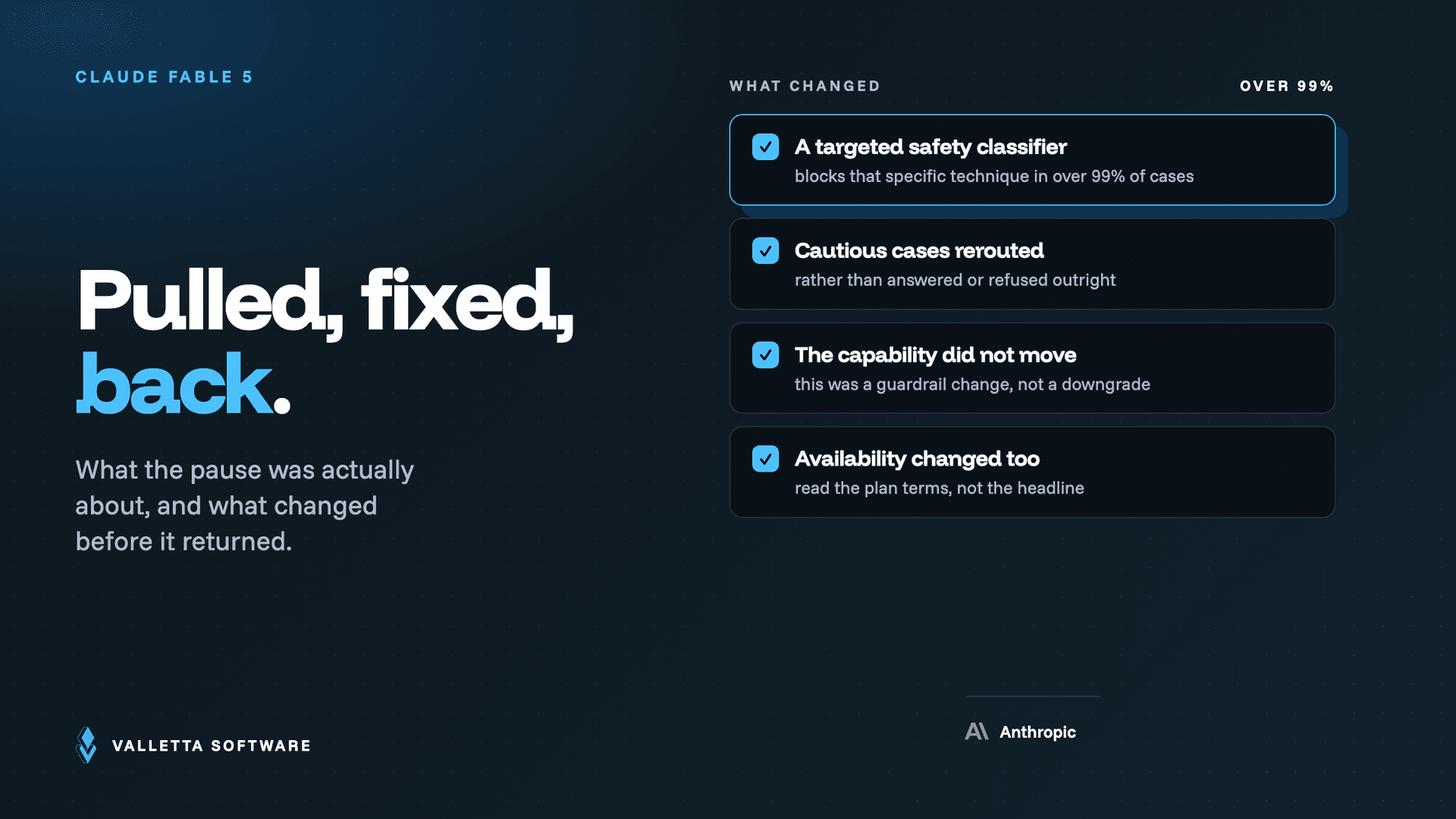

Claude Fable 5 is back. Anthropic's most capable publicly available AI model returned to general release on July 1, 2026, after the US government lifted the export controls that had forced it offline. Fable 5 launched on June 9, was suspended on June 12 under an export-control order, and is now redeploying globally behind an upgraded safety classifier for the technique that triggered the block. This page tracks why Claude Fable 5 was pulled, what changed to bring it back, and how to get access again.
Updated July 19, 2026: the subscription limbo is over. Anthropic announced on July 18 that beginning July 20, Claude Fable 5 is included in all Max and Team Premium plans as a standard benefit, at 50% of usage limits. Pro and Team Standard subscribers keep access through usage credits and receive a one-time $100 credit. The free window that was extended twice still ends on July 19, and the temporary 50% boost to Claude Code weekly rate limits ends with it. This page reflects the new plan terms throughout.
Updated July 13, 2026: Anthropic has extended free Claude Fable 5 access on all paid plans again, now through July 19, 2026, and is keeping Claude Code weekly rate limits 50% higher through the same date. This is the second extension: the window moved from July 7 to July 12 earlier in the month, and now to July 19. Pro, Max, Team, and premium seat-based Enterprise subscribers can keep using Fable 5 for up to 50% of their weekly usage limit, then continue on usage credits or switch to another model to stay within their limits. The extension lands in a crowded stretch for frontier models, with OpenAI's GPT-5.6 arriving on July 9 and xAI's Grok 4.5 on July 8. This page reflects the July 19 date throughout.
Updated July 1, 2026: the US export controls on Fable 5 and Mythos 5 were lifted on June 30. Fable 5 is redeploying globally from July 1 behind a new safety classifier that blocks the flagged jailbreak in over 99% of cases. This update rewrites the return timeline, the staged access terms, and the Opus 4.8 comparison to reflect the relaunch.
Key takeaways
- It is back: export controls lifted June 30, 2026, and Fable 5 is redeploying globally from July 1 across the Claude Platform, Claude.ai, Claude Code, and Claude Cowork.
- Why it was pulled: Amazon researchers found a way to bypass Fable 5's safeguards to identify software vulnerabilities, escalated it to the White House, and a June 12 US export-control order followed.
- What changed: Anthropic deployed a targeted safety classifier that blocks that specific technique in over 99% of cases, routing any caught request to Claude Opus 4.8.
- Getting access: from July 20, 2026, Fable 5 is included in all Max and Team Premium plans at 50% of usage limits; Pro and Team Standard run on usage credits with a one-time $100 credit. Cloud-partner access on AWS, Google Cloud, and Microsoft Foundry is being restored.
- What it is: Anthropic's highest publicly shipped capability tier, priced at $10 / $50 per million tokens, with a 1M-token context window and the strongest safeguards Anthropic has applied to a model.
When did Claude Fable 5 come back?
Claude Fable 5 came back on July 1, 2026. The US government lifted the export controls on both Fable 5 and Mythos 5 on June 30, and Anthropic began redeploying Fable 5 globally the next day. You can reach it again on the Claude Platform (API), Claude.ai, Claude Code, and Claude Cowork, with access through AWS, Google Cloud, and Microsoft Foundry being restored as quickly as possible.
Access is ramping back in stages rather than all at once:
- July 1 through July 19: Fable 5 usage counts toward up to 50% of weekly usage limits for Pro, Max, Team, and premium Enterprise plans, so you can try it without a separate purchase. Anthropic first set this window to July 7, extended it to July 12, then extended it again to July 19 after sustained subscriber demand. Claude Code weekly rate limits also stay 50% higher through July 19.
- From July 20: Fable 5 becomes a standard part of all Max and Team Premium plans, included at 50% of usage limits. Pro and Team Standard subscribers continue on usage credits and receive a one-time $100 credit. Announced on July 18, this replaces the earlier plan to move every subscriber to usage credits.
- Cloud partners: AWS, Google Cloud, and Microsoft Foundry access is being restored, so check your provider console if you consume Fable 5 there.
What changed to bring Claude Fable 5 back
Two things unblocked the relaunch: a technical mitigation and the lifting of the export controls.
- A targeted safety classifier: Anthropic deployed a new classifier aimed at the exact vulnerability-identification technique described in the Amazon report. It blocks that technique in over 99% of cases, and any request it catches is redirected to Claude Opus 4.8 rather than answered by Fable 5.
- Export controls lifted: with the mitigation in place, the US government lifted the controls on Fable 5 and Mythos 5 on June 30, 2026, clearing the way for redeployment.
Anthropic also stressed that the flagged behavior was not unique to Fable 5. In its own testing, less capable models could reproduce the same vulnerability-identification behavior, including Claude Haiku 4.5, Sonnet 4.6, Opus 4.6, Opus 4.7, and Opus 4.8, plus GPT-5.4, GPT-5.5, and Kimi K2.7. Alongside the relaunch, Anthropic is standing up an industry jailbreak-severity framework with Amazon, Microsoft, and Google (scoring jailbreaks on capability gain, breadth, ease of weaponization, and discoverability), opening a HackerOne channel for Fable 5 cybersecurity jailbreak reports, and deepening its collaboration with US government agencies. See Anthropic's note on redeploying Fable 5 for the official framing.
Why was Claude Fable 5 pulled?
Claude Fable 5 was pulled because of a US government export-control directive that cited national-security concerns. To stay compliant, Anthropic had to abruptly disable both Fable 5 and the unrestricted Mythos 5 for all customers, which is why a model that launched on a Tuesday was gone by Friday.
The trigger was a narrow jailbreak technique: Amazon researchers found a way to get the model past its safeguards to read a codebase and identify software vulnerabilities, a capability that can be steered toward offensive security work. More than 1,000 hours of external red-teaming had found no universal jailbreak, but this specific bypass was serious enough that Amazon escalated it to the White House, and that escalation produced the June 12 export block.
Two related details still matter for anyone who used the model during the suspension window:
- Data retention: Fable-class "Covered Models" carry a 30-day data-retention requirement to support jailbreak research. Anthropic says this monitoring data is not used for training.
- Scope: the suspension hit everyone at once, including paying API and subscription customers, which is why the change felt so abrupt. Anthropic's original statement on Fable and Mythos access has the launch-time framing.
Claude Fable 5 vs Opus 4.8: what to use now
With Fable 5 back online, you have a real choice again. Fable 5 sits a tier above Claude Opus 4.8 on raw capability, but Opus 4.8 is available everywhere at half the token price and stays the safe default for cost-sensitive or high-volume work. From July 20, Max and Team Premium plans include Fable 5 at 50% of usage limits, so many teams will run both and route only the hardest jobs to Fable 5.
| Claude Fable 5 | Claude Opus 4.8 | |
|---|---|---|
| Capability tier | Highest Anthropic has shipped publicly | Previous flagship, still excellent |
| Availability (July 20, 2026) | Included in Max and Team Premium plans at 50% of limits; usage credits elsewhere | Fully available on all plans |
| Price (input / output per 1M tokens) | $10 / $50 | $5 / $25 |
| Context window | 1M tokens | 1M tokens |
| Best for right now | Frontier coding, agents, long-horizon migrations | Cost-sensitive and high-volume work |
Some teams moved experimental work to alternatives like GLM 5.2, OpenRouter Fusion, and Kimi K2.7-Code during the outage, and those remain useful for specialized tasks. For production that needs a stable, supported frontier model, the choice is now Fable 5 or Opus 4.8. If a top-tier model changes your token math, our breakdown of controlling Anthropic token costs still applies: the levers are the same.
What Claude Fable 5 actually is
Claude Fable 5 is a tier above Opus in Anthropic's lineup, and the company is unusually direct about what that means: its capabilities exceed those of any model Anthropic has ever made generally available. The release mechanic is the interesting part. Anthropic trained a frontier model, Claude Mythos 5, that it considers too capable in certain domains to ship openly. Fable 5 is that same model behind a safeguard layer, with sensitive queries routed to Claude Opus 4.8, the previous flagship we reviewed in depth in May.
Fable 5 vs Mythos 5: same brain, different doors
| Claude Fable 5 | Claude Mythos 5 | |
|---|---|---|
| Underlying model | Identical | |
| Safeguards | Cyber, bio/chem, distillation, plus the new post-relaunch classifier | Lifted per partner program |
| Who can use it | Everyone (Claude Platform, Claude.ai, Claude Code, Cowork) | Project Glasswing cybersecurity partners and select biology researchers |
| Pricing | $10 / $50 per million tokens | Partner terms |
The Mythos 5 results explain why the gate exists. In Anthropic's partner tests, the unrestricted model sped up protein-design work by roughly 10x, produced viable candidates for 9 of 14 protein targets, and generated novel molecular-biology hypotheses that scientists preferred about 80% of the time over Opus-class output.
What it could do: launch benchmarks and demos
When it first shipped, the Claude Fable 5 launch lit up X for a full day. The official announcement leaned on third-party validation rather than benchmark tables. The standouts:
- Stripe reported that Fable 5 compressed months of engineering into days, including a 50-million-line Ruby codebase migration finished in one day against a two-month manual estimate.
- Cognition measured the highest score among frontier models on its FrontierCode evaluation.
- Vision: first Claude model to complete Pokemon FireRed end to end using vision alone, with no helper tools.
- Memory: persistent file-based memory tripled performance in the long-horizon game Slay the Spire compared with Opus 4.8.
- Long context: a 1M-token context window with up to 128K output, and sustained focus across millions of tokens via compaction.
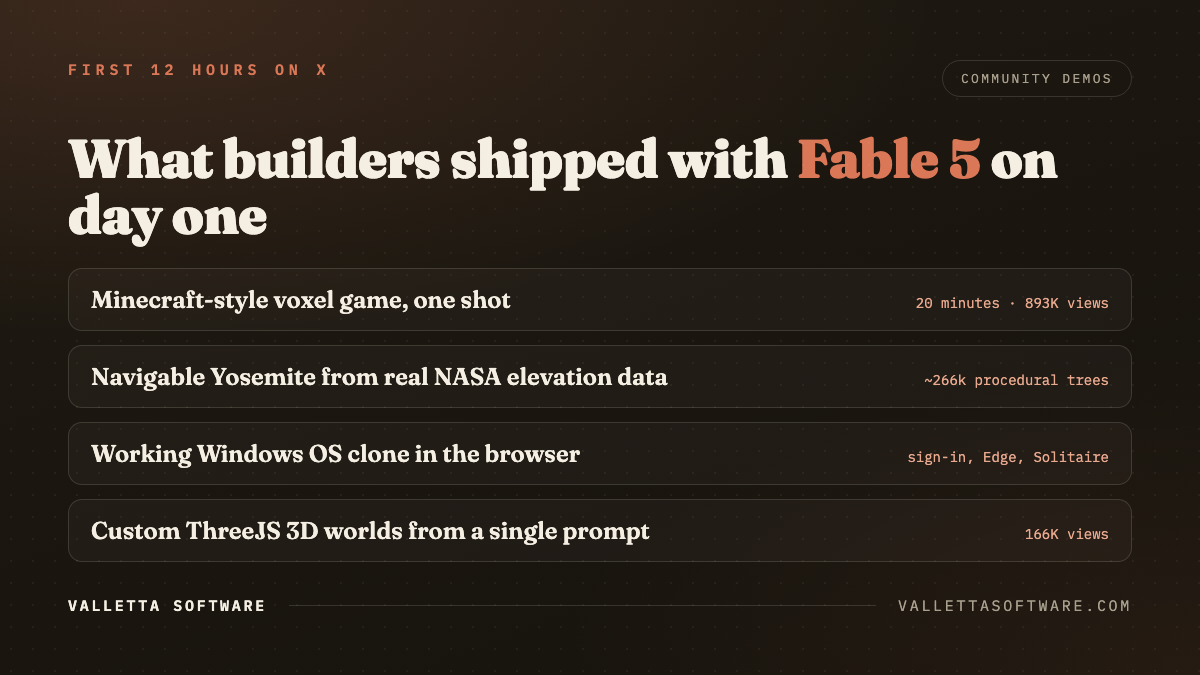
Benchmarks are one thing. The reason Fable 5 trended all day was what ordinary subscribers shipped with single prompts:
- A Minecraft-style voxel game, one shot: a working game in about 20 minutes, with multiple biomes, a day and night cycle, ores, and caves. The clip passed 890K views in hours.
- Yosemite, to scale: the model pulled satellite imagery and real NASA elevation data, classified forest pixels into roughly 266,000 procedural trees, and wrote custom water shaders for all six famous waterfalls, placed on the correct cliffs.
- A Windows OS clone in a browser tab: sign-in screen, notifications, a working Edge-style browser, Solitaire, and, with some irony, its own Copilot.
- Network packets as traffic: live packets logged and rendered as cars on a highway, with different vehicle types for different packet types: an instant, legible observability toy.
The skeptics had a fair point too. A Minecraft clone is, by definition, a reproduction of software the model has seen thousands of derivatives of, so one-shot copies prove fluency, not invention. The launch also attracted engagement bait: a widely shared story about a fired quant rebuilding a trading algorithm in 48 hours carried both a paid-partnership disclosure and an AI-generated content label, and should be treated as fiction. On launch days, verify before you cite. If you are experimenting with this style of prompt-to-product building, our guide to the best vibe coding tools in 2026 covers the tooling around these models.
Pricing and availability
Fable 5 is priced at $10 per million input tokens and $50 per million output tokens, less than half of what Claude Mythos Preview cost and roughly double Opus 4.8. From July 20, 2026, Fable 5 is included in all Max and Team Premium plans at 50% of usage limits. Pro and Team Standard subscribers continue on usage credits and receive a one-time $100 credit toward Fable 5 usage. Anthropic announced the change on July 18, after a free window it had extended twice (July 7, then July 12, then July 19) under sustained subscriber demand, and it delivers on the company's stated aim of restoring Fable 5 as a standard paid-plan benefit once capacity allowed. The included allowance is half the promo-window limits, which some subscribers have criticized as an effective cut. API and consumption-based Enterprise plans get direct access, and cloud-partner availability on AWS, Google Cloud, and Microsoft Foundry is being restored. For most teams the practical question is no longer what to fall back to, but which jobs are worth Fable 5's premium over Opus 4.8.
What "made safe" actually meant
Three classifier families sit between users and the raw model. The cyber classifier blocks offensive security work (external testers got zero compliance across 30 cyberattack-planning attempts). The bio/chem classifier gates dual-use biology. The distillation classifier blocks attempts to extract the model's capabilities to train a competitor. Anthropic says the safeguards fire in under 5% of sessions, that more than 1,000 hours of external red-teaming produced no universal jailbreak, and that a 30-day retention policy applies to safety-monitoring data, which is not used for training. The narrow, codebase-flavored jailbreak that became the government's stated concern is exactly what the post-relaunch classifier is built to close, blocking the flagged technique in over 99% of cases and routing anything it catches to Opus 4.8.
Should your team build on Claude Fable 5 right now?
Yes, with sensible guardrails. Fable 5 is back in general release, so you can build on it again for frontier coding, agents, and long-horizon migrations. Two caveats for production: subscription access is now tiered (from July 20, Fable 5 is included only on Max and Team Premium plans at 50% of usage limits, while Pro and Team Standard run on usage credits), and a small fraction of security-adjacent requests will be routed to Opus 4.8 by the new classifier. Keep your prompts and agent scaffolding model-agnostic, keep Opus 4.8 wired in as a fallback, and keep a human review step (our walkthrough on auditing a vibe-coded app before it goes live applies doubly to frontier output). If you are scaling a team around these tools, see our guide to hiring AI developers in 2026.
Frequently asked questions
Is Claude Fable 5 back?
Yes. The US export controls were lifted on June 30, 2026, and Anthropic began redeploying Fable 5 globally on July 1, 2026 across the Claude Platform, Claude.ai, Claude Code, and Claude Cowork. Cloud-partner access on AWS, Google Cloud, and Microsoft Foundry is being restored. From July 20, 2026, Fable 5 is also included in all Max and Team Premium plans at 50% of usage limits.
Why was Claude Fable 5 suspended?
A US government export-control directive on national-security grounds. The trigger was a narrow jailbreak: Amazon researchers found a way past Fable 5's safeguards to identify software vulnerabilities, then escalated it to the White House. Anthropic had to disable Fable 5 and Mythos 5 for all customers to comply, from June 12, 2026.
What changed so Claude Fable 5 could come back?
Anthropic deployed a new safety classifier that blocks the specific vulnerability-identification technique from the Amazon report in over 99% of cases, redirecting any caught request to Claude Opus 4.8. With that mitigation in place, the US government lifted the export controls on June 30, 2026.
Is Claude Fable 5 banned permanently?
No. The suspension was temporary. The export controls were lifted on June 30, 2026 once Anthropic shipped a classifier targeting the flagged technique, and the model is back in general release.
What can I use instead of Claude Fable 5?
Claude Opus 4.8 is the recommended fallback and is fully available at $5 / $25 per million tokens, which makes it a strong default for cost-sensitive or high-volume work even now that Fable 5 is back. Some teams also use GLM 5.2, OpenRouter Fusion, or Kimi K2.7-Code for specialized tasks.
Claude Fable 5 vs Claude Opus 4.8: which is better?
On raw capability, Fable 5 sits a tier above Opus 4.8, and it is available again as of July 1, 2026. Opus 4.8 is cheaper and has no cyber classifier rerouting, so it remains the better pick for cost-sensitive, high-volume, or security-adjacent work. Many teams run both and send only the hardest jobs to Fable 5.
Is Claude Fable 5 included in my Claude subscription?
From July 20, 2026, all Max and Team Premium plans include Fable 5 at 50% of usage limits, per Anthropic's July 18 announcement. Pro and Team Standard plans do not include it: access there runs on usage credits, and Anthropic is issuing those subscribers a one-time $100 credit. Before July 20, every paid plan had promotional access for up to 50% of weekly limits.
How much does Claude Fable 5 cost, and what is its context window?
$10 per million input tokens and $50 per million output tokens, with a 1,000,000-token context window and up to 128,000 output tokens per request.
What is the difference between Claude Fable 5 and Claude Mythos 5?
They are the same underlying model. Fable 5 ships with the strongest safeguards Anthropic has applied, cyber, bio/chem, and distillation classifiers plus the new post-relaunch classifier, and is generally available. Mythos 5, with fewer safeguards, stays limited to Project Glasswing partners for defensive cybersecurity work. The export controls on both were lifted on June 30, 2026.