

5 Best Vibe Coding Tools in 2026: Cursor vs Lovable vs Bolt

Vibe coding tools promise the same thing: describe an app in plain English, get working software back. What they don't promise, and what you need to know before you pick one, is how much of your future engineering pain each tool quietly writes into the code it ships. Whichever tool you picked, audit your AI-generated app before launch.
Updated June 2026: the 2026 tool lineup (Cursor, Lovable, Bolt.new, v0, Replit Agent) was re-checked and an official documentation reference was added.
Key takeaways
- Five vibe coding tools matter in 2026: Cursor, Lovable, Bolt.new, v0, Replit Agent.
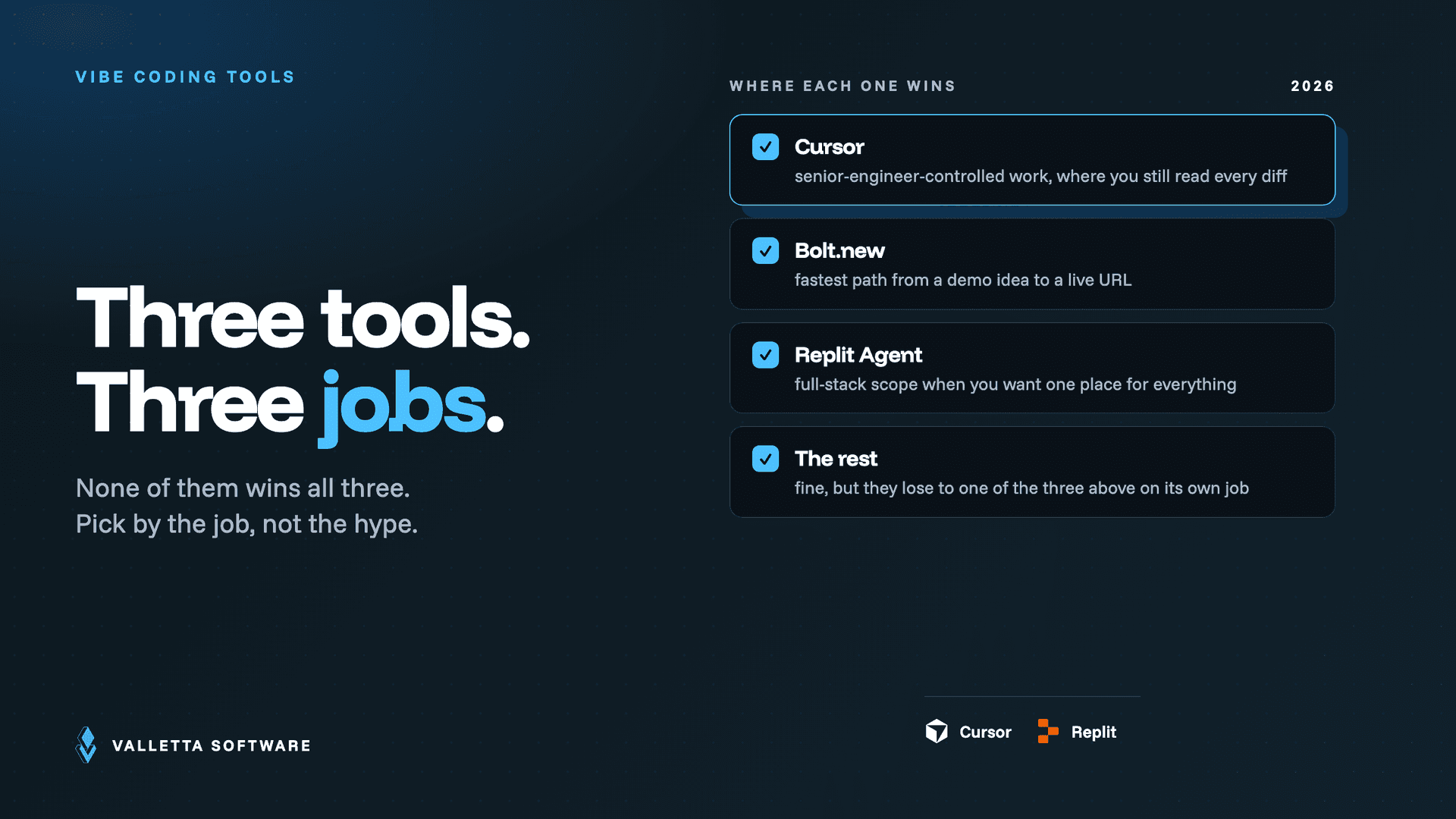
- Cursor wins for senior-engineer-controlled vibe coding; Bolt.new for fastest demo-to-URL; Replit Agent for full-stack scope.
- Lovable and v0 lead on UX-first prototyping but ship the most cleanup work later.
- No tool ships production-grade code by default. All require a human audit before launch.
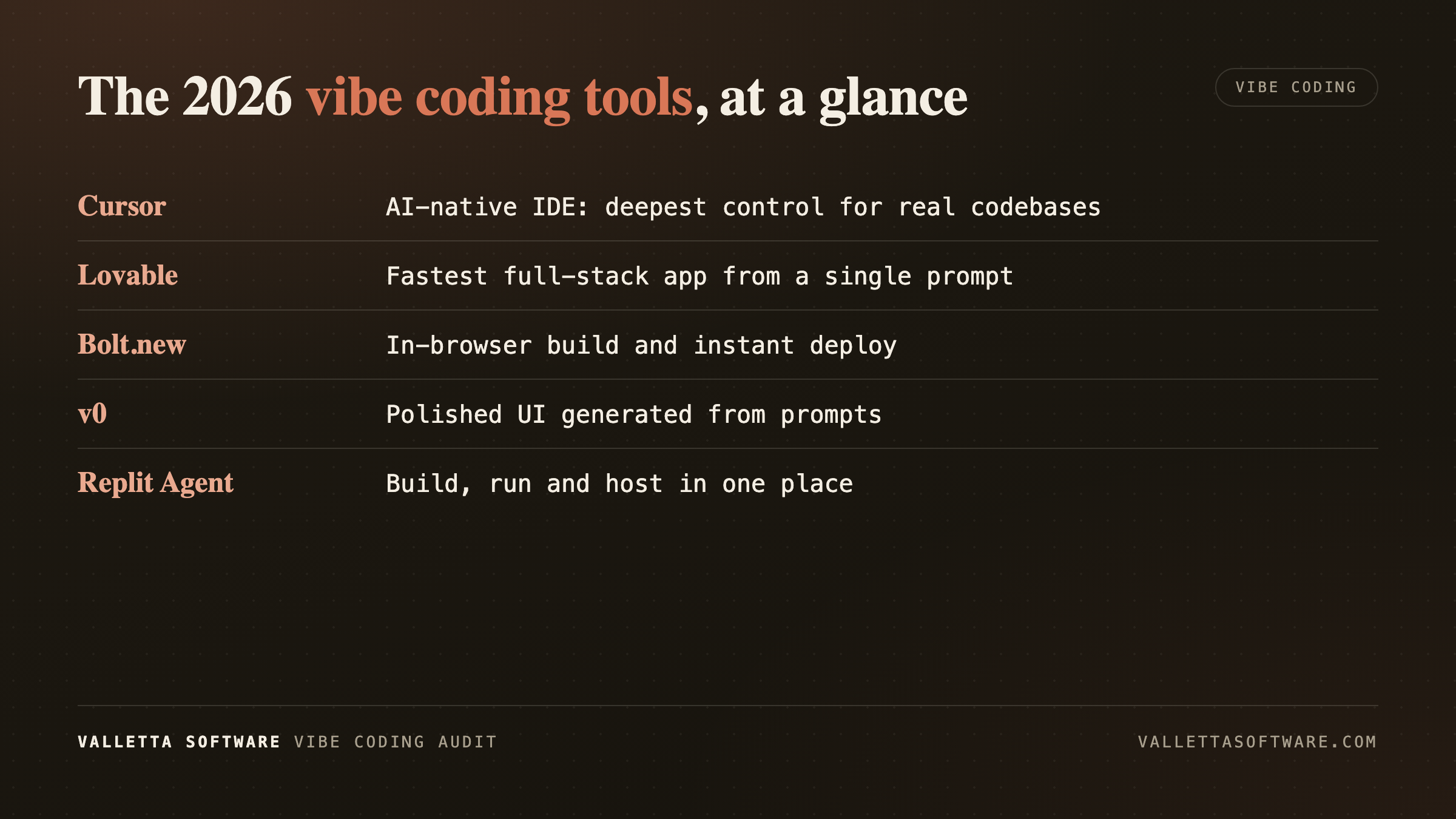
This guide compares the five vibe coding tools that matter in 2026 – Cursor, Lovable, Bolt.new, v0, and Replit Agent, plus the chat-based assistants (Claude, ChatGPT, Google AI Studio, Gemini) that fill in the gaps. We rank them on the four criteria that decide whether your prototype becomes a product or becomes a liability.
New to the concept? Start with the vibe coding pillar, this guide assumes you already know what vibe coding is.
Which AI Coding Tool Is Best?
Cursor, Lovable, Bolt.new, v0, and Replit Agent each optimize for different tradeoffs, speed, control, or simplicity, and the right choice depends on whether you're a developer, founder, or prototyper.
What Actually Matters
- Speed is not the differentiator, all tools are fast; the tradeoffs are security, control, and maintainability.
- App-generation platforms optimize for shipping, not scaling.
- Agentic IDEs preserve long-term code quality but require developer skill.
- Handoff-readiness determines future engineering cost.
- The wrong tool creates technical debt by default.
What Counts as a Vibe Coding Tool?
If you're new to the concept, start here.
A vibe coding tool is any AI-native environment where a human describes intent in natural language and the system generates, executes, and iterates on real code. (For the term itself, origin, definition, and how it differs from no-code, see what is vibe coding.) That's a wider category than most people assume. It covers agentic IDEs that extend a professional workflow, app-generation platforms that produce full-stack software from a sentence, and conversational AI that writes scripts and components on demand.
What unites them is the shift in where the human spends attention: away from syntax, toward outcome. What separates them is everything else, who the tool was built for, how much of the stack it generates, how opinionated its defaults are, and how cleanly you can hand off the output to a real engineering team.
Best vibe coding tools fall into three tiers:
- Agentic IDEs for developers who want AI velocity without losing code ownership (Cursor, v0, GitHub Copilot Workspace).
- App generation platforms for founders and PMs who need a working product, not a codebase (Lovable, Bolt.new, Replit Agent).
- Chat-based assistants with code execution for scripts, prototypes, and one-off automation (Claude, ChatGPT, Google AI Studio, Gemini).
The tool you pick determines the debt you inherit. That's not marketing copy, it's the consistent pattern across every founder who's had to bring in engineering help six months after launch.
The Four Criteria That Actually Matter
Most roundups of vibe coding platforms compare feature lists. Feature lists lie. The things that predict whether a tool will still be serving you a year from now are boring and structural:
1. Speed to working prototype.
How fast does "I have an idea" become "I have a live URL"? This is what the marketing of every AI vibe coding tool optimizes for, and it's where they differentiate least. They're all fast. The question is what they give up to get there.
2. Security defaults.
Does the tool ship parameterized queries or string concatenation? Does it apply auth middleware by default, or only when asked? Does it store secrets in environment variables, or inline them in generated code? Bad defaults compound silently, you don't notice until the breach. For the full failure catalog, see vibe coding security.
3. CI/CD and environment integration.
Can the output be pushed to a real git repository, tested in a real CI pipeline, and deployed through infrastructure you control? Or is the tool a walled garden where "deploy" means "run on their servers, their way, forever"?
4. Handoff-readiness.
This is the one nobody checks until it's too late. When a real engineer joins your team, can they read the codebase, understand the architecture, and make changes safely? Or is it a pile of AI-generated stratigraphy that has to be rewritten before anyone can touch it?
Every vibe coding application below gets scored on these four axes. The rankings reflect real founder outcomes, not vendor press releases.
The Best Vibe Coding Tools in 2026, Ranked
1. Cursor – The Developer's Choice
Best for: Experienced developers who want to keep code ownership while moving 5-10x faster.
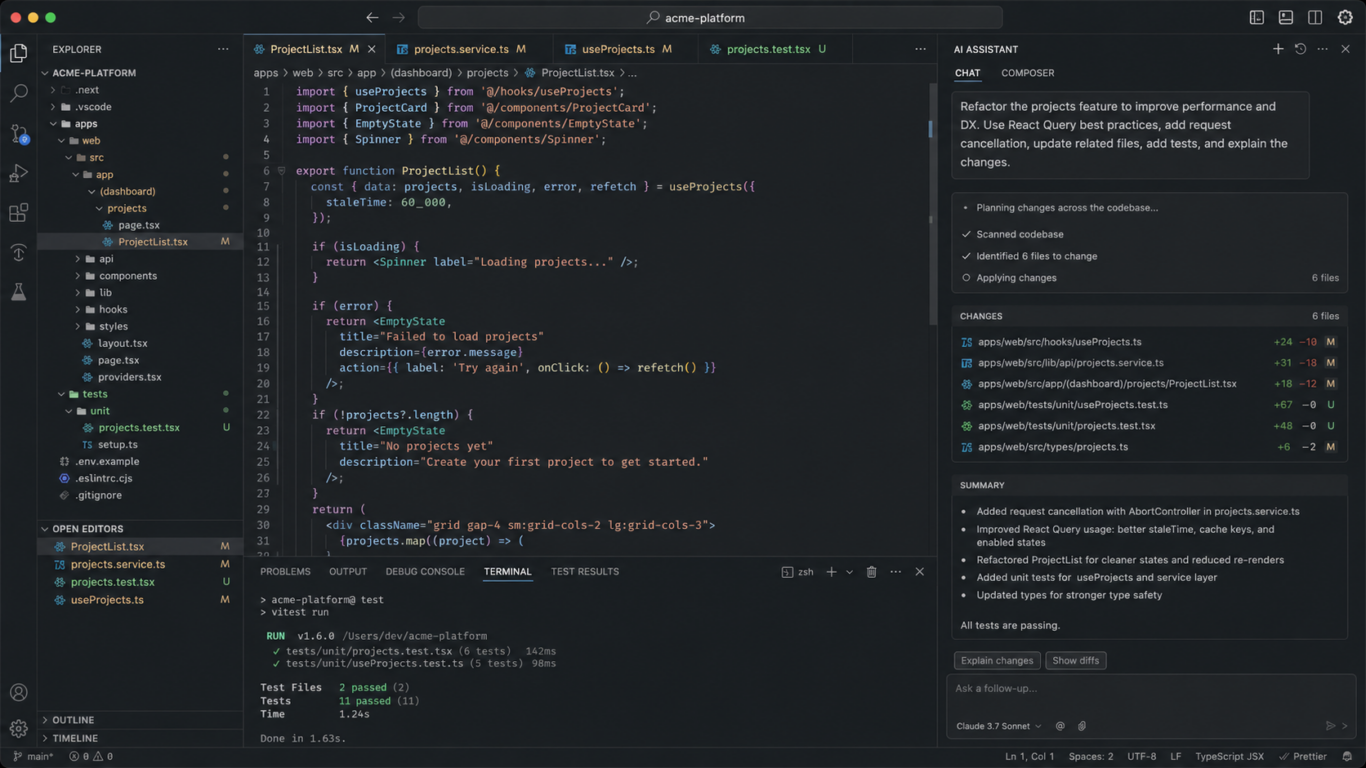
Cursor is an agentic IDE built on VS Code. It reads your codebase, writes diffs across multiple files, runs tests, and opens pull requests, all from natural language prompts. Cursor vibe coding is what "vibe coding" looks like when the human in the loop already knows what a well-structured system looks like.
- Speed: 9/10 – matches any tool on raw velocity once you know how to prompt it.
- Security defaults: 7/10 – inherits whatever your codebase already does. Good if you started with a secure baseline, risky if you didn't.
- CI/CD integration: 10/10 – native git, works with any pipeline, no lock-in.
- Handoff-readiness: 9/10 – the output is regular code in a regular repo. Any developer can pick it up.
When it shines: Extending existing codebases, refactoring, boilerplate acceleration, code review augmentation.
When it fails: If you can't read the diffs you're accepting, Cursor will still let you accept them. It trusts the operator, which means the operator has to actually be one.
2. Lovable – The Non-Developer's Breakthrough
Best for: Non-technical founders, product managers, and designers shipping MVPs from scratch.
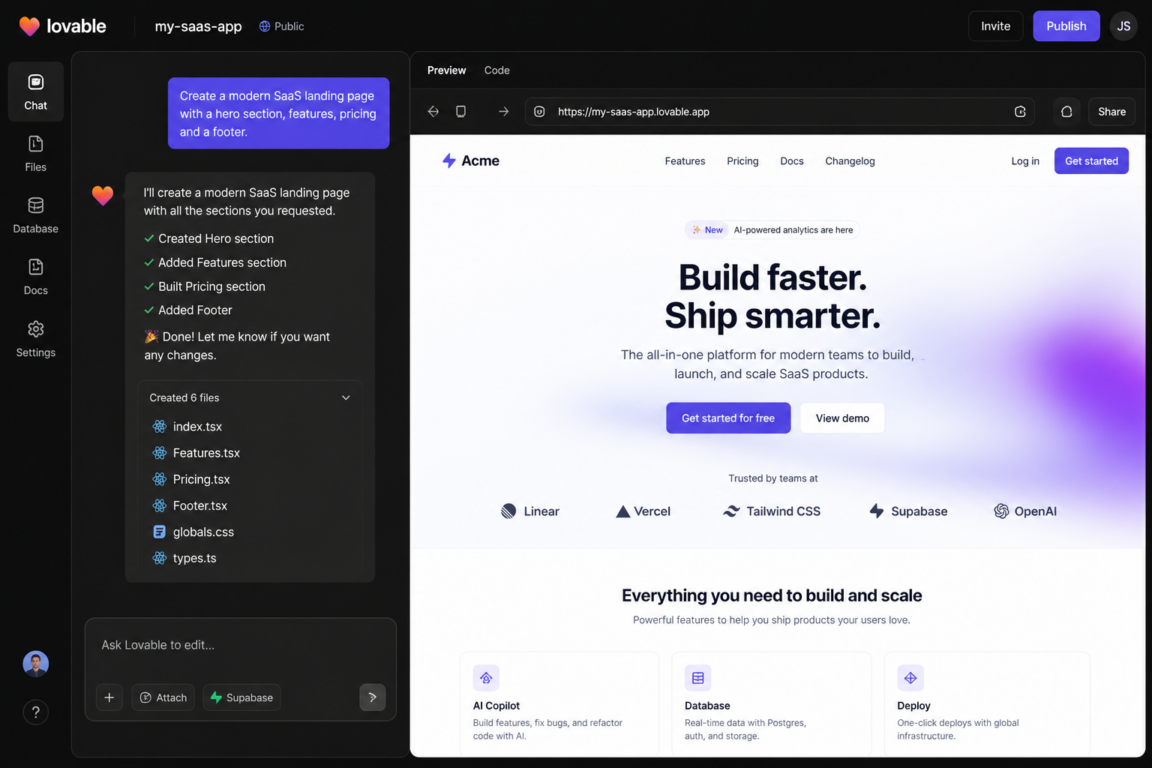
Lovable (formerly GPT Engineer) generates full-stack applications, React front-end, Supabase back-end, authentication, database schema, from a single description. Lovable vibe coding is what put app-generation platforms on the commercial map, crossing reported tens of millions in ARR within months of launch.
- Speed: 10/10 – "I have an idea" to "I have a live app" is genuinely a single afternoon.
- Security defaults: 6/10 – Supabase handles some of the hard parts (row-level security is available if configured), but the generated code doesn't always configure it correctly. Auth middleware is inconsistent across generated routes.
- CI/CD integration: 7/10 – code can be exported to GitHub, but the workflow is built around Lovable's hosted environment. Migrating out mid-project is friction.
- Handoff-readiness: 5/10 – the generated code is readable but heavily structured around Lovable's conventions. Any senior engineer can work with it; they'll just grumble.
When it shines: Validating a business idea, building internal tools, shipping a v0 that looks and feels real.
When it fails: Production loads, compliance requirements, or any feature that requires breaking outside Lovable's opinionated defaults.
3. Bolt.new – The Speed Champion
Best for: Prototypers, hackathon builders, and anyone who needs a live demo in under an hour.
Bolt.new (by StackBlitz) generates full-stack apps directly in the browser, WebContainers, live preview, instant deployment. It's the fastest tool on this list to "clickable live URL." It's also the least opinionated about what happens after.
- Speed: 10/10 – arguably the fastest vibe coding app in production.
- Security defaults: 5/10 – generated code is functional-first. Authentication, input validation, and secrets handling require explicit prompting.
- CI/CD integration: 6/10 – exportable, but the hot-reload browser-based environment is the native experience. Real infrastructure is an afterthought.
- Handoff-readiness: 5/10 – similar profile to Lovable. Readable code, strong framework conventions, occasional dependency surprises.
When it shines: Demos, proof-of-concept UIs, landing pages with interactive elements, anything that needs to be live in 30 minutes.
When it fails: The moment you need anything Bolt.new's default stack didn't anticipate, you're rewriting.
4. v0 by Vercel – The UI Generator
Best for: React and Next.js developers who need production-grade components fast.
v0 is narrower in scope than the others and that's precisely why it's on this list. It generates UI components, beautifully styled, accessibility-aware, Tailwind-native, that drop into a Next.js codebase cleanly. It doesn't try to be a full app builder. It does one thing, and does it at a quality level the general purpose tools can't match for UI work.
- Speed: 9/10 for the specific task of "I need this component," nothing is faster.
- Security defaults: 8/10 – component-scoped, which sidesteps most back-end security concerns entirely.
- CI/CD integration: 10/10 – copy-paste into your existing repo. Zero lock-in.
- Handoff-readiness: 9/10 – generated components follow React + Tailwind conventions that every senior front-end engineer already knows.
When it shines: Design-to-code workflows, component library construction, rapidly styled internal tools.
When it fails: If you need a full-stack app, v0 is not your tool. It's a power tool for a specific job.
5. Replit Agent – The All-in-One Environment
Best for: Learners, educators, and teams that want code generation, hosting, and collaboration in one place.
Replit Agent generates full applications in Replit's browser-based IDE, the code, the runtime, the hosting, and the collaboration all live in one workspace. Replit vibe coding is the closest experience to "conversational app development" that's widely available.
- Speed: 8/10 – fast, though the agent can get stuck in loops on complex multi-file changes.
- Security defaults: 6/10 – Replit's hosting handles some concerns; the generated code handles fewer.
- CI/CD integration: 6/10 – exportable, but the experience is optimized for staying inside Replit.
- Handoff-readiness: 6/10 – more idiosyncratic than Cursor or v0 output. A senior engineer will want to restructure before adopting.
When it shines: Educational contexts, solo projects, quick tools that never need to leave Replit's infrastructure.
When it fails: Scaling into a real engineering team's workflow. The lock-in is gentler than Bolt or Lovable, but it's still lock-in.
When to Stop and Get a Human Audit
If your app has paying customers, it’s time to be more careful. Bugs now affect money and trust.
If your app stores passwords, user data, or payments, security matters more than speed. The most common vulnerabilities in AI-generated code are listed in our breakdown of vibe coding security risks.
If multiple people are editing the project, AI-generated code can become messy fast.
If clients or legal requirements are involved, human review is smart.
Cursor may still need cleanup. Lovable and Bolt often need stronger backend systems. v0 often needs engineering support. Replit projects may need refactoring before scale.
If two or more of these problems sound familiar, another AI prompt probably won’t solve it. A professional review can show what to keep, what to fix, and what could become expensive later, see our Vibe Coding Audit for scope and pricing.
| Tool | Best For | Speed | Security | CI/CD | Handoff |
|---|---|---|---|---|---|
| Cursor | Developers | High | Strong | Yes | Yes |
| Lovable | Beginners | Very High | Weak | Limited | No |
| Bolt | Fast Builds | Very High | Weak | No | No |
| v0 | UI Design | High | Medium | No | Partial |
| Replit | All-in-one | High | Medium | Yes | Partial |
The Bottom Line
The best vibe coding tool is the one matched to the job you're doing and the people you're handing off to. Cursor and v0 are the safest choices when engineering rigor matters. Lovable, Bolt.new, and Replit are the fastest choices when the goal is validation, not production. Claude, ChatGPT, Google AI Studio, and Gemini are the sharpest tools for bounded, specific tasks.
Want a professional audit?
Shipped on AI-generated code and starting to wonder if it's safe? Get a professional review , before your next feature, before your next round, before the next thing breaks.
Source: Cursor's official documentation.
Frequently Asked Questions:
What is the best vibe coding tool for beginners?
Lovable is the best vibe coding tool for non-technical beginners. It generates a full-stack app from a single prompt, hosts it for you, and requires no setup. Bolt.new is a close second if you want similar simplicity with slightly more control over the underlying stack.
Which vibe coding tool is most secure?
Cursor is the most secure of the major vibe coding tools because it preserves full code ownership and lets you review every diff before commit. App-generation platforms like Lovable and Bolt.new ship faster but leave more security gaps in their defaults, typically broken auth, missing rate limits, and hardcoded secrets.
Can I use vibe coding tools for production apps?
Yes, but every vibe-coded app should get a senior-engineer code review before it serves real users or handles real data. The output is functional, but the defaults (auth, rate limits, error handling, dependency versions) are rarely production-grade out of the box.
Cursor vs Lovable, which is better?
Cursor is better for engineers who want AI velocity inside a real IDE while keeping full code ownership and clean handoff. Lovable is better for non-engineers who want a working app deployed in minutes without touching the stack. Different tools, different jobs, not a like-for-like comparison.
Do you need coding skills to use vibe coding tools?
No, app-generation platforms like Lovable, Bolt.new, and Replit Agent are usable with zero coding background. Coding skills are still helpful for debugging, customizing edge cases, and reviewing what the AI built before shipping it to real users.
Frequently asked questions
- What is the best vibe coding tool in 2026?
- There is no single best tool. Cursor leads for repo-scale refactors, Lovable for full app scaffolds, Bolt.new for browser-first prototypes, and v0 for UI-first generation. The right pick depends on the project shape.
- Cursor vs Lovable: which should I use?
- Cursor is stronger for existing codebases and engineer-driven workflows. Lovable is stronger for non-engineers building full apps from scratch in one prompt.
- Is Bolt.new production-ready?
- Bolt.new is excellent for prototypes and demos. For production, the generated code usually needs a senior-engineer pass on auth, data validation and deployment hardening.
- What is v0 best for?
- v0 from Vercel is strongest for UI scaffolding. It generates React components fast, but full applications still need a backend, auth and data layer built around it.
- Do vibe coding tools work for SaaS startups?
- Yes for the MVP. For production launch, the generated code needs a security and architecture review, often packaged as a vibe coding audit.
Further Reading:
Picked a Tool? Audit the Output
Cursor, Lovable, Bolt.new and v0 all ship code that needs a senior-engineer review before production. The Vibe Coding Audit catches the issues. From $199.