

Best AI Model for Coding: Grok 4.5 vs Claude vs GPT-5.5

The best AI model for coding in mid 2026 depends on what you optimize for: Claude Fable 5 leads on raw coding accuracy, Grok 4.5 wins on cost and speed, Claude Opus 4.8 is the most balanced all rounder, and GPT-5.5 stays competitive on agentic tasks. There is no single winner for every team. This guide ranks the four frontier models on the benchmarks that matter, the price you actually pay per token, and which one fits your workflow, so you can pick with data instead of hype.
Key takeaways
- There is no single best AI model for coding. Pick Fable 5 for accuracy, Grok 4.5 for cost and speed, Opus 4.8 for balance, and GPT-5.5 for a strong OpenAI option.
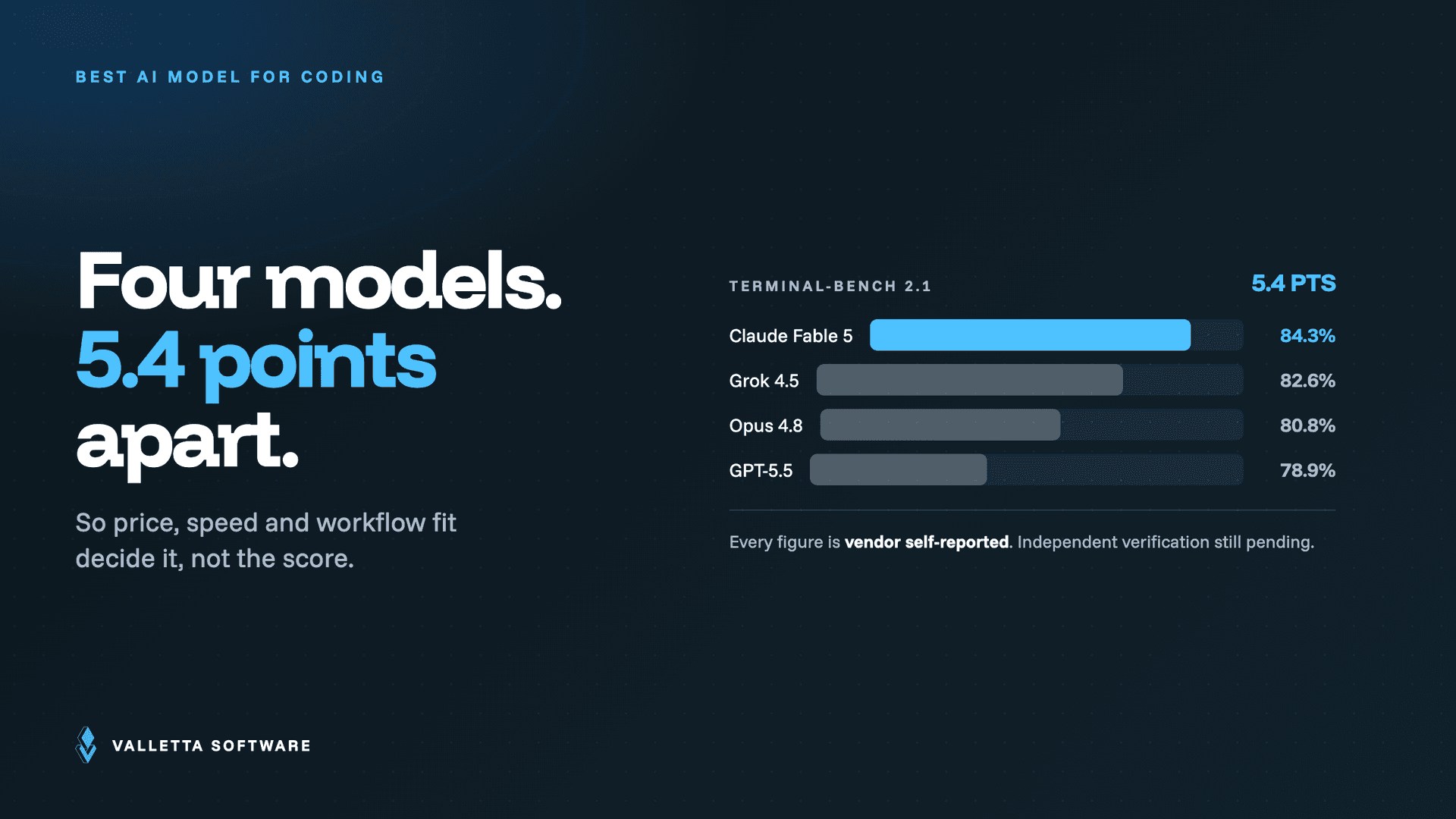
- On Terminal-Bench 2.1 the top four sit within 5.4 points of each other (84.3% down to 78.9%), so price, speed, and workflow fit usually decide the choice.
- Grok 4.5, launched July 8 2026, resolves SWE-Bench Pro tasks with about 4.2 times fewer output tokens than Opus 4.8. That efficiency is where its cost advantage comes from.
- Claude Fable 5 posts the highest coding-accuracy scores of the group: SWE-Bench Pro 80.4% and DeepSWE 1.1 70%.
- Every benchmark figure here is vendor self-reported. Independent verification is still pending, so treat the numbers as directional, not final.
What is the best AI model for coding right now?
If you want one answer: for pure coding accuracy, Claude Fable 5 is currently ahead, and for the best accuracy per dollar, the newly launched Grok 4.5 is the one to beat. Everything else is a trade off. The four leading models are close enough on capability that the deciding factors are cost, speed, context window, and how well each one fits into the tools your team already uses.
That is why a benchmark table alone will not tell you what to adopt. A model that is one point higher on a leaderboard but three times more expensive per token is not the better choice for a team shipping thousands of agent runs a day. The rest of this guide breaks the decision into the three questions that actually move the needle: how they score, what they cost, and who each one is for.
The four contenders at a glance
- Grok 4.5 (xAI). Launched July 8 2026, built on a 1.5 trillion parameter foundation and trained alongside Cursor, the AI coding editor. Its pitch is frontier-class coding at a fraction of the cost, priced at $2 per million input tokens and $6 per million output tokens. Elon Musk described it as an Opus-class model, per TechCrunch.
- Claude Opus 4.8 (Anthropic). The balanced all rounder. Strong on agentic coding, reasoning, and honesty, and the model most teams already run inside Claude Code. See our hands-on Claude Opus 4.8 review for the details.
- Claude Fable 5 (Anthropic). The accuracy leader of this group on coding benchmarks. We covered its return and what changed in our Claude Fable 5 review.
- GPT-5.5 (OpenAI). Competitive on agentic terminal tasks and a safe default for teams already standardized on OpenAI, though it trails the Claude models on the toughest repository benchmark.
How do the coding benchmarks compare?
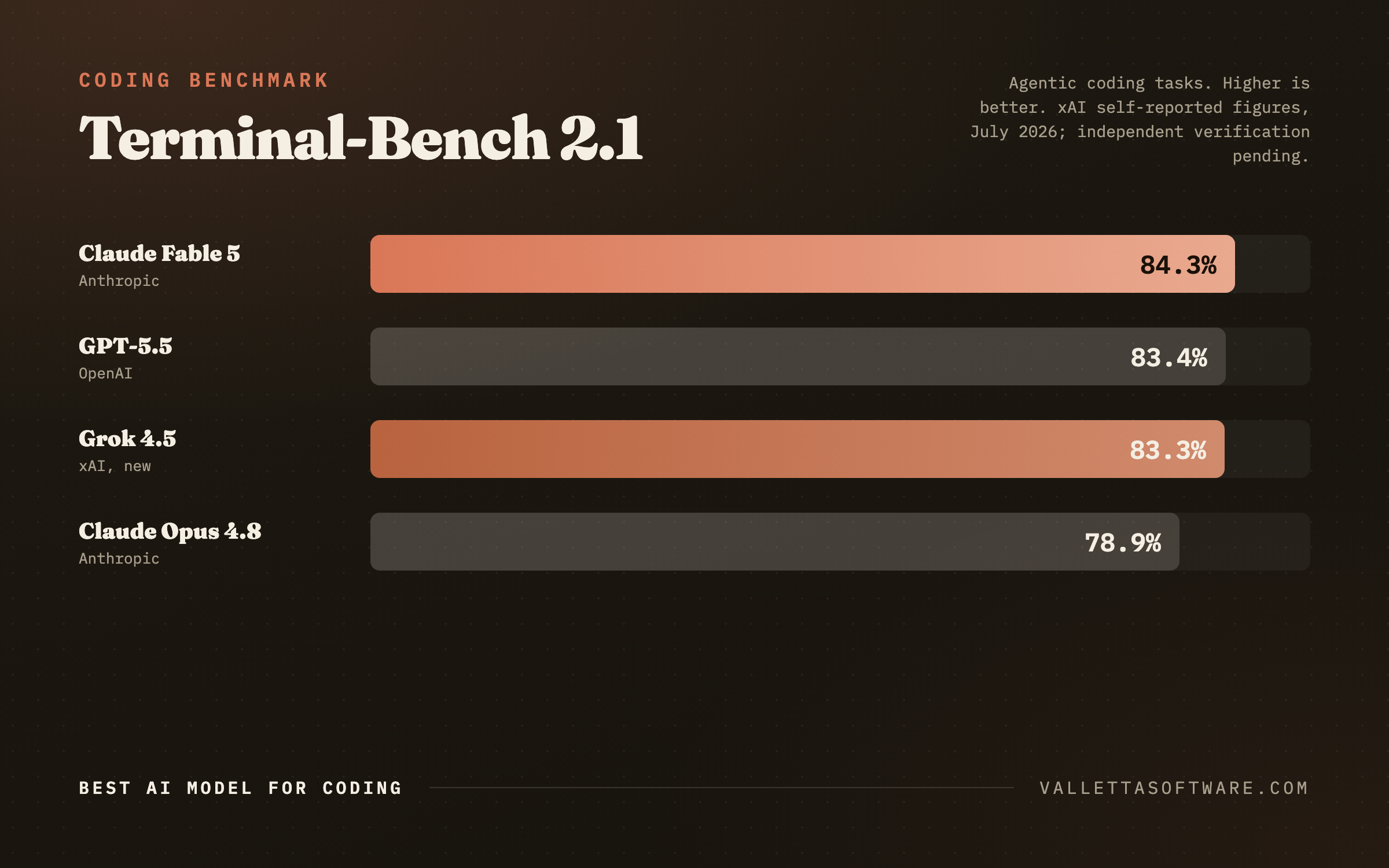
Start with Terminal-Bench 2.1, the one agentic coding benchmark that reports all four models. The race is tight. Fable 5 leads at 84.3%, GPT-5.5 and Grok 4.5 are almost level at 83.4% and 83.3%, and Opus 4.8 sits at 78.9%. When the spread across four frontier models is this small, the leaderboard position matters less than cost and fit.
On the harder repository-level benchmarks, the Claude models pull ahead. SWE-Bench Pro runs against live repositories with no leaked ground-truth answers, and DeepSWE 1.1 tests multi-step fixes. Here is how the four compare on the figures published so far.
The pattern is clear. Fable 5 is the accuracy leader across every coding benchmark it reports, GPT-5.5 is a close second on the multi-step tests, and Grok 4.5 is competitive rather than dominant on raw resolve rate. All of these are vendor self-reported figures published on the xAI launch page and Cursor's writeup, and independent verification is still pending, so read them as directional.
Which model is the most cost effective for coding?
This is where Grok 4.5 makes its case. It is priced at $2 per million input tokens and $6 per million output tokens and runs at roughly 80 tokens per second, all xAI self-reported. On its own that is aggressive pricing, but the more interesting number is token efficiency. On SWE-Bench Pro, xAI reports that Grok 4.5 resolves a task using an average of 15,954 output tokens against 67,020 for Opus 4.8, a 4.2 times gap.
That efficiency compounds. If a model reaches a similar answer using a quarter of the output tokens, you pay roughly a quarter of the output cost for the same job, before the lower per-token price is even factored in. For a team running thousands of agent invocations a day, that difference is the line item that decides your monthly bill. Grok 4.5 does not need to top every leaderboard to be the rational default for cost-sensitive, high-volume workloads. It just needs to be close on quality and far cheaper per resolved task, which is exactly the position it is in.
Which AI coding model should your team use?
Match the model to the job rather than chasing the top of a leaderboard. A practical way to choose:
- Highest code quality on hard problems: Claude Fable 5. When a wrong answer is expensive, such as a complex refactor, a security-sensitive change, or a gnarly multi-file bug, the accuracy leader earns its keep.
- Best cost per resolved task at scale: Grok 4.5. For high-volume agent workloads, batch jobs, and CI automation where you run the model constantly, its token efficiency and low price win.
- Best all-round default: Claude Opus 4.8. If you want one model for day-to-day work inside Claude Code with strong reasoning and honest self-reporting, this is the safe pick.
- Already on OpenAI: GPT-5.5. It is competitive on agentic tasks and avoids a tooling migration if your stack is already built around OpenAI.
Most mature teams do not standardize on one model. They route cheap, high-volume work to the most efficient model and reserve the accuracy leader for the changes that carry real risk. The models are close enough that a routing strategy beats loyalty to any single vendor.
What this means for engineering teams
The takeaway for engineering leaders is that model choice is now a cost and workflow decision, not a capability gamble. All four models can write good code. The value is in picking the right one per task and, more importantly, in the human review discipline around whatever the model produces. Faster, cheaper generation raises the volume of code your team ships, which makes review the real bottleneck, not typing.
This is the same shift we describe in what happens to developers in the Claude Code era: the developer moves up a level to own outcomes and direct agents, and the scarce skill becomes judgment, not keystrokes. It is also why critical paths still need an independent human check. A model that confidently reports code as secure can still be wrong, which we covered in the security risks of vibe coding. If you are building an AI-augmented team and want help choosing and operating the right models, that is exactly the work we do when companies hire AI developers.
Frequently asked questions
What is the best AI model for coding in 2026?
There is no single best model. Claude Fable 5 leads on coding accuracy benchmarks, Grok 4.5 offers the best cost and speed, Claude Opus 4.8 is the most balanced all rounder, and GPT-5.5 is a strong option for teams already on OpenAI. The right pick depends on whether you optimize for accuracy, cost, or workflow fit.
Is Grok 4.5 better than Claude for coding?
Not on raw accuracy. On the reported benchmarks, Claude Fable 5 and Opus 4.8 score higher on the hardest repository tests such as SWE-Bench Pro. Grok 4.5 is competitive on Terminal-Bench and clearly wins on cost and token efficiency, so it can be the better choice for high-volume, cost-sensitive work even if it is not the accuracy leader.
How much does Grok 4.5 cost?
Grok 4.5 is priced at $2 per million input tokens and $6 per million output tokens, and it runs at roughly 80 tokens per second, according to xAI's self-reported launch figures. It also uses about 4.2 times fewer output tokens than Opus 4.8 on SWE-Bench Pro, which lowers the effective cost per resolved task further.
Are these benchmark numbers verified?
No. The figures in this guide are vendor self-reported, published by xAI and its launch partner Cursor. Independent verification is still pending, so treat the numbers as directional and confirm them against your own workloads before standardizing on a model.
Which AI model is best for large codebases?
For complex, multi-file changes on large codebases, the accuracy leaders are the safer bet, which currently means Claude Fable 5, with Opus 4.8 close behind. Cheaper models like Grok 4.5 are well suited to high-volume routine tasks, while the highest-risk changes are worth spending the accuracy leader's tokens on.
Should a team use one model or several?
Most mature teams use several. A common pattern is to route cheap, high-volume work to the most token-efficient model and reserve the accuracy leader for risky or complex changes. Because the top models are so close on capability, a routing strategy usually beats committing to a single vendor.