

Vibe Coding Explained: What It Is & 5 Risks to Avoid (2026)


Vibe coding is the fastest way to ship software that no one alive fully understands, including the person who built it. That's not a criticism. It's a description of how the technology actually works, and why it matters that you know what you're getting before you scale it into a production environment with real users and real data. If you suspect any of these risks already live in your app, get a vibe coding audit.
Updated June 2026: the risk checklist, the current 2026 tool landscape, and every linked source on this page were re-verified for accuracy.
This guide covers the vibe coding definition, the tools behind it, who's using it, how it works in practice, and critically, what experienced engineers know about it that the hype cycle tends to leave out.
Quick Answer
Vibe coding is a way of building software by describing what you want in natural language and letting an AI model generate the code. It enables extremely fast prototyping, even for non-engineers but introduces security, technical-debt, and maintainability risks if the output is not reviewed before production.
Key Takeaways
- Vibe coding replaces syntax with prompting, shifting the developer's role from writing code to directing intent.
- The term was coined by Andrej Karpathy (OpenAI co-founder) in February 2025.
- It dramatically speeds up MVP creation, even for non-technical founders.
- Security risks are concrete and common: SQL injection, missing authentication, hardcoded secrets, IDOR, outdated dependencies.
- Technical debt compounds quickly because AI-generated code has no mental owner.
- The biggest risk isn't the AI, it's skipping review before shipping to real users.
What Is Vibe Coding?
For a focused explainer on the term itself, origins, Karpathy's tweet, the Torvalds counterpoint, see What is vibe coding.
Vibe coding is a development approach where a person describes what they want to build in natural language and an AI model, typically a large language model with code generation capabilities writes the code to make it happen. The human's role shifts from writing syntax to directing intent: describing features, reviewing outputs, and prompting corrections.
The term was coined by OpenAI co-founder Andrej Karpathy in February 2025, in a post that read:
There's a new kind of coding I call "vibe coding", where you fully give in to the vibes, embrace exponentials, and forget that the code even exists. It's possible to just see stuff, say stuff, ship stuff, and mostly forget what you even made.
Andrej Karpathy, February 2025
The phrase stuck because it named something that was already happening. Developers and non-developers alike were using tools like Cursor, Lovable, Bolt, and Replit Agent to go from idea to working prototype in hours, with little or no traditional programming knowledge required.
In the vibe coding definition that's emerged, three things are always present:
- Natural language input – you describe what you want in plain English (or any language).
- AI code generation – the model writes, debugs, and iterates the code.
- Minimal syntax involvement – the human steers direction, not implementation details.
This is distinct from AI-assisted coding (where an experienced developer uses Copilot-style autocomplete as a tool) and from no-code platforms (where a GUI handles logic). Vibe coding is neither: you're producing real, functional code, but you're not writing it yourself.
Vibe Coding Meaning in Context: Why 2025 Was the Inflection Point
The vibe coding AI moment didn't emerge from nowhere. It required the convergence of three things that happened to align in late 2024 and early 2025:
1. Models capable of long-context code generation
GPT-4, Claude, and Gemini each crossed a threshold where they could hold a full application's context, routes, components, schema, state management within a single session without losing coherence. Earlier models generated individual functions well; newer models generate coherent systems.
2. Agentic IDEs that could execute, not just suggest
Tools like Cursor and Windsurf crossed from autocomplete into autonomy, they could read a project, run tests, identify failing lines, and fix them without the developer manually shepherding each change. The loop of generate → test → fix became machine-speed.
3. The rise of app-generation platforms
Lovable (formerly GPT Engineer) crossed $10M ARR in its first months of operation, with users primarily being non-technical founders building MVPs. Bolt and Replit Agent followed with similar adoption curves. Suddenly "I shipped a working app last weekend" became a normal thing non-developers said.
The combination made vibe coding a genuine category, not a curiosity. Which is precisely when the serious questions started.
What Is a Vibe Coder?
A vibe coder is someone who builds functional software primarily through AI prompting rather than traditional programming. The term covers a wide range of people:
- Non-technical founders building MVPs to validate business ideas
- Product managers prototyping features without waiting for engineering bandwidth
- Designers turning Figma mockups into functional front-ends
- Experienced developers using vibe coding to accelerate boilerplate, scaffolding, and repetitive work
- Students and hobbyists building tools for personal use
What vibe coders share is not a skill level, it's a workflow. The core loop is:
- Describe the desired feature in natural language.
- Review the AI's generated output (visually or functionally).
- Prompt corrections or refinements.
- Accept, merge, or deploy when the output matches intent.
This loop is fast. For simple apps, a vibe coder can go from concept to deployed prototype in a single afternoon. That speed is the central appeal, and the source of most of the risk.
Vibe Coding Tools: The Current Landscape
The vibe coding tools ecosystem has fragmented quickly. Different tools serve different use cases, and the choice of tool determines a lot about what risks you're taking on.
Agentic IDEs – for developers who still want code ownership
These tools – Cursor, Windsurf, GitHub Copilot Workspace, integrate into a development environment and give AI access to your full codebase. A developer prompts in natural language; the tool writes diffs, runs tests, and creates pull requests. The human reviews changes before committing.
App generation platforms – for non-developers building from scratch
Lovable, Bolt.new, and Replit Agent take a description and generate a full-stack application, front-end, back-end, database schema. The user sees a live preview; the code lives in the platform's infrastructure or can be exported. Lovable's revenue trajectory (reportedly reaching tens of millions ARR within months of launch) is the defining data point for this category's commercial momentum.
Chat-based assistants with code execution, for prototyping and scripts
ChatGPT with Code Interpreter, Claude with computer use, and Google AI Studio can write, execute, and iterate on code within a conversation. These are less suited to full-application development and more suited to automation scripts, data processing, and single-purpose tools.
For a full comparison of tools, features, and appropriate use cases, see our guide to vibe coding tools.
How to Vibe Code: The Basic Workflow
The practical mechanics of how to vibe code are simpler than most tutorials make them sound. The skill is in prompting, not in programming.
Step 1 – Define scope tightly before you start
The most common vibe coding failure is starting with "build me a SaaS app." Start instead with the smallest possible slice: "Build a login form with email/password that validates on submit and shows an error state." Narrow scope = coherent output.
Step 2 – Choose the right tool for the output
If you need a full-stack app with a database, use Lovable, Bolt, or a similar platform. If you're extending an existing codebase, use an agentic IDE. If you need a quick script, use a chat-based assistant. Tool mismatch is responsible for a significant proportion of bad vibe coding experiences.
Step 3 – Prompt in outcomes, not implementations
"Make the button blue" is a worse prompt than "The primary CTA button should be visually dominant – use the brand accent color with high contrast." Describe what you want the user to experience, not what CSS to write. The model decides implementation; you decide intent.
Step 4 – Review every change before accepting
This step is where vibe coders most often get into trouble. When a change "looks right," it's tempting to accept without reading the diff. But AI-generated code can introduce subtle issues, unused variables, inefficient queries, missing validation, that aren't visible in the UI.
Step 5 – Test on real inputs, not just happy paths
AI-generated code is typically optimized for the example in the prompt, not for edge cases. Test with empty inputs, malformed data, and unexpected user behavior before shipping.
Step 6 – Maintain a record of what was built
This sounds obvious but is consistently skipped. A brief comment on each major feature ("AI-generated checkout flow, not reviewed for PCI compliance") creates an audit trail that becomes essential if you ever need to debug, hand off, or secure the codebase.
For a detailed walkthrough with worked examples, see how to vibe code.
Is Vibe Coding Bad? The Honest Assessment
This is the question that generates the most search traffic, and the most polarized opinions.
Linus Torvalds, creator of Linux and someone whose opinion on code quality carries weight, has not been complimentary about AI-generated code in general, describing it as producing "random crap." His broader concern is that AI systems generate plausible-looking code that lacks the deep architectural reasoning that makes systems maintainable and secure over time.
This is not a fringe view. It's shared by a significant portion of the senior engineering community.
But "is vibe coding bad" is the wrong question. The better questions are:
Bad for what?
Vibe coding is arguably ideal for: MVPs, internal tools, personal projects, prototyping, throwaway scripts, front-end mockups, and any context where speed matters more than long-term maintainability. It is arguably dangerous for: production systems handling sensitive data, applications with compliance requirements (HIPAA, PCI-DSS, SOC 2), and any system where a security flaw has real commercial or legal consequences.
Bad compared to what?
A non-technical founder using vibe coding to validate a business idea is not comparing it to "a senior engineer building it properly." They're comparing it to "not building it at all" or "waiting six months to find a developer." In that comparison, vibe coding wins on almost every axis.
Bad without what?
Vibe coding without any technical review is higher-risk than vibe coding with a code audit before launch. The technology doesn't have to be used carelessly. Most of the cautionary stories in the vibe coding discourse are stories about a lack of review process, not about AI code generation being inherently flawed.
The vibe coding meme, the jokes about founders shipping apps they can't maintain, AI writing code that looks like it works until it doesn't contains real truth. But so does the counter-narrative: real products have been built, real revenue generated, real problems solved by people who would never have been able to ship software before these tools existed.
The pragmatic answer: vibe coding is a powerful tool with specific failure modes. Know the failure modes before you rely on the tool.
Vibe Coding Security: The Risk Every Founder Misses
Security is where vibe coding's risk profile diverges most sharply from traditional development, and where the consequences of not knowing what you're shipping are most serious.
AI code generators are trained on vast corpora of existing code. That code includes both secure and insecure patterns. When a model generates authentication logic, input handling, or API endpoints, it statistically reflects the patterns it was trained on, which includes patterns that are outdated, misconfigured, or explicitly vulnerable.
The most common security issues in AI-generated code:
SQL injection vulnerabilities
Models frequently generate database queries using string concatenation rather than parameterized queries, especially when prompted in a way that doesn't specify the ORM or security context. A query that looks functional in testing can be exploited in production.
Missing authentication on API routes
It's common for AI-generated back-ends to generate API routes with logic but without authentication middleware applied. The route works; it just works for anyone, not just authenticated users.
Hardcoded secrets and credentials
Models sometimes generate example code with literal strings as API keys, database passwords, or tokens, and when that code is copy-pasted or deployed directly, those secrets go into version control or into the running application.
Insecure direct object references (IDOR)
AI-generated data-fetching code frequently lacks authorization checks, verifying not just that a user is authenticated, but that they're authorized to access the specific resource they're requesting. This is one of the most exploited vulnerability classes in real applications.
Outdated dependencies
App-generation platforms that scaffold full-stack applications often install dependency versions from their training data, which may be months or years out of date. Outdated dependencies are a known entry point for supply-chain attacks.
None of these vulnerabilities are exotic. They're the same vulnerabilities that appear in OWASP's Top 10 every year. The difference with vibe coding is that the person who shipped the code may not know enough to review for them, and the AI generator doesn't know enough about the deployment context to flag them proactively.
Before you ship vibe-coded software to real users, here's what to audit, a checklist covering the most critical security checks for AI-generated codebases.
The Technical Debt Problem: What Happens After You Ship
Security is the acute risk. Technical debt is the chronic one.
Vibe-coded software tends to accumulate a specific type of technical debt that's harder to manage than debt incurred by human developers: structural debt without authorship.
When a human developer writes code that creates debt, a quick fix, a skipped abstraction, a copy-pasted block – they typically know they did it. They remember it. They can explain it. The code has a mental owner.
AI-generated code has no mental owner. The founder who prompted it may not understand what it does. The model that generated it has no persistent memory. If a bug appears six months later, the investigation starts from zero.
The specific patterns vibe coding creates that compound over time:
- Redundant implementations – AI generators frequently create duplicate functions or components, one version for each time the feature was prompted. The first version doesn't get cleaned up because the human doesn't know it exists.
- Inconsistent data handling – Different parts of an AI-generated codebase may handle the same data type in different ways, because each section was generated in a separate prompt context. This creates subtle bugs that appear only when the sections interact.
- Untraceable dependencies – AI-generated code often imports libraries the prompter didn't request and doesn't recognize. When those libraries become deprecated or vulnerable, there's no one who knows why they're there or what depends on them.
- Missing test coverage – AI generators focus on making code functional. Test suites are an afterthought – often absent entirely unless explicitly prompted. A codebase without tests cannot be refactored safely.
The velocity of vibe coding makes it easy to accumulate six months of technical debt in two weeks. That debt is real, and the long-term cost of skipping a review compounds with every feature added on top of an unreviewed foundation.
The Vibe Coding Meme: What the Internet Got Right (and Wrong)
"Vibe coding" became a meme almost immediately after Karpathy named it. The canonical format – founder ships app in a weekend, app has no tests, founder can't explain how it works, founder raises venture funding – captured something real about the moment.
What the meme gets right
- The speed is real. Prototypes that would take weeks can genuinely be built in days.
- The comprehension gap is real. Vibe coders frequently don't understand the code they shipped.
- The confidence mismatch is real. The fact that something works in a demo does not mean it will survive production traffic, edge cases, or a security researcher.
What the meme gets wrong
- The implication that this is uniquely a non-developer problem. Experienced developers using vibe coding tools also accept AI changes without reading diffs, also accumulate unexplained dependencies, also ship without testing edge cases. The failure modes are the same; the developer's background only changes how quickly they can recover when things go wrong.
- The implication that the output is necessarily bad. AI-generated code, reviewed carefully and tested properly, can be production-quality. The process is different; the outcome quality is variable, not inherently lower.
The meme's cultural staying power is a signal, not a verdict. It means the industry recognizes that a new set of failure modes exists. The useful response is not mockery, it's a clear-eyed framework for which failure modes you're accepting and which you're mitigating.
What Founders and Technical Leaders Need to Know Before Scaling
If you're a founder who has used vibe coding to get to an MVP, or a technical leader whose team is adopting AI-assisted development at scale, the questions to ask before you grow are:
1. Do you know what your dependencies are?
Run npm audit or the equivalent for your stack. Look at the dependency tree. Count how many packages were installed by the AI generator that you didn't explicitly request. This is your baseline for supply-chain risk.
2. Do you have any authentication review in your deploy pipeline?
Every route that serves user data should be manually verified to have authentication and authorization applied. This is a one-time audit that catches the most common class of AI-generated security flaw.
3. Is any sensitive data processed by the AI-generated code?
If PII, payment information, or health records are involved, you need a professional security review before you have users. The cost of a review is orders of magnitude lower than the cost of a breach.
4. Can you onboard a new developer to this codebase in a week?
If the answer is no, if the codebase is structurally incoherent, has no documentation, and the original builder can't explain it, you have an organizational risk as well as a technical one. The codebase is a single point of failure.
5. What does your escalation path look like?
When something breaks in production, who fixes it? If the answer is "we prompt the AI again and hope," you don't have a maintenance plan, you have a gamble.
These questions don't require abandoning vibe coding. They require treating it as what it is: a powerful accelerant with specific operational requirements, not a replacement for engineering judgment.
FAQ
What is vibe coding?
Vibe coding is a development approach where software is built by describing desired functionality in natural language and using AI tools to generate the code. The human directs intent; the AI handles implementation.
Who coined the term "vibe coding"?
Andrej Karpathy, AI researcher and former OpenAI co-founder, coined the term in a February 2025 social-media post describing a style of development where the developer "fully gives in to the vibes" and lets AI handle the code.
What is a vibe coder?
A vibe coder is anyone who builds software primarily through AI prompting rather than writing code manually. This includes non-technical founders, product managers, designers, and experienced developers using AI tools to accelerate their workflow.
Is vibe coding safe to use for production apps?
Vibe coding carries specific security risks, including SQL injection vulnerabilities, missing authentication, and hardcoded secrets, that require review before production deployment. It is not inherently unsafe, but deploying AI-generated code without a security audit significantly increases risk.
What tools do vibe coders use?
Common vibe coding tools include Cursor and Windsurf (agentic IDEs for developers), Lovable and Bolt (app generation platforms for non-technical users), and ChatGPT and Claude (chat-based assistants for scripts and prototyping).
What did Linus Torvalds say about vibe coding?
Linus Torvalds has been generally critical of AI-generated code, describing it as producing low-quality output that lacks the architectural reasoning required for maintainable systems. His critique applies most strongly to code shipped without expert review.
The Bottom Line
Vibe coding is one of the most significant shifts in how software gets built since the introduction of high-level programming languages. It has genuinely democratized the ability to ship working software. It has also introduced a new class of problems for founders and engineering teams who don't understand what the AI built on their behalf.
The founders who will get the most out of vibe coding over the next three years are the ones who treat it as a powerful first draft, not a finished product, who use it to move fast to validation, then bring in the engineering judgment to harden what they've built before it scales.
The rest will find out why experienced engineers have strong opinions about this, in the most expensive way possible.
Building on AI-generated code? Get it reviewed before you scale.
Valletta Software's engineering team runs security and technical-debt audits specifically for vibe-coded codebases. We check for the failure modes above, SQL injection, missing auth, IDOR, outdated dependencies, structural debt, and give you a prioritized fix list before your next release.
Frequently asked questions
- What is vibe coding?
- Vibe coding is the practice of building working software by prompting AI tools like Cursor, Lovable, Bolt.new or v0 instead of writing each line by hand. The developer steers the AI with natural-language instructions and iterates on the output.
- What are the main risks of vibe coding?
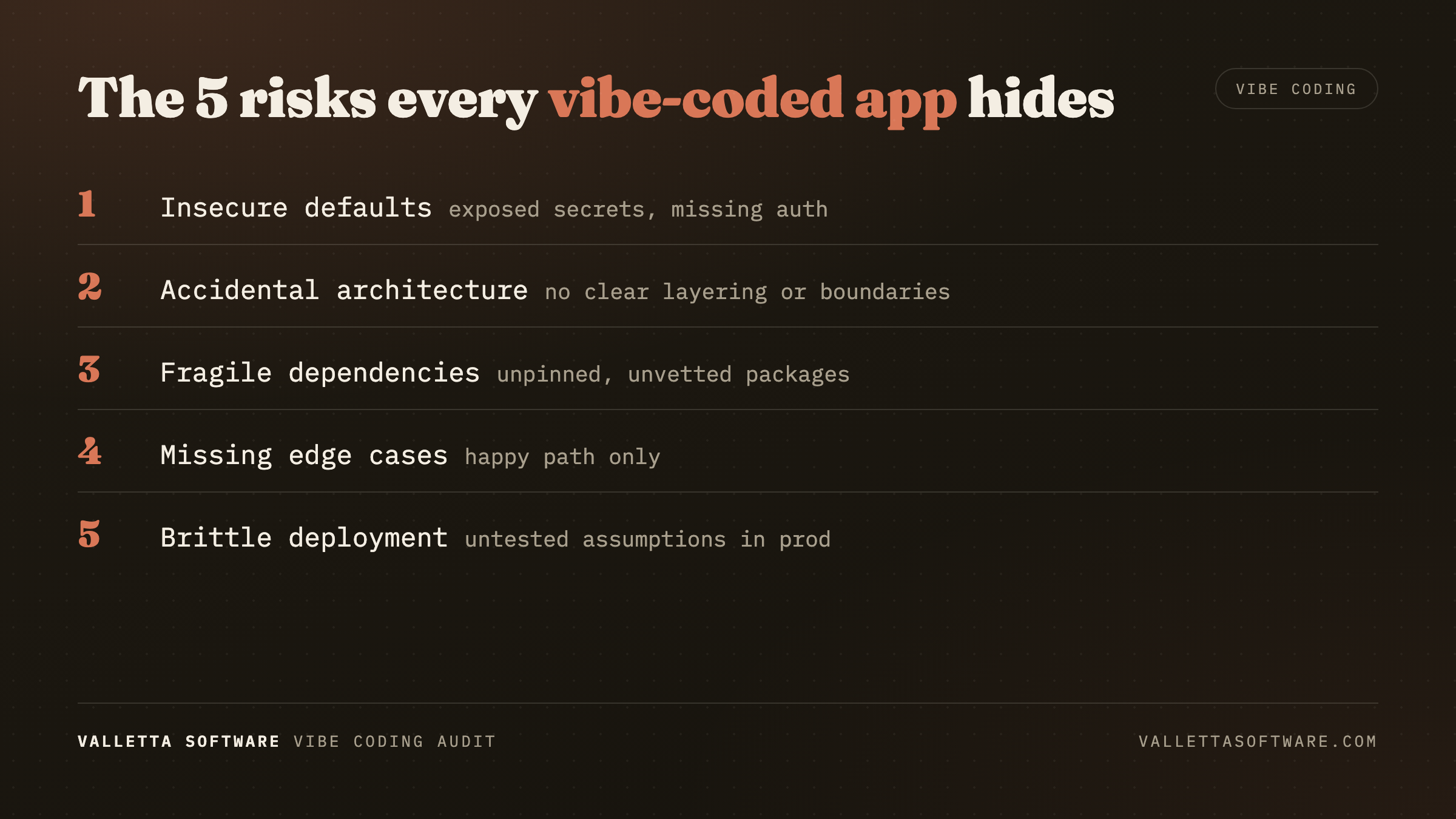
- The five most common risks are: insecure defaults (exposed secrets, missing auth), accidental architecture (no clear layering), fragile dependencies, missing edge-case handling, and brittle deployment assumptions. Each one is usually invisible until production traffic or an investor review hits.
- Is vibe coding safe for production?
- It can be, but only after a senior-engineer review. AI tools can ship features fast, but the generated code rarely enforces auth boundaries, validates input the same way a hand-built app would, or handles concurrency and rate limits.
- How do I know if my AI-built app has hidden risks?
- Run a vibe coding audit. A senior engineer reviews the authentication, database, API and deployment layers, then returns a prioritized remediation roadmap. Valletta Software runs fixed-fee audits from $199.
- Which AI coding tools are reviewed in a vibe audit?
- Apps built with Cursor, Lovable, Bolt.new, v0 and similar AI-assisted workflows. The audit looks at the actual codebase rather than the tool, so any AI-generated stack qualifies.
Further Reading:
Request a Vibe Coding Audit
Fixed-fee senior-engineer review of apps built with Cursor, Lovable, Bolt.new or v0. Find the risks before launch, fundraising or handoff. From $199.