

AI Development Solutions: Types, Patterns, and Business Use Cases Globally (2026)

AI development solutions are the combination of AI products, platforms, and engineering patterns that help organizations turn data and knowledge into reliable, measurable business outcomes, such as copilots, automation, forecasting, and decision support. They typically include foundation model APIs, custom model development (including fine-tuning), and MLOps or LLMOps tooling for evaluation, monitoring, and governance. In 2026, adoption is mainstream but scaling is still the hard part: McKinsey reports that reported AI use in at least one business function reached 88% in 2025, while most organizations still struggle to operationalize AI consistently across teams. At the same time, Gartner forecasts worldwide AI spending will total $2.52 trillion in 2026 (up 44% year over year), which raises the bar on choosing the right solution type and delivery pattern. This article breaks down major types of AI development solutions, key implementation patterns, and how global enterprises can select the right approach for their needs. To pick the right AI solution for your business, talk to a senior AI development team.
Types of AI Development Solutions
AI development solutions can be broadly categorized into three main types: pre-trained APIs, custom model development, and embedded AI platforms. Each addresses different business requirements and levels of investment.
- Pre-Trained AI APIs: Services such as LLM and embedding APIs, speech-to-text, translation, and computer vision that allow rapid integration of AI features with minimal development overhead. In 2026, these commonly run through managed foundation model platforms like AWS Bedrock, Azure OpenAI Service, and Google Vertex AI. They are ideal for organizations seeking quick wins and standardized solutions.
- Custom Model Development: This approach involves designing, fine-tuning, training, and deploying proprietary AI models tailored to specific business needs, including domain adaptation of foundation models, distillation for lower latency, and edge deployments where applicable. It affords granular control and competitive differentiation, but requires significant expertise, strong data practices, and production-grade MLOps.
- Embedded AI Platforms: Tools and frameworks, often operationalized within cloud environments, that enable organizations to build, manage, and scale AI workflows end to end. In 2026 this typically includes both MLOps and LLMOps capabilities: evaluation pipelines, prompt and model versioning, guardrails, monitoring, and governance. Common building blocks include Amazon SageMaker, Databricks MLflow, Kubernetes, Terraform, and OpenTelemetry.
Key considerations for solution selection:
Time-to-market pressures often drive preference for pre-trained APIs, especially for copilots and document intelligence.
Differentiated use cases with proprietary data call for custom models or fine-tuned foundation models.
Strategic AI programs benefit from embedded platforms for lifecycle management, governance, and operational control.
Popular AI Solution Design Patterns
Selecting the right architectural pattern is as important as the solution type. Design patterns frame how AI components interact with data, users, and systems, influencing scalability, reliability, and business value.
- Retrieval-Augmented Generation (RAG): Combines generative AI with real-time retrieval to improve grounding and reduce hallucinations. In 2026, strong RAG implementations typically add hybrid search (keyword + vector), reranking, metadata filtering, and evaluation gates. It is suited for enterprise search, knowledge assistants, support, and regulated knowledge work.
- Ensemble Modeling: Mixes multiple model outputs or combines specialized models (for example, rules + ML + LLM) to boost performance and reliability. This remains common in fraud detection, risk scoring, and forecasting where stability matters as much as raw accuracy.
- AI Pipelines: Orchestrate end-to-end workflows (data ingestion, preprocessing, training or fine-tuning, evaluation, serving, monitoring) across modular tools, ensuring reproducibility, auditability, and controlled releases. In 2026, pipelines often include automated red-teaming, regression tests for prompts and models, and observability for cost and latency.
- Online Learning: Enables real-time model updates based on incoming data, which is crucial for changing business environments. This pattern is effective when concept drift is frequent and there is a safe feedback loop, such as dynamic pricing, inventory, anomaly detection, and streaming personalization.
- Recommender Systems: Drives personalized content, product, or workflow recommendations in e-commerce, media, and SaaS. Modern recommenders increasingly blend traditional ranking models with embeddings and context signals to support real-time personalization.
Choosing a pattern hinges on requirements around interpretability, latency, data privacy, governance, and ease of iteration.
Comparison Table: Solution Types vs. Business Fit
| Solution Type | Speed to Deploy | Customization | Cost Profile | Common Use Cases |
|---|---|---|---|---|
| Pre-Trained AI APIs | High | Low | $ (Low) | Customer support copilots, document extraction, OCR, translation, basic analytics |
| Custom Model Development | Low/Medium | High | $$$ (High) | Fraud and risk scoring, demand forecasting, predictive maintenance, domain-tuned models |
| Embedded AI Platforms | Medium | Medium/High | $$ (Mid-High) | Enterprise RAG stacks, agent orchestration, model governance, monitoring and compliance |
Evaluating When to Use Each Approach
Matching a solution with your organizational maturity, business objectives, and data sophistication is crucial.
- Pre-trained AI APIs:
- Budget or time constraints, or the need to ship a production pilot quickly.
- Use cases where differentiation is limited and reliability can be achieved with guardrails.
- Limited access to proprietary data, or data sensitivity that makes custom training impractical.
- Custom model development:
- Proprietary datasets, strict compliance requirements, or data residency constraints.
- High return on investment from incremental accuracy, lower latency, or unique decision logic.
- Need for durable competitive advantage or business process transformation that off-the-shelf tools cannot deliver.
- Embedded AI platforms:
- Ongoing AI initiatives demanding governance, auditability, and enterprise scaling.
- Multiple teams shipping models, prompts, and agent workflows that require shared controls and observability.
- Desire to reduce operational friction as systems move from experiments to monitored, compliant production.
Best Practices for Implementation
Successful AI adoption is rarely accidental. In 2026, high-performing teams typically:
- Pilot projects with clear business owners, measurable KPIs, and visible ROI.
- Build cross-functional teams blending domain, data, engineering, security, and compliance expertise.
- Use evaluation harnesses (quality, safety, latency, cost) before every release of a model or prompt.
- Design scalable infrastructure with modular components, plus monitoring and incident response from day one.
- Align data governance and controls early, including access policies and standards (for example ISO/IEC 27001 and SOC 2 Type II).
- Start with a single high-value workflow, prove impact, then expand horizontally across similar processes.
- Invest in experiment tracking, model registries, and controlled rollouts to avoid regressions as teams scale.
- Use routing, caching, and fallback logic to control inference costs while meeting latency targets.
- Continuously validate outputs against business KPIs and user feedback, not just model metrics.
- Instrument systems with end-to-end observability (quality, drift, latency, cost) and enforce governance checkpoints.
Frequently Asked Questions
How do I decide between off-the-shelf and custom AI solutions?
What are the key risks with AI solution implementation?
What data infrastructure do successful AI projects require?
How do I evaluate potential technology partners?
How can I estimate the ROI of AI projects?
Conclusion
Aligning AI development solutions with business strategy is pivotal for lasting value. Companies that map specific challenges to the right solution type and pattern, and operationalize governance and evaluation, are primed to unlock real ROI in 2026. Ready to discover which AI approach fits your organization? Start by assessing current processes, available data, compliance constraints, and success metrics to guide your next AI investment.
Frequently asked questions
- What are the main types of AI development solutions in 2026?
- LLM-powered features, RAG (retrieval-augmented generation), AI agents, document automation, recommendation systems, predictive analytics, computer vision, and full MLOps platforms.
- Which AI patterns work best for SaaS products?
- RAG over product data, LLM-powered support and onboarding flows, structured-output extraction (forms, invoices), and lightweight agents that act on user data with explicit scopes.
- What about AI for enterprise teams?
- Document automation, contract review, internal search, knowledge graphs, observability for AI systems, and compliance-friendly RAG with audit trails are the highest-impact patterns.
- Which tooling stack do most AI builds use?
- Python or TypeScript, an LLM provider API (Anthropic, OpenAI, open-source), a vector database, an experiment tracker, a model registry, an observability layer, and a CI/CD pipeline with safety gates.
- Where do AI projects most often fail?
- Unclear use case scoping, missing data foundation, premature production launch, no evaluation harness, and underestimated MLOps and security cost.
Build the Right AI Solution
Valletta Software ships AI features, RAG systems, agents and MLOps platforms for SaaS and enterprise teams. Senior engineers, EU contract, AI Act aware.
Key takeaways
- 4 main AI development solution types: LLM integration, agent systems, classical ML, computer vision pipelines.
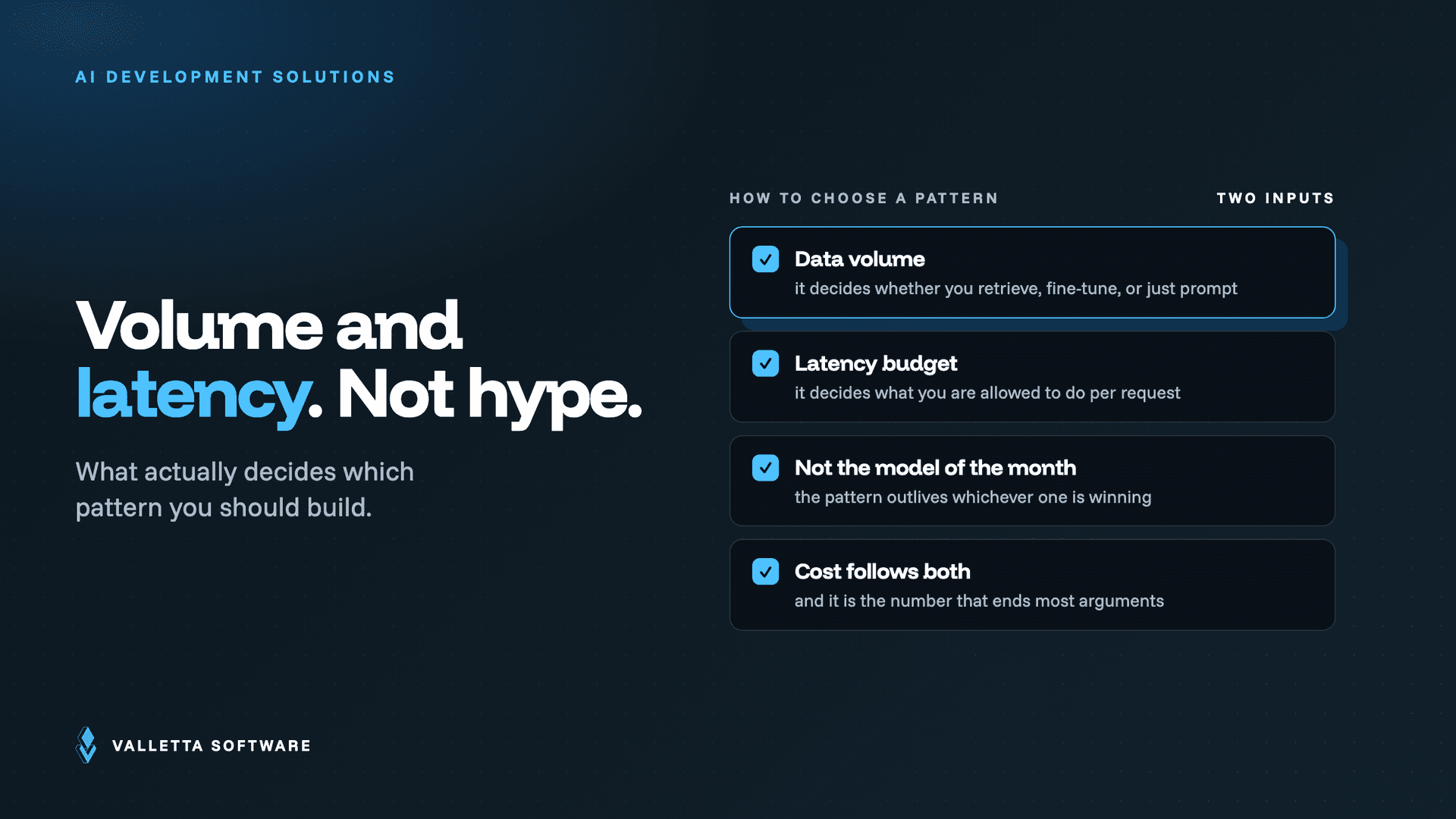
- Pattern selection depends on data volume and latency budget, not on which model is hyped this month.
- EU AI Act compliance is now a solution-architecture concern, not just a legal one. Build it in from day 1.
- The right team composition: AI engineer, MLOps, data engineer, backend, plus security review for production scope.