

Kimi K3 vs Claude Fable 5: The Full Benchmark Scorecard
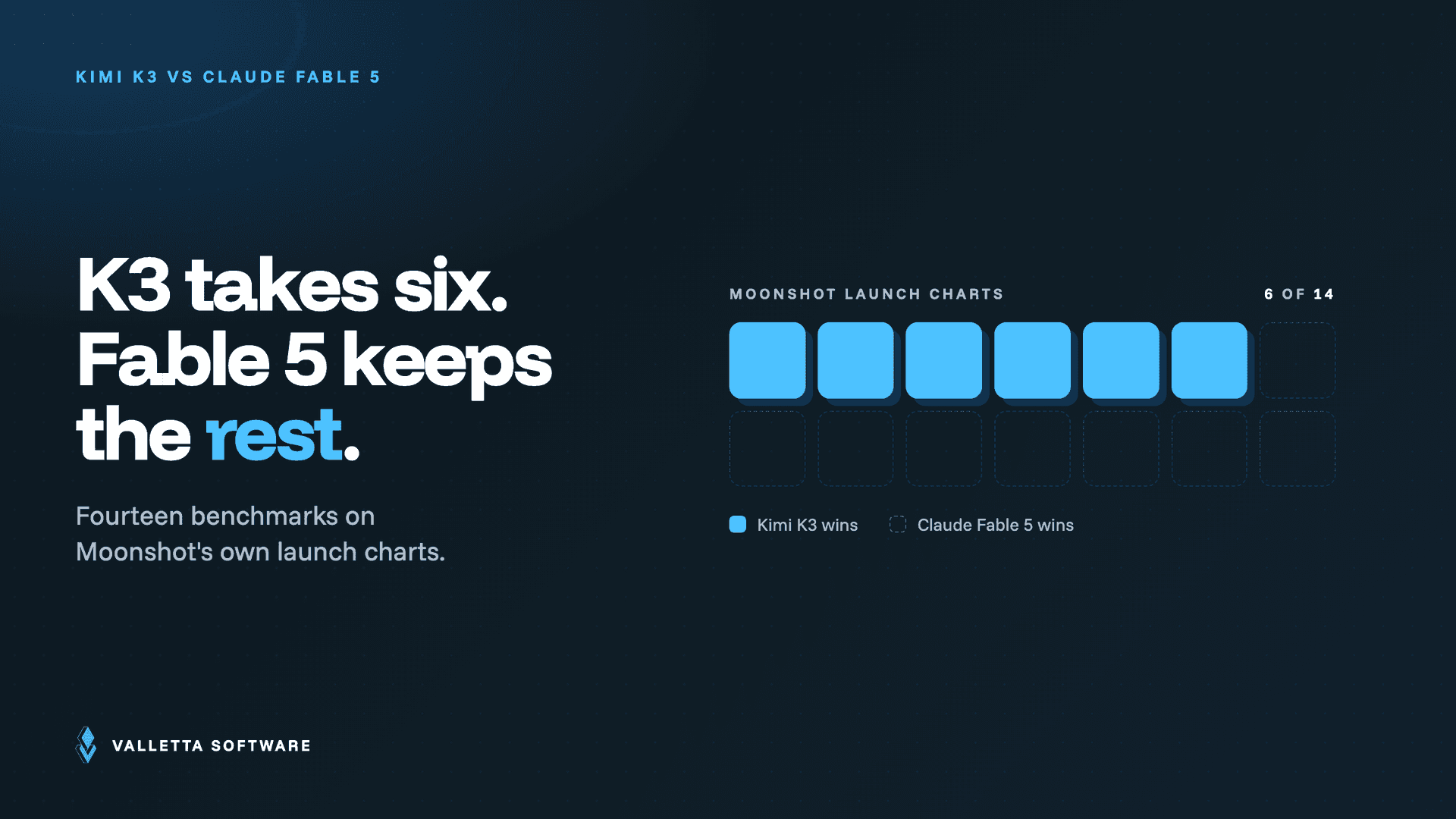

Kimi K3, the new 2.8 trillion parameter open model from Moonshot AI, beats Claude Fable 5 on 6 of the 14 benchmark charts Moonshot published at launch, and it just took the number one spot on Arena's Frontend Code leaderboard. Fable 5 still wins the other 8 charts, but K3 posts its scores as an open model: the weights ship on July 27, and the API undercuts every frontier lab.
Key takeaways
- Kimi K3 launched July 16, 2026: 2.8T total parameters, a sparse MoE that activates 16 of 896 experts per token, a 1M token context window, and native multimodality. Moonshot calls it the first open 3T-class model.
- On Moonshot's own launch charts, K3 beats Claude Fable 5 on 6 of 14 benchmarks: Terminal Bench 2.1, Program Bench, SWE Marathon, Automation Bench, SpreadsheetBench 2, and BrowseComp. Fable 5 wins the other 8.
- K3 is now #1 on Arena's community-voted Frontend Code leaderboard with 1679 points, ahead of Fable 5 and a 17-place jump from Kimi K2.6.
- API pricing: $0.30 per million input tokens on cache hits, $3.00 per million on cache misses, $15.00 per million output tokens.
- Credibility detail: Fable 5 still wins Kimi's own internal benchmark (Kimi Code Bench 2.0), which Moonshot published anyway. Charts that let the competitor win at home deserve a little more trust.
- All scores below are vendor-run at maximum thinking effort. Treat them as directional, and test on your own workload before moving anything.
Published July 17, 2026. Every number in this piece comes from Moonshot AI's launch charts or Arena's public leaderboard, and we say which is which as we go. Vendor benchmarks are marketing with axes; the leaderboard is human votes. Neither is your workload.
What Kimi K3 actually is
Moonshot AI shipped Kimi K3 on July 16, 2026 across Kimi.com, Kimi Work, Kimi Code, and the Kimi API platform. The headline specs: 2.8 trillion total parameters in a sparse mixture-of-experts arrangement Moonshot calls Stable LatentMoE, activating 16 of 896 experts per token, with a 1 million token context window and native vision. Full weights are promised for July 27, which would make it, in Moonshot's words, the world's first open 3T-class model.
Two architecture claims stand out in the technical blog. Kimi Delta Attention delivers up to 6.3x faster decoding in million-token contexts, which is the difference between a 1M window you advertise and a 1M window people actually use. Attention Residuals add roughly 25% training efficiency at under 2% extra cost, and the whole recipe lands at about 2.5x the scaling efficiency of Kimi K2. Those are vendor numbers, but they explain how a lab with a fraction of Anthropic's compute keeps showing up on the same charts.
The coding charts: three wins each
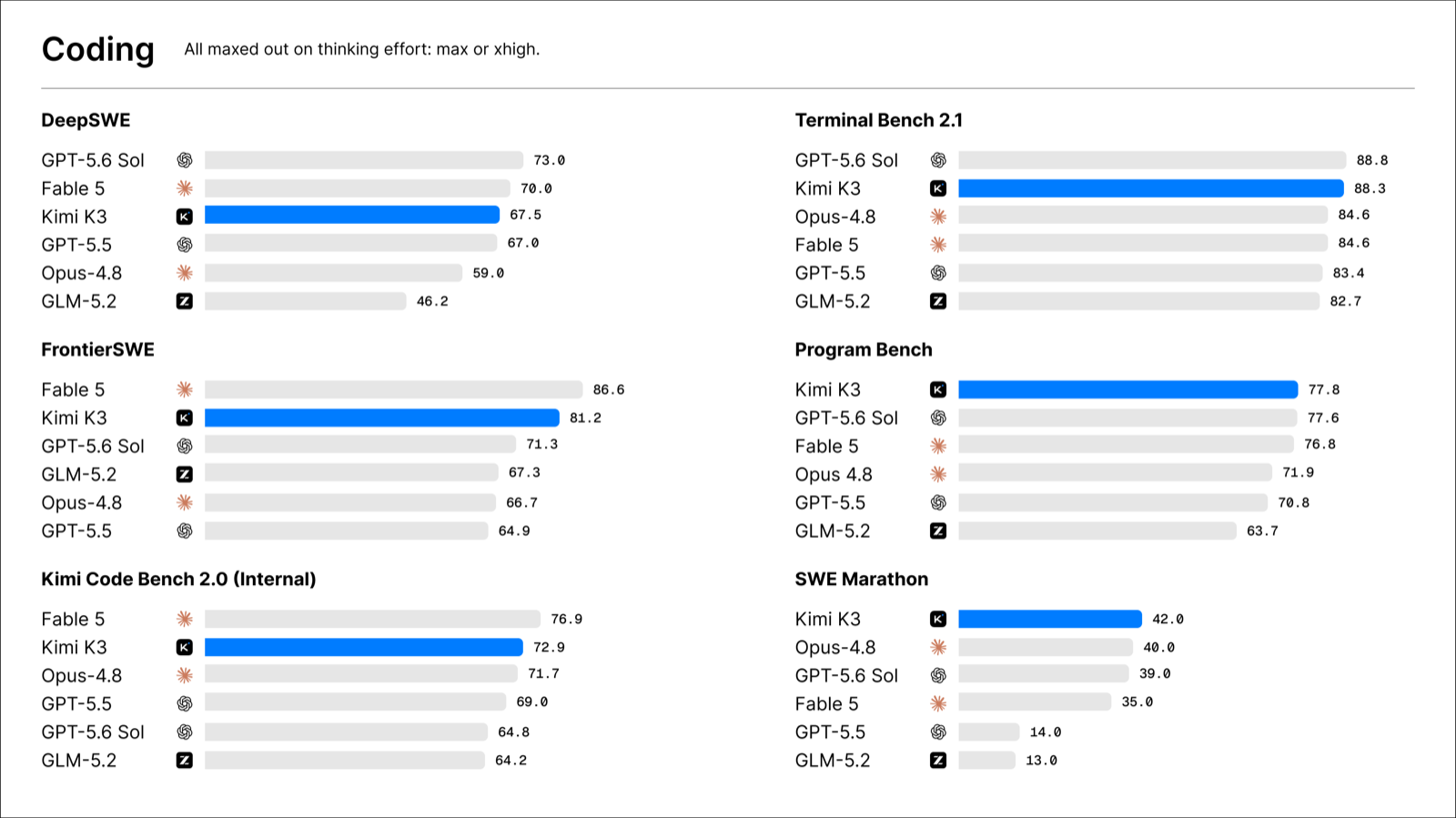
The coding picture is a genuine split: three charts each. Claude Fable 5 keeps the classic repo-repair benchmarks. FrontierSWE is the widest gap anywhere on these charts, 86.6 against K3's 81.2. DeepSWE goes 70.0 to 67.5 for Fable. And on Kimi Code Bench 2.0, Moonshot's own internal eval, Fable 5 wins 76.9 to 72.9, which is the single most trust-building number in the whole release.
Kimi K3 wins where the work gets long or lives in a shell. Terminal Bench 2.1 goes 88.3 to Fable's 84.6, with only GPT-5.6 Sol higher at 88.8. Program Bench puts K3 at the top outright, 77.8 over Sol's 77.6 and Fable's 76.8. And SWE Marathon, the long-horizon eval, is K3's biggest statement: 42.0 against Opus 4.8's 40.0 and Fable 5's 35.0. If that number holds up in the wild, it is the one that matters for agentic coding, because marathon-style tasks are what real backlog work looks like.
The agent charts: Fable holds the line, K3 takes the browser
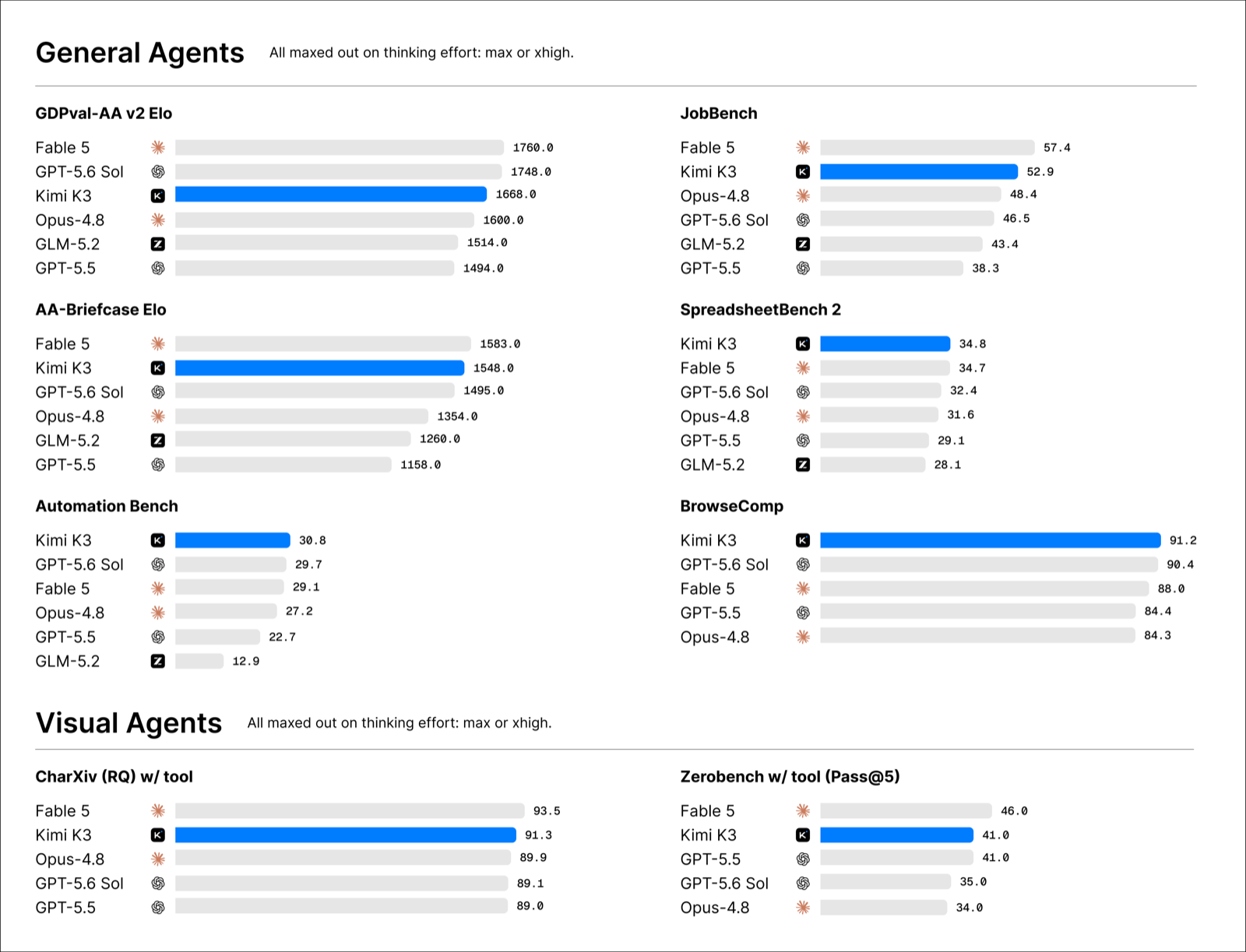
On general agents, Fable 5 holds the economically weighted evals: GDPval-AA v2 at 1760 Elo against K3's 1668, AA-Briefcase at 1583 to 1548, and JobBench at 57.4 to 52.9. It also sweeps both visual agent charts, CharXiv at 93.5 to 91.3 and Zerobench at 46.0 to 41.0. If your agents read dashboards, charts, or screenshots, Fable 5 is still the model to beat.
K3 answers with BrowseComp, the deep web research eval, at 91.2 against Fable's 88.0, plus Automation Bench at 30.8 to 29.1 and SpreadsheetBench 2 by a single decimal, 34.8 to 34.7. A browsing win of that size from an open model is new territory; browse-heavy research agents have been a proprietary stronghold until now.
Head-to-head scorecard
All 14 charts from the launch set, Kimi K3 against Claude Fable 5 only. Higher is better everywhere.
Final count: Fable 5 takes 8, Kimi K3 takes 6. A year ago the honest version of this table would have been a shutout. That is the story.
The frontend result everyone is quoting
The number driving the discourse is not on Moonshot's charts. Arena's community-voted Frontend Code leaderboard now has Kimi K3 at #1 with 1679 points, ahead of Claude Fable 5, ranked first in 6 of 7 frontend domains including Brand and Marketing, Reference-Based Design, and Data and Analytics. That is a 17-place jump from Kimi K2.6, which sat at #18. Unlike the launch charts, this is not vendor-run: it is thousands of blind human votes on real frontend tasks, which is why it traveled so fast.
It is also why the hottest take of the week came from shadcn, who posted that a few weeks ago Fable 5 was considered so advanced it "had to be taken offline," while today arguably better models cost $20 a month. Great tweet, wrong premise: Fable 5 was never taken offline. Anthropic moved it to usage-credit billing on subscriptions because demand outran capacity, said on the record it aims to restore it, and kept it fully available via API the entire time. We untangled that saga in our Claude Opus 5 leak breakdown, and our Claude Fable 5 review covers what the model actually is when it is not being eulogized on X.
Pricing and the open-weights card
The Kimi K3 API prices at $0.30 per million input tokens on cache hits, $3.00 per million on cache misses, and $15.00 per million output tokens. For a model trading blows with frontier flagships, that is aggressive; frontier-tier output tokens have typically cost several times that.
The bigger lever is the July 27 weights release. Once the weights are public, K3 stops being a cheaper API and becomes infrastructure: self-hostable, fine-tunable, and immune to the capacity politics that made the Fable 5 subscription story such a mess. No proprietary flagship can match that property at any price. The catch is operational: serving a 2.8T-parameter MoE, even a sparse one, is not a weekend project, and most teams will still consume it through an API run by someone else.
What this means if you ship with AI
Read the split, not the headline. Fable 5 is still the stronger model for hard repo surgery (FrontierSWE by 5.4 points is the largest gap on any chart), for economically weighted agent work, and for anything visual. Kimi K3 is now a serious candidate for exactly three things: frontend generation, where humans blind-vote it #1; terminal-native and long-horizon agents, where it wins Terminal Bench and SWE Marathon; and browse-heavy research, where it takes BrowseComp outright.
The practical move is the same one we recommend in our Grok 4.5 vs Claude vs GPT comparison: run the contenders on your own tasks before believing anyone's chart, including this one. Two-point benchmark deltas evaporate under real prompts, tooling, and codebases. And if the motivation is cost rather than capability, start by fixing token spend on the models you already run; our notes on OpenClaw cost control for Anthropic usually recover more budget than a model switch does.
FAQ
Is Kimi K3 better than Claude Fable 5?
On the published evidence, no single winner: Fable 5 wins 8 of 14 launch benchmarks, including the hardest software engineering and visual evals, while K3 wins 6 and holds the #1 community rank for frontend code. K3's case is price and open weights; Fable 5's case is peak capability.
Is Kimi K3 open source?
The model is live now via API and Kimi's products, and Moonshot has committed to releasing full weights on July 27, 2026. Open weights are not the same as open source (training data and code stay private), but they do mean you can self-host and fine-tune.
How much does the Kimi K3 API cost?
$0.30 per million input tokens with cache hits, $3.00 per million without, and $15.00 per million output tokens, per Moonshot's launch pricing.
Should I switch from Claude to Kimi K3?
Not on charts alone. Trial it where its wins are relevant: frontend generation, terminal agents, long-horizon coding runs, and web research. Keep your hardest reasoning and visual workloads on Fable 5 until your own evals say otherwise.