

Hire DevOps Engineers in 2026: Vetted Senior Talent

To hire DevOps engineers who actually cut downtime and shipping friction, screen for hands-on ownership of CI/CD pipelines, infrastructure as code, and production observability, not certifications alone. The most reliable path is a structured process: review real pipeline and infrastructure work, run a scenario-based interview grounded in your own stack, then set a short paid trial task on a representative problem. That sequence separates engineers who can recite tool names from those who keep systems fast, cheap, and reliable under real load.
Key takeaways
- Hire DevOps engineers on demonstrated delivery outcomes: faster, safer releases and lower cloud spend, not badge counts.
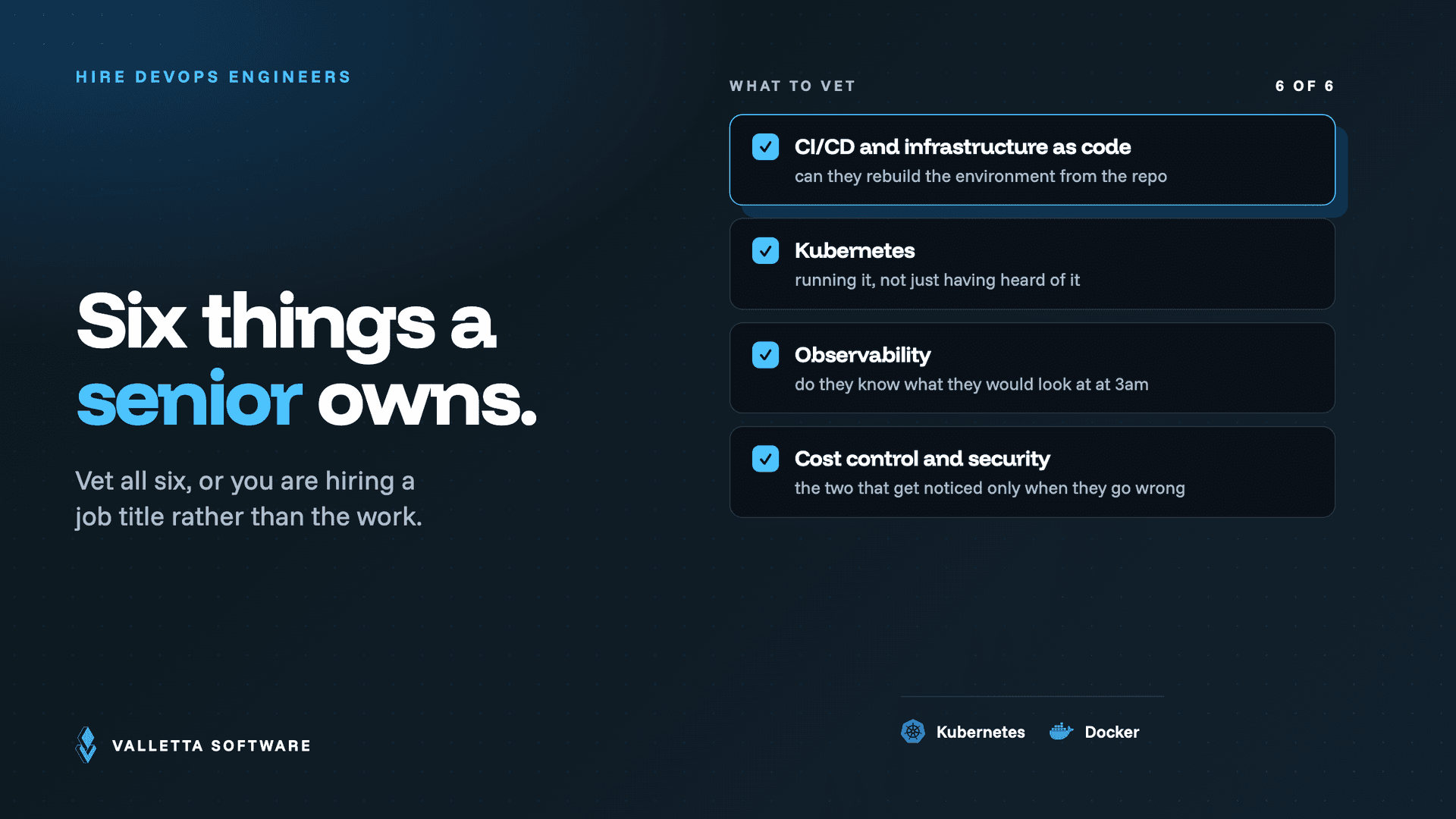
- Vet the six things a senior owns: CI/CD, infrastructure as code, Kubernetes, observability, cost control, and security.
- Use a short paid trial task on a broken pipeline or a small Terraform module to see real judgment under time pressure.
- Rates vary widely by region in 2026, so compare on delivery speed, reliability, and retention rather than headline hourly numbers.
What a senior DevOps engineer owns
A DevOps engineer connects the work of building software to the reality of running it in production. A senior one does this with judgment: they automate the path from commit to production, encode infrastructure as reviewable code, and build the monitoring that turns a 2am outage into a quick, calm fix. The clearest way to define the role is by the outcomes it protects, which the industry-standard DORA State of DevOps research frames as four measures: deployment frequency, lead time for changes, change failure rate, and time to restore service.
When you hire DevOps engineers, look for people who own these six areas end to end:
- CI/CD: automated build, test, and deploy pipelines with safe rollbacks, so releases are frequent, boring, and reversible instead of risky events.
- Infrastructure as code: environments defined in Terraform, Pulumi, or similar, version-controlled and repeatable, so nothing lives only in someone's memory or a console.
- Kubernetes and orchestration: container workloads that scale, self-heal, and roll out without downtime, using the wider cloud-native ecosystem maintained by the Cloud Native Computing Foundation.
- Observability: metrics, logs, and traces wired into dashboards and alerts, so the team sees problems before customers do and can find root cause fast.
- Cost control: right-sizing, autoscaling, and spend visibility that keep the cloud bill in line with actual usage rather than growing unchecked.
- Security: secrets management, least-privilege access, image scanning, and pipeline guardrails that build compliance into delivery instead of bolting it on later.
Depth in one cloud (AWS, Azure, or Google Cloud) plus sound engineering judgment matters far more than a long list of logos. For a fuller picture of the practices a strong hire should already follow, our team keeps a working reference on senior DevOps consulting and delivery that pairs well with this hiring guide.
How to vet DevOps engineers: signals and a trial task
A repeatable process protects you from confident interviewees who cannot deliver under real conditions. Use these stages in order and reject early when one fails.
Step 1: Write a scope-first role brief
Before posting anything, write down the systems the person will own, the cloud and tooling they will work in, the scale they will operate at, and the first three problems they will solve in month one. A brief that says "senior DevOps engineer, AWS and Kubernetes, cut deploy time and stabilize a service handling 50,000 daily requests" attracts far better candidates than a generic tool list. It also becomes your scoring rubric for every later stage.
Step 2: Screen for real infrastructure work
Read their actual work before their resume. Ask for a public repository, a pipeline they built, or a walkthrough of an incident they resolved. Strong signals include clean, modular infrastructure code, sensible pipeline design, tests and validation on infrastructure changes, and clear stories about outages they diagnosed and fixed. Weak signals are people who only describe tools in the abstract and cannot explain a rollback, a blast radius, or a postmortem they wrote.
Step 3: Run a scenario-based interview
Keep every interview to the same script so you can compare candidates fairly. A 60-minute session that works well: 10 minutes on background, 25 minutes on a design scenario from your real stack (for example, "our deploys take 40 minutes and sometimes fail silently, how would you fix it"), 15 minutes reviewing infrastructure code they wrote, and 10 minutes for their questions. Push on failure modes: what happens when a deploy goes wrong at peak traffic, how they contain blast radius, and how they measure whether the fix worked.
Step 4: Assign a short, paid trial task
The best predictor of on-the-job performance is a small slice of the real job. Give a paid, time-boxed task of 4 to 8 hours on a representative problem. Good options: fix a seeded bug in a broken CI pipeline and explain the root cause, write a small Terraform module that provisions a service with sane defaults, add meaningful alerts and a dashboard to a sample app, or containerize a service and get it running on Kubernetes with a health check and a rollback path. Judge correctness, clarity, testing, and how well they document assumptions and trade-offs. Pay for their time. It respects senior candidates and improves who says yes.
Step 5: Check references on reliability
Finish with two reference calls focused on how the person behaves during incidents and how their changes held up over time, not on personality. Confirm timezone overlap, on-call expectations, communication style, and notice period before you make an offer. For contract or agency hires, this is also where you align on the engagement model and rate, covered next.
Engagement models and what DevOps engineers cost
There are three common ways to bring DevOps talent onto a product, and the right one depends on how much ownership you need and how defined the work is.
- Staff augmentation: you add one or more DevOps engineers to your existing team and manage them directly. Best when you have a roadmap and a lead but need more hands on pipelines, cloud, or Kubernetes.
- Dedicated team or platform pod: a partner supplies a self-managing group that owns your delivery platform and reliability. Best for ongoing platform work where you want outcomes rather than day-to-day management.
- Project-based: a fixed scope, timeline, and price for a defined deliverable such as a cloud migration, a CI/CD rebuild, or a Kubernetes rollout. Best when requirements are clear and stable.
Cost depends heavily on seniority and region, so treat the following as typical 2026 market ranges rather than fixed quotes. For dedicated senior DevOps engineers, Central and Eastern European rates commonly fall in a mid four-figure to low five-figure monthly range, Western European and UK rates run higher, and senior US contractors typically sit at the top of the range. Freelance marketplaces show wide hourly spreads for the same seniority. Always weigh total cost against reliability and speed, because an engineer who ships fragile automation and causes outages is rarely the lower-cost option. The same principle applies when you hire backend developers or hire AI developers for the systems those pipelines deploy.
Why teams hire DevOps engineers through Valletta Software
Valletta Software Development is an EU-based custom software agency that provides vetted senior DevOps engineers as staff augmentation, dedicated platform pods, or fixed-scope project builds. Every engineer we place has already passed the kind of structured screening described above, so you skip the slow, expensive top of the hiring funnel and start with people who have run production systems and cleaned up real incidents.
Our delivery is AI-empowered: engineers use modern AI tooling to move faster on pipeline scaffolding, infrastructure code, and reviews, while senior humans stay accountable for reliability, security, and cost. Because we are EU-based, we offer strong timezone overlap with European clients and comfortable hours for much of the US East Coast, plus GDPR-aware handling of sensitive infrastructure and data.
If you are ready to hire DevOps engineers without spending months on sourcing and screening, tell us what you are running and where it hurts. Start the conversation on the Valletta Software contact page and we will map out engineers, an engagement model, and a realistic plan to make your delivery faster and more reliable.
Frequently asked questions
How much does it cost to hire a DevOps engineer?
It depends on seniority and region. As typical 2026 market ranges, dedicated senior DevOps engineers in Central and Eastern Europe often cost a mid four-figure to low five-figure monthly rate, while Western European, UK, and US senior contractors sit higher. Compare total cost against release speed, uptime, and cloud savings rather than headline hourly rates alone.
What skills should a senior DevOps engineer have?
Look for hands-on depth in CI/CD, infrastructure as code (such as Terraform), containers and Kubernetes, observability, and at least one major cloud, plus solid scripting and a security mindset. Just as important is judgment: knowing when to automate, how to contain a failing deploy, and how to keep cost and reliability in balance under real traffic.
DevOps engineer vs platform engineer vs SRE: what is the difference?
The roles overlap heavily. A DevOps engineer focuses on the delivery pipeline and the culture and tooling that speed up safe releases. A platform engineer builds the internal platform other developers self-serve from. A site reliability engineer (SRE) owns reliability targets and error budgets. For most teams a strong senior DevOps engineer covers the core of all three; you add specialists as scale demands.
How fast can I hire a DevOps engineer?
Hiring directly usually takes several weeks to a few months once you include sourcing, interviews, a trial task, and notice periods. Working through an agency with pre-vetted engineers is faster, often a matter of days to a couple of weeks, because the screening and availability checks are already done before you start.
Do I need a full-time DevOps engineer or a fractional one?
Early-stage products often get what they need from a fractional senior engineer who sets up solid pipelines, infrastructure as code, and monitoring, then hands off maintenance. As deploy volume, uptime needs, and on-call load grow, a full-time hire or a small platform team becomes worth it. Match the commitment to your current release demands.