

Hire Backend Developers in 2026: Vetted Senior Engineers
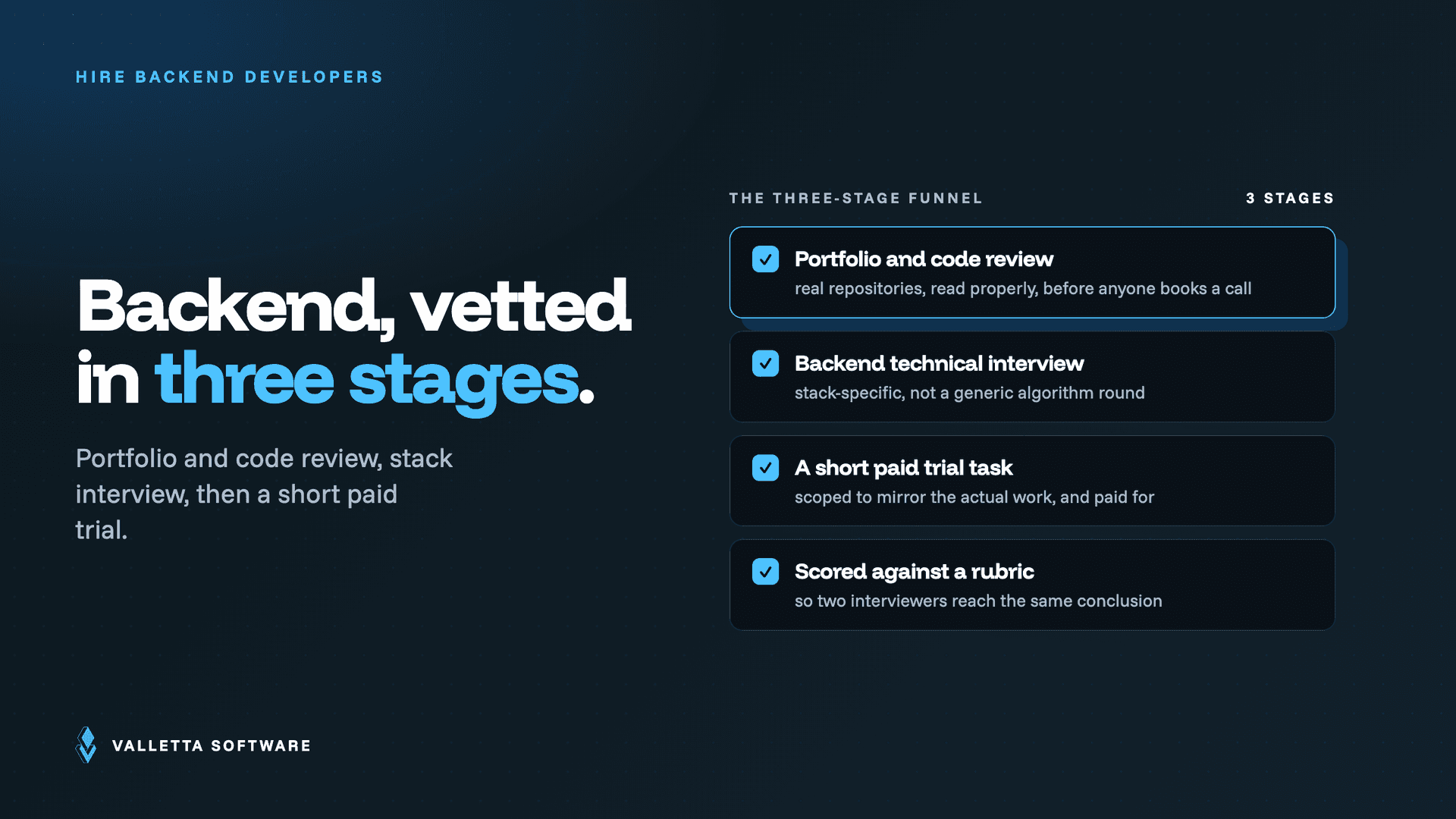

To hire backend developers, define the systems and scale you are building for, then screen candidates on real API, database, and architecture work instead of resume keywords. The most reliable path is a short, structured process: a portfolio and code-history review, a technical interview grounded in your actual stack, and a paid trial task on a representative problem. That sequence separates engineers who can talk about backends from those who ship and maintain them in production.
Key takeaways
- Hire backend developers on demonstrated work: real APIs, data models, and production incidents, not keyword-matched CVs.
- Run a three-stage funnel: portfolio and code review, a stack-specific technical interview, then a short paid trial task.
- Choose an engagement model by scope. Staff augmentation for extra hands, a dedicated team for owned roadmaps, project-based for fixed deliverables.
- In 2026, typical market rates vary widely by region, so compare senior engineers on outcomes and retention rather than headline hourly numbers.
What a senior backend developer does for your product
A backend developer builds the parts of your product that users never see but always depend on: the APIs, business logic, databases, authentication, background jobs, and integrations that keep everything correct and fast under load. A senior backend developer goes further. They design data models that will not need painful migrations later, choose the right consistency and caching trade-offs, and put in the observability and tests that keep a growing system stable.
The core toolkit is well established. In the Stack Overflow Developer Survey, PostgreSQL and Node.js rank among the most used database and web technologies, alongside languages such as Python, Go, Java, and C#. A strong hire is fluent in at least one of these ecosystems and, more importantly, understands why they would reach for one over another.
When you hire backend developers, look for people who own these responsibilities end to end:
- API design: clear, versioned, well-documented REST or GraphQL contracts that front-end and mobile teams can build against.
- Data modeling: schemas, indexing, and query performance that hold up as tables grow into millions of rows.
- Reliability: error handling, retries, idempotency, monitoring, and alerting so failures are visible and recoverable.
- Security: authentication, authorization, input validation, secrets handling, and safe defaults for sensitive data.
- Scale and cost: caching, queues, and horizontal scaling decisions that keep latency and cloud bills in check.
How to hire backend developers: a step-by-step vetting process
A repeatable process removes guesswork and protects you from confident interviewees who cannot deliver. Use these five steps in order and reject early when a stage fails.
Step 1: Write a scope-first role brief
Before you post anything, write down the systems the person will own, the stack they will work in, the scale they will operate at, and the first three problems they will solve in month one. A brief that says "senior backend developer, Node.js and PostgreSQL, payment reconciliation service handling 50,000 daily transactions" attracts far better candidates than a generic list of technologies. It also becomes your scoring rubric for every later stage.
Step 2: Screen portfolios and code history
Read code before you read a resume. Ask for a public repository, a private sample, or a walkthrough of a system they built. You are looking for readable code, sensible commits, tests, and evidence they handled real production concerns like migrations, backfills, and failure modes. Screen out anyone who can only describe work in the abstract. If the role leans heavily on machine learning or model integration, apply the same rigor you would use to hire AI developers, since AI-adjacent backends add data pipelines and model-serving concerns on top of the usual stack.
Step 3: Run a structured technical interview
Keep every interview to the same script so you can compare candidates fairly. A 60-minute session that works well: 10 minutes on their background, 25 minutes on a system-design discussion drawn from your real product, 15 minutes reviewing a snippet of their own code, and 10 minutes for their questions. Ask how they would design an API you actually need, then push on edge cases: concurrency, partial failures, data consistency, and rollback. Score against the rubric from Step 1, not gut feel.
Step 4: Assign a short, paid trial task
The single best predictor of on-the-job performance is a small piece of the real job. Give a paid, time-boxed task, ideally 4 to 8 hours, on a representative problem: build a small endpoint, model a schema, or fix a seeded bug in a sample service. Judge correctness, code clarity, tests, and how they communicate assumptions and trade-offs. Pay for their time. It respects senior candidates and dramatically improves who says yes.
Step 5: Check references and confirm the fit
Finish with two reference calls focused on shipped outcomes and how the person behaves under pressure, not on personality. Confirm working hours, timezone overlap, communication style, and notice period before you make an offer. For contract or agency hires, this is also where you align on the engagement model and rate, covered next.
Engagement models and what backend developers cost
There are three common ways to bring backend talent onto a product, and the right one depends on how much ownership you need and how defined the work is.
- Staff augmentation: you add one or more backend engineers to your existing team and manage them directly. Best when you have a roadmap and a lead but need more hands in a specific stack.
- Dedicated team: a partner supplies a self-managing group (engineers, a lead, often QA) that owns a product area. Best for ongoing roadmaps where you want outcomes rather than day-to-day management.
- Project-based: a fixed scope, timeline, and price for a defined deliverable such as an MVP or a specific service. Best when requirements are clear and stable.
Cost depends heavily on seniority and region, so treat the following as typical 2026 market ranges rather than fixed quotes. For dedicated senior backend engineers, Central and Eastern European rates commonly fall in a mid four-figure to low five-figure monthly range, Western European and UK rates run higher, and senior US contractors typically sit at the top of the range. Freelance marketplaces show wide hourly spreads for the same reason. Always compare total cost against retention, code quality, and delivery speed, because a cheaper engineer who ships fragile systems is rarely the lower-cost option. For a fuller breakdown of how modern engagements are priced, see our guide to what AI and software development services cost.
Why teams hire backend developers through Valletta Software
Valletta Software Development is an EU-based custom software agency that provides vetted senior backend engineers as staff augmentation, dedicated teams, or fixed-scope project builds. Every engineer we place has already passed the kind of structured screening described above, so you skip the slow, expensive top of the hiring funnel and start with people who have shipped production systems.
Our delivery is AI-empowered: engineers use modern AI tooling to move faster on scaffolding, tests, and reviews, while senior humans stay accountable for architecture, security, and correctness. Because we are EU-based, we offer strong timezone overlap with European clients and comfortable hours for much of the US East Coast, plus GDPR-aware handling of sensitive data. You can see how this plays out in delivery in our success story on taking a regulated EU fintech platform from looks-live to genuinely production-ready.
If you are ready to hire backend developers without spending months on sourcing and screening, tell us what you are building and we will assemble a team around it. Start the conversation on the Valletta Software contact page and we will map out engineers, engagement model, and a realistic timeline for your product.
Frequently asked questions
How much does it cost to hire a backend developer?
It depends on seniority and region. As typical 2026 market ranges, dedicated senior backend engineers in Central and Eastern Europe often cost a mid four-figure to low five-figure monthly rate, while Western European, UK, and US senior contractors sit higher. Compare total cost against delivery speed, code quality, and retention rather than headline hourly rates alone.
How fast can I hire a backend developer?
Hiring directly usually takes several weeks to a few months once you include sourcing, interviews, trial tasks, and notice periods. Working through an agency with pre-vetted engineers is faster, often a matter of days to a couple of weeks, because the screening and availability checks are already done before you start.
Backend developer vs full-stack developer: which do I need?
Hire a dedicated backend developer when the hard problems are data, scale, integrations, and reliability, which is common for APIs, fintech, and data-heavy products. A full-stack developer suits smaller teams and products where one person can reasonably own both the interface and the server. For complex backends, specialist depth almost always wins over breadth.
Do you sign NDAs before sharing project details?
Yes. We routinely sign non-disclosure agreements before discussing sensitive product details, and we can work within your own legal templates. As an EU-based team we also handle personal and regulated data with GDPR-aware practices, which matters for fintech, health, and other compliance-sensitive backends.
Which backend technologies should my developer know?
Match the stack to your product, but the widely used core is a strong bet: a mainstream language such as Node.js, Python, Go, Java, or C#, a relational database like PostgreSQL, plus solid API design, cloud fundamentals, containers, and CI/CD. Depth in one ecosystem and sound engineering judgment matter more than a long list of buzzwords.