

DevOps Best Practices Explained: 2026 Senior Guide

DevOps best practices in 2026 are the field-tested patterns that let senior teams ship multiple times per day without breaking production: trunk-based development with short-lived branches, fully automated CI/CD, infrastructure as code, SLO-driven on-call, shift-left security, and observability that engineers actually use. The practices below are ordered by impact-per-effort, drawn from the public DORA research and from what we see working in production at our consulting clients.
Key takeaways
- Trunk-based development beats long-lived feature branches for delivery speed and change-failure rate.
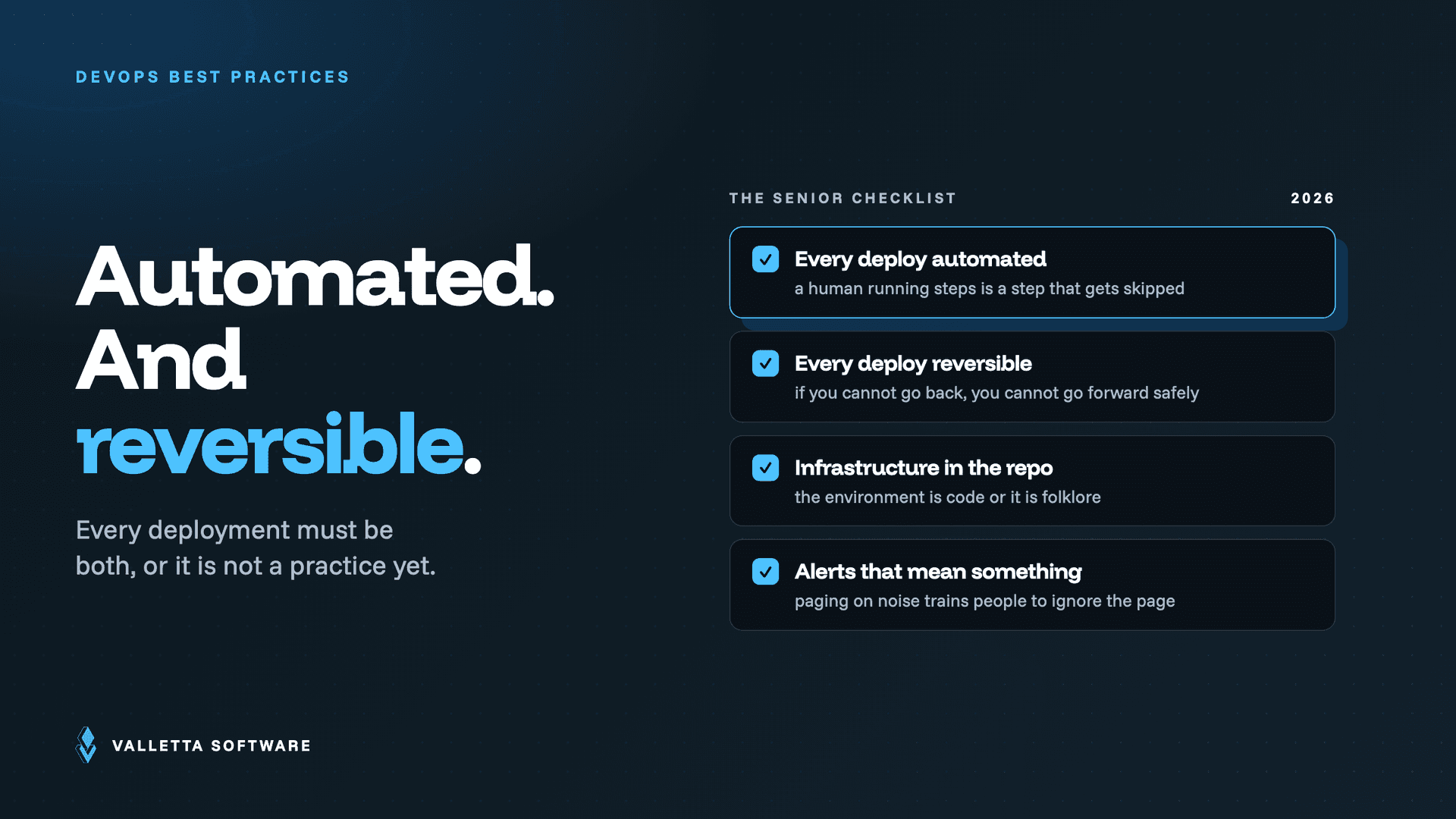
- Every deployment must be automated and reversible. Manual production steps are an outage waiting to happen.
- Infrastructure as code is a baseline, not a bonus. If you cannot rebuild your environment from a Git repo, you do not have IaC.
- Security tooling belongs in CI, not in a final review gate. Block on critical findings, warn on the rest.
- Observability is what you measure when something is wrong that you did not predict. Logs and dashboards alone are not observability.
- The DORA four key metrics (deployment frequency, lead time, change-failure rate, MTTR) are the only scoreboard that matters for DevOps maturity.
1. Adopt trunk-based development
Long-lived feature branches accumulate merge conflicts, hide integration bugs, and stall releases. Trunk-based development means every developer merges to the main branch at least once a day, behind feature flags if the work is not yet user-visible. Pull requests are short (under a day) and reviewed within hours. The trunkbaseddevelopment.com playbook is the reference.
What you need for it to work: a robust CI suite that runs in under 10 minutes, automated test coverage above 70% on the change-prone surface, and feature flags via LaunchDarkly, Statsig, or an in-house flag service.
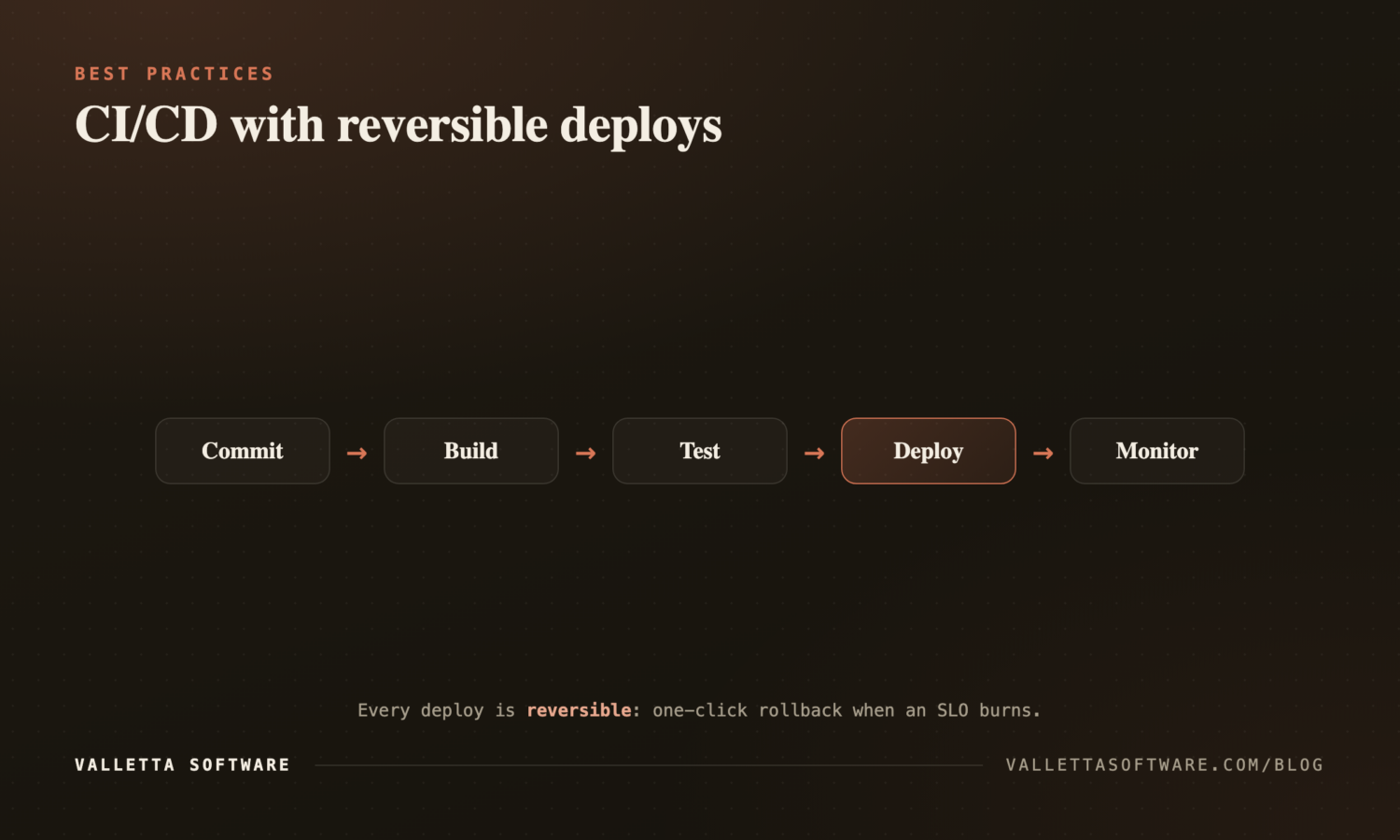
2. Fully automated CI/CD with reversible deploys
The deployment pipeline takes a commit on main and ships it to production with no human in the loop except an approval click if you choose to keep one. Best practices:
- Build once, deploy many. The artifact you tested in staging is the artifact you ship to production. No rebuilding per environment.
- Immutable artifacts. Use container images or signed binaries, not in-place updates.
- Progressive delivery. Roll out to 1%, then 10%, then 100% with automated health checks at each step. Roll back automatically on regression.
- Database migrations are expand-then-contract. Never deploy code and a destructive migration together.
If your team is still on Jenkins jobs that nobody updates, consider GitHub Actions, GitLab CI, or Buildkite. Pipeline-as-code is the baseline.
3. Infrastructure as code, version-controlled and reviewed
Every cloud resource lives in a Git repository. Terraform, OpenTofu, or Pulumi describe the desired state. Pull requests show diffs of the planned change. CI runs terraform plan as a check.
Mature teams go further: drift detection runs on a schedule, manual changes in the cloud console are caught and either codified or rolled back, and the production state can be rebuilt from scratch in a disaster-recovery drill. Read more in our Infrastructure as Code explainer.
4. SLO-driven reliability and on-call
Pick the three to five user-facing things that must work. Define a service-level indicator for each (request latency, error rate, queue lag). Set an SLO target you can actually defend (99.9% over 30 days, not 99.99% on a wish). The gap between SLO and 100% is your error budget; when it runs out, you stop shipping features and stabilize.
Pair this with a real on-call rotation. The team that writes the service is on call for it. Page severity rules are explicit. Postmortems are blameless and published. The Google SRE Book is the canonical reference.
5. Observability, not just monitoring
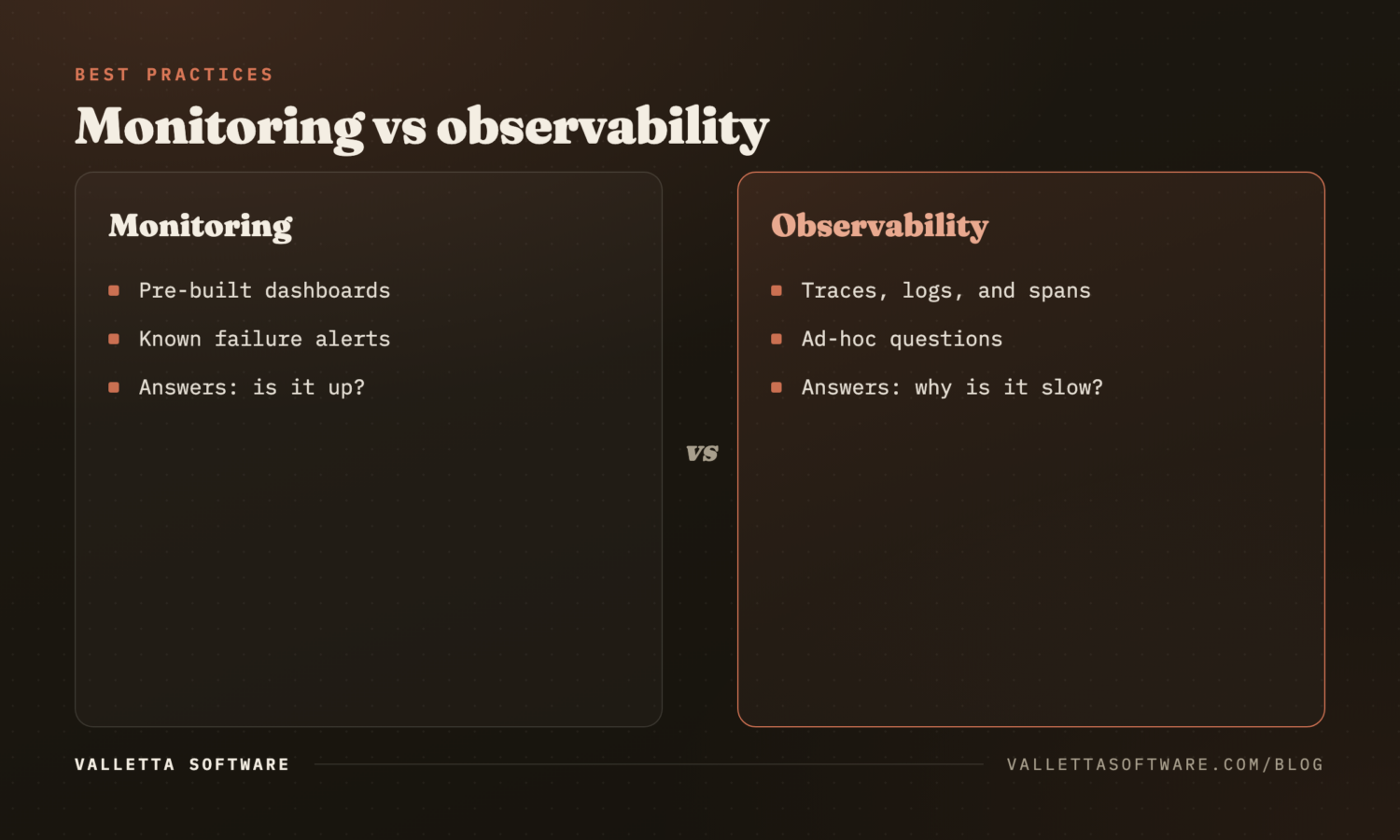
Monitoring tells you what you already knew to look for. Observability lets you ask new questions about a live system. The practical bar in 2026:
- Structured logs (JSON), not free-text. Logs flow into a queryable store (Elasticsearch, OpenSearch, ClickHouse, BigQuery).
- Metrics on every meaningful operation, with high enough cardinality to slice by customer or endpoint.
- Distributed tracing through every service boundary. OpenTelemetry is the standard SDK.
- Alerting on symptoms (users see errors) not causes (CPU at 80%). Pages that wake an engineer must be actionable.
6. Shift security left
Security checks run in CI on every commit:
- Static analysis (Semgrep, CodeQL).
- Dependency scanning (Dependabot, Snyk, GitHub Advanced Security).
- Container image scanning (Trivy, Grype).
- Secret detection (gitleaks, truffleHog) in pre-commit hooks too.
- Infrastructure-as-code scanning (tfsec, Checkov) catches misconfigured S3 buckets and overly permissive IAM before merge.
Block on critical findings. Warn on the rest, with an SLA for triage. Read more about the operating model in our DevOps consulting overview.
7. Secrets management that is actually used
Secrets never live in code, env files in repos, or CI variables that anyone can read. They live in a vault (HashiCorp Vault, AWS Secrets Manager, Doppler, 1Password Secrets Automation). The CI/CD pipeline fetches them at deploy time. Rotation is automatic where possible (database credentials, API tokens). Audit logs on secret access are reviewed.
8. Release management without ceremony
Releases are events for users, not for engineering. Engineering ships continuously. Marketing announcements get decoupled from deploys via feature flags. Cohort rollouts (by region, by user segment, by customer ID) become routine. The change advisory board (CAB) meeting goes away or becomes async.
9. AWS, Azure, and cloud-specific best practices
AWS DevOps
Use IAM Identity Center (formerly SSO) and short-lived role assumptions, not long-lived access keys. Multi-account architecture with AWS Organizations and service control policies. CodePipeline + CodeBuild work, but most teams prefer GitHub Actions with OIDC federation to AWS. Cost reporting via tags is non-negotiable.
Azure DevOps
Azure Pipelines is solid for Microsoft-heavy stacks; treat YAML pipelines as code. Use managed identities, not service principal secrets. Azure Policy enforces guardrails at the subscription level. Azure DevOps Server (the on-prem version) is fine but maintenance-heavy in 2026.
10. Automation and toil reduction
Track team toil. Anything a human does repeatedly that a script could do is a candidate for automation. Google's SRE rule of thumb: more than 50% time on toil means the team is sliding backward.
Specifically automate: environment provisioning, certificate rotation, secret rotation, on-call handoff, dependency updates (Renovate, Dependabot), and runbook execution.
11. Architecture best practices
DevOps practices fail on bad architectures. Practical guidelines:
- Small, owned services with clear interfaces, not a shared monolith with five teams committing into it.
- Asynchronous messaging (SQS, Pub/Sub, Kafka) for cross-team dependencies.
- Statelessness where you can manage it. State sits in managed databases, not on individual VMs.
- Backward-compatible APIs. Versioning is a contract, not a marketing decision.
See our Kubernetes vs Docker guide for when each orchestration model fits.
12. Testing best practices
- The test pyramid still holds: many unit tests, fewer integration tests, very few end-to-end tests.
- Tests run in CI in under 10 minutes. Longer than that and developers will not run them locally.
- Flaky tests are bugs. Quarantine them, fix them, do not retry-loop them away.
- Production traffic replay (using shadow traffic or synthetic transactions) catches integration bugs that unit tests cannot.
What is changing in 2026
Three shifts are worth planning for:
- AI-assisted ops. LLMs triage incidents, suggest fixes, and execute runbooks under guardrails. Mature teams are starting to measure mean-time-to-detect with AI in the loop.
- Platform engineering as the operating model. The platform team builds internal developer platforms; product teams consume them. See our platform engineering services.
- Supply-chain security. SBOMs, signed builds, and SLSA-level provenance are moving from "nice to have" to compliance requirements.
Where to start if you are behind
If you are doing none of this and want to catch up fast, the order matters:
- Get every deploy on a pipeline you trust. No more SSH-and-rsync.
- Codify your infrastructure (even one Terraform module is a start).
- Stand up observability (managed Datadog, Honeycomb, or Grafana Cloud beats DIY).
- Define SLOs on your top 3 user journeys.
- Embed security scanners in CI.
For a foundation primer, see our DevOps overview. If you want senior engineers to accelerate this, Schedule Free Consultation and we will scope it.
Frequently asked questions
What are the most common DevOps anti-patterns?
Long-lived feature branches, manual production steps, environment drift (staging does not match prod), security audits at the end of the release cycle, and on-call schedules that exclude the developers who wrote the service.
How do you measure DevOps maturity?
The DORA four key metrics: deployment frequency, lead time for changes, change-failure rate, and mean time to restore. Public benchmarks exist for each. Track them quarterly.
What is the difference between DevOps and DevSecOps?
DevSecOps is DevOps with security treated as a first-class concern at every pipeline stage. In 2026 the two terms are converging because security in CI is already best practice.
Are CI/CD best practices the same for monoliths and microservices?
Mostly. Microservices need per-service pipelines and stricter API versioning; monoliths benefit more from feature flags and progressive rollout within a single deploy.
How often should we deploy to production?
As often as you can without breaking the change-failure rate target. Elite DORA performers deploy multiple times per day per service. If you cannot deploy daily, the cause is rarely lack of features; it is missing automation, tests, or trust.