

Kubernetes vs Docker: When to Use Each (2026)
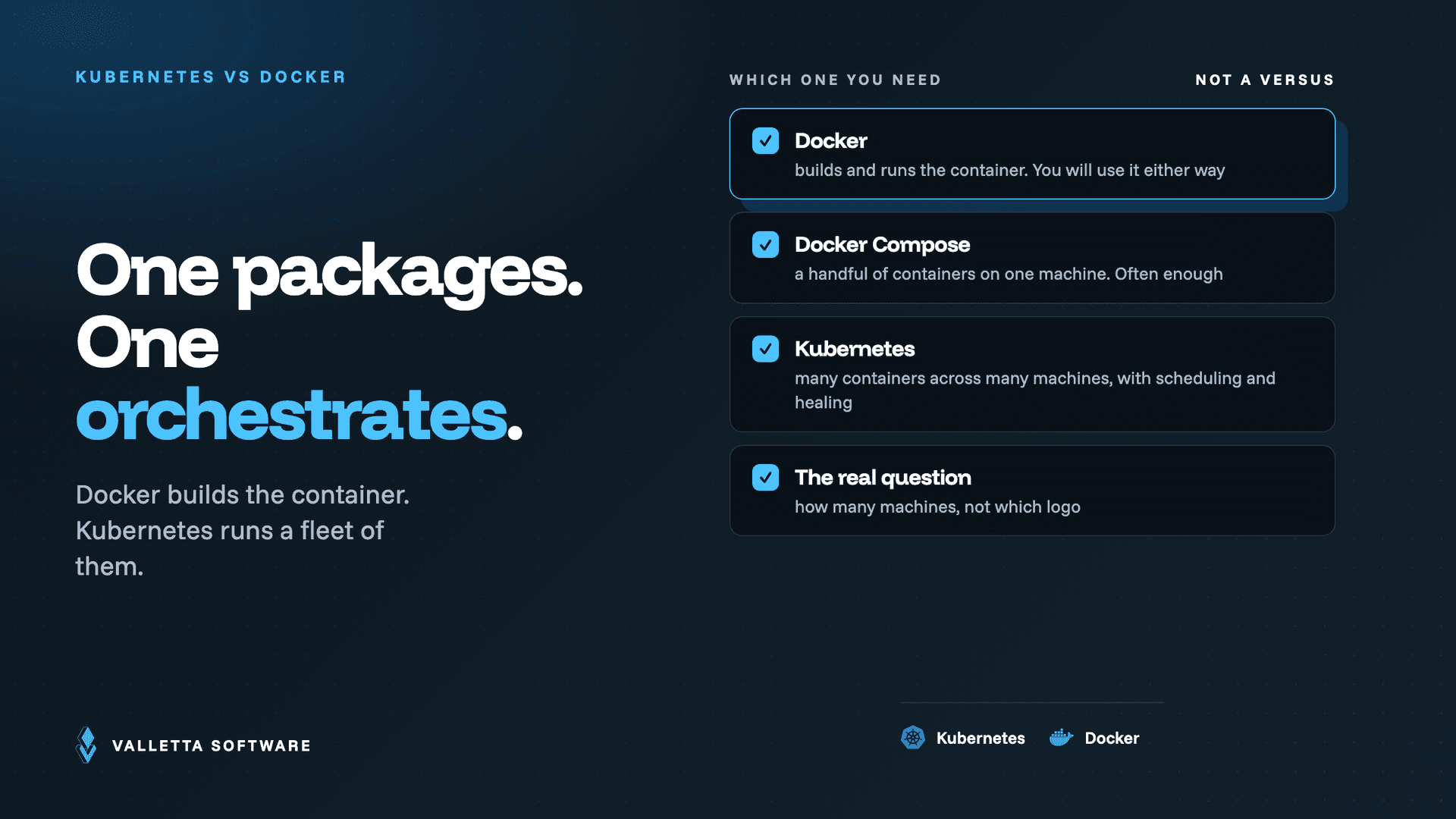

Kubernetes vs Docker is a category mistake: Docker is a container runtime and tooling around it, Kubernetes is the orchestrator that runs containers (built by Docker or anyone else) across many machines. The practical question is when to run containers with Docker Compose alone, when Docker Swarm is enough, and when you need full Kubernetes. The short answer: most Seed to Series A teams should run Docker Compose or a managed PaaS, most Series B+ teams with 10+ services need Kubernetes, and Docker Swarm is rarely the right choice in 2026.
Key takeaways
- Docker is a container runtime. Kubernetes is a container orchestrator. They are complementary, not competing.
- For a single host and a handful of services, Docker Compose is enough and Kubernetes is overkill.
- Once you need multi-host scheduling, rolling updates, autoscaling, and service discovery across many services, Kubernetes is the standard answer.
- Docker Swarm exists but the ecosystem has consolidated on Kubernetes; new projects should not pick Swarm in 2026.
- Use managed Kubernetes (EKS, GKE, AKS) rather than self-managed unless you have a specific reason otherwise.
What is Docker?
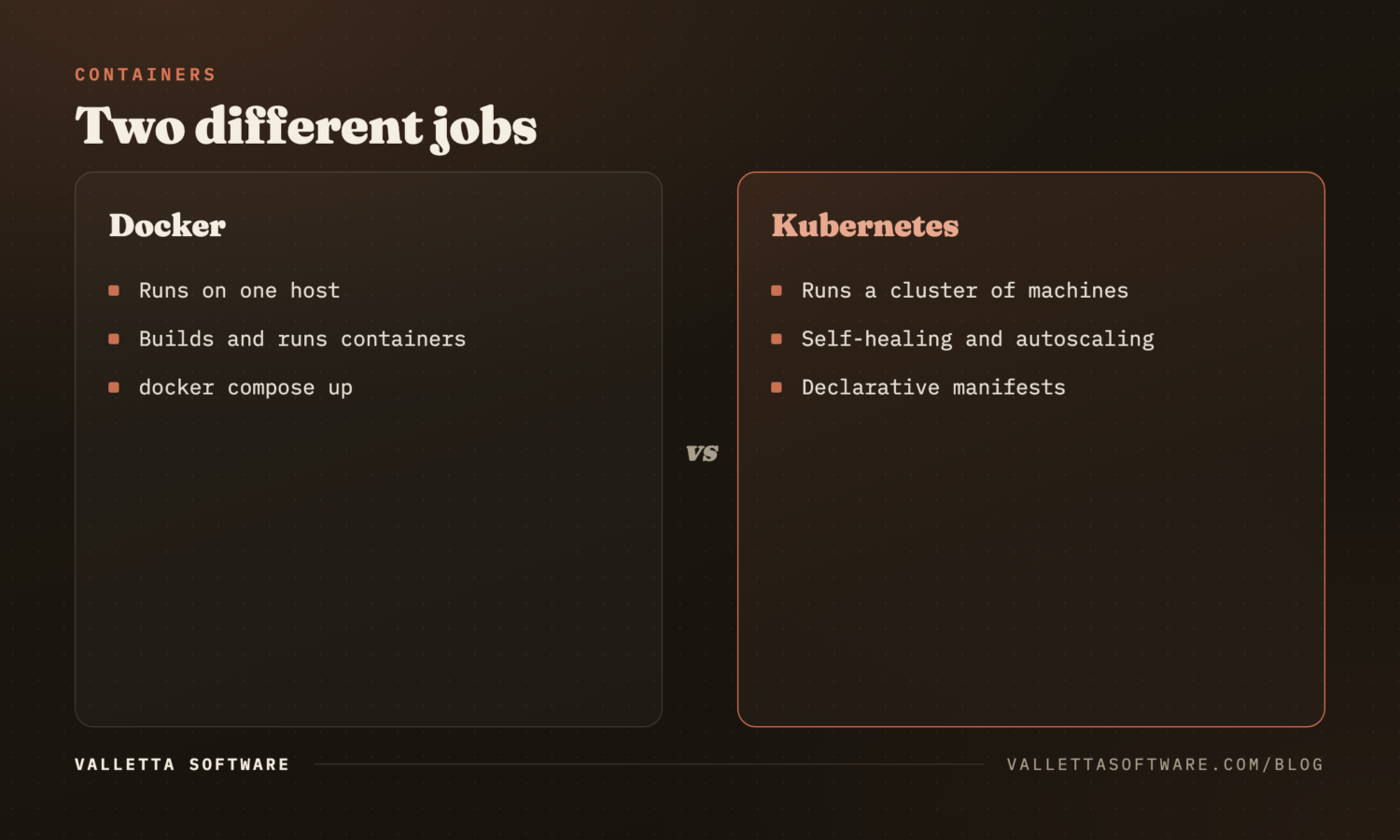
Docker is a platform for building, packaging, and running containers. A container packages an application and its dependencies into an isolated, portable image that runs identically on a developer's laptop, in CI, and in production. Docker Inc. is also the company; Docker Engine is the runtime; Docker Hub is the image registry; Docker Compose is a tool for running multi-container applications on a single host.
Under the hood, the container runtime has moved on. The original Docker daemon has been replaced in production by containerd (which Docker uses internally) and runc (the low-level OCI runtime). When people say "Docker container" in 2026 they usually mean "OCI-compliant container," which is an open standard that any orchestrator (including Kubernetes) understands.
What is Kubernetes?
Kubernetes (often abbreviated K8s) is an orchestrator: it schedules containers across many machines, restarts them when they crash, scales them up or down, gives them stable networking, routes traffic, and rolls out new versions with zero downtime. It was open-sourced by Google in 2014 and is governed by the Cloud Native Computing Foundation.
Kubernetes does not build containers. It runs them. The images you give it can be built with Docker, BuildKit, Buildah, or any other OCI-compliant builder.
Why the "versus" framing is misleading
Docker and Kubernetes solve different layers. A real production stack typically uses both: developers build container images with Docker on their laptops, CI builds and signs the production image, and Kubernetes runs the image across a cluster. Asking "Kubernetes or Docker?" is like asking "jet engine or airplane?"
The useful comparison is: Docker (with Docker Compose or Docker Swarm) vs Kubernetes as the orchestration layer. That is the real decision a team makes.
Docker Compose vs Kubernetes
Docker Compose runs multiple containers on a single machine, configured via a docker-compose.yml file. It is perfect for:
- Local development environments.
- CI test suites that need a database and a few services.
- Small production deployments (one or two hosts, low traffic, no need for rolling updates or autoscaling).
Kubernetes does everything Compose does, plus:
- Scheduling across many hosts.
- Self-healing (restarting crashed containers automatically).
- Rolling updates and rollbacks.
- Horizontal autoscaling.
- Service discovery and load balancing across pods.
- Declarative configuration via YAML manifests, GitOps-friendly.
- A vast ecosystem of operators, controllers, and add-ons.
The tradeoff is operational complexity. A Compose file is a hundred lines. A production Kubernetes cluster has dozens of moving parts: ingress controller, service mesh (optional), observability, secret management, IaC modules, autoscaler tuning, upgrade automation.
Docker Swarm vs Kubernetes
Docker Swarm is Docker's own orchestrator, included with Docker Engine. It is simpler than Kubernetes and uses the same docker CLI. In 2017 it was a credible alternative; by 2026 it is not.
What changed:
- The cloud providers all built managed Kubernetes (EKS, GKE, AKS, Linode, DigitalOcean). Managed Swarm is rare.
- The CNCF ecosystem (Helm, ArgoCD, Istio, Prometheus, Cilium) is built around Kubernetes APIs.
- Hiring is easier. Many more engineers know Kubernetes than Swarm.
- Mindshare. New tools target Kubernetes first; Swarm gets table scraps.
Swarm still works and is fine if you already run it. New projects in 2026 should not pick Swarm.
Kubernetes vs Docker security
Security at the container layer is largely the same regardless of orchestrator: minimal base images, no root user inside the container, no privileged mode, image scanning in CI, signed images, runtime detection. The big addition in Kubernetes is the network and policy layer:
- NetworkPolicies for east-west traffic control.
- RBAC for who can do what in the cluster.
- Pod Security Standards (the replacement for the deprecated PodSecurityPolicy).
- Service mesh (Istio, Linkerd) for mTLS, identity, and authorization between services.
- OPA/Gatekeeper or Kyverno for policy-as-code.
None of this exists in Docker Compose or Swarm at the same depth. If your security model needs per-service identity, encryption in transit between services, or policy enforcement at admission time, you need Kubernetes (or a comparable platform). Read our DevOps best practices guide for the broader security shift-left model.
Kubernetes vs Docker vs Jenkins
This question pops up in interviews. Jenkins is a CI/CD tool that orchestrates builds and deploys; it does not run containers in production. A pipeline can use Jenkins to build Docker images and then deploy them to a Kubernetes cluster. The three live at different layers:
- Jenkins (or GitHub Actions, GitLab CI, Buildkite): build and deploy automation.
- Docker / BuildKit: container image format and runtime.
- Kubernetes: orchestration of containers in production.
Kubernetes vs OpenShift
OpenShift is Red Hat's Kubernetes distribution. It is Kubernetes plus opinionated additions: a developer portal, built-in CI/CD, stricter security defaults, and Red Hat support. For regulated industries on premises it is often the right answer. For cloud-native startups, vanilla managed Kubernetes (EKS, GKE, AKS) is usually simpler and cheaper.
When to pick each in 2026
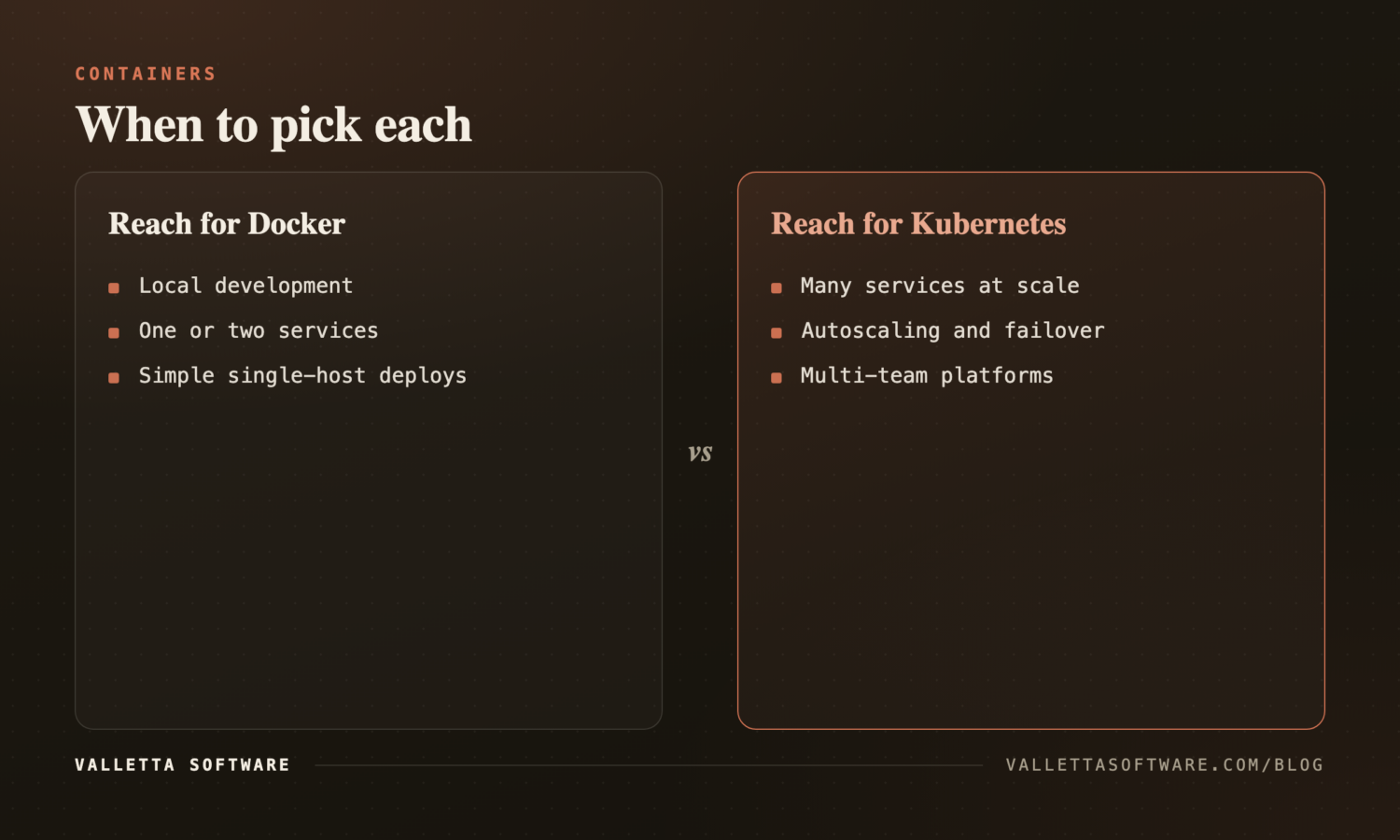
Stick with Docker Compose if
- You run on one or two hosts.
- Your team is 1 to 5 engineers.
- You do not need zero-downtime deploys (your traffic is light or your users tolerate short windows).
- You are pre-product-market-fit and operational simplicity beats theoretical scalability.
Pick a managed PaaS (Fly.io, Railway, Render, Heroku) if
- Compose feels limiting but Kubernetes feels too heavy.
- You want autoscaling and zero-downtime deploys without running the cluster yourself.
- Your workloads are mostly stateless web services.
Pick managed Kubernetes if
- You run 10+ services with cross-team ownership.
- You need per-service autoscaling, network policies, or service mesh.
- You will hire DevOps or platform engineers (in-house or contracted) within the next year.
- Your traffic shape demands sub-second scale-up.
- You are running stateful workloads or jobs alongside web services and want one operator model.
Avoid self-managed Kubernetes unless
- You have specific compliance or air-gap requirements.
- You have dedicated platform engineers (3+).
- The cost math demonstrably beats managed.
Common Kubernetes misconceptions
- "Kubernetes is for microservices." Not exclusively. A monolith plus three workers runs fine on Kubernetes if you want the autoscaling and self-healing.
- "Kubernetes is expensive." The cluster control plane on managed services costs $70-100/month. The cost is in over-provisioned worker nodes if you do not tune autoscaling.
- "Kubernetes is hard." Vanilla Kubernetes is much simpler than the rumor says. The complexity is in the ecosystem around it (mesh, ingress, observability, IaC). Start vanilla; add only what you need.
- "You need Helm to do anything." Kustomize is often simpler. Plain manifests are fine for small surfaces.
Architecting this for production
If you are picking between Compose, Swarm, Kubernetes, and a managed PaaS, and want a second opinion before committing, our platform engineering team can help. Schedule Free Consultation for a 45-minute scoping call.
Related reading
- DevOps: what it is, how it works, and what to watch for
- Infrastructure as code explained: Terraform to Pulumi
- DevOps best practices, 2026 senior guide
Frequently asked questions
What is the difference between a Kubernetes container and a Docker container?
There is no difference in the container itself. Both are OCI-compliant containers. "Docker container" usually refers to one built and run with the Docker CLI; "Kubernetes container" refers to the same kind of container scheduled by Kubernetes (often built originally with Docker or BuildKit).
Can you run Docker inside Kubernetes?
Yes, although "Docker inside Kubernetes" can mean two different things. Kubernetes can run any OCI container, which is what most people mean. Running the Docker daemon itself inside a pod (Docker-in-Docker) is possible for CI use cases but has security trade-offs; modern alternatives use BuildKit or Kaniko instead.
Is Kubernetes overkill for a small startup?
Usually yes. If you are 1 to 5 engineers with a single application, Docker Compose or a managed PaaS will get you to product-market fit faster than learning Kubernetes. Adopt Kubernetes when service count and team size justify the operational tax.
What is the difference between Docker Compose and Kubernetes?
Compose runs multi-container apps on one host using a YAML file. Kubernetes orchestrates containers across many hosts with scheduling, self-healing, autoscaling, and service discovery. Compose is right for local dev and tiny prod; Kubernetes is right for production workloads at scale.
Is Docker dying?
No. Docker the runtime is being replaced by containerd in production, but Docker the company and tools (Docker Desktop, BuildKit, Compose) remain widely used. The OCI standards that Docker pioneered are the foundation of modern container ecosystems, including Kubernetes.