

Platform Engineering Services: K8s and SRE Experts
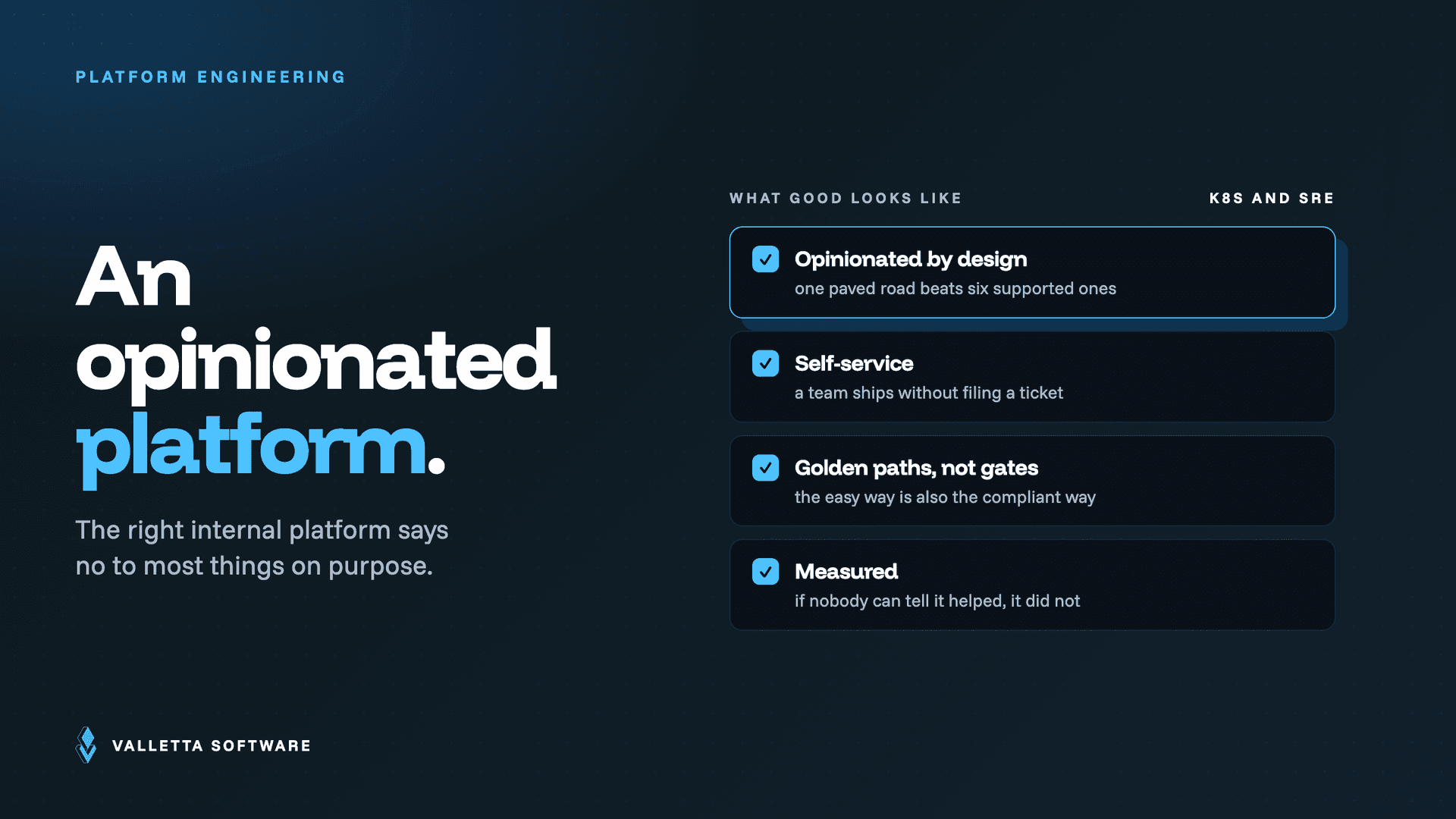

Valletta Software's platform engineering services design, build, and operate the internal developer platforms (IDPs) that mid-to-large engineering organizations use to ship faster without buying every Kubernetes drama. We bring senior Kubernetes, SRE, and developer-experience specialists who treat the platform as a product: opinionated golden paths, self-service onboarding, observable defaults, and measurable productivity outcomes for the product teams that consume it.
Key takeaways
- Platform engineering treats the developer platform as a product, with product managers, SLAs, and user research, not as a side project of the ops team.
- The right platform is opinionated. "Pick your own stack" platforms scale until the first incident and then collapse into a support queue.
- Internal developer platforms cut onboarding from weeks to hours and standardize the way 80% of services are built.
- We staff fractional platform leads, full pods (PM + engineers + SRE), and one-off audits.
- Engagements measure success in DORA metrics, developer NPS, and platform adoption rate, not in tickets closed.
What we do
Internal developer platform design
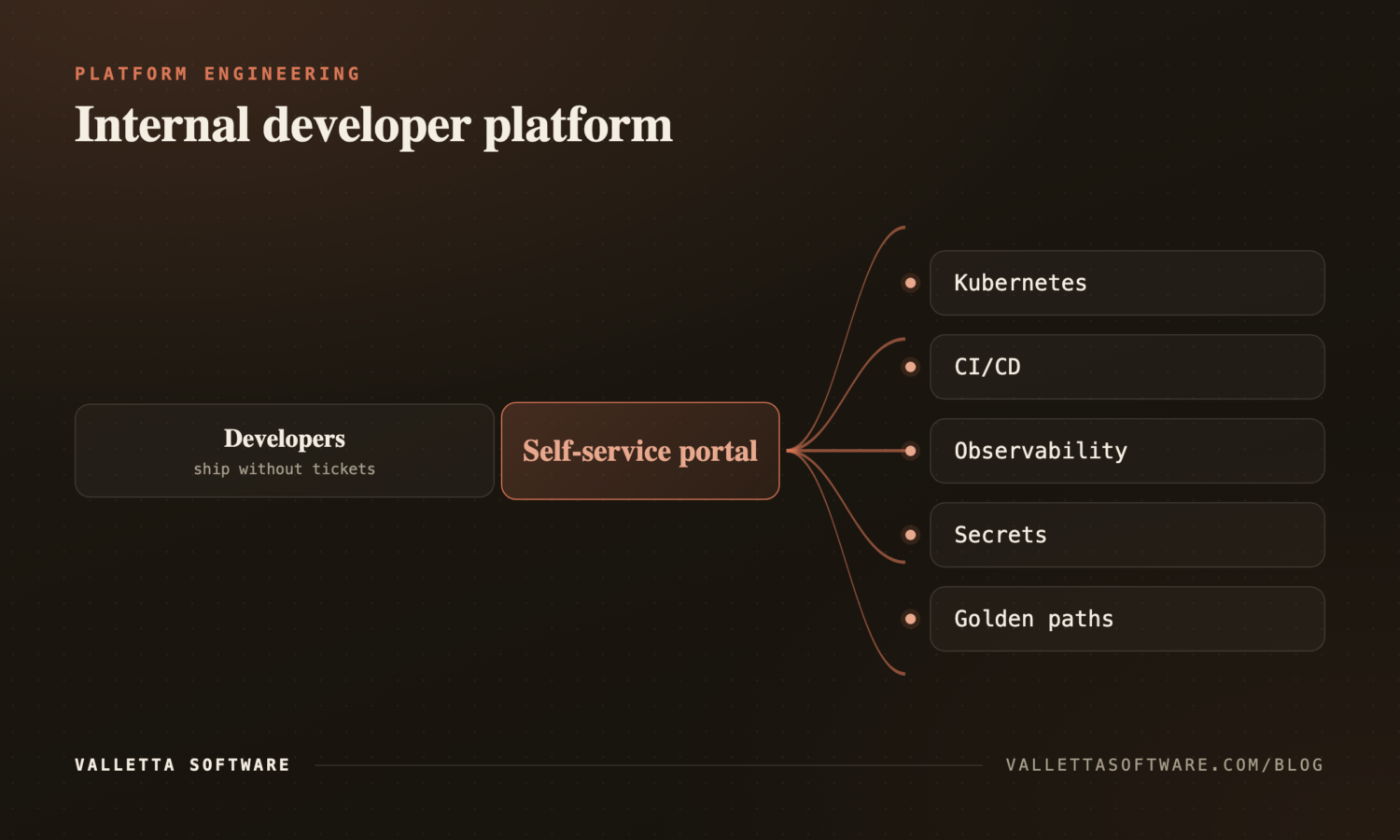
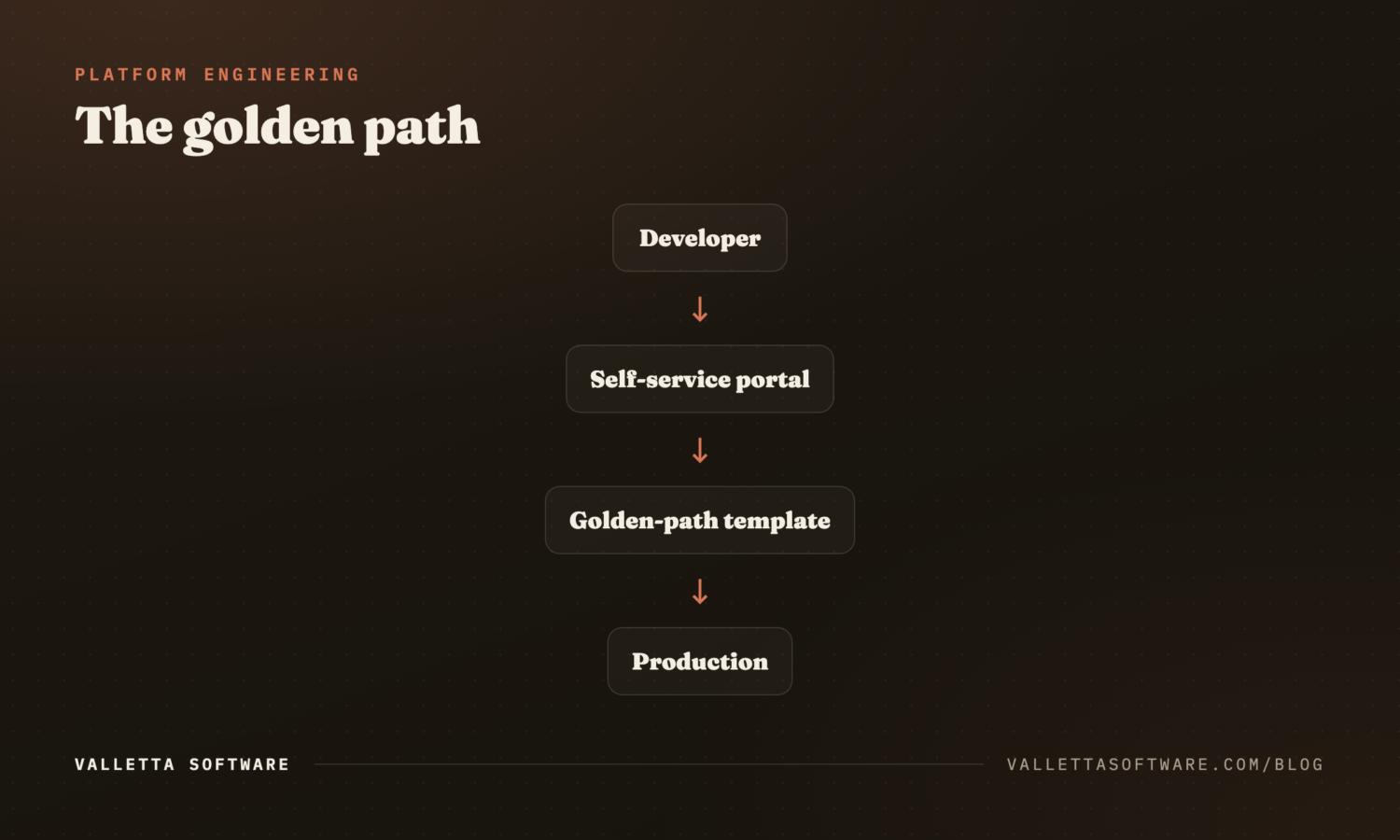
We design the platform around the actual workflows your product teams need: a new service from template to production in under an hour, observability on by default, secrets handled, cost tagged. Tools we commonly assemble: Backstage, ArgoCD, Crossplane, Kustomize/Helm, Datadog or Grafana Cloud, Terraform/OpenTofu modules behind a portal.
Kubernetes platform builds
EKS, GKE, AKS, or on-prem. Cluster topology, multi-tenancy isolation, ingress and service mesh choices, autoscaling, cost controls, upgrade automation. Deep reference reading: our K8s vs Docker comparison.
SRE practice rollout
SLO definitions on the top user journeys, error-budget policy, on-call rotation design, incident response runbooks, blameless postmortem culture. We work with engineering leaders to make the policies stick rather than gather dust.
Infrastructure as code modules and golden paths
Reusable IaC modules that encode the platform's choices: an opinionated module to spin up a new service with VPC, IAM, secrets, and observability wired up. See our IaC guide for the underlying patterns.
Developer experience and self-service portals
Backstage as the front door, with templates that bake in the platform's standards. Service catalog, ownership metadata, dependency graphs, and integrated docs. The goal is that a new engineer ships a service on day one without reading a wiki.
Why platform engineering, not DevOps?
DevOps merged dev and ops. Platform engineering recognizes that at scale, a small group of platform engineers serves a larger group of product engineers as an internal product. Product teams consume self-service capabilities; the platform team is judged on the quality of those capabilities.
If you have 30+ engineers and your DevOps team is drowning in ticket work, the platform engineering operating model is usually the right next step. The shift from "DevOps as a service" to "platform as a product" is one of the most visible changes in engineering organization in 2026.
Who this is for
- Mid-size engineering orgs (50 to 500 engineers) where DevOps tickets dominate the queue.
- Series C to Fortune 500 companies running tens to hundreds of services on Kubernetes.
- Companies that have tried to roll out Kubernetes once and want to do it right the second time.
- Teams whose product teams are blocked on basic infrastructure changes for days or weeks.
How engagements work
- Free consultation: 45-minute call to understand your platform maturity, team structure, and target outcomes.
- Platform audit (optional, 1 to 2 weeks): we map your current state and propose a 12-month platform roadmap with quarterly deliverables.
- Build phase (3 to 9 months): a pod of senior engineers (3 to 6 people typically) builds the platform alongside an in-house counterpart team.
- Handoff and retainer: the in-house team owns the platform; we stay on a reduced retainer for upgrades, on-call backup, and quarterly reviews.
Standards and methodology
- CNCF-aligned tooling. We do not push proprietary stacks unless they earn their place.
- Open-source first for the load-bearing components (Kubernetes, Terraform, Prometheus, ArgoCD). Managed services where they accelerate without locking you in.
- Documentation is a deliverable. Every module ships with usage docs, troubleshooting guides, and ADRs explaining the trade-offs.
- Adoption is measured. We track platform NPS, time-to-first-deploy, and percentage of services using the golden path.
Differentiation
- Senior pods, not seat fillers. Every engineer on a platform engagement has shipped a platform before.
- US time-zone overlap. Synchronous work with your team during business hours.
- Outcome-scoped SOWs. We name the platform-adoption metric we are moving.
- Honest scope. If you are pre-Series-B and don't need a platform team yet, we will say so and recommend a leaner setup. See our DevOps consulting services if a generalist engagement fits better.
What clients ask us first
What is the difference between platform engineering and DevOps?
DevOps is a culture and practice. Platform engineering is the operating model that scales DevOps in larger orgs by treating the developer platform as a product. Most platform engineers are senior DevOps practitioners with a product mindset added.
Do we need Backstage?
Not necessarily. Backstage is a strong default for the developer portal layer, but you can run an effective platform with a wiki, a CLI, and good Slack norms. We help you pick the right complexity for your size.
How do we measure platform success?
Time-to-first-deploy for a new service, platform adoption rate (services on the golden path / total services), DORA metrics for product teams, and developer NPS. Tickets closed is not a useful metric.
Do you handle SRE specifically?
Yes. SRE is a core part of our platform practice. SLOs, error budgets, on-call design, postmortem culture, and the observability stack to back them.
Can you help us migrate from one cloud to another?
We have done it. It is rarely the right move financially; usually the better answer is to consolidate per workload and optimize what stays. We will tell you that honestly before we quote a migration.
Get started
A 45-minute call gives us enough to tell you whether platform engineering is the right next investment, and what a first engagement would look like.