

How an International School in the Netherlands Built Its Timetable in 3 Days Instead of 3 Weeks
An international school in the Netherlands was building each term timetable in spreadsheets over three weeks, finding clashes late and fixing them by hand. After a five-day Discovery audit and a focused build, the school now generates a clash-free timetable in three days, with attendance captured the same day.
Key Takeaways
- Timetable preparation fell from 3 weeks to 3 days (about 5x faster)
- Scheduling clashes dropped 80%
- Time spent on routine administration fell 55%
- Attendance moved from next-day to same-day, and parent messages reached families faster in both languages
The client is an international school in the Netherlands with around 700 students and a bilingual community of families and staff. For confidentiality we describe the engagement without naming the firm or the people involved.
The Challenge: Three Weeks of a Senior Teacher's Term, in a Spreadsheet
Every term, the same senior teacher disappeared into a spreadsheet for three weeks. The school had around 700 students, a bilingual staff, a mix of curriculum blocks, and a finite set of rooms. All of those constraints had to be reconciled by hand before a single lesson appeared on a timetable, and the first draft was never the last: clashes surfaced after publication, fixes knocked loose other slots, and the back-and-forth continued into the first days of term.
Routine admin compounded the pressure. Parent messages had to be written in two languages for every communication the school sent, which doubled the drafting load on already stretched staff. Attendance was collated manually each afternoon and the summary reached form tutors and administrators the following morning, a full day after the register closed. The cumulative time cost was not dramatic on any single day, but across a term it was substantial.
When we mapped the actual hours against the school year, the picture was clear. Three weeks of a senior teacher's working term went into timetabling alone. Bilingual parent communications added several hours each week. Next-day attendance meant the school was always acting on yesterday's data. The school needed a different approach, not more spreadsheets.
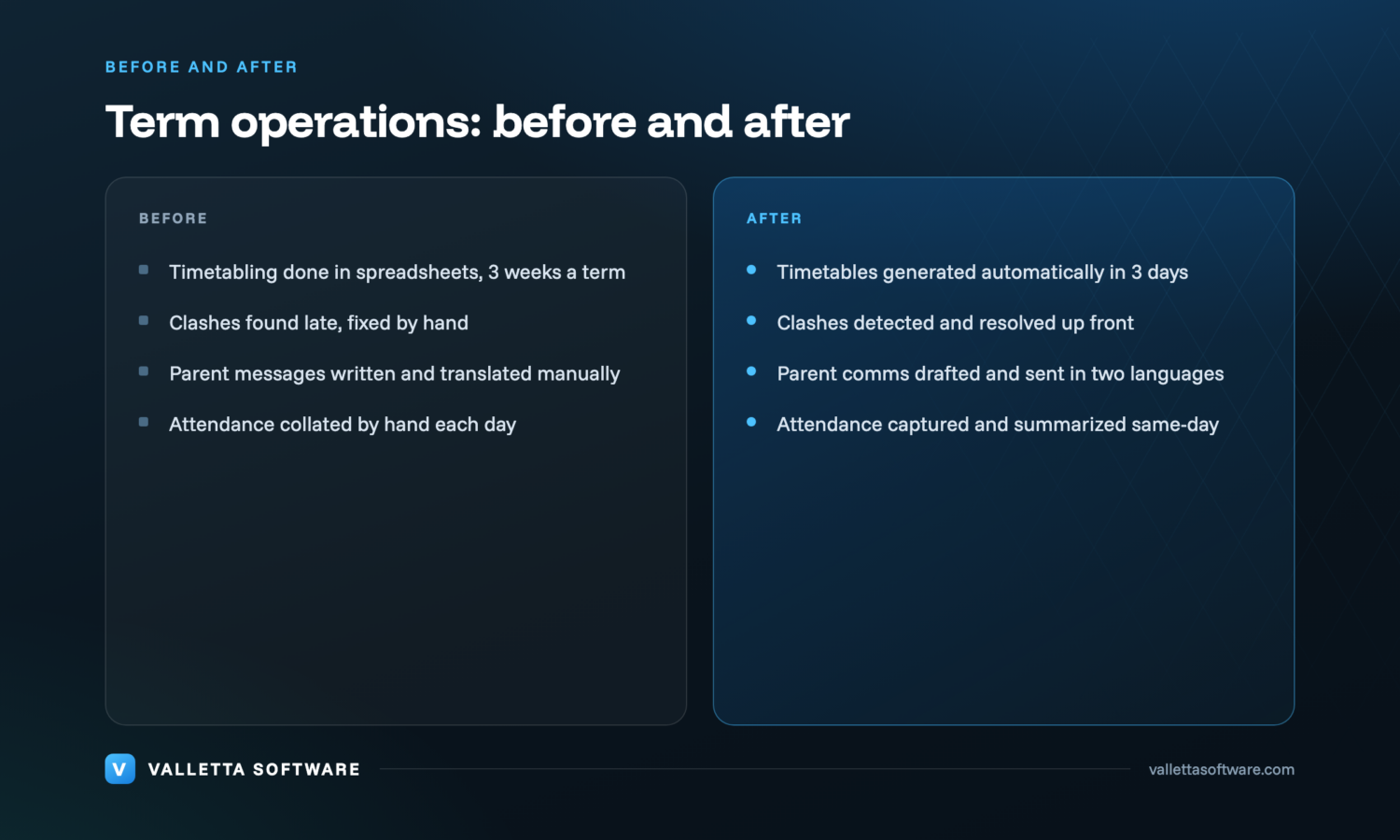
- Timetabling done in spreadsheets, 3 weeks a term
- Clashes found late, fixed by hand
- Parent messages written and translated manually
- Attendance collated by hand each day
The Approach: A Five-Day Discovery Audit
We started with a five-day Discovery audit. Two of our engineers spent a full working week at the school, sitting with the operations coordinator and the timetabling lead, watching a timetable get built from the constraints list to the published grid, and tracing how daily communications and attendance actually flowed.
The audit produced three findings that shaped the whole build. First, timetabling was a constraint-satisfaction problem that a solver could handle in minutes once the rules were captured correctly, but the school was re-encoding those rules from memory each term. Second, bilingual drafting was almost entirely mechanical for routine messages such as absence notes, schedule reminders, and term-date confirmations, which meant automation could cover the majority of the volume. Third, next-day attendance was a data-latency problem, not a staffing one: the register data existed same-day but no system aggregated it automatically.
One constraint was non-negotiable from the start: pupil schedules, family contact details, and attendance records are all personal data relating to minors, and every part of the build had to comply with the EU General Data Protection Regulation and the Dutch implementation under the AVG, with data staying resident in the EU and no pupil or family data passing through public AI services under any circumstances.
The Solution: Generated Timetables, Same-Day Attendance, Bilingual Comms
We built an operations toolkit with three linked modules: a constraint-based timetable generator that turns the school's own rules into clash-free schedules for staff to review and adjust, a bilingual communications layer that drafts and sends routine parent messages in both Dutch and English, and a same-day attendance pipeline that aggregates register data and surfaces summaries as soon as the register closes. The three modules share a single access-controlled data layer so information flows between them without manual re-entry.
- Model. The school's constraints, including rooms, staff availability, subject blocks, year-group requirements, and shared-space rules, are captured once as a structured rules set rather than rebuilt each term. When constraints change between terms, staff update the rules set, not a spreadsheet, so the system reflects the current reality before generation starts.
- Generate. Clash-free timetable options are generated automatically in hours rather than weeks, for teaching staff and the operations coordinator to review and adjust through a simple interface. Staff keep the final say on every schedule, and any manual change is validated against the rules set before it is saved, so late-breaking clashes are caught before publication rather than after.
- Resolve. Any remaining scheduling tensions are surfaced up front with suggested resolutions, giving staff a prioritized list to work through rather than a grid to scan by eye. The system distinguishes hard constraints, such as room capacity and teacher availability, from soft preferences, so staff know immediately which conflicts require a decision and which the generator can resolve itself.
- Communicate. Routine parent messages are drafted automatically in both Dutch and English, reviewed by a staff member, and sent from a single queue, so the drafting burden shifts from composition to approval. Attendance is captured from the register the same day, aggregated by class and year group, and delivered to form tutors and the administration team before the end of the school day.
Because the data in this system relates to minors, their schedules, their attendance, and their family contact details, GDPR compliance was the first design requirement, shaped around the specific obligations that apply to children's personal data under Dutch law:
- All pupil and family data is minimized to what each processing task strictly requires: the timetabling module works from anonymized staff and room identifiers during generation and resolves to named data only at the review stage, limiting exposure at every step.
- Processing runs entirely within a private, EU-resident deployment that meets the data-residency requirements of the AVG. No pupil schedules, attendance records, or family contact details are routed through public AI services or third-party training pipelines at any point.
- Access is role-based and scoped by function: timetabling administrators see scheduling data, form tutors see their own class attendance, and communication staff see outbound message queues. No role has broader access than its responsibilities require, and every access event is written to an audit log.
- Parental consent for data processing is recorded and linked to each family record. Every change to a timetable, attendance entry, or outbound communication is logged with a timestamp and the acting user, giving the school a complete, auditable trail it can present to regulators or parents on request.
Three weeks of a senior teacher's term went into a spreadsheet nobody enjoyed building.
The senior teacher who used to lose three weeks to a spreadsheet got those weeks back, and the bilingual communications load that had quietly doubled the drafting workload each week was reduced to a review queue that took minutes rather than hours.
The Results: Faster Timetables, Fewer Clashes, Less Routine Admin
We piloted on a single year group's timetable at the end of one term, proved the generated schedule was sound and that staff could make adjustments without difficulty, then ran the next full term across all year groups on the new toolkit. Attendance and bilingual communications went live at the same time. The first full term produced a clear before-and-after picture measured against the school's own historical baseline.
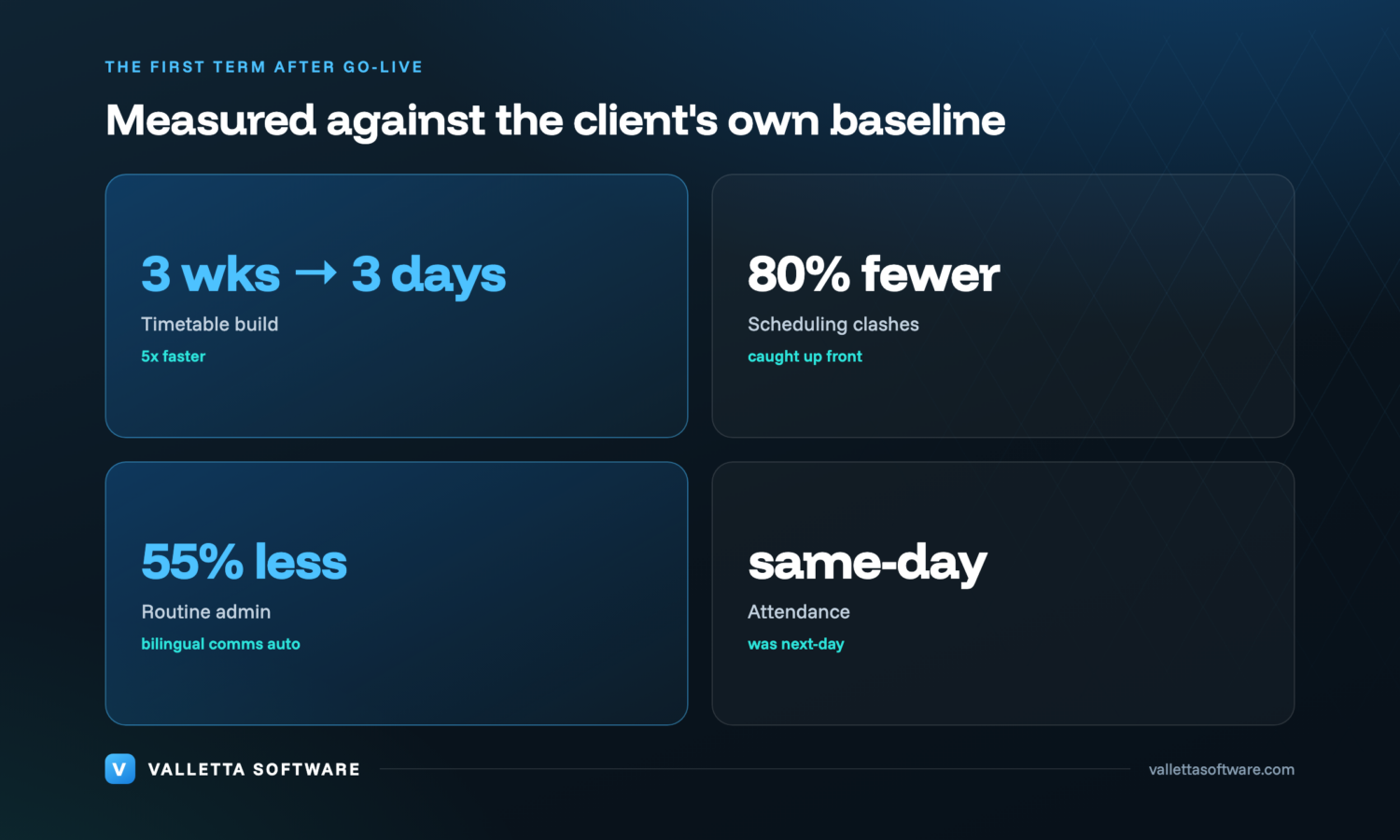
- Timetable preparation fell from 3 weeks to 3 days (about 5x faster).
- Scheduling clashes dropped 80%.
- Time spent on routine administration fell 55%.
- Attendance moved from next-day to same-day, and parent messages reached families faster in both languages.
The school now enters each term with a published, clash-free timetable that took three days rather than three weeks to produce, with senior staff free to prepare for teaching rather than spreadsheet-building. Routine admin that used to follow staff home in the evenings was handled by the system before the end of the school day. For more on how we approach work like this, see our school automation services.
Frequently Asked Questions
Can automated timetabling handle a complex international curriculum?
Yes. The generator works from the school's own constraints, rooms, staff availability and subject blocks, and proposes clash-free timetables that staff review and adjust, rather than building from a blank spreadsheet.
How is family and pupil data handled under GDPR?
Data is minimized to what each task needs, kept within the EU, encrypted, and access-controlled, with parental consent tracked. No pupil or family data is sent to public AI services.
Start With a Five-Day Discovery Audit
International schools carry a particular administrative load: bilingual communities, complex curriculum structures, regulatory obligations around children's data, and senior staff who are too valuable to spend three weeks in a spreadsheet. If timetabling, attendance, or parent communications are eating time that should go to teaching and leadership, a Discovery audit will show you precisely where the hours go and what it would take to recover them.
In five working days, for a fixed fee of €2,000, two of our engineers map your real workflow, measure where the manual hours and errors actually sit, and hand you a costed, prioritized automation plan, whether or not you build it with us.
Book your five-day Discovery audit: vallettasoftware.com/malta-ai-automation/international-schools