
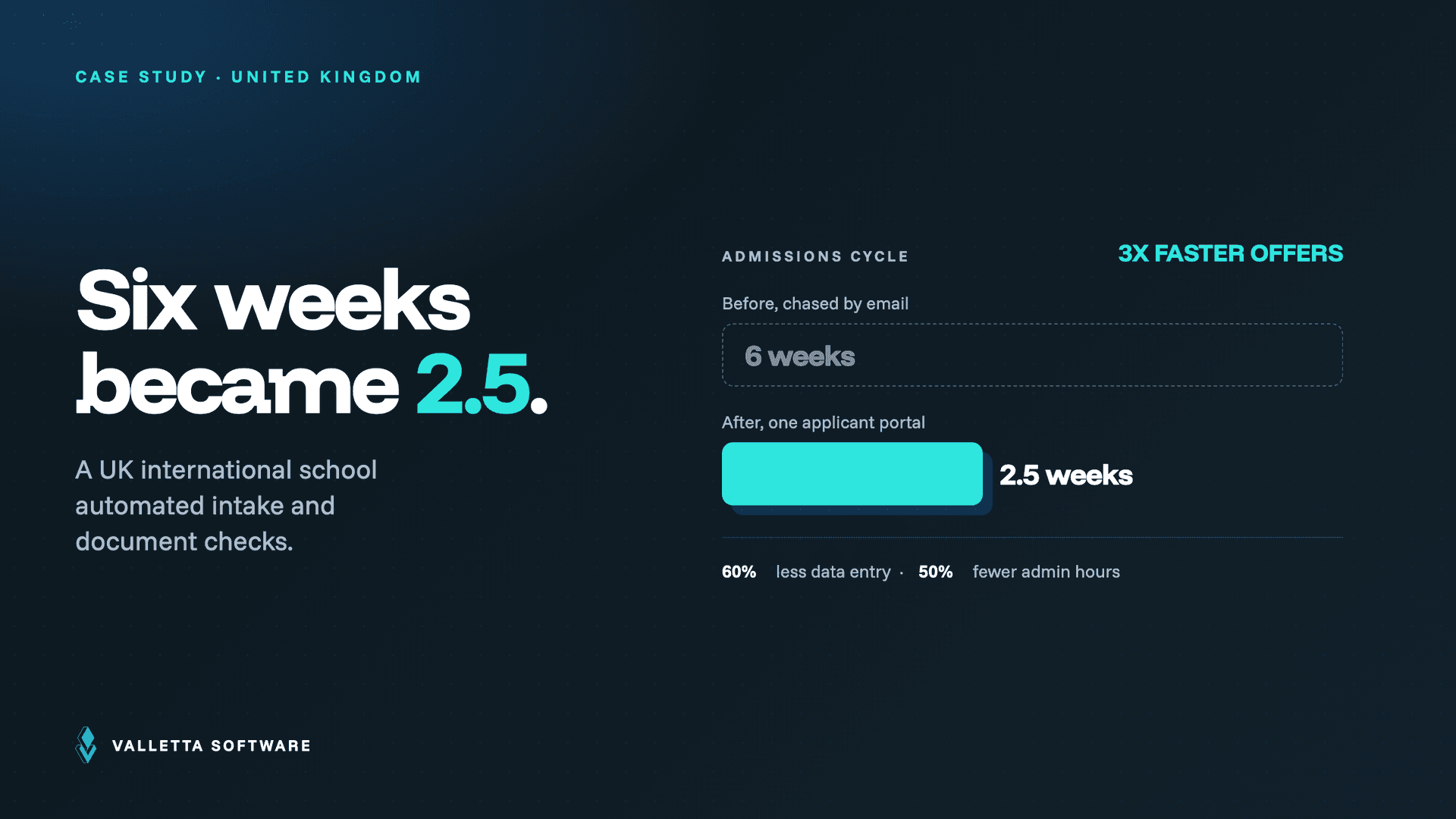
How an International School in the UK Cut Its Admissions Cycle From 6 Weeks to 2.5
An international school in the UK was running its admissions on email, chasing passports, visas and prior-school records by hand across a six-week cycle. After a five-day Discovery audit and a focused build, the admissions cycle now runs in 2.5 weeks, with offer turnaround three times faster.
Key Takeaways
- The admissions cycle fell from 6 weeks to 2.5
- Manual data entry dropped 60%
- Admissions staff hours on administration fell 50%
- Offer turnaround was 3x faster, improving enrolment conversion for relocating families
The client is an international school in the United Kingdom with around 900 students and a six-person admissions team serving families relocating from abroad. For confidentiality we describe the engagement without naming the firm or the people involved.
The Challenge: Six Weeks of Chasing Documents From Across the World
Families relocating from abroad were waiting six weeks to learn whether their child had a place. The admissions team handled around 1,300 applications a year, each one a bundle of forms and identity documents collected over many emails, chased individually, and checked by hand before an offer could go out. For a family mid-move and arranging schooling around an employment start date, six weeks was not a minor inconvenience.
A Discovery audit set out to quantify exactly where those six weeks were going. The team tracked every application from first enquiry to enrolment decision, recording the time spent on each manual step: initial inbox triage, document requests, follow-up chasing, completeness checks, and the handoff from admissions to the safeguarding lead.
The picture that emerged was consistent. Collection and chasing consumed the largest share of the cycle, not review or decision-making. Families submitted documents piecemeal by email with no structured format, staff checked each submission against a checklist by hand, and a single missing visa copy could stall a file for days while someone remembered to follow up. The bottleneck was process, not people.
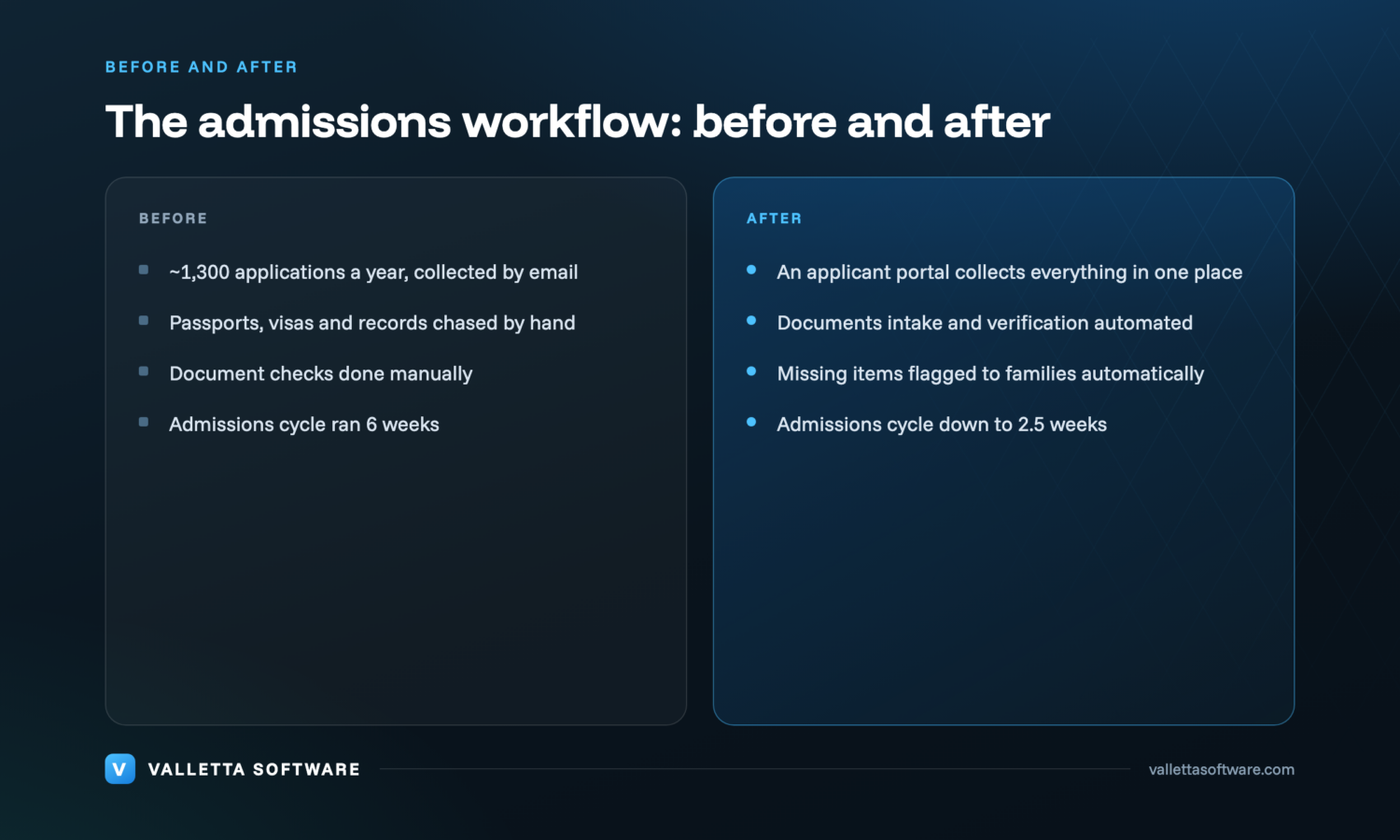
- ~1,300 applications a year, collected by email
- Passports, visas and records chased by hand
- Document checks done manually
- Admissions cycle ran 6 weeks
The Approach: A Five-Day Discovery Audit
Two of our engineers spent a week embedded with the admissions team, working alongside staff as they processed live applications. They timed each manual step, counted re-work loops caused by incomplete submissions, and mapped the handoffs between the admissions coordinator, the registrar and the safeguarding lead.
The audit produced a clear cost model: how many staff hours each stage consumed, which document types generated the most back-and-forth, and where delays clustered. It also established the design boundaries for any solution: a verified record of exactly which family member submitted which document and when, clearly defined retention periods for applicant data, and a reliable audit trail in case of a safeguarding query.
Children's data requires the highest standard of care under UK law, so compliance was treated as a hard constraint, not an afterthought. The final audit report included a data-flow map reviewed against the guidance published by the UK Information Commissioner's Office, and that map became the foundation for the build specification.
The Solution: An Applicant Portal, Automated Verification, Humans on the Decisions
We built an admissions pipeline that collects, verifies and chases automatically, removing the manual coordination overhead while keeping every consequential decision with the team. The pipeline was designed from the outset to meet UK GDPR requirements for children's data: minimized collection, clear retention limits, encrypted storage, and a full audit trail. It runs in four stages.
- Apply. Families submit applications and all required documents through a single structured portal, replacing scattered email threads and inconsistent attachments. The portal enforces a defined document checklist at submission, so the team receives complete or near-complete files rather than fragments arriving out of sequence.
- Verify. Identity documents, prior-school records and visa materials are checked automatically for completeness and document validity, with anything that cannot be confirmed automatically flagged for a staff member to review. Verification runs the moment a family submits, reducing the batch-check delay that previously added days to every application.
- Chase. When a document is missing or a check cannot be resolved, the system sends a structured request to the family with clear instructions on what is needed and by when. Nothing stalls because a follow-up email was forgotten at the end of a busy admissions week.
- Decide. The team works from complete, verified application files rather than partial records assembled across multiple inboxes. Admissions decisions, interviews and all safeguarding checks remain with qualified staff, and the system provides a timestamped audit trail to support those judgments, not to replace them.
Because the data concerns children and relocating families, protection requirements shaped every design decision from the earliest specification, not as a compliance checklist at the end:
- Data minimization was enforced at the portal level: applicant families are asked only for information the school demonstrably needs for the application, and retention periods were agreed in advance so records are purged on schedule rather than accumulated indefinitely.
- A data protection impact assessment was completed before any build work began, covering the categories of data processed, the legal basis for each, the risks associated with automated document handling, and the mitigations applied, including the decision to use a private, school-controlled deployment with no pupil or family data routed to public AI services.
- Encryption is applied in transit and at rest across all applicant files, and access is restricted by role: admissions coordinators see active applications, the registrar sees completed files, and the safeguarding lead sees only the data relevant to a safeguarding inquiry. No staff member has broader access than their role requires.
- Parental consent is collected and recorded as a structured field on every application, timestamped and linked to the specific data uses consented to, and every access, document submission and status change is written to an immutable audit log so the school can respond to a subject access request or a safeguarding query with a clear, complete record.
A family relocating across the world should not be waiting six weeks to know if their child has a place.
The automation took the paperwork, not the judgment. Admissions decisions, safeguarding assessments and interview conversations stayed entirely with the team, who now approach them with complete files rather than partial records assembled across dozens of emails.
The Results: Faster Offers and Families Who Hear Back Sooner
We ran the pipeline first on a single intake cohort to validate that automated verification was reliable on the school's own document types, then extended it to a full admissions cycle. The first complete cycle on the new pipeline measured the improvement against the school's own pre-automation baseline.
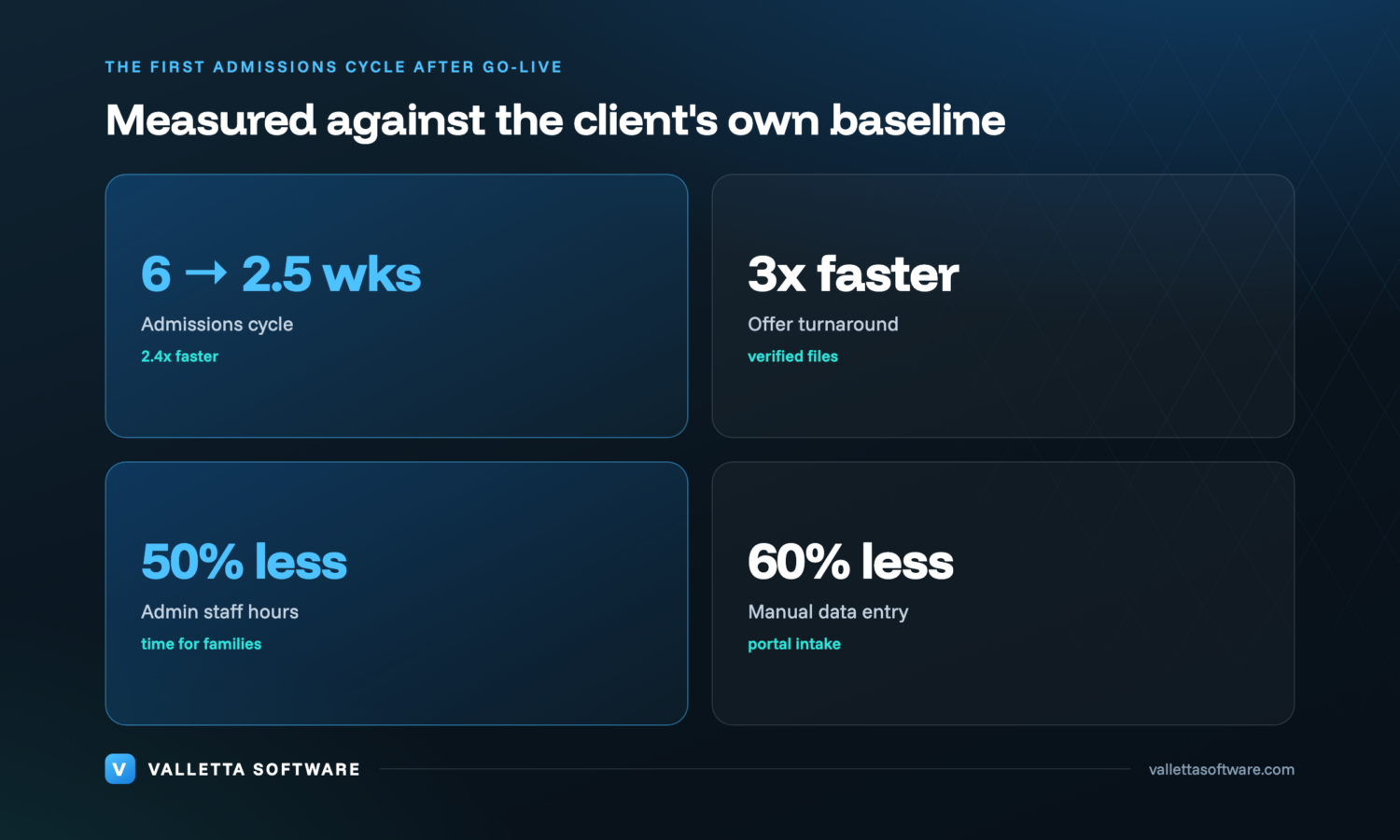
- The admissions cycle fell from 6 weeks to 2.5.
- Manual data entry dropped 60%.
- Admissions staff hours on administration fell 50%.
- Offer turnaround was 3x faster, improving enrolment conversion for relocating families.
Relocating families received decisions in 2.5 weeks rather than six, at a point in a relocation when certainty about schooling materially changes what a family can plan. The admissions team spent its recovered hours on conversations with families rather than chasing attachments. For more on how we approach this kind of work, see our school automation services.
Frequently Asked Questions
How do you protect children's data in school admissions automation?
Children's data is treated as high-risk. The system applies data minimization and retention limits, encryption, strict role-based access, and a data protection impact assessment, with no pupil data sent to public AI services and parental consent tracked.
Does automation remove the human judgment from admissions?
No. The system handles collection, verification and chasing. Admissions decisions, interviews and safeguarding checks stay with the team, who now spend their time on families rather than paperwork.
Start With a Five-Day Discovery Audit
If your admissions team is spending its working week chasing documents and checking submissions by hand, that time is recoverable. A Discovery audit maps exactly where the manual hours go, which steps are automatable without removing human judgment from decisions, and what a realistic build would cost and deliver.
In five working days, for a fixed fee of €2,000, two of our engineers map your real workflow, measure where the manual hours and errors actually sit, and hand you a costed, prioritized automation plan, whether or not you build it with us.
Book your five-day Discovery audit: vallettasoftware.com/malta-ai-automation/international-schools