
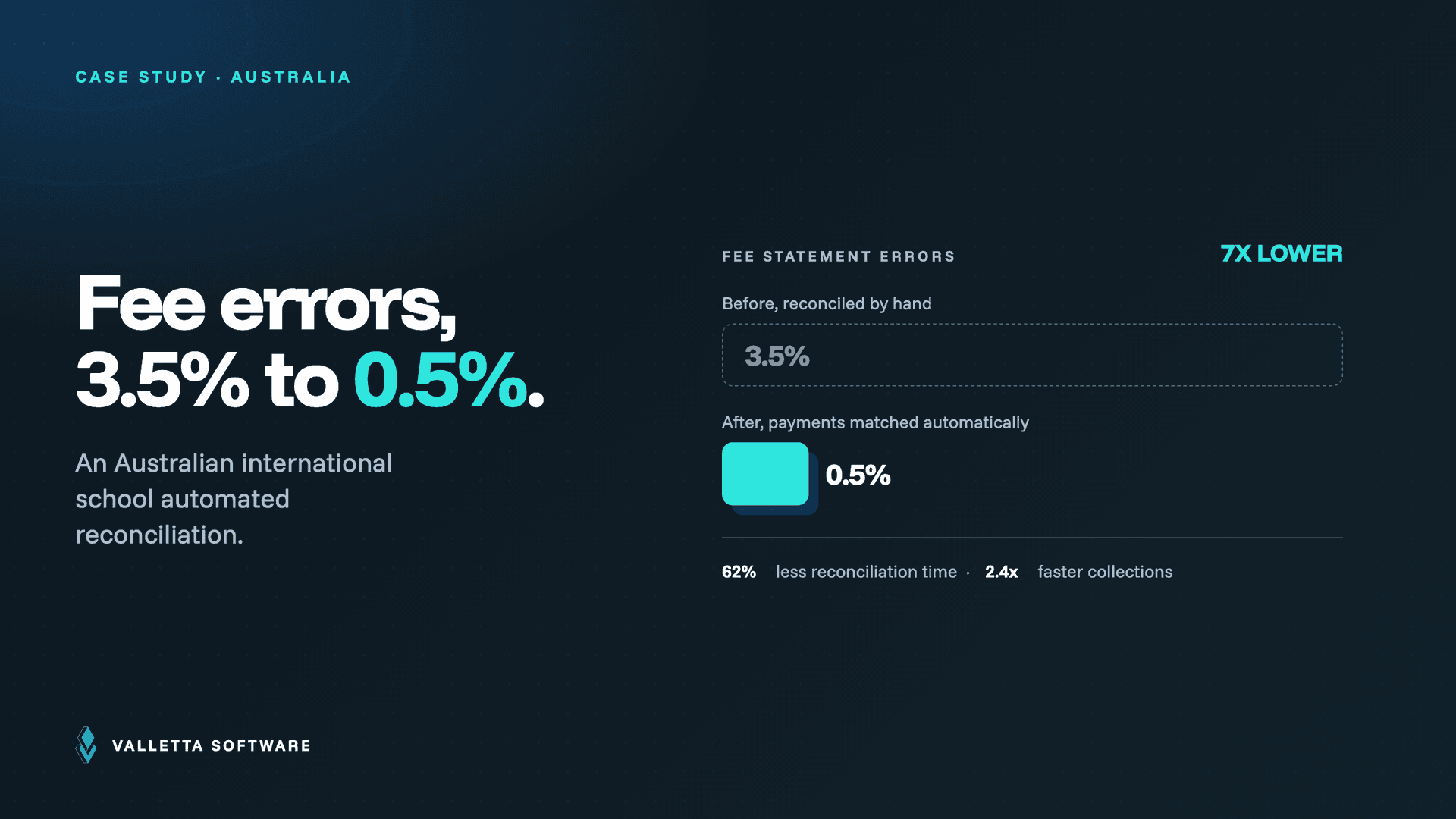
How an International School in Australia Cut Fee Statement Errors From 3.5% to 0.5%
An international school in Australia was reconciling around 2,000 fee transactions a term by hand, tracking scholarships and sponsors in spreadsheets and issuing statements with a 3.5% error rate. After a five-day Discovery audit and a focused build, reconciliation time fell 62% and statement errors dropped to 0.5%.
Key Takeaways
- Time spent on fee reconciliation fell 62%
- Fee statement error rate dropped from 3.5% to 0.5%
- Finance team administration fell 45%
- The collections cycle ran 2.4x faster, with student records consolidated into one source of truth
The client is an international school in Australia with around 1,100 students, a four-person finance team, and a mix of full-fee, scholarship and corporate-sponsored families. For confidentiality we describe the engagement without naming the firm or the people involved.
The Challenge: Two Thousand Transactions a Term, Reconciled by Hand
The finance team was four people responsible for around 1,100 students, and every term brought the same cycle: pull payment records from the banking portal, open the student information system, open the spreadsheet tracking scholarships and corporate sponsors, and begin matching line by line. Full-fee families were straightforward. Scholarship recipients needed a discount applied before the balance was calculated. Corporate-sponsored families required the sponsor's portion to be split out and invoiced separately. Every variation had to be handled manually, and any mismatch between the banking records and the student records produced a statement error.
The 3.5% statement error rate sounds small until a parent calls to dispute a figure. Each dispute took time to investigate, required pulling records from at least two systems, and damaged trust at the very moment a family was deciding whether to re-enrol. For a school where parent confidence is a direct factor in retention, incorrect fee statements were not a back-office nuisance: they were a reputational risk.
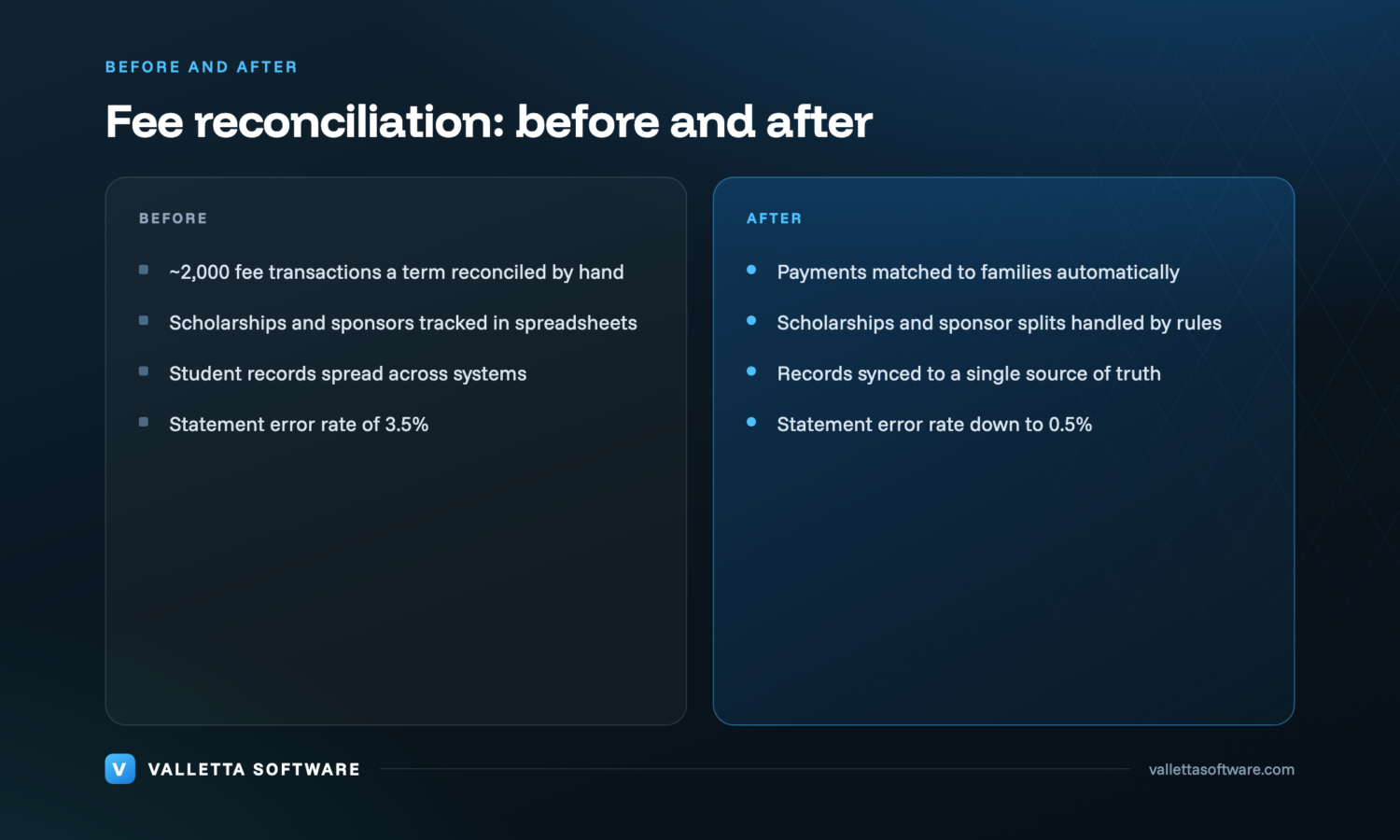
A Discovery audit set out the full picture of where the hours and the errors were coming from:
- ~2,000 fee transactions a term reconciled by hand
- Scholarships and sponsors tracked in spreadsheets
- Student records spread across systems
- Statement error rate of 3.5%
The Approach: A Five-Day Discovery Audit
Two of our engineers spent five working days with the finance team, attending the start-of-term reconciliation push and mapping every step from payment receipt to statement dispatch. We timed each task, recorded where records were copied between systems, and logged every case where a manual judgement had to be made about a scholarship threshold or a sponsor split percentage.
The audit produced three findings that shaped the entire build. First, the manual matching of roughly 2,000 payments to families and invoices each term was consuming the majority of the team's time, yet it was almost entirely mechanical: the data was there, it just lived in the wrong places. Second, statement errors traced back to a single root cause: scholarship and sponsor rules were held in spreadsheets that the student information system knew nothing about, so every statement required a human to mentally combine data from multiple sources. Third, the records consolidation problem was not optional: until student and fee data lived in one place, no amount of process improvement would remove the divergence that caused errors.
The audit also fixed the compliance frame for the build. Family financial data and student records together represent some of the most sensitive information a school holds, and the school's obligations under the Australian Privacy Act and the GDPR for its EU-resident families were non-negotiable design constraints, fully documented by the Office of the Australian Information Commissioner.
The Solution: Automated Matching, Rule-Based Splits, One Source of Truth
We built a fee-reconciliation pipeline that takes over the mechanical work of matching, splitting and statement generation, while the finance team retains oversight of every exception and every final figure. The pipeline connects the school's banking portal, student information system and billing module through a single reconciliation layer, so data moves between them by rule rather than by hand. It runs in four stages, and each stage replaces a category of manual effort that had been quietly absorbing staff time every term.
- Match. Incoming payments are read from the banking portal and matched to the correct family account and invoice automatically, using name, reference number and amount as corroborating signals. Confident matches are posted for one-click confirmation, while anything ambiguous is surfaced to a finance officer with the most likely candidates shown alongside the evidence, so the decision is fast and the reasoning is visible.
- Allocate. Scholarship discounts, bursary adjustments and corporate sponsor splits are applied by rule rather than by hand, with each rule defined once in the system and applied consistently across every family it covers. A sponsor paying 60% of a child's fees no longer requires a finance officer to manually calculate the split each term: the allocation happens automatically, and the sponsor receives a correctly itemized invoice without additional effort.
- Sync. Student records, family account details and fee data are synchronized into a single source of truth that all downstream processes read from, ending the term-by-term divergence between the student information system and the fee ledger. When a student changes enrolment status, switches scholarship tier, or has a sponsor arrangement updated, the change propagates automatically rather than being re-entered in each system separately.
- Statement. Fee statements are generated directly from the reconciled ledger data, so the figure a family sees on their statement is the same figure the finance team sees in the system, with no manual re-assembly step in between. Statements for full-fee, scholarship and sponsored families each render correctly from the same pipeline, with the appropriate deductions, credits and sponsor-portion exclusions applied before the document is produced.
Because the system holds both family financial data and student records, which together attract the highest level of protection under Australian privacy law and the GDPR for the school's EU-resident families, security and compliance were embedded in the design from the first day of the build rather than reviewed at the end:
- Family financial data and student records are encrypted in transit and at rest, with role-based access controls that ensure finance staff can see the accounts they need and nothing beyond them, and that teachers and administrators cannot access fee data that is not relevant to their role.
- The build was designed to satisfy the Australian Privacy Act and to provide GDPR-compliant handling for EU-resident families, including documented lawful basis, data minimization applied to each processing step, and a data-processing record available for review by the school's data protection lead or any regulatory authority.
- All processing runs within the school's chosen data-residency boundary on a private deployment: no family financial data, no student records, and no payment information is sent to public AI services or used to train third-party models.
- Every match, allocation, sync and statement generation event is written to an immutable audit log, so the school can reconstruct the basis for any fee statement at any point in time and demonstrate to a parent, an auditor, or a regulator exactly how each figure was calculated.
When a fee statement is wrong, you do not just lose time. You lose a parent's trust on day one.
The finance team moved from rebuilding statements to reviewing exceptions, and from investigating errors to confirming figures. The shift took roughly a term to become routine, and the statement error rate reflected it.
The Results: Cleaner Statements, Faster Collections, Records That Agree
We ran the first pilot on a single term's reconciliation data, using historical payment records and the existing scholarship and sponsor rules to prove that the matching and allocation were correct before going live. Once the team was satisfied that the outputs were accurate, we consolidated records across systems and ran the first live term on the full pipeline. Two terms later, the numbers told the story.
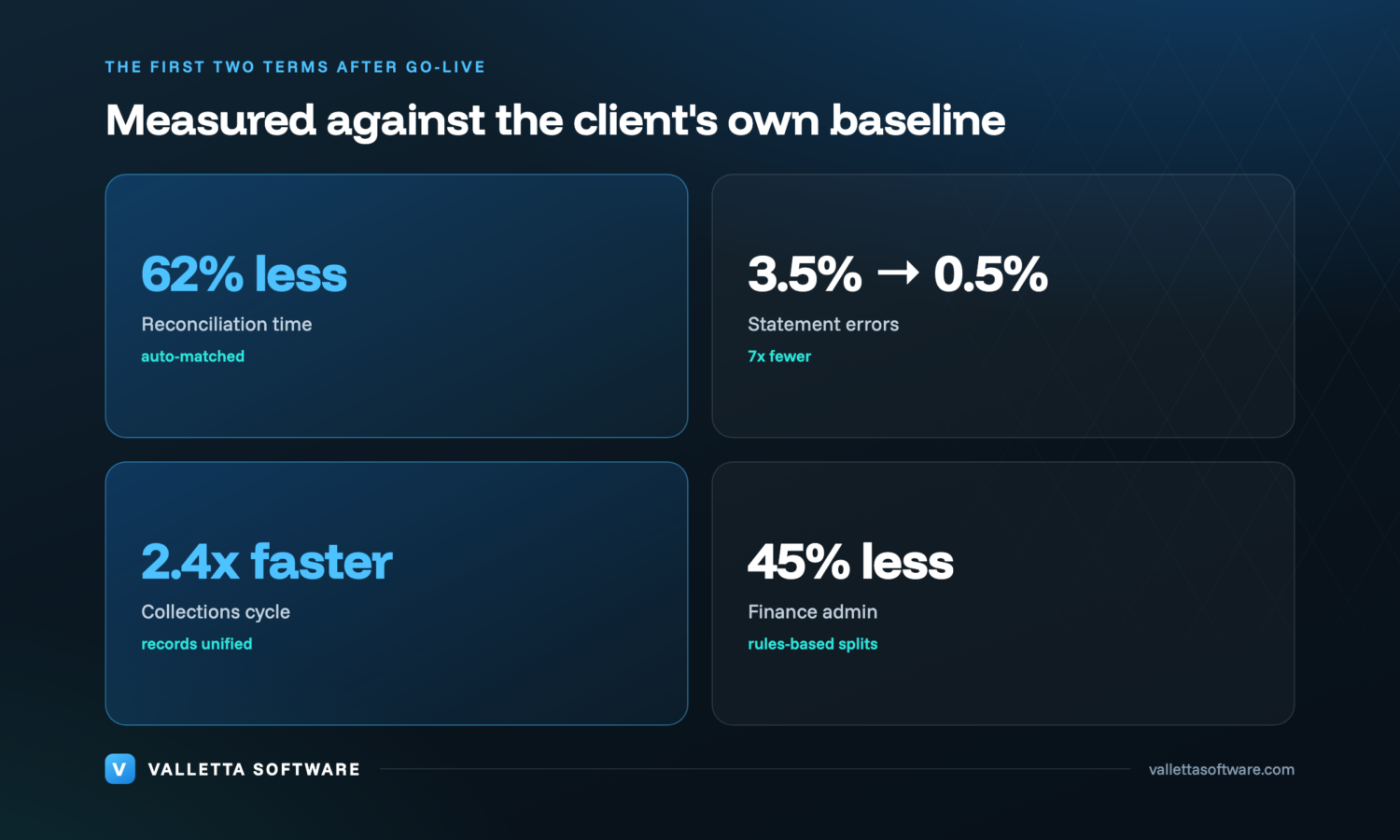
- Time spent on fee reconciliation fell 62%.
- Fee statement error rate dropped from 3.5% to 0.5%.
- Finance team administration fell 45%.
- The collections cycle ran 2.4x faster, with student records consolidated into one source of truth.
The school entered each term with a finance operation it could trust: statements that went out right the first time, a collections cycle that ran 2.4x faster because families were not disputing figures, and records that agreed across every system the school used. For more on how we approach this kind of work, see our school automation services.
Frequently Asked Questions
Can automation handle scholarships, sponsors and split fee arrangements?
Yes. Sponsor splits, scholarships and discounts are handled by rules, so each family statement is built correctly without a finance officer reconstructing it by hand every term.
How is student and family financial data kept secure?
Data is encrypted, access is role-based, processing keeps to the school's data-residency commitments, and every change is logged. No family or student data is sent to public AI services, with GDPR handling for EU-based families.
Start With a Five-Day Discovery Audit
Finance teams in international schools carry a structural complexity that most automation tools are not built for: full-fee, scholarship and sponsored families, multiple currencies in some cases, and student records that need to stay in sync with billing at all times. The fastest way to understand what is actually consuming your team's time each term, and where the statement errors are coming from, is the same way this engagement started: a five-day Discovery audit that maps your real workflow before any build begins.
In five working days, for a fixed fee of €2,000, two of our engineers map your real workflow, measure where the manual hours and errors actually sit, and hand you a costed, prioritized automation plan, whether or not you build it with us.
Book your five-day Discovery audit: vallettasoftware.com/malta-ai-automation/international-schools