

How a US Commercial Insurance Broker Cut Quote Turnaround From 4 Days to 1.5
A US commercial insurance brokerage was re-keying ACORD forms and email submissions into its agency system by hand, with quotes taking an average of four days. After a five-day Discovery audit and a focused build, submission intake now runs 3x faster and quote turnaround has dropped to 1.5 days.
Key Takeaways
- Submission intake ran 3x faster
- Manual re-keying fell 60%
- Quote turnaround dropped from 4 days to 1.5
- Renewal preparation took 45% less effort, and fewer submissions slipped through unquoted
The client is a commercial property and casualty insurance brokerage in the United States, around 80 staff, with a growing book of mid-market and EU-domiciled corporate clients. For confidentiality we describe the engagement without naming the firm or the people involved.
The Challenge: Every Submission Re-Keyed, Every Quote a Day Behind
The brokerage was winning business faster than it could process it. Around 1,800 submissions arrived every month as emails and ACORD PDFs, and a producer or CSR had to open each one, identify the insured, locate or create the account in the agency management system, and key the coverage details by hand. With 35% of submission data going through that re-keying step, the new-business queue backed up quickly, and producers were watching quotes stall while competitors with lighter stacks moved faster.
Renewals compounded the problem. Each renewal started the same way a new submission did: someone pulled the expiring policy, found the current values, and manually updated the AMS before the marketing process could even begin. With 80 staff and a growing book of mid-market accounts, the overhead was not just an inconvenience. It was a structural drag that made adding volume harder, not easier.
A Discovery audit gave the leadership team concrete numbers to work with:
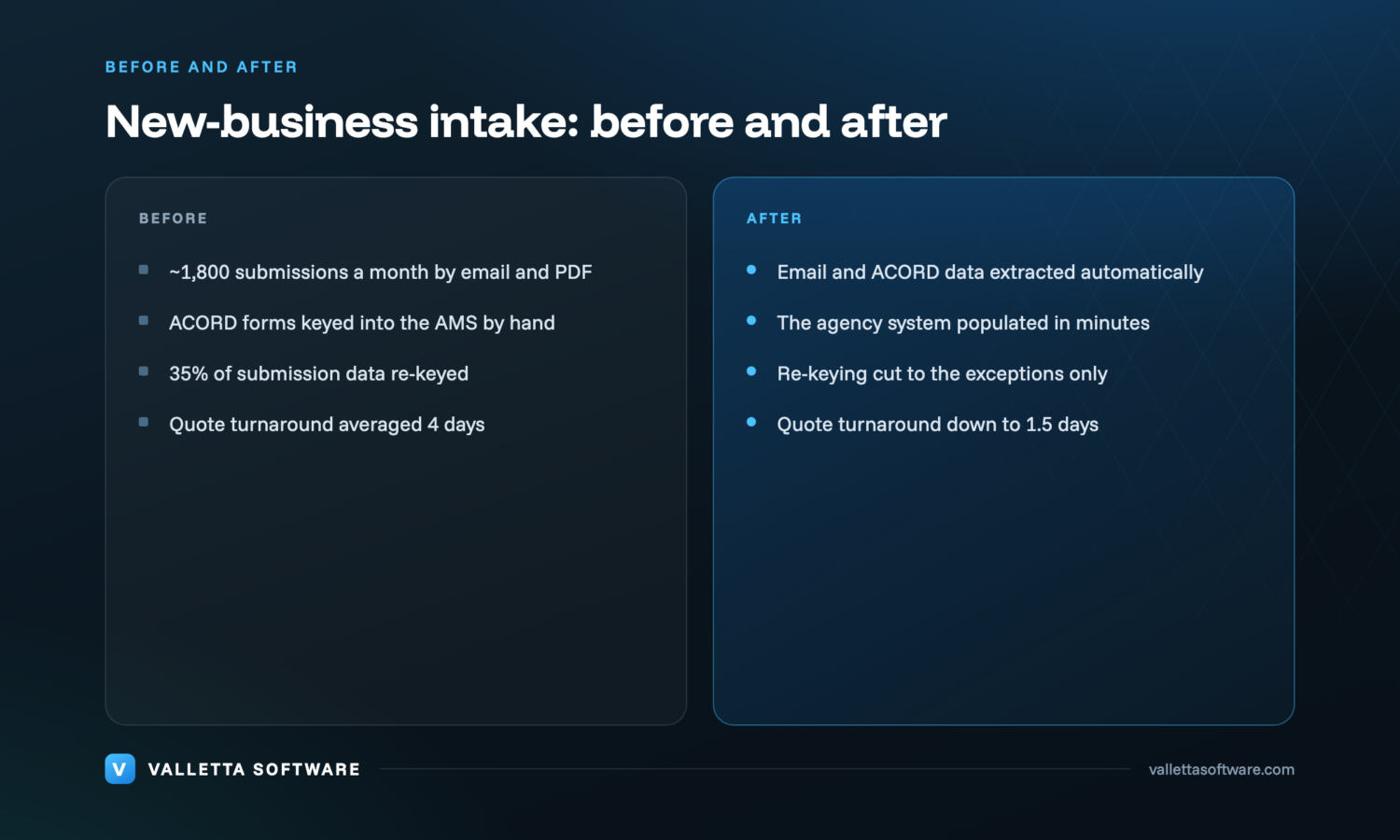
- ~1,800 submissions a month by email and PDF
- ACORD forms keyed into the AMS by hand
- 35% of submission data re-keyed
- Quote turnaround averaged 4 days
The Approach: A Five-Day Discovery Audit
We started, as we always do, with a five-day Discovery audit rather than a proposal built on assumptions. Over one working week, two of our engineers embedded with the new-business and renewals teams, tracing every submission from the moment it arrived in the inbox to the moment a producer had a complete record ready to market.
The audit surfaced three findings that shaped the entire build. First, re-keying consumed a disproportionate share of staff time: most of it clustered around ACORD form fields that appear on nearly every commercial account, such as named insured, effective dates, limits, and SIC codes. Second, quote turnaround was the number losing deals, not coverage knowledge or market access. Third, renewals were re-doing manual work that already existed in the AMS, because nobody had built a reliable way to pull it forward.
Those three findings gave us a clear brief: eliminate re-keying on the common fields, get submissions into the AMS in minutes rather than hours, and make renewals a pull-forward operation rather than a rebuild. The audit also fixed the security baseline that any build would have to meet: commercial PII and coverage data handled under SOC 2-aligned controls and the NIST Cybersecurity Framework, with GDPR-compliant processing for the brokerage's EU-domiciled corporate clients.
The Solution: Automated Extraction Into the Agency System, Exceptions to Humans
We built a submission intake pipeline that reads incoming emails and ACORD PDFs, extracts structured data, and populates the agency management system automatically, leaving only the fields that genuinely need a human to the producer. The design was intentional about what it automated and what it left alone: common, structured data fields were fair game; coverage decisions and client judgment were not. In practice the pipeline runs in four stages.
- Capture. New-business emails and ACORD PDFs are captured automatically as they arrive, with both the message body and all attachments treated as data sources. Submissions that arrive outside business hours are queued and processed without delay, so no producer has to manually sort an inbox first thing in the morning.
- Extract. Structured data is pulled from ACORD form fields and free-text email content using document-understanding models trained on commercial P&C submissions. Low-confidence fields, those where the source document is ambiguous or contradicts the AMS history, are flagged for a producer to confirm rather than written in silently.
- Populate. Extracted and validated fields are written into the agency management system in minutes, so the account is quote-ready without any manual re-keying of the common data. For renewals, the pipeline pulls the expiring values forward from the existing AMS record and highlights what has changed, turning a rebuild into a review.
- Quote. Producers work from a queue of complete, pre-populated records rather than raw emails, and the system surfaces any submission that is missing information before it becomes a quote delay. Renewals enter the same pipeline on a scheduled basis, so the marketing process can start as soon as a producer picks the account up.
Because the brokerage handles sensitive commercial and personal information, including coverage details, financials, and PII for mid-market clients with EU-domiciled operations, the security controls were specified before the first line of code was written:
- All data is encrypted in transit using TLS and at rest using AES-256, with single sign-on and role-based access controls that restrict each user to the accounts and lines of business they are authorized to see, aligned to SOC 2 Type II control expectations.
- The extraction models run in a private, single-tenant deployment; no submission data, no ACORD form fields, and no client PII is ever sent to a public AI service or used to train third-party models.
- GDPR-compliant handling is applied to all EU-domiciled corporate clients: a documented lawful basis for processing, data minimization to what the submission workflow requires, and a data-processing agreement that the brokerage can present to any EU counterparty or regulator.
- Every extraction, field edit, and AMS write is recorded in an immutable audit log that supports both internal compliance review and carrier or E&O audit requirements, with access to the log itself restricted by role.
A submission that sits in an inbox for three days is a deal you are losing to a faster broker.
The producers stopped functioning as a data-entry layer between the email inbox and the agency system, and went back to placing business. The AMS became a live, accurate record rather than a destination that was always a few days behind reality.
The Results: Faster Intake, Faster Quotes, Fewer Lost Submissions
We piloted the pipeline on a single line of business, general liability submissions from mid-market accounts, and ran extraction against the brokerage's own historical submissions to tune accuracy before touching live workflows. Once confidence thresholds were met, we extended to all new-business lines and then to the renewals pipeline. By the end of the first two quarters after full go-live, the numbers had held across the wider book.
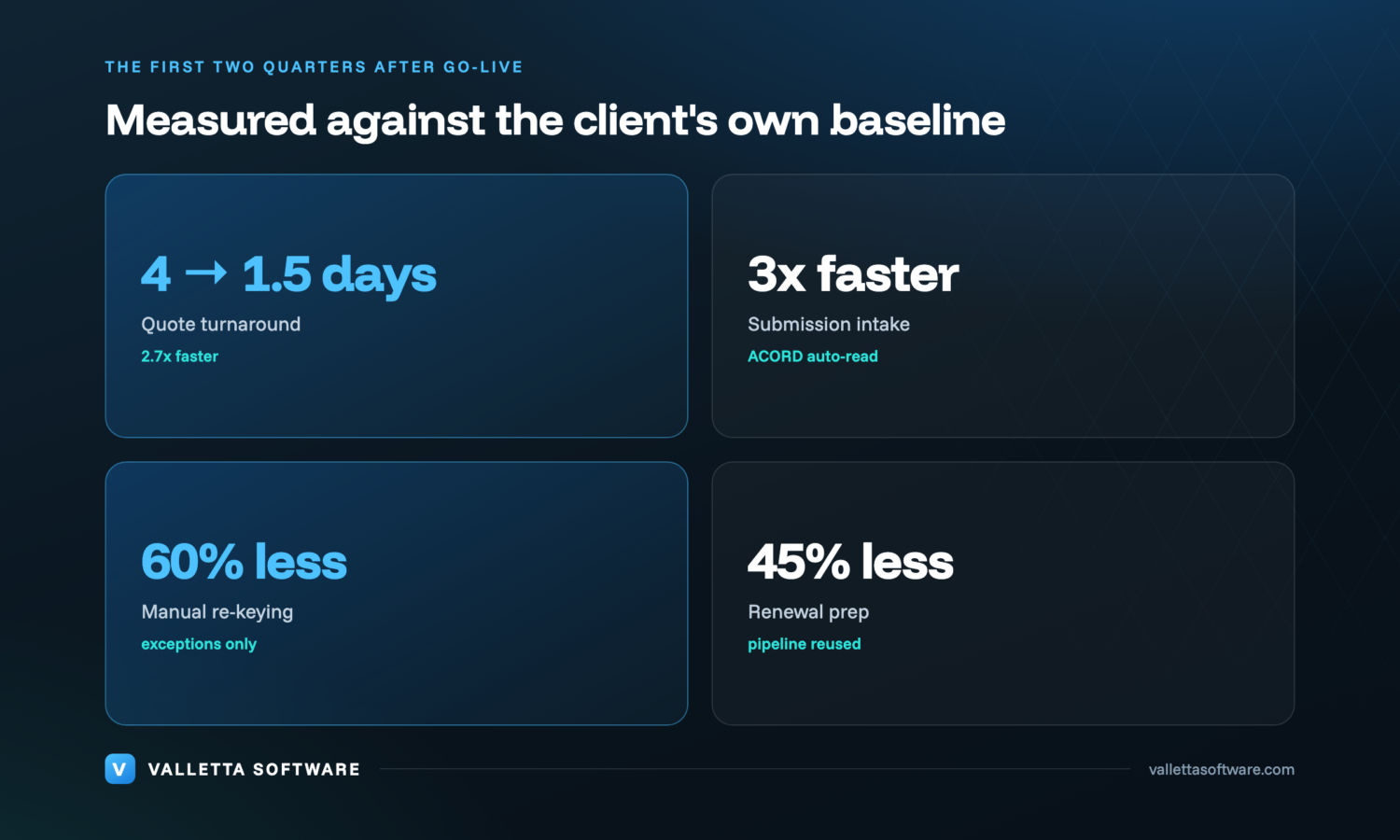
- Submission intake ran 3x faster.
- Manual re-keying fell 60%.
- Quote turnaround dropped from 4 days to 1.5.
- Renewal preparation took 45% less effort, and fewer submissions slipped through unquoted.
The brokerage quoted faster, lost fewer submissions to the backlog, and freed its producers to spend time on coverage and client relationships rather than on data entry. The gains on renewals were quieter but equally real: 45% less preparation effort meant that producers could start marketing earlier in the renewal cycle and had more time to review terms rather than reconstruct records. For more on how we approach this class of work, see our insurance automation services.
Frequently Asked Questions
Can automation read ACORD forms and email submissions reliably?
Yes. The pipeline extracts structured data from ACORD PDFs and free-text emails, then populates the agency management system. Low-confidence fields are flagged for a human rather than guessed.
How is client data protected in submission automation?
Data is encrypted, access is role-based, and controls are aligned to SOC 2 expectations, with GDPR handling for EU-domiciled clients. No client data is used to train third-party models.
Start With a Five-Day Discovery Audit
If a submission can sit in an inbox for days before it becomes a quote, the delay is almost never a capacity problem. It is a data-entry problem, and data entry is automatable. A Discovery audit is the fastest way to find out exactly how much of your team's time sits in re-keying, how much of that is recoverable, and what a prioritized build to fix it would cost, whether or not you build it with us.
In five working days, for a fixed fee of €2,000, two of our engineers map your real workflow, measure where the manual hours and errors actually sit, and hand you a costed, prioritized automation plan, whether or not you build it with us.
Book your five-day Discovery audit: vallettasoftware.com/malta-ai-automation/insurance