
How a German Insurer Cleared Its Correspondence Backlog With Same-Day Routing
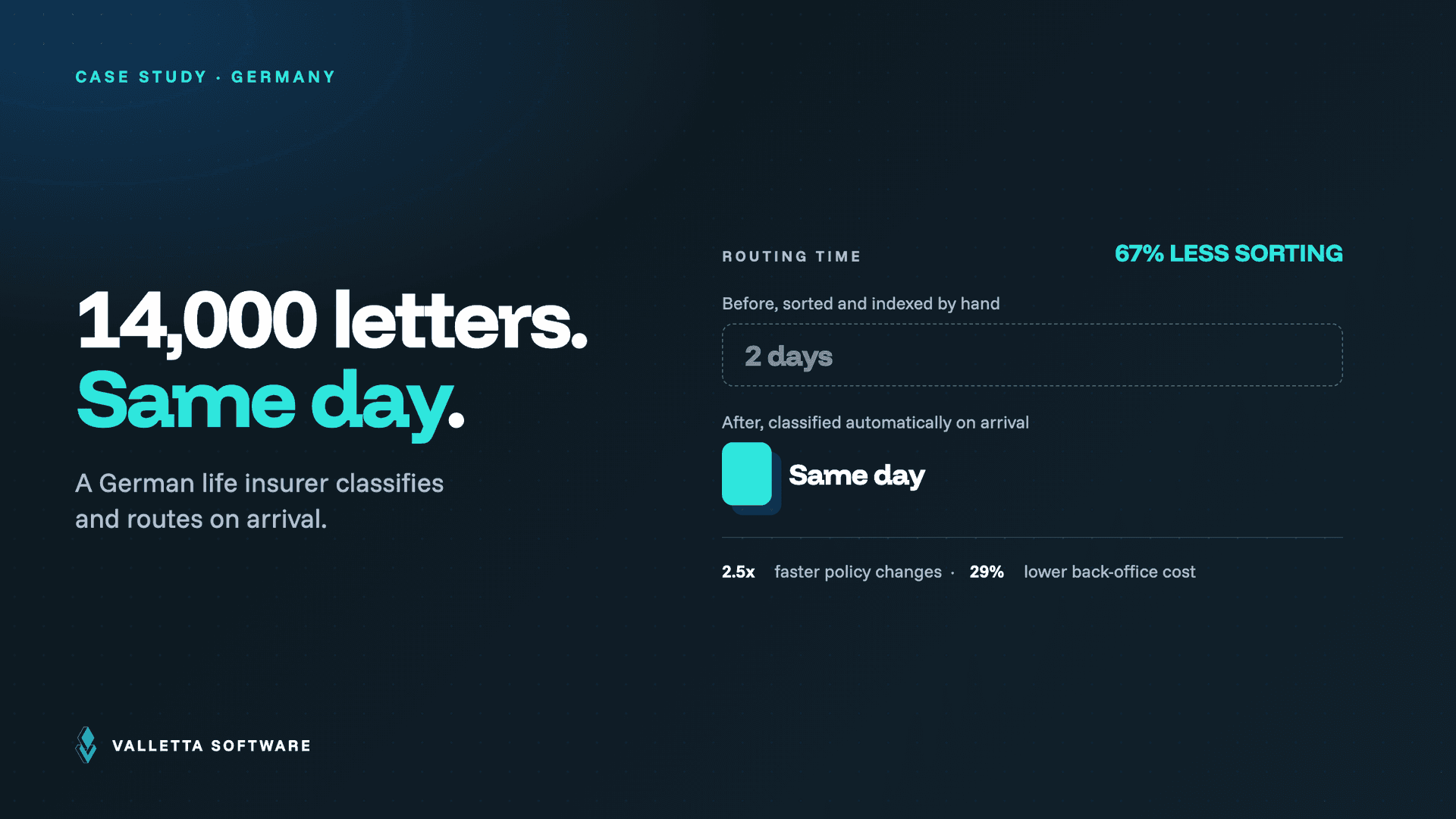
A German life and pension insurer was running its insurance back office on paper, sorting around 14,000 inbound documents a month by hand, with an average routing time of two days and backlogs that built up at every peak. After a five-day Discovery audit and a focused build, correspondence is now classified and routed the same day it arrives.
Key Takeaways
- Correspondence routing went from 2 days to same-day
- Manual sorting and indexing fell 67%
- Policy-change requests were processed 2.5x faster
- Cost to run the back office fell 29%, and peak backlogs were eliminated
The client is a life and pension insurer in Germany, with an operations team of around 120 people processing high volumes of inbound policy correspondence. For confidentiality we describe the engagement without naming the firm or the people involved.
The Challenge: A Two-Day Routing Queue That Never Cleared
The insurer's operations team of around 120 people was handling roughly 14,000 inbound documents a month: pension adjustment letters, policy-change requests, beneficiary updates, complaints, and general policyholder enquiries. Every item arrived as a letter or email, was classified by a person, assigned an index code, and placed in a queue for the relevant department. The average wait from arrival to the right desk was two days. During peak periods, such as the annual statement run and the January renewals window, that queue stretched further, and work the team had not started yet kept arriving on top of work it had not finished.
The consequences for the insurance back office were concrete. A policy-change request that waited two days in the sorting queue waited two more days before anyone acted on it. Policyholders who called to confirm a change had been received were told it was in process, which was accurate but not reassuring. The team was skilled and diligent; the bottleneck was not effort but the structure of the work itself.
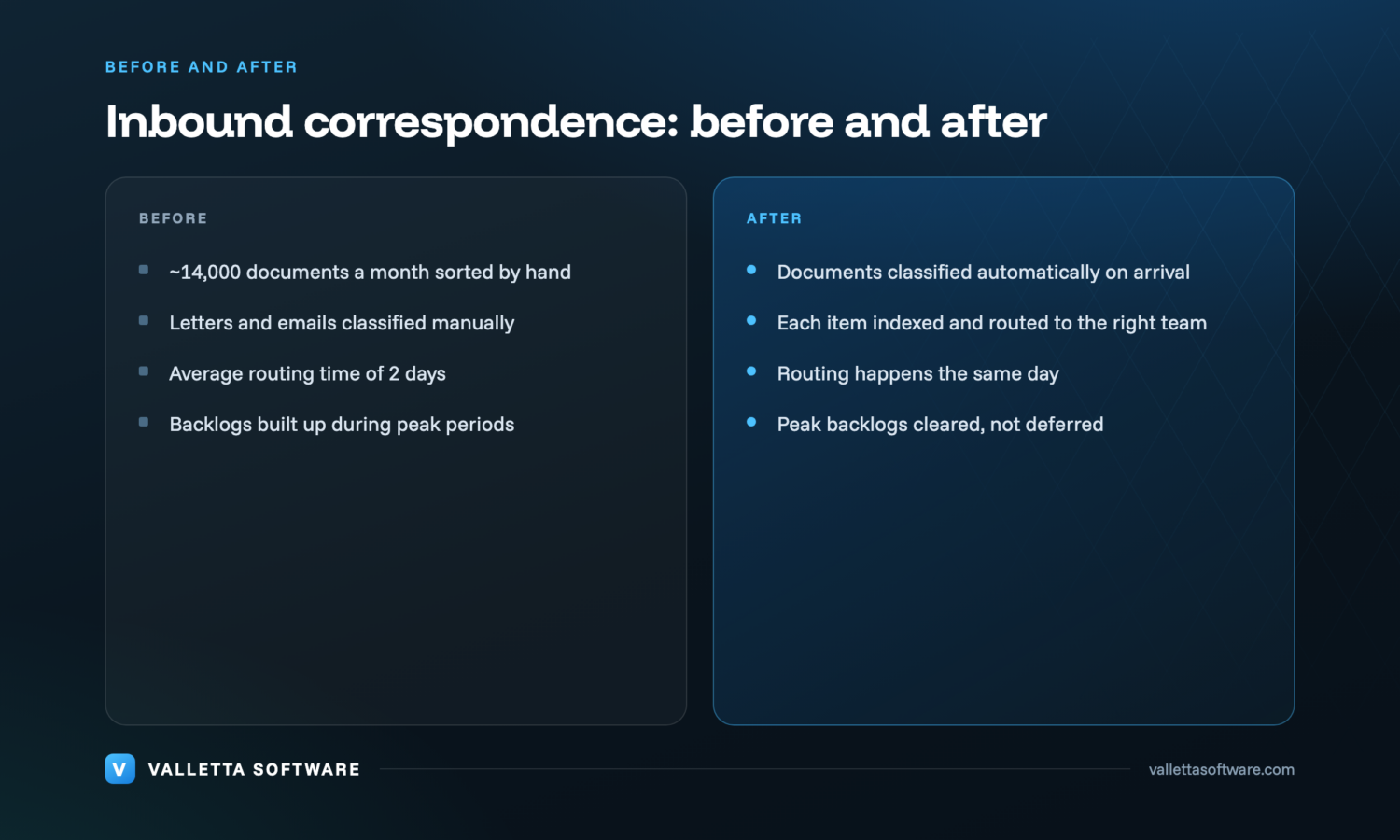
A Discovery audit mapped the problem in detail:
- ~14,000 documents a month sorted by hand
- Letters and emails classified manually
- Average routing time of 2 days
- Backlogs built up during peak periods
The Approach: A Five-Day Discovery Audit
We started with a five-day Discovery audit rather than a proposal. Two of our engineers spent a full working week in the operations centre, sitting with the correspondence team, timing every step from document arrival to department handoff, and building a precise picture of volume, type distribution and handling time.
The audit surfaced three findings that shaped the build. First, around 80% of inbound volume fell into a small number of repeating document types, which meant a classifier trained on the insurer's own historical mail could handle the vast majority of cases with high confidence. Second, routing delay was not caused by slow reading but by the queuing structure: documents were batched and sorted in blocks rather than individually, which meant a letter arriving at 9 a.m. might not be routed until mid-afternoon. Third, the index data being extracted by hand was already structured in a predictable way, making it a strong candidate for automated extraction. The audit also fixed the compliance frame: policyholders are natural persons whose correspondence contains sensitive personal data, and the entire design had to be built around strict GDPR obligations and the German Federal Data Protection Act, the BDSG, from the start.
We benchmarked the classifier against a held-out sample of historical correspondence before any production rollout, and cross-checked classification categories against the insurer's own department structure to confirm routing logic matched how the teams actually worked. The applicable standard for lawful automated processing of personal data is set by the EU General Data Protection Regulation, which the insurer was already subject to and which the build had to satisfy in full.
The Solution: Classify and Route on Arrival, Escalate the Uncertain
We built a correspondence pipeline that takes each document at the point of arrival, classifies it, extracts the index fields, and routes it to the correct team without the item entering a manual sorting queue. The design kept a human in the loop for any item the system could not classify with sufficient confidence, and the threshold for escalation was set conservatively so the team retained full control over edge cases and sensitive correspondence.
- Classify. Each inbound document, whether a scanned letter, a PDF attachment or a structured email, is read and classified by type on arrival. The classifier was trained on the insurer's own historical correspondence, so it recognises the specific document categories the operations team actually uses rather than a generic taxonomy.
- Index. Key fields, including policy number, member identifier, request type and urgency indicators, are extracted from each document and matched to the correct policy record. Items where the classifier's confidence falls below the escalation threshold are routed to a person rather than processed automatically, with the reason for escalation visible in the queue.
- Route. The document is delivered to the correct department queue the same day it arrives, replacing the two-day manual sort with an automated one that runs continuously rather than in batches. Routing rules reflect the insurer's own department structure and can be updated without a code change when the structure evolves.
- Update. For policy-change requests, the relevant policy record is pre-filled with the extracted data so the handling team confirms the change rather than re-keying it from the original document. This step cut the end-to-end time for policy changes by 2.5x and reduced the risk of transcription error in the update itself.
Because the GDPR and the German Federal Data Protection Act, the BDSG, set specific and enforceable obligations around the automated processing of personal data, compliance was treated as a design constraint rather than a post-build checklist:
- The build satisfies the requirements of both the GDPR and the BDSG, including the specific German provisions on automated decision-making and the rights of data subjects. All processing has a documented lawful basis, and the insurer's records of processing activities were updated to reflect the new pipeline before go-live.
- Data stays resident in Germany and the EU throughout its lifecycle, encrypted in transit and at rest, with no personal correspondence or policy data passing through public AI services or third-party model infrastructure.
- A data protection impact assessment, DPIA, was completed prior to deployment, covering the classification and extraction steps, the retention periods for processed documents, and the measures in place to protect data subjects in the event of a misclassification or routing error.
- The works council was consulted during the design phase, as required under German co-determination law, and the final configuration was agreed before any system was deployed into the live correspondence stream.
The post does not stop for a backlog. Every day behind on routing is a day behind on every policy change.
The queue did not just move faster. It changed shape: instead of a pile of unsorted items waiting for a person to read and direct them, it became a set of team-specific work lists populated in real time, with uncertain items surfaced clearly rather than buried.
The Results: Same-Day Routing and Backlogs That Stay Cleared
We piloted the pipeline on the three highest-volume document types first, running the classifier alongside the manual sort for two weeks to validate accuracy against the insurer's own routing decisions before switching to automated routing. Once the pilot types were stable, we extended the pipeline across the full inbound stream. Four months after full go-live, the operations picture had changed in every dimension the audit had measured.
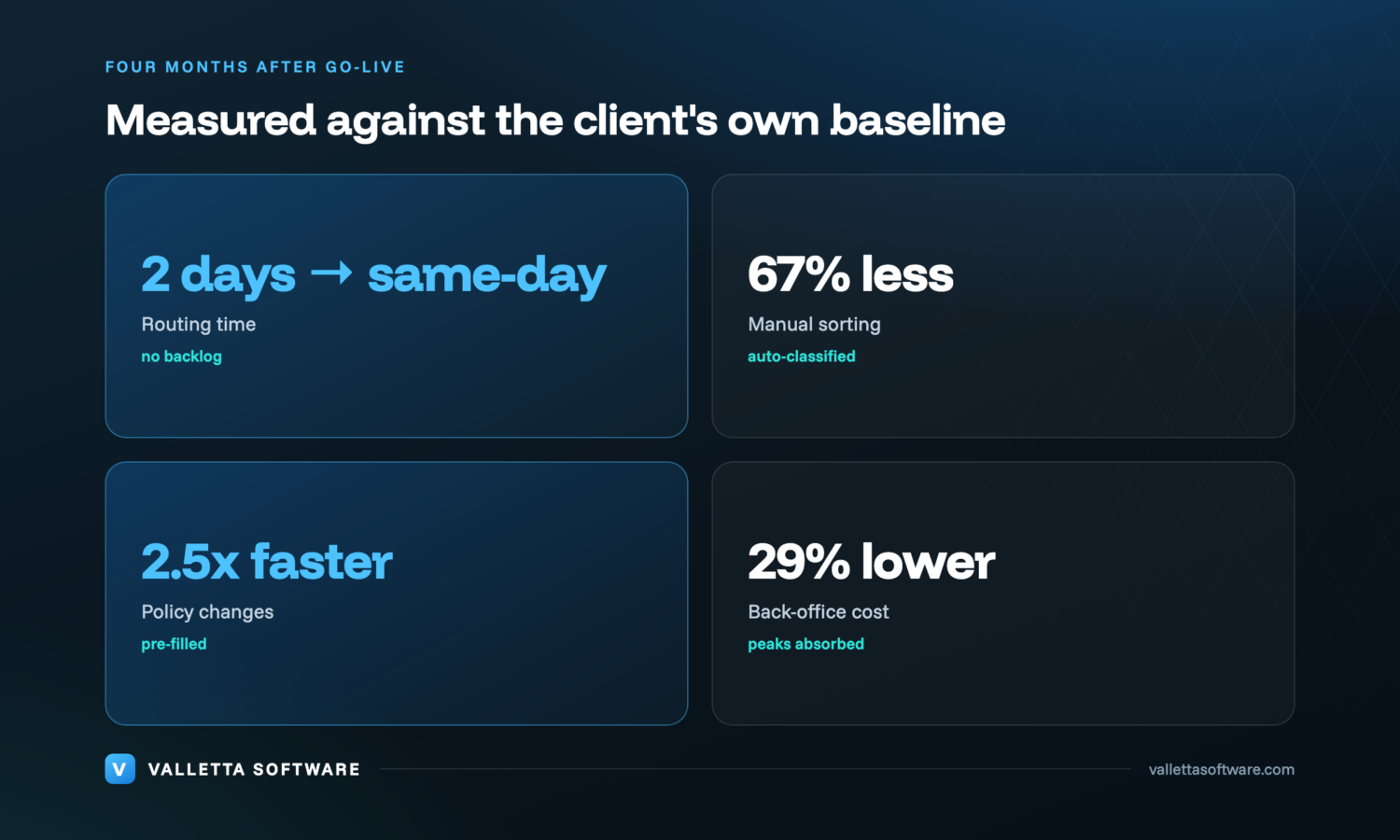
- Correspondence routing went from 2 days to same-day.
- Manual sorting and indexing fell 67%.
- Policy-change requests were processed 2.5x faster.
- Cost to run the back office fell 29%, and peak backlogs were eliminated.
The back office cost less to run, the team spent its time on policy work rather than sorting, and policyholders calling to check the status of a request were told it had already reached the right team. For more on how we approach insurance back-office automation, see our insurance automation services.
Frequently Asked Questions
How does GDPR and the German BDSG affect insurance automation?
They shape the design. Data stays resident in Germany and the EU, processing runs on a private deployment, a data protection impact assessment is completed, and where required the works council is consulted before rollout.
Can AI classify insurance correspondence accurately enough to route it?
Yes. The system classifies and indexes each document on arrival and routes it to the right team, with low-confidence items escalated to a person. Accuracy improves as it sees more of the insurer's own mail.
Start With a Five-Day Discovery Audit
If your insurance back office is running a manual correspondence sort, the cost is not just the sorting time. It is the delay that compounds through every process sitting behind it: policy changes, complaints, and member requests that all wait for the queue to clear. A Discovery audit measures the true cost in five days and hands you a costed plan to eliminate it.
In five working days, for a fixed fee of €2,000, two of our engineers map your real workflow, measure where the manual hours and errors actually sit, and hand you a costed, prioritized automation plan, whether or not you build it with us.
Book your five-day Discovery audit: vallettasoftware.com/malta-ai-automation/insurance