

How a Canadian Bookkeeping Firm Stopped Chasing Clients for Documents
A Canadian bookkeeping firm was spending most of every month chasing clients for receipts and statements, then categorizing transactions by hand. After a five-day Discovery audit and a focused build, document chasing fell 65% and new-client onboarding dropped from three weeks to five days.
Key Takeaways
- Time spent collecting documents fell 65%
- Transaction categorization reached 96% accuracy with human review on exceptions
- Manual data entry fell 55%
- New-client onboarding dropped from 3 weeks to 5 days, lifting capacity about 30% with no new hires
The client is a bookkeeping firm in Canada, around 25 staff serving roughly 90 recurring clients, several with cross-border operations. For confidentiality we describe the engagement without naming the firm or the people involved.
The Challenge: Most of the Month Was Spent Asking for Receipts
The firm did good work, and its reputation showed it. Around 90 recurring clients trusted it with their books, several running cross-border operations that added currency complexity and regulatory nuance on top of the normal workload. But roughly 60% of every month was not bookkeeping at all. It was collecting the documents that made bookkeeping possible: receipts from business owners who were busy, bank statements that arrived late, invoices that showed up in three different formats from the same client. Every hour spent on collection was an hour not spent on the work the firm was actually good at.
New-client onboarding made the problem concrete. Bringing on a single client could take three weeks before a single transaction was booked. Each one required a separate setup conversation, a custom request list, and several rounds of follow-up email. The firm had no capacity problem in theory, but in practice it could not absorb new clients without adding staff, because the intake process could not scale.
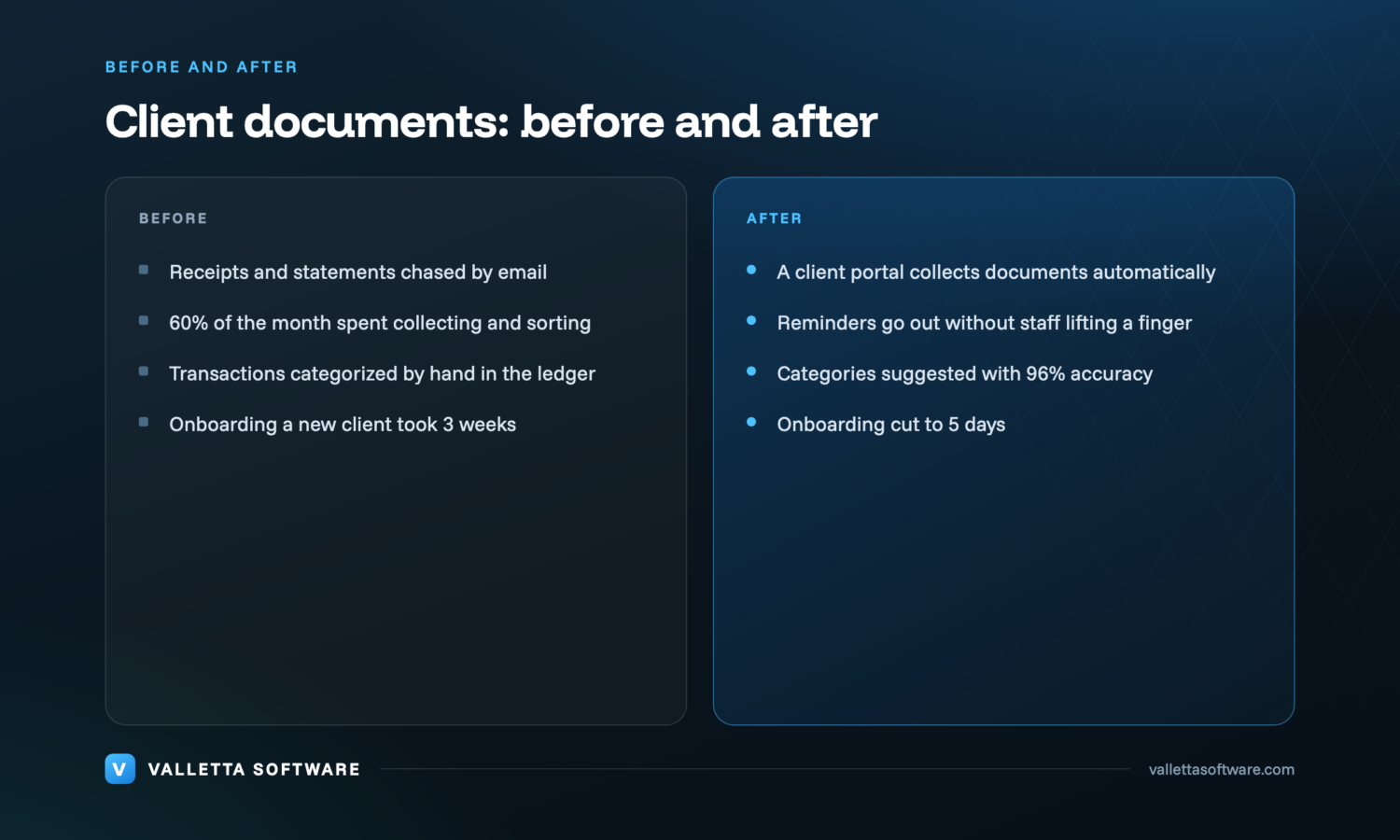
A Discovery audit put numbers to the drag:
- Receipts and statements chased by email
- 60% of the month spent collecting and sorting
- Transactions categorized by hand in the ledger
- Onboarding a new client took 3 weeks
The Approach: A Five-Day Discovery Audit
We started with a five-day Discovery audit rather than a proposal built on assumptions. Two of our engineers spent a week working alongside the team, timing every step from the first client email to the last posted transaction, and mapping where the hours actually disappeared.
The audit produced three findings that shaped the build. First, document collection and sorting consumed the majority of staff time, and most of that time was spent on reminders rather than actual bookkeeping work. Second, transaction categorization was repetitive and judgment-light for established clients, with the same chart-of-accounts logic applied month after month, making it a strong candidate for automation with human review on exceptions. Third, onboarding took three weeks not because setup was inherently complex, but because every new client started from a blank page with no template, no structured intake, and no automated follow-up to keep the process moving.
The audit also fixed the compliance frame from day one. Several clients operated across borders, which meant personal and financial data handled under PIPEDA for domestic clients and GDPR-equivalent protections for cross-border ones. Any solution had to keep data inside controlled, auditable boundaries aligned with the Office of the Privacy Commissioner of Canada, and sending client documents through public AI services was ruled out immediately.
The Solution: A Client Portal, Automated Reminders, and AI Categorization
We replaced the email chase with a secure portal and a categorization engine that learns each client's books over time, while keeping a bookkeeper accountable for every exception and every posting decision. The build covered four connected stages, each one removing a distinct category of manual work.
- Collect. A secure client portal gathers receipts, invoices and bank statements in one place, with automated reminders that follow up on missing items without any staff involvement. Clients respond faster because the request is clear, the upload is simple, and they no longer have to decode an email thread to know what is needed.
- Classify. Incoming documents are read and sorted by type and client automatically as they arrive, so nothing waits in a shared inbox to be triaged by hand. Each document is matched to the right client file before a bookkeeper even opens the queue.
- Categorize. Each transaction is matched to the client's chart of accounts with a suggested category, reaching 96% accuracy on established client files, and anything outside confidence thresholds is flagged for bookkeeper review rather than posted silently. The model improves as it sees more of each client's own history, so accuracy compounds over time.
- Sync. Confirmed entries sync to the firm's existing ledger through its API, keeping the ledger as the single source of truth, and a new client's portal setup is generated from a standard template so onboarding starts from a structured baseline rather than a blank page.
Because the firm handles personal financial data for clients under PIPEDA, and GDPR-equivalent obligations for those with cross-border operations, compliance was built into the architecture from the start rather than addressed after the fact:
- Data is encrypted in transit and at rest, with Canadian data residency for domestic clients and documented controls for cross-border data handling, so the firm can demonstrate compliance to any client or regulator that asks.
- Document categorization and all AI-assisted processing run in a private, single-tenant deployment, meaning client financial data is never sent to public AI services or used to train third-party models.
- Client consent and document provenance are tracked throughout the intake pipeline, with a clear retention and deletion policy documented in a data-processing agreement the firm can produce on request.
- Every upload, suggested categorization, bookkeeper confirmation and ledger posting is written to an immutable audit log, giving the firm a defensible record of every action taken on a client's behalf.
Half the job was not bookkeeping. It was emailing people to ask for a photo of a receipt.
The team stopped spending their days as a collections department and returned to doing the work they were trained for. Every manual task that remained was one that genuinely required judgment, not one that simply had not been automated yet.
The Results: Less Chasing, Faster Onboarding, More Capacity
We piloted the portal and categorization engine with a small group of established clients, let the model learn their chart-of-accounts patterns against real historical data, confirmed the accuracy held, then extended the system across the firm's full client book. One full quarter after go-live, the numbers were clear and consistent.
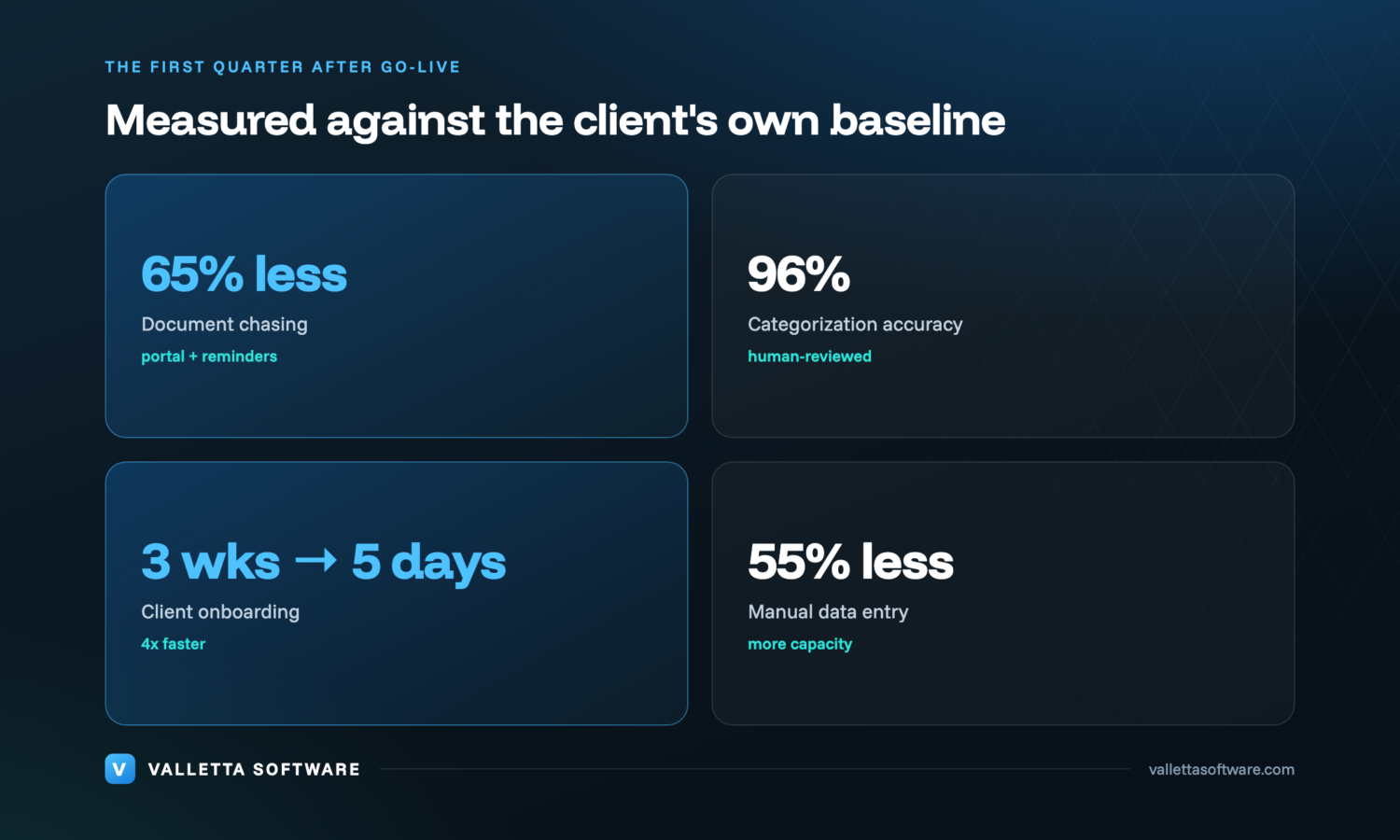
- Time spent collecting documents fell 65%.
- Transaction categorization reached 96% accuracy with human review on exceptions.
- Manual data entry fell 55%.
- New-client onboarding dropped from 3 weeks to 5 days, lifting capacity about 30% with no new hires.
Perhaps the most significant result was capacity: the firm absorbed roughly 30% more clients in the quarter after go-live without adding a single member of staff, simply by reclaiming the hours it had been spending on document chasing and manual categorization. To see how we approach this kind of work, visit our bookkeeping automation services.
Frequently Asked Questions
How do you get clients to send documents on time?
A secure client portal collects documents and sends automated reminders, so chasing happens without staff time. Most clients respond faster because the ask is clear and the upload is simple.
How accurate is automated transaction categorization?
In this engagement it reached 96%, with anything uncertain flagged for a bookkeeper to confirm. Accuracy improves as the system learns each client's chart of accounts.
Start With a Five-Day Discovery Audit
If your team spends more time collecting documents and chasing clients than actually booking transactions, that is recoverable time, and the path to recovering it is clearer than most firms expect. A five-day Discovery audit is how every engagement like this one starts: two engineers, one week, a precise measurement of where the hours go, and a costed plan for what automation would actually change.
In five working days, for a fixed fee of €2,000, two of our engineers map your real workflow, measure where the manual hours and errors actually sit, and hand you a costed, prioritized automation plan, whether or not you build it with us.
Book your five-day Discovery audit: vallettasoftware.com/malta-ai-automation/accounting