

How a Singapore Bookkeeping Firm Cut Its Month-End Close From 9 Days to 2
A mid-sized accounting firm in Singapore was losing the first two weeks of every month to manual data entry and spreadsheet reconciliation. After a five-day Discovery audit and a focused automation build, the same close now takes two working days, with data-entry errors down from 4.1% to 0.6%.
Key Takeaways
- Month-end close went from 9 working days to 2 (about 4x faster)
- Manual data entry fell 62%
- Data-entry error rate dropped from 4.1% to 0.6%
- Cost to run the bookkeeping operation fell 34% per client served
The client is a mid-sized bookkeeping and outsourced-finance firm in Singapore, around 40 staff serving roughly 120 SME clients across Southeast Asia, several of them EU-domiciled. For confidentiality we describe the engagement without naming the firm or the people involved.
The Challenge: Two Weeks Lost to Manual Work Every Month
The firm was profitable and growing, and that was exactly the problem. Every new client added more supplier invoices, bank statements, and expense receipts, and every document still passed through a person's hands before a single figure reached the ledger. The month-end close had quietly stretched to nine working days, not because the team was slow, but because the volume of manual steps had outgrown the hours available to complete them.
The partners could see the ceiling approaching. Taking on ten more clients would require hiring two more staff, who would spend the majority of their time on data entry and spreadsheet reconciliation rather than on judgment-heavy advisory work. The business model was becoming less efficient as it scaled, which is the opposite of what a well-run practice should look like.
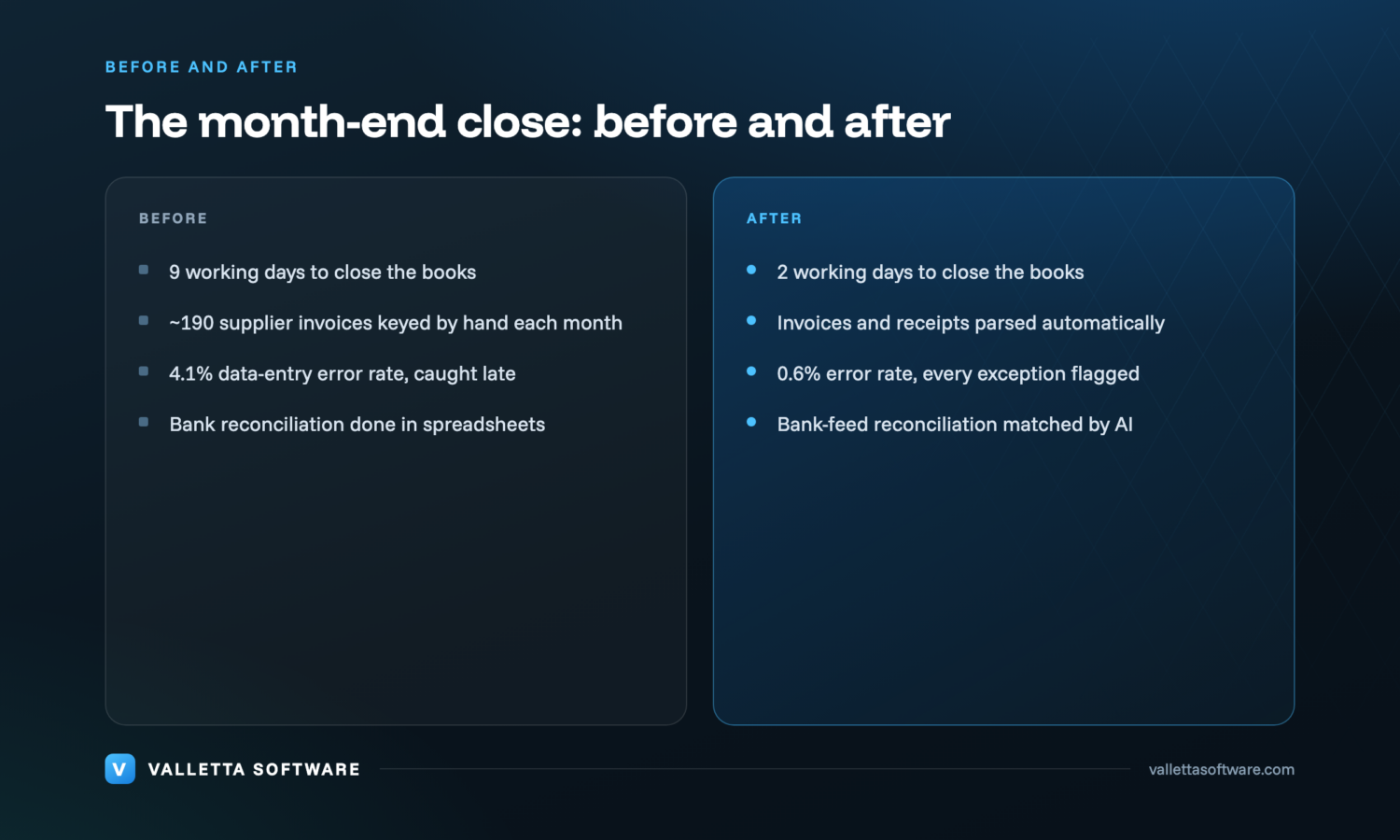
When we mapped the actual workload across a live month-end, the numbers gave the problem a sharper edge:
- 9 working days to close the books
- ~190 supplier invoices keyed by hand each month
- 4.1% data-entry error rate, caught late
- Bank reconciliation done in spreadsheets
The Approach: A Five-Day Discovery Audit
We started where we always start: a five-day Discovery audit rather than a proposal built on assumptions. Two of our engineers embedded with the team for one full working week, shadowing the close from the first invoice batch to the final bank reconciliation. Every manual step was timed, every handoff was traced, and every exception was logged.
The audit produced a granular map of how 190-plus supplier invoices moved through the practice each month. Two steps accounted for more than 70% of the total manual hours: document intake (opening, reading, and keying each invoice) and bank reconciliation (matching feed transactions to invoices in a spreadsheet, row by row). The firm already subscribed to a capable cloud ledger, but its API was unused. The data entry work was being done on top of a system that was fully capable of receiving structured inputs automatically.
One finding shaped the entire architecture: the firm serves several EU-domiciled clients, which means any automation touching their financial documents must satisfy the data-handling requirements set by Singapore's Personal Data Protection Commission as well as GDPR. Sending invoices through a public AI service was ruled out on day two of the audit. The pipeline would have to run inside a controlled, private deployment with a documented data-processing agreement.
The Solution: Automated Intake, AI-Matched Reconciliation, Data Inside the Perimeter
We built a four-stage document-processing pipeline designed around one principle: automate the mechanical steps completely, and surface every judgment call to the bookkeeper with enough context to decide in seconds rather than minutes. The system connects to the firm's existing cloud ledger through its published API, so the ledger remains the single source of truth and the team does not need to learn a new accounting tool.
- Intake. Invoices and receipts arrive by email or through a secure upload portal and are parsed automatically, whether the source is a structured PDF from a large supplier or a phone photo of a handwritten receipt from a sole trader. The extracted fields, supplier name, invoice number, date, line items, and tax amounts, are written to a staging record before any match is attempted.
- Validation. Each staged record is checked against the client's chart of accounts, their supplier history, and recent transaction patterns. Any document where an extracted value falls outside the expected tolerance range, an unfamiliar supplier, an amount above a set threshold, or a missing required field, is flagged immediately for human review rather than being held in a queue or posted silently.
- Reconciliation. Bank-feed transactions are pulled in daily and matched to open invoices automatically. Confident matches, where amount, date, and payee all align within defined parameters, are proposed for one-click approval. Ambiguous transactions are surfaced with their two or three most likely candidates ranked by confidence, so the bookkeeper makes a decision rather than a search.
- Posting. Once a bookkeeper approves a match, the entry flows into the existing cloud ledger through its API with all supporting fields populated. Nothing posts without a human sign-off, and every action, extraction, edit, and approval, is written to an immutable audit log with a timestamp and user attribution.
Because the firm handles regulated financial data under both the PDPA and the GDPR for its EU-domiciled clients, compliance and security were built into the architecture from the first design session, not added as a checklist at the end:
- The document models run in a private, single-tenant deployment on infrastructure hosted within a region that satisfies the firm's data-residency commitments, so client financial data is never processed by public AI services and is never used to train third-party models.
- All data is encrypted in transit using TLS 1.2 or higher and encrypted at rest using AES-256, with encryption keys managed independently of the application layer and rotated on a defined schedule.
- Access is granted on a least-privilege, role-based basis: each staff member sees only the clients assigned to their portfolio, and every extraction, edit, and approval action is written to an immutable audit log that cannot be altered after the fact.
- A formal data-processing agreement documents the retention policy, the sub-processor list, and the data minimization approach, giving the firm a ready-made artifact to hand to any EU client conducting a vendor review or to any regulator requesting evidence of GDPR compliance.
We were not short on talent. We were short on hours. The close used to eat the first two weeks of every month.
The human-in-the-loop design served two purposes at once. It kept a qualified bookkeeper accountable for every entry that reached the ledger, which satisfied the firm's professional obligations. And it gave the team the confidence to trust automation precisely because the system never acted on its own: it proposed, they approved.
The Results: A 2-Day Close and Room to Grow
We piloted the pipeline with a subset of ten clients during the first month, measuring accuracy and exception rates against the firm's own historical baseline. After two weeks of tuning the matching thresholds and refining the chart-of-accounts mapping, we rolled the system out across the full book of 120 clients. By the end of the first complete quarter after go-live, the results were clear and consistent.
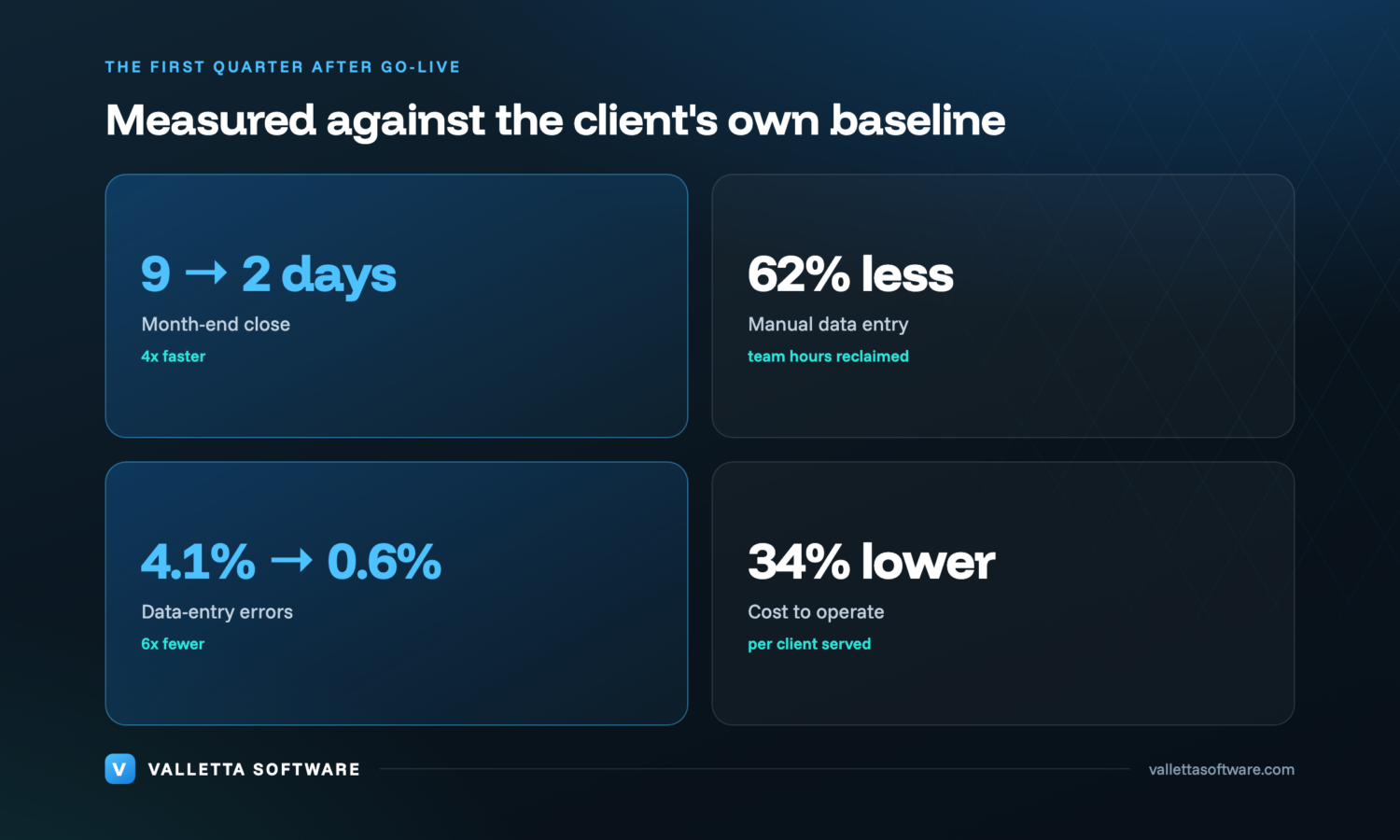
- Month-end close went from 9 working days to 2 (about 4x faster).
- Manual data entry fell 62%.
- Data-entry error rate dropped from 4.1% to 0.6%.
- Cost to run the bookkeeping operation fell 34% per client served.
None of these gains came at the cost of control or auditability. The cloud ledger remained the record of truth, every posted entry carried a human approval behind it, and the audit trail was more complete after the project than it had been before. The partners now take on new clients without asking whether the team can absorb the volume. For more on how we approach this kind of work, see our accounting automation services.
Frequently Asked Questions
How long does it take to automate bookkeeping reconciliation?
For a firm of this size, the build ran a few weeks after a five-day Discovery audit, with a pilot group of clients first and then a staged rollout across the book.
Is client financial data safe when you automate reconciliation?
Yes. The document models run in a private, single-tenant deployment, data is encrypted in transit and at rest, access is role-based, and every action is written to an immutable audit log. Client data is never sent to public AI services.
Start With a Five-Day Discovery Audit
Most accounting and bookkeeping practices we meet are sitting on the same hidden cost: qualified staff spending the majority of their time on data entry that software should be handling. The loss is real, it just does not show up as a line item on the P and L. It shows up as overtime, missed deadlines, and a ceiling on how many clients the practice can serve. The fastest way to find out where your hours are actually going is the same way this engagement started: a five-day Discovery audit with two engineers embedded in your real workflow.
In five working days, for a fixed fee of €2,000, two of our engineers map your real workflow, measure where the manual hours and errors actually sit, and hand you a costed, prioritized automation plan, whether or not you build it with us.
Book your five-day Discovery audit: vallettasoftware.com/malta-ai-automation/accounting