

How an Australian Accounting Firm Cut Invoice Approval From 6 Days to 1.5
A three-office accounting firm in Australia was drowning in supplier invoices, with approvals chased over email and three-way matching done by hand. After a five-day Discovery audit and a focused build, accounts payable now runs 3.4x faster and invoice approval has fallen from six days to 1.5.
Key Takeaways
- Accounts-payable processing ran 3.4x faster
- Manual data entry fell 58%
- Invoice approval cycle dropped from 6 days to 1.5
- Cost per invoice processed fell 41%, and duplicate-payment risk dropped sharply
The client is a three-office accounting and advisory firm in Australia, around 65 staff, running accounts payable and BAS preparation for a few hundred SME clients. For confidentiality we describe the engagement without naming the firm or the people involved.
The Challenge: Three Offices, Three Piles of Invoices
Growth had given the firm three offices and one shared headache. Each location had developed its own way of handling supplier invoices: different naming conventions, different approval chains, different filing habits. By the time a multi-office engagement needed a consolidated view of outgoings, nobody could produce one quickly, and quarter-end BAS preparation had become a five-day scramble to locate and reconcile documents that should have been organised all along.
The volume made it worse. Around 2,400 invoices arrived every month across the three offices, keyed into the ledger by hand. Three-way matching, which should be a mechanical check, was assembled manually each time, and approvals were chased over email, where threads forked, deadlines slipped, and the audit trail evaporated. Duplicate-payment risk was real, and the team knew it.
A Discovery audit put numbers to the pain:
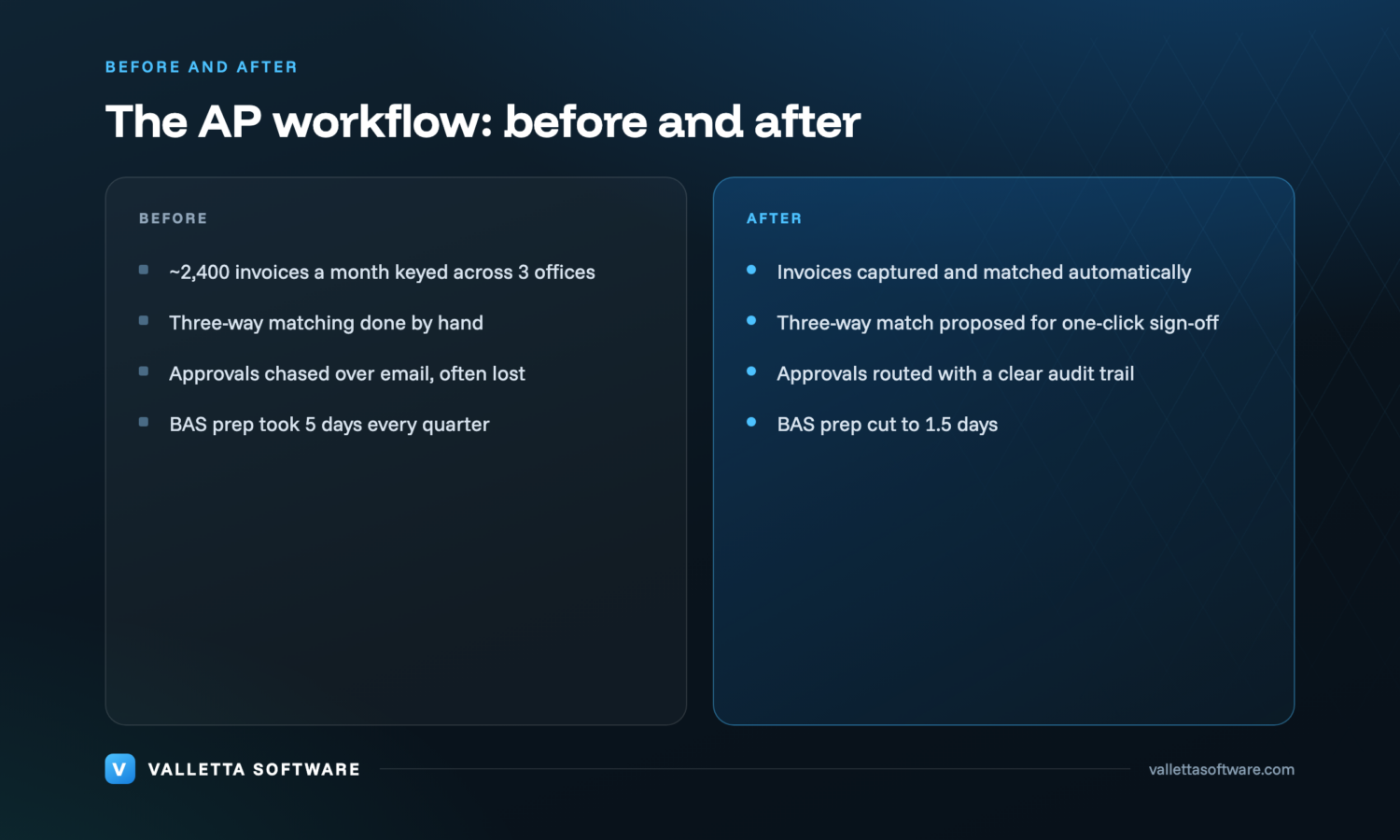
- ~2,400 invoices a month keyed across 3 offices
- Three-way matching done by hand
- Approvals chased over email, often lost
- BAS prep took 5 days every quarter
The Approach: A Five-Day Discovery Audit
Two of our engineers spent a full working week inside the firm's accounts-payable process, visiting each of the three offices rather than relying on secondhand accounts. They timed every step from invoice arrival to ledger posting, counted the handoffs, and followed the approval emails to wherever they died.
The audit produced three findings that shaped the entire build. First, a disproportionate share of manual hours, equivalent to nearly one full-time role, sat in two steps: data entry at capture and the assembly of three-way matches. Second, approval delays were almost entirely a routing problem, not a decision problem; approvers were willing but unreachable by email. Third, BAS preparation was painful because invoice data was scattered, not because the calculations were complex. Fixing the data flow would fix the quarter-end crunch as a side effect.
The audit also fixed the compliance frame from day one: the firm handles client financial data under the Privacy Act 1988 and, for its EU-domiciled clients, under the GDPR, and the solution had to satisfy the standards published by the Office of the Australian Information Commissioner, so sending invoice documents through any public AI service was ruled out before design began.
The Solution: Automated Capture, Three-Way Matching, and an Audit Trail That Holds
We built an accounts-payable pipeline that captures every invoice at the point of arrival, proposes the three-way match automatically, routes each approval to the right person in the right office, and feeds the existing ledger through its API, all without changing the chart of accounts or forcing the three offices to abandon their local workflows. The architecture keeps each office's segregation-of-duties controls intact while giving the partners a single, complete view of the whole AP operation. It runs in four stages.
- Capture. Invoices arrive by email or supplier portal upload and are read automatically at every office, with supplier name, ABN, amount, GST component and line items extracted regardless of whether the source is a structured PDF, a scanned paper invoice or an attached image. Nothing waits in a shared inbox to be triaged and keyed by a junior.
- Match. The system performs the three-way match against the relevant purchase order and goods-receipt record and presents the result for one-click sign-off, flagging any discrepancy in amount, quantity or supplier detail rather than posting silently. The matching logic runs against the firm's own invoice history, so it improves as it learns each client's supplier patterns.
- Approve. Approval requests are routed by rule directly to the authorised person in the correct office, with the matched invoice and supporting documents attached and a clear deadline visible. Segregation of duties is enforced by the workflow itself, so the person who enters an invoice cannot approve their own submission, and every decision is timestamped and attributed.
- Post. Approved invoices post to the firm's existing ledger through its published API, keeping the ledger as the single source of truth. BAS-relevant data, GST classifications and supplier ABNs, is aggregated automatically so that quarter-end preparation draws on clean, already-reconciled records rather than a retrospective search across three inboxes.
Because the firm handles client financial data under the Privacy Act 1988 and the GDPR for its EU-domiciled clients, security controls were designed into the architecture from the first planning session rather than added as a compliance layer after the build:
- Single sign-on and role-based access are enforced across all three offices, so each location's staff see only their own clients and approval queues, and no one can access another office's records without an explicit grant.
- Segregation of duties is built into the approval workflow rather than delegated to trust: the system prevents the same user from both entering and approving an invoice, and the rule cannot be bypassed without a logged override by a principal.
- All invoice data and extracted documents are encrypted in transit and at rest, and processing runs in a private single-tenant deployment so that client financial information never passes through a public AI service or contributes to any third-party model.
- Every capture, match, approval and ledger posting is written to an immutable, timestamped audit log that is exportable for any client query, ATO review or internal governance check.
Every office had its own pile of invoices and its own way of chasing approvals. We needed one trail, not three.
The result was one complete, visible trail across all three offices, without requiring any office to change the way it structures its client work or its supplier relationships. The firm got consolidation without uniformity.
The Results: Faster Approvals, Cheaper Invoices, Calmer Quarter Ends
We piloted the pipeline in the busiest of the three offices first, running it in parallel with the existing manual process for a full month to validate matching accuracy and approval routing before the team relied on it. After tuning the matching thresholds against the office's own invoice history, we extended the rollout to the remaining two offices in sequence. Two full quarters after all three offices were live, the numbers had stabilised and the gains were consistent across the book.
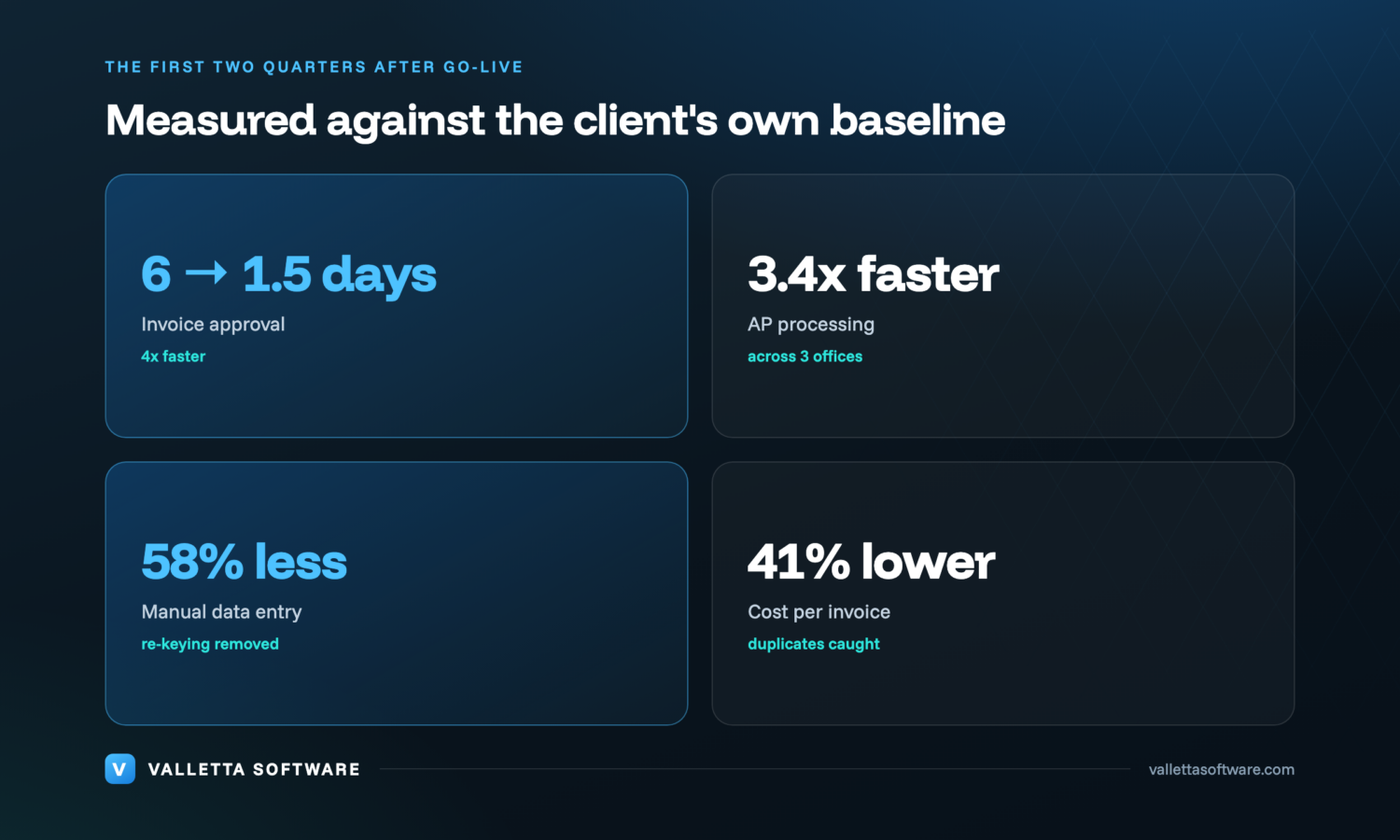
- Accounts-payable processing ran 3.4x faster.
- Manual data entry fell 58%.
- Invoice approval cycle dropped from 6 days to 1.5.
- Cost per invoice processed fell 41%, and duplicate-payment risk dropped sharply.
The improvement was structural, not a one-month sprint. Because the pipeline feeds the ledger directly and aggregates GST data continuously, the firm's next BAS season required 1.5 days of preparation rather than five, and duplicate-payment risk dropped sharply as matching replaced manual spot-checks. For more on how we approach this work, see our accounting automation services.
Frequently Asked Questions
Can accounts-payable automation handle approvals across multiple offices?
Yes. Approval rules and segregation of duties are enforced in software, so each office keeps its own controls while the data and audit trail stay centralized.
Does AP automation replace the existing accounting system?
No. The pipeline feeds the firm's existing ledger through its API. The ledger stays the single source of truth and nothing posts without a human sign-off.
Start With a Five-Day Discovery Audit
If your firm runs accounts payable across more than one team or office, the hidden cost is almost always the same combination: skilled people re-keying invoices, three-way matches assembled by hand, and approvals lost in email threads. Those three problems compound each other, and together they are almost always worth more to fix than firms expect. A five-day Discovery audit is the fastest way to measure exactly how much time and money is sitting in the gap between the invoice arriving and the ledger posting.
In five working days, for a fixed fee of €2,000, two of our engineers map your real workflow, measure where the manual hours and errors actually sit, and hand you a costed, prioritized automation plan, whether or not you build it with us.
Book your five-day Discovery audit: vallettasoftware.com/malta-ai-automation/accounting