

We Built a Polymarket Trading Bot with Claude Fable 5

A polymarket trading bot is the internet's favorite money printer this month, and most of the viral screenshots do not survive a Community Notes check. We just shipped a real one: a Claude Fable 5 agent system that scans Polymarket, estimates fair value, backtests strategies, and executes under hard risk limits, built for a private trader in the EU. The strategy ideas were the client's. Our job was engineering: we made those ideas testable and executable in days instead of weeks, leveraging Fable 5 for the reasoning layer and deterministic code for everything that touches money.
Key takeaways
- The viral "Claude turned $50 into $2,980 in 48 hours" thread is flagged by Community Notes: practitioners point out the liquidity and cost math does not work at that speed and size.
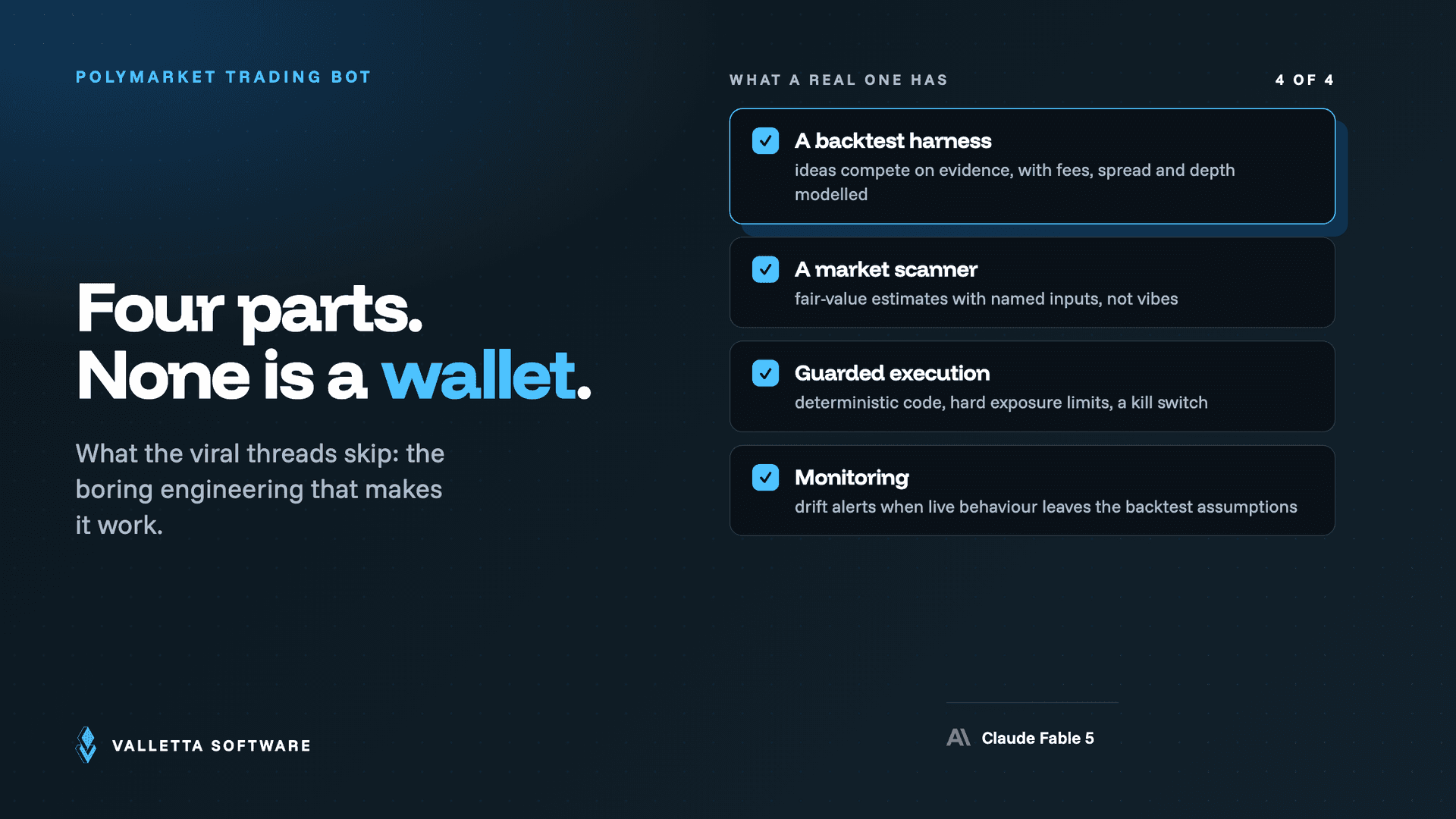
- A real Polymarket trading bot has four parts: a backtest harness, a market scanner with fair-value estimation, an execution layer with hard risk limits, and monitoring. The model reasons; typed, tested code trades.
- In our client build, every strategy idea came from the trader. The automation cut the idea-to-verdict cycle from weeks of manual work to days.
- Most strategy ideas die in backtesting before they ever risk a dollar. That is the point of the harness, and it is the part every viral thread skips.
- Claude Fable 5 improved the fair-value layer: better judgment on ambiguous resolution wording and long-context reasoning across whole market categories in one pass.
- Prediction market access and rules vary by jurisdiction, and nothing in this article is financial advice.
Last verified: July 22, 2026. The viral posts discussed below are quoted as claims, not verified results. This article describes engineering work on an anonymized client project and is not financial advice.
What is a Polymarket trading bot?
A Polymarket trading bot is software that reads prediction market prices through Polymarket's public APIs, builds its own estimate of an outcome's probability, and places orders automatically when the gap between price and estimate is large enough to matter after fees, spread, and slippage. The interesting engineering is not the ordering code. It is everything that decides whether the order should exist at all: the fair-value model, the backtests behind the strategy, and the risk limits around the position.
The viral Polymarket bot claims, checked
If you searched "polymarket claude" on X this month, you saw the same three stories we did. A tutorial video where a paused frame at 0:47 showed a second monitor with a Polymarket wallet at $868,862 and a claimed 28,620 winning Bitcoin trades in 15 minutes. A February thread about an agent given $50 and told to "pay for yourself or you die" that supposedly reached $2,980 in 48 hours. A trading blogger reporting $110,343 in six weeks from a hybrid Up and Down temporal strategy. These are the posts our client arrived with, asking one question: is any of this real?
The pattern here is the same one we documented when we traced how AI model rumors get promoted to facts: confident tone, round numbers, artifacts that cannot be checked. The useful takeaway is not "it is all fake". It is that the claims worth engineering against are the checkable ones: the strategy classes, the APIs, the market mechanics. Those are real, and they are documented.
The real brief: a trader with strategies and no engineering bench
Our client is a private trader in the EU working with a small team. They came with something the viral threads never have: actual strategy hypotheses, built from months of watching short-horizon crypto markets and event markets on Polymarket. Accumulation patterns across Up and Down sides at different points in a market's life. Fair-value gaps on news-driven markets where resolution wording rewards careful reading. A watchlist logic for which market categories deserve attention at all.
What they did not have was a way to test any of it quickly. Validating one idea meant pulling historical prices by hand, wrestling them into spreadsheets, and writing one-off scripts. Each cycle took weeks, and most ideas were abandoned unverified, not disproven. They asked us to compress that loop. Not to invent strategies for them, and not to promise returns: to build the machine that turns a hypothesis into a verdict.
Anatomy of a Polymarket trading bot that actually ships
The system we delivered has four components. None of them is exotic on its own. The discipline is in what talks to what.
1. The backtest harness
Historical market data, order book snapshots, and resolution outcomes flow in through Polymarket's public CLOB and Gamma APIs and are stored in a replayable form. A strategy is a small, declarative spec: entry conditions, exit conditions, sizing rule. The harness replays it against history with realistic fills, modeling fees, spread, and the depth actually available at each moment, because a strategy that works at $10 a clip and dies at $500 is not a strategy, it is a screenshot. Every idea gets the same treatment and produces the same report format, so ideas compete on evidence instead of enthusiasm.
2. The market scanner and fair-value layer, on Claude Fable 5
On a schedule, the scanner walks active markets and hands batches to Claude Fable 5 with a structured brief: the market's resolution criteria, current pricing, order book context, and retrieved background. The model returns a structured fair-value estimate with its reasoning and its named inputs, and flags markets where the gap against the current price clears the client's threshold. Fable 5's long context lets one pass reason across an entire category of related markets instead of pricing each one blind, which is where correlated mispricings live.
3. Execution under hard limits
Nothing the model outputs touches money directly. Execution is deterministic, tested code that consumes the scanner's flags and applies the client's rules: fractional Kelly sizing with a hard cap, per-market and per-category exposure ceilings, and a kill switch that halts everything when fills deviate from what the backtests assumed. The model proposes. Typed code, written and reviewed the boring way, disposes.
4. Monitoring and alerts
Dashboards track open exposure, fill quality, API health, and model spend. Alerts fire on drift: when live slippage stops matching backtest assumptions, when a market's liquidity thins out, when the model's estimates start disagreeing with realized outcomes in a systematic way. This is the component that makes the system operable by the client's own small team without us in the loop.
The engineering result the client cared about: the idea-to-verdict cycle went from weeks to days. Strategy hypotheses now queue up, run against history overnight, and come back with a decision-grade report. The ideas that survive graduate to small live positions under the exposure caps. The ones that fail, fail cheaply, on historical data, before any capital moves.
Polymarket arbitrage: where the edge actually lives (and dies)
The strategy class behind most serious bots, including the honest parts of the viral threads, is polymarket arbitrage in its broad sense: buying combinations of outcomes whose prices sum to less than they should. In short-horizon Up and Down markets that often means temporal accumulation, building both sides at different moments so the combined cost of a guaranteed $1 payout is under $1. In multi-outcome event markets it means catching moments when the outcome prices sum away from the book's fair total.
Backtesting is what separates the version of this that works from the version that only works in a thread. Three things eat headline edges in every honest test: depth (the visible mispricing is often available for a fraction of the size the screenshot implies), costs (spread and slippage are the whole game at sub-cent edges), and decay (public edges attract bots, and the mispricing you found in March is a crowd in July). A harness that models all three tells you which of your ideas clears the bar at the size you actually intend to trade. That number is allowed to be "none of them", and a system that can tell you so before you fund a wallet has already paid for itself.
What Claude Fable 5 changes for trading automation
The scanner architecture predates Fable 5; agent systems like this were being built on earlier Claude generations. What the new model tier changed in practice, in this build, was the quality of the judgment layer. Resolution criteria on prediction markets are legal-adjacent text, and ambiguous wording is exactly where fair-value models embarrass themselves. Fable 5 is measurably more careful there, and its long context window lets the scanner price a whole related market family in one reasoned pass. We covered the model's positioning in our Kimi K3 vs Claude Fable 5 benchmark review.
Cost discipline matters too. Fable 5 is a premium model, so it does the premium work: fair-value calls and strategy-spec reviews. Bulk parsing, data plumbing, and formatting run on cheaper tiers, the same multi-model routing pattern we use in our own tooling. The bill for the reasoning layer is a monitored metric on the client's dashboard, next to slippage, because an agent whose inference costs exceed its edge is just a slower way to lose.
Risks, and the boring disclaimer
A responsible writeup lists what can go wrong, because plenty can. Backtest results do not guarantee future performance, and overfit strategies are the default outcome of enthusiastic testing, not the exception. Resolution risk is real: market outcomes can be disputed and resolved against the obvious reading. Liquidity can vanish. APIs go down mid-position. Keys can be stolen if custody is sloppy. And access rules for prediction markets differ by country and change over time, so jurisdiction and compliance homework belongs at the start of a project like this, not the end.
Nothing in this article is financial, investment, or legal advice. It describes software engineering delivered to a client. Trading on prediction markets can lose money, and availability of these platforms depends on your jurisdiction.
Frequently asked questions
Can Claude run a Polymarket trading bot on its own?
Claude does the reasoning: scanning markets, estimating fair value, reviewing strategy specs. It should not hold keys or place orders directly. In every serious build, execution is deterministic code with hard risk limits, and the model's outputs are proposals that code validates before anything trades.
Are the viral profit screenshots real?
The most-shared ones are either flagged by Community Notes or built on artifacts nobody can verify, like a wallet glimpsed in a deleted video. The strategy classes behind them are real and testable. The specific dollar figures are marketing until someone shows an auditable track record.
Is running a bot allowed on Polymarket?
Polymarket exposes public APIs and a developer ecosystem, and automated trading through them is an established practice. Whether you may trade on the platform at all depends on your jurisdiction, so check the platform's terms and your local rules before funding anything.
How long does it take to build a Polymarket trading bot?
A production system with backtesting, a fair-value layer, guarded execution, and monitoring is a matter of weeks, not months, when the strategy ideas already exist. In this project the client's validation cycle went from weeks per idea to days, with the four components delivered as one operable system.
Does a good backtest guarantee the strategy makes money?
No. A good backtest kills bad ideas cheaply and tells you what a surviving idea assumed: the depth, the costs, the regime. Live performance then drifts from those assumptions, which is why monitoring compares live fills against backtest expectations and halts the system when they diverge.
Have a strategy you want validated?
Every idea in this project came from the client. Our job was to make those ideas testable and executable in days, with Claude Fable 5 doing the reasoning and hard-limited code doing the trading. If you have a workflow, a strategy, or a market you want automated and honestly backtested, that is exactly the shape of work we do.