

AI Development Services Cost in 2026: Pricing Models, Cost Drivers and Estimation Heuristics
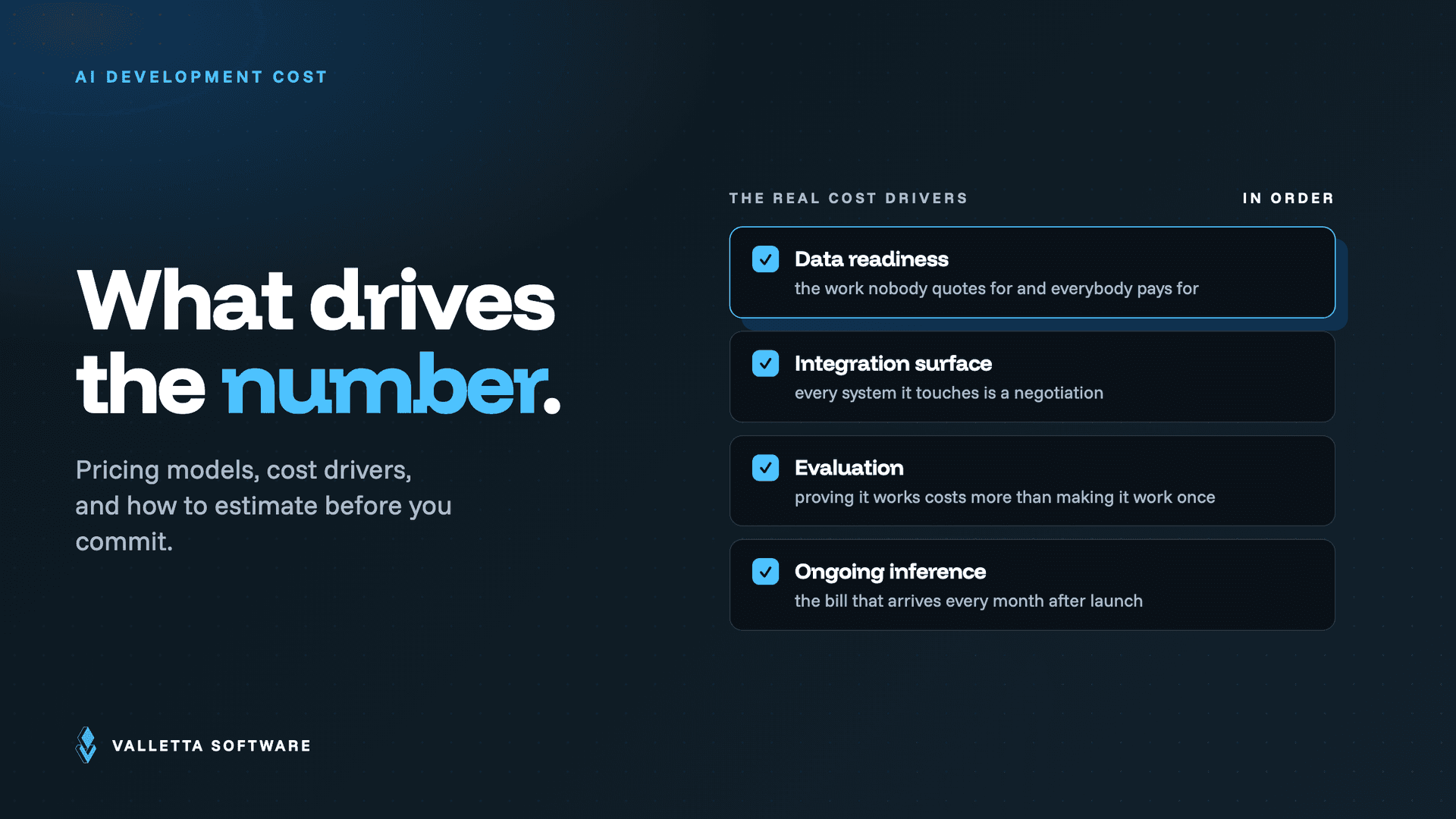

AI development services cost is the total expenditure required to design, build, deploy, and maintain a software system that incorporates artificial intelligence capabilities, encompassing compute infrastructure, specialized engineering labor, data preparation, model training or API consumption, MLOps tooling, and ongoing inference costs. In 2026, the range spans from under $35,000 for a focused proof-of-concept to well over $100,000 for a production-grade platform with custom models, real-time pipelines, and multi-cloud deployment. Understanding what drives these numbers, and how professional engineering teams estimate them, is the difference between a controlled investment and an unpredictable money pit. For a scoped quote tailored to your stack and timeline, request an AI development team estimate.
This guide breaks down every major cost driver, compares the dominant pricing models used by AI development companies, and provides the estimation heuristics that technical presales teams actually use when scoping AI projects. If you are evaluating vendors or building an internal business case for AI development services, the frameworks below will give you a concrete basis for comparison.
The Five Layers of AI Development Cost
AI project budgets are not a single line item. They decompose into five distinct cost layers, each with its own dynamics and optimization levers. Misunderstanding any one of them leads to budget overruns or, worse, architectural decisions made purely on price rather than fitness.
Layer 1: Compute infrastructure. This is often the most volatile cost category. Training a custom model on NVIDIA H100 GPUs through a major cloud provider can run $25-$40 per GPU-hour, and a meaningful fine-tuning job on a large language model may require hundreds of GPU-hours. AWS Trainium chips offer a lower-cost alternative for training workloads on AWS, often achieving 30-50% savings over equivalent GPU instances for supported model architectures. For inference at scale, AWS Inferentia instances provide purpose-built silicon that can reduce per-query costs by a similar margin compared to general-purpose GPU inference. According to a 2025 Andreessen Horowitz analysis of AI infrastructure economics, compute typically accounts for 20-40% of total cost of ownership for production AI systems. The choice between accelerators is an architectural decision that directly shapes your ongoing cost structure.
Layer 2: Engineering labor. This is the largest cost component for most AI development services engagements. Specialized roles, including ML engineers, data engineers, MLOps architects, and AI-focused developers who manage multi-agent generation pipelines, command higher rates than traditional software developers. Senior ML engineers typically bill at $45-$80/hour depending on the engagement model and region, while specialized roles managing AI-first code generation workflows may command $55-$65/hour, reflecting the skill set required to operate multi-agent pipelines, validate context chains, and enforce architecture at generation time. Stanford's 2025 AI Index Report found that demand for AI-specialized engineering talent has grown roughly 3.5x since 2020, putting sustained upward pressure on labor costs across all AI development services providers.
Layer 3: Data preparation and management. Data cleaning, annotation, pipeline construction, and storage architecture account for 20-40% of total project hours in most AI engagements. Projects that require custom training data, such as computer vision systems trained on YOLO-based models for real-time inference or NLP systems fine-tuned on domain-specific corpora, will see this layer dominate the early phases. A frequently cited IBM estimate suggests that data scientists spend approximately 80% of their time on data preparation rather than model development, which directly maps to the cost weight of this layer.
Layer 4: AI API and token consumption. For projects that leverage foundation models (GPT, Claude, Gemini, open-source LLMs via Hugging Face Inference Endpoints or Replicate) through API calls rather than training from scratch, token costs become a recurring operational expense. During AI-assisted development workflows, token usage for code generation and occasional regeneration cycles must also be budgeted explicitly. These costs are small relative to manual development time but add up across a full engagement.
Layer 5: MLOps, monitoring, and maintenance. Post-deployment costs include model monitoring for drift, automated retraining pipelines, infrastructure scaling, and CI/CD for ML. Tools like Kubecost provide real-time visibility into Kubernetes cluster spend, allowing teams to attribute costs to specific ML workloads and prevent runaway expenses. The FinOps Foundation's framework for cloud financial management has become the industry standard for governing these ongoing costs, especially across multi-cloud AI deployments. According to Gartner, organizations that adopt FinOps practices reduce cloud waste by an average of 20-30% within the first year.
Cloud ML Platform Pricing Compared: AWS vs. Azure vs. GCP
One of the most consequential decisions when scoping AI development services cost is the choice of cloud ML platform. Each hyperscaler offers a managed ML suite with different pricing structures, GPU availability, and purpose-built accelerators. The following comparison reflects mid-2025 list pricing and should be validated against current rates, as cloud providers adjust pricing frequently.
Note: Prices are approximate mid-2025 list rates and vary by region, commitment tier, and instance family. Always validate against current provider pricing pages before making procurement decisions.
For most mid-range AI development services projects, the platform choice matters less than how well the team optimizes within that platform. Spot/preemptible instances for training, auto-scaling for inference, and proper storage tiering deliver far more savings than switching providers. That said, if your workload supports AWS Trainium or GCP TPUs, purpose-built silicon can deliver meaningful compute savings over generic GPU instances.
AI Development Services Pricing Models Compared
Vendors structure AI development services engagements under three primary pricing models. Each model shifts risk differently between client and provider, and the right choice depends on how well-defined your requirements are at contract signing.
Time-and-materials (T&M) is the most common model for AI projects, and for good reason. AI development inherently involves experimentation: model selection, hyperparameter tuning, data quality discovery, and architecture iteration. T&M pricing charges for actual hours consumed at agreed rates, giving the client full flexibility to adjust scope as the project reveals new information. The downside is budget unpredictability if scope is not managed through sprint-based delivery with regular checkpoints. Most professional AI development services firms provide cost estimates as a range, minimum to maximum, where the minimum reflects the floor below which the project cannot be completed without reducing functionality, and the maximum accounts for requirements that will be refined during development.
Fixed-price engagements work for well-scoped AI modules, such as integrating a pre-trained model into an existing application or building a defined API layer around an inference endpoint. They are risky for research-oriented or custom-model projects, because scope changes in AI are not "nice to haves" but often technically necessary pivots that fixed contracts penalize.
Hybrid models combine a fixed-price discovery or evaluation phase with T&M execution. This is increasingly the standard approach for serious AI development services engagements. A structured evaluation sprint, typically 40 hours for small projects and up to 80 hours for large or complex projects, validates feasibility, converts client artifacts (Figma designs, specifications, documents) into standardized context, prepares the development infrastructure, and identifies which modules suit AI-assisted generation versus classical manual development. This upfront investment dramatically reduces estimation risk for the execution phase.
Cost Driver Reference Table: What Moves the Number
The following table maps the primary cost drivers to their typical impact range and the key decision that governs each. Use this as a checklist when evaluating AI development services proposals or building your own budget model.
Estimation Heuristics: How Engineering Teams Actually Size AI Projects
Accurate estimation is the hardest part of AI presales. Unlike traditional CRUD applications, AI projects carry research risk. Here are the heuristics that experienced technical teams use to convert ambiguous requirements into defensible budget ranges for AI development services.
Heuristic 1: Decompose into generatable vs. classical components. Modern AI-first development methodologies split every project into modules that can be generated by multi-agent AI pipelines (standard CRUD, UI components, REST APIs, dashboards) and modules that require hand-written code (custom ML models, deep third-party integrations, high-risk business logic). Teams that use this approach report that the generatable portion typically costs 30-40% of what classical development would. The classical portion is estimated using standard decomposition: backend entities, backend processes, frontend views, with coefficients for QA, UX/UI, and DevOps layered on top. Not every vendor operates this way, some use fully manual workflows, so this is one of several valid approaches to evaluate.
Heuristic 2: Use project-tier benchmarks as sanity checks. Small AI projects (under $35,000) typically require 80-160 development hours and complete in one to two weeks of active development. Average projects ($35,000-$100,000) run 160-240 hours over two to three weeks. Large projects (over $100,000) require around 320 hours or more across roughly four weeks of sprint time. These benchmarks assume a defined scope; projects entering with unclear requirements should budget an additional discovery phase. McKinsey's 2024 State of AI report found that 60% of AI projects exceed their initial budget estimates, underscoring the importance of realistic scoping.
Heuristic 3: Budget the evaluation sprint as non-negotiable. Every AI project should begin with a structured evaluation sprint that validates feasibility, converts incoming client artifacts into standardized context, prepares the development infrastructure, and identifies which modules suit AI-assisted generation versus classical development. Skipping this step is the single most common cause of AI project budget overruns, because teams commit to estimates without validating that the approach works for the specific codebase and design. Industry data from the Project Management Institute shows that projects investing at least 10-15% of budget in upfront scoping and validation deliver 2-3x more predictable outcomes.
Heuristic 4: Factor in regeneration cost for design changes. In AI-assisted development workflows, design changes create new context and may require regeneration of affected components. Small updates incur small regeneration costs. Major redesigns require full regeneration. This is still faster and cheaper than manual rework, but it means that design stability directly correlates with budget predictability. Projects with finalized, frozen designs achieve the lowest cost-per-feature ratios.
Heuristic 5: Separate training cost from inference cost in your model. A common estimation mistake is blending one-time training expenses with ongoing inference costs. Training on NVIDIA H100 clusters or AWS Trainium is a capital-like expenditure that may occur once or on a scheduled cadence. Inference on AWS Inferentia, GCP TPUs, or similar purpose-built chips is an operational cost that scales with user traffic. These two line items have entirely different scaling curves and should be modeled independently in any AI development services budget.
How AI-Assisted Development Changes the Cost Equation
The emergence of AI development services built around multi-agent code generation pipelines has fundamentally altered the cost structure of software projects that include AI components. Rather than writing every line of code manually, some teams now use deterministic AI agent workflows that generate production-grade code from structured context, including Figma designs, technical specifications, and architecture rules. This is one of several emerging approaches, alongside low-code ML platforms (DataRobot, H2O.ai) and hybrid manual-assisted workflows.
The economic impact can be significant for suitable projects. Engagements with finalized designs, clear requirements, and a scope dominated by standard flows (CRUD operations, dashboards, APIs) report delivery at 30-40% of the classical development cost when using AI-first generation. The generated code follows enterprise-grade standards: clean architecture, low coupling, high cohesion, strict linting, full typing, clear abstractions, and complete auto-documentation. Any senior developer can extend it manually after delivery, avoiding vendor lock-in.
The trade-off is a higher hourly rate for specialized AI-pipeline roles ($55-$65/hour versus $40-$50 for a traditional mid-level developer), but the total hours consumed drop dramatically enough that the net project cost decreases by 40-70%. This is the same dynamic as investing in better tooling: higher unit cost, vastly lower total cost.
For modules that are not suitable for AI generation, complex ML models, risky integrations, domain-specific business rules, the classical hand-written development approach applies. The result is a hybrid estimate: AI-generated components (fast, lower cost) combined with classic components (stable, predictable). When evaluating AI development services providers, assess whether a vendor can actually deliver this hybrid model rather than just claiming AI involvement in their marketing.
Infrastructure Cost Optimization: Turning Ongoing Spend Into a Managed Line Item
Post-deployment, AI infrastructure costs are the area most likely to spiral without active governance. Flexera's 2025 State of the Cloud Report found that organizations waste an average of 28% of their cloud spend, with AI/ML workloads among the top contributors due to idle GPU instances and over-provisioned training clusters.
A real-world optimization engagement illustrates the levers available. One team achieved over 40% reduction in AWS costs through a systematic approach: right-sizing EC2 instances and switching to Spot Instances for non-critical tasks, implementing auto-scaling policies for SageMaker inference endpoints that scale up only during high-traffic predictions and scale down during off-peak hours, scheduling training jobs with SageMaker Pipelines and AWS Step Functions to trigger only when new data is available (eliminating redundant retraining), moving infrequently accessed training data to S3 Glacier while keeping only active datasets in standard S3, and deploying models with SageMaker Multi-Model Endpoints to host multiple model versions on a single instance.
Kubecost has become the standard tool for teams running ML workloads on Kubernetes, providing per-namespace and per-pod cost attribution that makes it possible to answer questions like "how much does our recommendation model's inference pipeline cost per month?" On the Azure side, Azure Cost Management + Advisor offers similar workload-level attribution. GCP provides equivalent functionality through its Cost Management suite and Active Assist recommendations. The FinOps Foundation's practices, including tagging standards, showback/chargeback models, and anomaly detection, provide the organizational framework around these tools regardless of cloud provider. Without FinOps discipline, even well-architected AI systems tend to accumulate cost debt as teams spin up resources for experiments and forget to decommission them.
Real Project Cost Anatomy: What a $50,000-$100,000 AI Engagement Looks Like
To make the above concrete, consider a mid-range AI development services project: a fraud detection system for a payment platform. The scope includes real-time transaction monitoring with ML models analyzing transaction patterns, a risk scoring system based on device fingerprinting, user behavior, and transaction history, adaptive learning that continuously improves detection rules, and automated transaction blocking with alerts.
The cost breakdown for such a project distributes across several categories. Data engineering and pipeline construction (Kafka, Redis, S3) consume roughly 25% of the budget. Model development and training (Python, TensorFlow, XGBoost on SageMaker or Vertex AI) take approximately 30%. Backend API and integration layer (Node.js, FastAPI, PostgreSQL) account for about 20%. Frontend dashboard and alerting (React, TypeScript) represent roughly 10%. The remaining 15% covers infrastructure, MLOps setup, CI/CD, and QA including automated testing with Selenium and performance testing with JMeter.
This kind of real-world AI implementation shows how budget allocation maps to technical architecture. The ML component itself is only about a third of total cost; the surrounding data infrastructure, integration, and operational tooling consume the majority. Deloitte's 2024 Enterprise AI Adoption survey corroborates this pattern, finding that data engineering and integration account for 40-50% of total spend in the average enterprise AI deployment.
Hidden Costs in AI Development Services That Vendors Rarely Mention Upfront
Several cost categories are frequently omitted from initial proposals, not necessarily through deception, but because they depend on decisions made during development.
Model retraining cadence. Models that process dynamic data (fraud patterns, user behavior, market conditions) need periodic retraining. Each retraining cycle incurs compute cost and engineering time for validation. If your vendor's proposal does not include a retraining budget, ask how they plan to handle model drift post-launch.
Data labeling at scale. Supervised learning projects require labeled data. Initial datasets may be manageable, but as the model needs to handle edge cases, the labeling budget grows. Budget $0.05-$2.00 per label depending on complexity (Scale AI and Labelbox are common platforms for managed labeling), and assume you will need more labels than the initial estimate suggests.
Compliance overhead. Projects in healthcare (HIPAA), finance (PCI DSS, AML), or handling EU personal data (GDPR) require additional architecture work for data isolation, encryption, audit logging, and access controls. This typically adds 10-20% to the technical budget and is not optional. The NIST AI Risk Management Framework (AI RMF) is increasingly referenced as a governance standard that shapes these compliance requirements.
Integration testing across AI and non-AI components. The interface between deterministic application code and probabilistic ML outputs is where most production bugs live. Budget explicit QA hours for this boundary, including adversarial testing of model outputs and graceful degradation paths.
Model licensing and API rate limits. If your system relies on third-party foundation models, factor in licensing costs, token rate limits, and potential price changes. OpenAI, Anthropic, Google, and Cohere each have different pricing tiers and rate-limit structures that can impact production cost projections significantly.
How to Evaluate an AI Development Services Proposal: A Buyer's Checklist
When you receive a cost proposal for custom AI development services, validate it against these criteria.
First, check whether the proposal separates one-time costs (training, setup, evaluation sprint) from recurring costs (inference, monitoring, retraining). A proposal that blends these into a single number is hiding information you need to make ongoing budget decisions.
Second, verify that the estimate includes an evaluation or discovery phase. Proposals that jump directly to a fixed total without a validation phase are either estimating generically or absorbing risk into padding. The industry standard is a 40-80 hour evaluation sprint that produces a validated scope before the main development commitment.
Third, look for explicit assumptions. Professional estimates state their assumptions clearly: "this estimate assumes finalized designs," "this estimate assumes the client provides labeled training data," "complex ML modules are estimated using classical development hours." If assumptions are missing, the estimate is unreliable.
Fourth, confirm that the proposal addresses post-deployment operations. An AI system that works in staging but has no monitoring, no retraining pipeline, and no cost governance is not a finished product. The proposal should include at minimum CloudWatch, Azure Monitor, or equivalent observability, model performance tracking (SageMaker Model Monitor, Vertex AI Model Monitoring, or similar), and a cost management approach aligned with FinOps Foundation principles.
Fifth, ask about the vendor's approach to model evaluation and testing. Responsible AI development services include bias testing, performance benchmarking across demographic segments, and documented evaluation metrics. The absence of these from a proposal is a red flag, particularly for models making decisions that affect people.
Key Takeaways for AI Development Services Budget Planning
AI development services cost is driven by five interdependent layers: compute infrastructure, engineering labor, data preparation, API/token consumption, and MLOps operations. The single largest lever for reducing total project cost is selecting the right development approach, AI-assisted generation for standard components combined with classical development for complex logic, matched to the vendor that can credibly deliver it. Purpose-built hardware like AWS Trainium and GCP TPUs for training, and AWS Inferentia and GCP TPU v5e for inference, can reduce compute costs by 30-50% compared to general-purpose NVIDIA H100 GPUs, but only when model architectures are compatible. Post-deployment, Kubecost, Azure Cost Management, and FinOps Foundation practices are essential for preventing cost drift. And the most reliable way to get an accurate estimate is to invest in a structured evaluation sprint before committing to a full build, treating it as the first development sprint rather than an overhead cost.
Frequently Asked Questions About AI Development Services Cost
How much do AI development services cost in 2026?
AI development services typically range from under $35,000 for a focused proof-of-concept to over $100,000 for production-grade platforms with custom models. Small projects require 80-160 development hours, mid-range projects 160-240 hours, and large projects 320+ hours. The final cost depends on whether you train a custom model or use API-based inference, the complexity of data preparation, and the balance of AI-assisted versus classical development.
What is the biggest cost driver in AI development?
Engineering labor is the largest cost component for most AI development services projects, typically accounting for 40-60% of total budget. However, the choice between custom model training and API-based inference creates the widest cost variance, a 2x to 10x difference. Compute infrastructure becomes the dominant cost only for projects that require extensive custom model training on GPU clusters.
How can I reduce the cost of AI development services?
The most effective cost reduction strategies include using purpose-built accelerators (AWS Trainium, GCP TPUs) instead of general-purpose GPUs for compatible workloads (30-50% savings), leveraging AI-assisted code generation for standard components like CRUD operations and dashboards (30-40% savings on suitable modules), investing in a structured evaluation sprint to prevent scope creep, and implementing FinOps practices with tools like Kubecost for ongoing cost governance post-deployment.
Should I choose fixed-price or time-and-materials for AI development?
Time-and-materials is recommended for most AI development services engagements because AI projects inherently involve experimentation and discovery. Fixed-price works only for well-scoped, low-risk modules like integrating a pre-trained model into an existing application. The best approach is often a hybrid model: a fixed-price evaluation sprint (40-80 hours) followed by T&M execution with sprint-based delivery and regular budget checkpoints.
What hidden costs should I watch for in AI development proposals?
The most commonly underbudgeted costs in AI development services include model retraining (compute + engineering time for each cycle), data labeling at scale ($0.05-$2.00 per label), compliance overhead for regulated industries (10-20% of technical budget), integration testing between deterministic code and probabilistic ML outputs, and API rate limits or licensing fees for third-party foundation models. Any proposal that does not address post-deployment monitoring and retraining should be questioned.
Frequently asked questions
- How much do AI development services cost in 2026?
- A small AI feature integration starts around 5,000 to 15,000 USD. An AI MVP runs 25,000 to 75,000 USD. A dedicated AI team is typically 25,000 to 60,000 USD per month. Enterprise AI systems start at 150,000 USD.
- What drives AI development cost the most?
- Scope clarity, data readiness, integration surface, MLOps requirements and compliance posture (EU AI Act, SOC 2, HIPAA). Hosted LLM API spend is usually a smaller line than engineering time.
- Are AI projects fixed-fee or time-and-materials?
- Discovery and audit phases are usually fixed-fee. Build phases are typically time-and-materials with a capped budget, because AI systems iterate more than traditional software.
- What hidden costs should I plan for?
- Cloud egress, GPU inference, vector DB hosting, observability tooling, model evaluation infrastructure, prompt versioning, and red-team security review.
- Does Valletta Software publish AI development pricing?
- Valletta shares pricing bands during the audit or scoping call. A dedicated AI team is typically quoted on a monthly retainer with a clear scope and engagement model.
Get a Scoped AI Development Estimate
Tell us about your AI use case and target timeline. Valletta Software returns a pricing band and team composition for your AI build within a week.