

Codex vs Claude Code vs Cursor: What Devs Pick in 2026
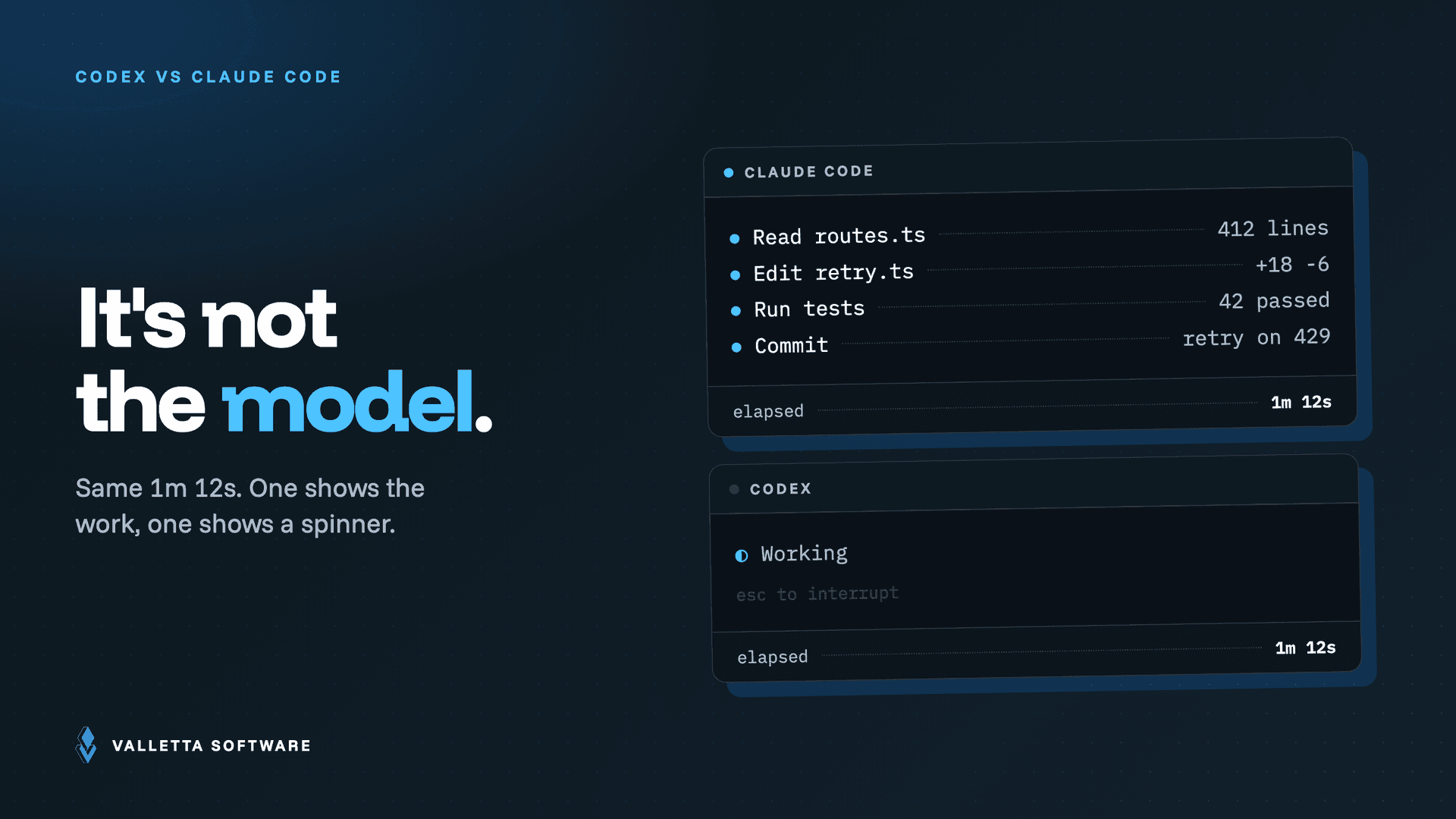

In the Codex vs Claude Code debate, most developers are not choosing on model quality at all. They are choosing on how the tool feels: whether output streams or sits behind a spinner, how often they hit a usage wall, and what the $20 tier buys against the $200 one. Cursor keeps winning that third argument, which is why it survives every round of the fight.
Key takeaways
- Claude Code feels faster than Codex largely because of how it renders progress, not because it is faster. Claude Code streams each step into the terminal; Codex compresses activity into a single animated line.
- Cursor's most repeated praise is not about its model. It is that developers rarely hit usage limits and rarely leave the editor, which is a workflow claim rather than a capability claim.
- All three start at $20 per month. Claude Pro includes Claude Code; Codex ships inside ChatGPT plans; Cursor Pro is $20. The tiers only diverge at the top.
- Claude Max and Cursor Ultra both sell the same idea: 20x the entry tier's usage. That multiplier, not benchmark scores, is what people are buying at $200.
- The churn is real and it runs in both directions. Treat the loud switching posts as signal about pricing pressure, not about which tool is better.
- You do not have to pick one. Running a different vendor's model inside Claude Code is a supported workflow, and plenty of teams use one tool at work and another on side projects.
Published August 4, 2026. Developer quotes are public posts on X from the trending discussion of August 3 and 4, 2026, attributed to their authors. Plan prices come from the vendors' own pricing pages on the date of publication and change often, so check the source links before budgeting.
The short answer
These three tools are not the same shape, and a lot of the argument comes from comparing them as if they were. Codex and Claude Code are agents you point at a repository, most often from a terminal. Cursor is an editor with an agent living inside it. That difference decides more than any benchmark.
Why Claude Code feels faster than Codex
The most useful observation in this week's argument was not about models. Andrew Wilkinson, co-founder of Tiny, posted that he likes Codex but that Claude Code feels faster, and he named the reason precisely: Claude Code slams a text update into the terminal as it completes each step, while Codex keeps the same work compressed into one line with a side-to-side fade.
He drew the comparison to chain of thought in chat products. The reasoning was always happening; showing it made the product feel both smarter and quicker. His suggested fix is a verbose mode, so users can "viscerally feel it ripping."
This matters more than it sounds. Perceived latency is a real product property, and it is measured in the user's head rather than in a benchmark harness. Two agents can finish an identical refactor in the same wall-clock time, and the one that narrates its progress will be described as faster in every review. Dario Mungoi replied to Wilkinson with the honest version of this: he does not really read what Claude Code writes, but it gives the impression that it is working.
So when you see "Codex is slower" in a thread, read it as a claim about feedback design first, and verify the wall-clock difference on your own repository second. If you want a genuine capability comparison instead, look at the underlying models rather than the wrappers. We broke those down in our Opus 5 vs Fable 5 vs GPT-5.6 Sol comparison.
Cursor wins on workflow, not on the model
Cursor's advocates are unusually consistent, and their praise is almost never about intelligence. Max Katz called it "the best designed app humanity has built." Robin Ebers called it the best AI coding tool in the world. Sarah, an ex-G2 developer, said Cursor is "miles ahead of Codex" and that it is not close.
The load-bearing one came from Jonathan Wilke, who said the reason he keeps coming back is that he almost never hits usage limits, and that on other tools he runs into them fast enough to kill his flow. That is the whole argument in one sentence. An agent that stops mid-task because you exhausted a quota is worse than a slightly weaker agent that finishes.
Cursor's published plans lean into exactly this. Pro is $20 per month, Pro+ advertises 3x Pro's agent limits, and Ultra advertises 20x. Usage through Auto, Cursor's routing setting that picks a model for the task, is not metered the same way as picking a frontier model by hand. If you never think about which model you are using, you rarely notice a ceiling.
The counterweight, from Wilson Wilson, was a shopping list rather than a complaint: cloud agents, a mobile app, easy handoff, and the ability to bring an existing Codex or Claude Code subscription. Nobody ships all four cleanly yet, which is a reasonable summary of where this category actually is.
The $20 versus $200 split
The pricing argument compressed itself into one widely shared line from a developer posting as Yash: if you have $20, use Codex; if you have $200, use Claude. It is a crude heuristic, and it is roughly how the market is behaving.
The entry tiers are genuinely level. Claude Pro is $20 per month billed monthly, or $17 on an annual plan, and includes Claude Code. Codex is bundled into ChatGPT plans starting with Plus at $20. Cursor Pro is $20. At that price the three are close enough that the tie-breaker is taste and habit.
The top of the range is where the framing changes. Claude Max starts at $100 and asks you to choose 5x or 20x Pro's usage. Cursor Ultra advertises 20x Pro's agent limits. OpenAI added a $100 Codex tier in April 2026 for people repeatedly hitting Plus limits, alongside the $200 ChatGPT Pro plan, and moved Codex from message-based pricing to token-based credits in the same period. Every vendor is now selling the same premium product: not a better model, just permission to keep going.
That reframing explains the sticker shock. FINN ISAAC's version was blunt: at $20 Codex gets the job done, but at $200 the tool had better write the entire codebase. Arun noted how many $20 Claude Code users were moving to Codex, Cursor, and GLM. Both are complaints about value per dollar at the margin, not verdicts on capability.
Read the switching posts carefully
The churn is loud and it points both ways in the same thread. Berny cancelled a Claude subscription to try Codex and was not sure about going back. Vadim said the more he used the Codex app, the more he noticed problems with the Claude app. Meanwhile the Cursor camp was insisting neither one beats their editor, and a developer posting as mel said they did not know a single person still using Cursor.
All of these are true statements about individual workflows, and none generalises. Jindu had the most defensible position in the whole discussion: each tool has strengths and weaknesses, and Claude is still good. That is unsatisfying as a hot take and accurate as an assessment.
The pattern worth extracting is that switching costs in this category have collapsed. When your agent reads a repository, edits files, and runs commands, moving to a competitor is a install-and-authenticate exercise rather than a migration. Vendors know it, which is why the limit multipliers keep climbing.
How to actually choose
Skip the leaderboard and answer four questions about your own work.
Where do you want to be? If you live in an editor and want completions, inline edits, and an agent in the same window, Cursor is the natural home. If you want to hand a task to something and come back to a diff, Codex or Claude Code fit better.
How often do you hit limits? This is the highest-signal question and the easiest to test. Run a normal week on the $20 tier of your first choice. If you never hit a wall, you have your answer and you have saved $180 a month.
How much do you read the output? If you supervise closely, Claude Code's verbose streaming is a feature. If you dispatch tasks and review at the end, Codex's compressed view is less noise.
What is your review process? The cost of a wrong answer scales with how much unreviewed code you ship. This is the part of the stack that people skip, and it is why we wrote up the agentic coding process we actually use and a walkthrough of Claude Code's security scanning plugin. A cheaper agent with a real review gate beats an expensive one without.
You do not have to pick one
The framing of the whole debate is a false binary, and the most productive developers in the thread said so. Dario Mungoi uses Claude Code for personal projects and Codex at work. Charlie Hills argued on LinkedIn that Claude Code or Codex is the wrong question, because you can run both, and that the defaults are what separate them rather than the underlying capability.
You can go further than running them side by side. Model access and tool harness are separable concerns, and pointing Claude Code at a different vendor's model is a working setup rather than a hack. We documented the routing in our guide to running GPT-5.6 inside Claude Code. The same logic applies to open models: if price is the binding constraint, an open weight model in a harness you already like is often the better trade, as we found comparing Kimi K3 against Claude Fable 5.
The honest summary of August 2026 is that all three tools are good, the gaps that people argue about loudest are interface gaps, and the thing you should actually optimise is how much finished, reviewed work leaves your machine each week.
FAQ
Is Codex better than Claude Code?
Neither wins outright. Codex is the cheaper entry into agentic coding because it rides along with a ChatGPT subscription, and it handles cloud task offloading well. Claude Code is preferred by developers who want to watch reasoning unfold step by step and who lean on it for harder multi-file work. Most head-to-head posts in August 2026 came down to interface preference rather than measured capability.
Why does Claude Code feel faster than Codex?
Because it streams a text update into the terminal after each step, while Codex compresses the same activity into a single animated line. Andrew Wilkinson made this point publicly on X in August 2026 and suggested Codex add a verbose mode. It is a difference in progress rendering, so verify actual wall-clock times on your own tasks before treating it as a speed gap.
Is Claude Code free?
No. Claude Code is included with paid Claude plans starting at Claude Pro, which is $20 per month billed monthly or $17 per month on an annual plan. The free Claude tier does not include it. Claude Max, from $100 per month, offers 5x or 20x Pro's usage.
Is Codex free?
Codex is bundled into ChatGPT plans rather than sold separately, and access extends down to the free tier with tightly limited usage. Practical daily use starts at ChatGPT Plus, $20 per month. OpenAI moved Codex to token-based credit pricing in April 2026, so heavy usage beyond the included allowance is billed as credits.
Is Cursor better than Claude Code and Codex?
Cursor competes on a different axis. It is an editor with an agent inside, so it wins for developers who want completions, inline edits, and agent runs without changing windows. Its most cited advantage is that users rarely hit usage limits. It is not obviously stronger on hard reasoning tasks, and it is a worse fit if you prefer dispatching work to a terminal agent.
Can I use Codex and Claude Code together?
Yes, and many developers do, commonly using one at work and the other on personal projects. The tool harness and the model are separable, so you can also run a different vendor's model inside Claude Code rather than maintaining two subscriptions for two workflows.