

Binance Hack and Polymarket Hack: How $6.3B Walked Out Through a Laptop and a Speed Script

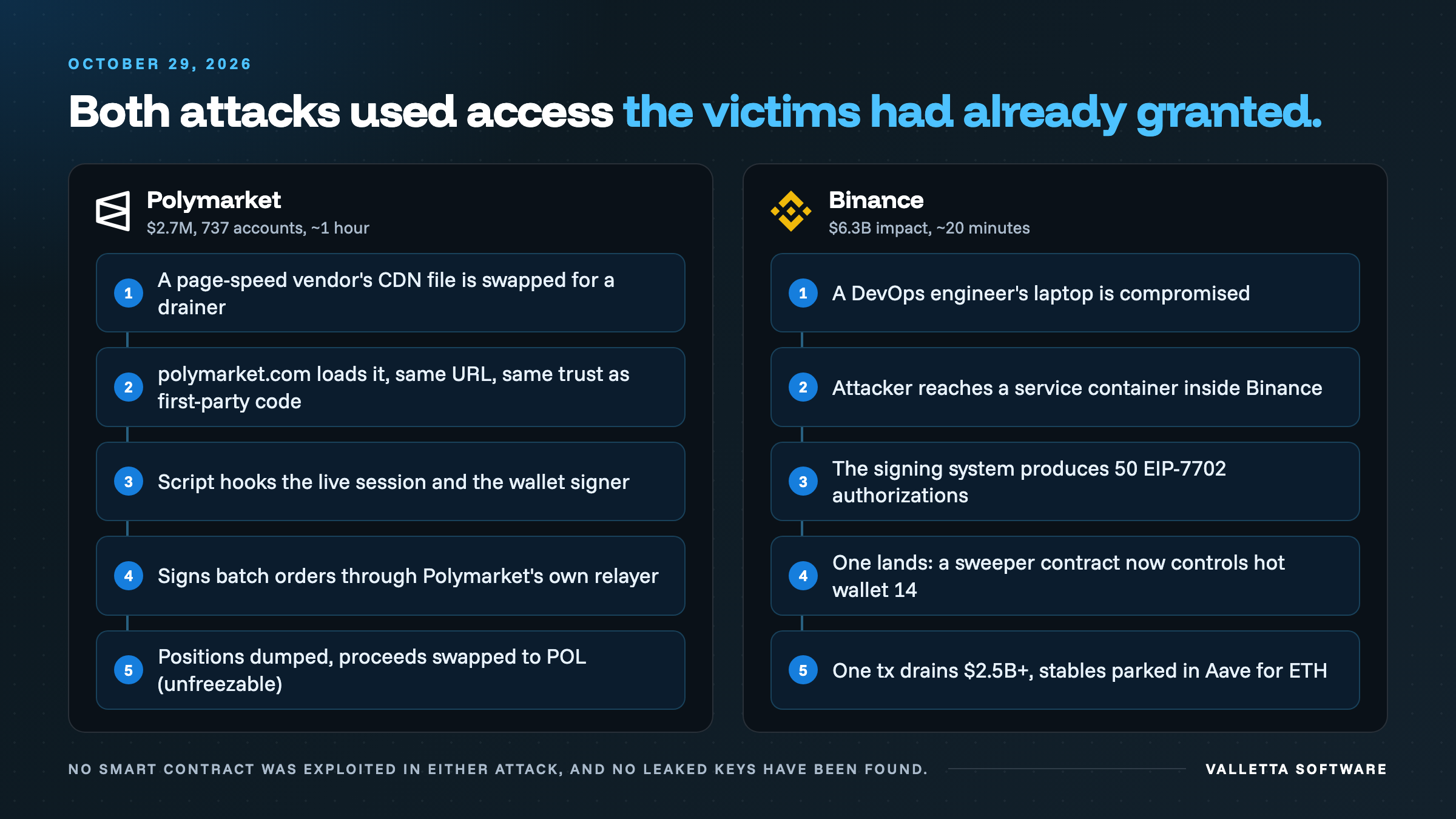
The Binance hack is the largest crypto theft on record. On October 29, 2026, an attacker used one compromised engineer laptop and a batch of pre-signed EIP-7702 authorizations to move funds out of Binance hot wallets, with an estimated impact of about $6.3 billion. No smart contract was exploited. About three hours earlier, a hijacked page-speed script on Polymarket took about $2.7 million from roughly 700 traders who were using the real website and did nothing wrong.
Key takeaways
- Binance: an attacker reached a service container from a DevOps engineer's laptop, got Binance's own signing pipeline to produce 50 EIP-7702 authorizations, and swept hot wallet Binance 14 in one transaction. Impact about $6.3B, about $3B frozen, Binance covering the rest.
- Polymarket: DebugBear's real-user monitoring script was swapped for a drainer at the same URL. It ran as first-party code, used each trader's live session and signer, and dumped positions through Polymarket's own relayer. About $2.7M from roughly 700 accounts in one hour.
- Neither attack exploited a smart contract, and no stolen keys have been found in either case. Both used access the victims had already granted: a script on the trading page, and a laptop one hop from the signer.
- Tether and Circle froze about $2.4B in stablecoins within an hour. By then the Binance attacker had put $60M USDT into Aave and borrowed ETH against it, and ETH cannot be frozen. The Polymarket drainer swapped straight into POL for the same reason.
- TRM Labs attributes the Binance theft to North Korea's TraderTraitor. Binance has promised a full technical post-mortem.
- If your product has a login, a payment form or a withdraw button, both attack paths exist in your stack today. The checklist at the end takes an afternoon.
Published October 30, 2026. Last updated October 30, 2026, 05:40 UTC. Developing story. Our team reconstructed both timelines from official statements by Binance, Polymarket and DebugBear, from on-chain data, and from the analysts who traced the money live on X (Blockaid, TRM Labs, Bitquery, Hudson Rock, Bubblemaps). Where figures disagree we show every source. We will update this page when Binance publishes its post-mortem.
Both attacks side by side
The two targets had little in common: an exchange holding about $144 billion in customer assets, and a prediction market. Both lost money on the same day, and in both cases the attacker got a component the system already trusted with money to move it. Nobody had to break any cryptography.
How the Polymarket hack worked: a JavaScript supply chain attack
Polymarket's international site, polymarket.com, loaded a small JavaScript file from DebugBear, a UK vendor that measures how fast pages load for real users. On October 29, the file at DebugBear's own CDN address was replaced with a drainer. The URL did not change, so the browser treated it exactly like Polymarket's own code. This is a software supply chain attack. The attacker never touched Polymarket's servers; they compromised a vendor whose code Polymarket's pages loaded. The US platform and MetaMask's Polymarket integration, which do not use that frontend, were not affected.
What the drainer did
Hudson Rock and several independent researchers pulled the payload apart. The script:
- read the page's wallet and auth state, then walked React's internals to hook the live trading client and the signer the user was already logged in with;
- skipped accounts worth less than $10, a threshold the attacker could change remotely (in Polymarket's June incident it was $100,000);
- sold every open position in Magic email accounts, first at 3% under market, then at half price, then at whatever the book would take, and swept the collateral, while external wallets had their position tokens transferred directly;
- sent signed batch instructions through Polymarket's own relayer, so the withdrawals passed the deposit wallets' normal approval checks and Polymarket paid the gas;
- converted the proceeds into POL, because the issuer can freeze USDC and nobody can freeze POL;
- reported each hit (wallet, country, portfolio size, success) back through DebugBear's own data endpoints, which nobody would think to block.
Nothing in the script exports passwords, seed phrases or private keys, because it did not need them. A script running inside a trading page can reach everything the page can reach, and labeling it "analytics" does not put it behind a separate security boundary.
Minute by minute
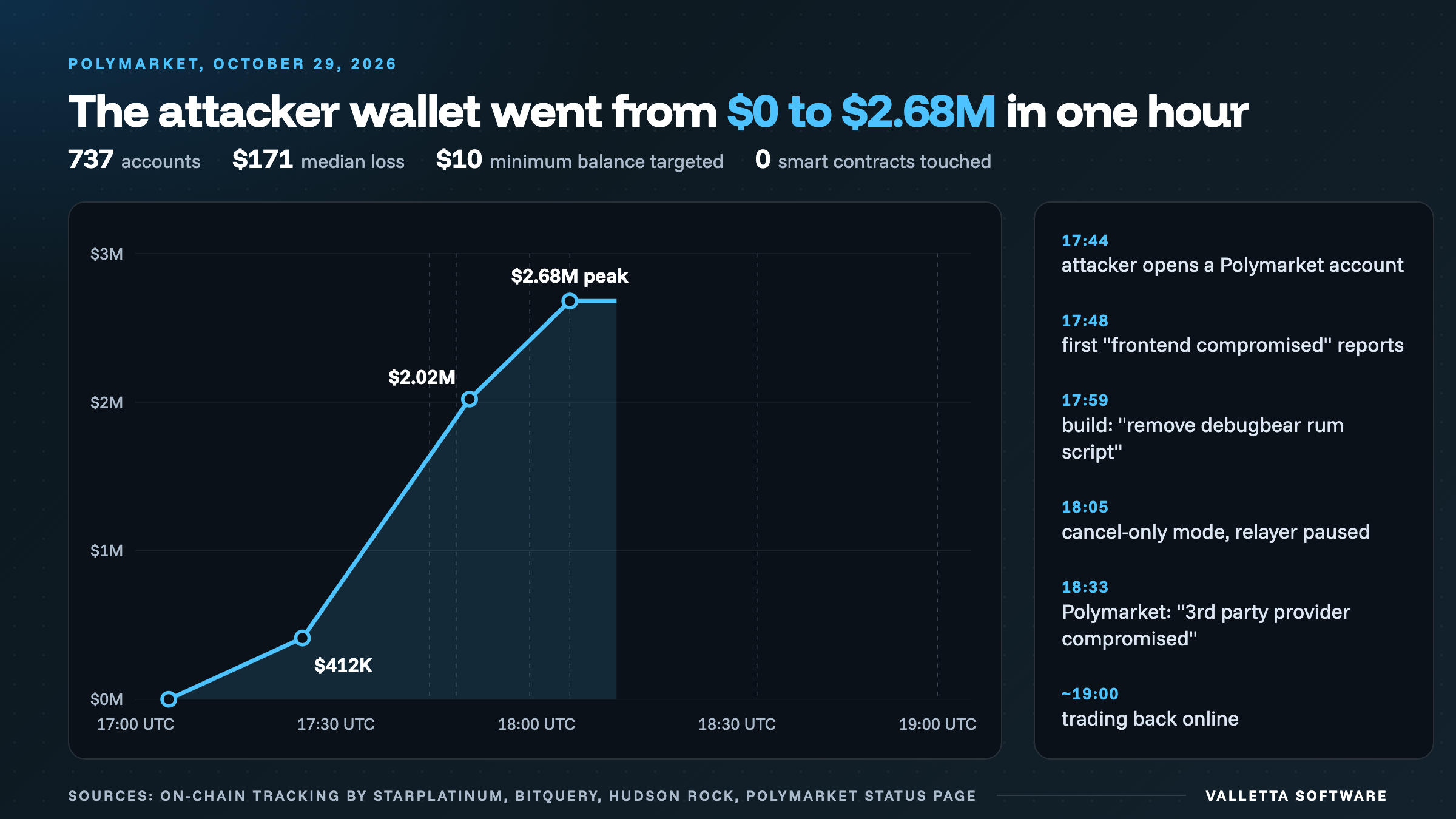
Sources: on-chain tracking published on X by StarPlatinum, Andrew 10 GWEI and Bubblemaps; Bitquery; Polymarket status page and official posts; DebugBear's post.
Why the loss figures differ
Address counts are not user counts: one person can own several wallets. Polymarket has not published its own loss figure.
Figures always spread like this during a live incident. The more useful number is Bitquery's median loss of $171 per account: the drain was wide and shallow and mostly hit ordinary traders. June's attack went the other way, taking about $3.1M from 11 large wallets.
The "$800K victim" who was not a victim
The first viral post claimed a well-known trader lost $800,000. Bubblemaps and other on-chain analysts showed his outflow did not match the drainer's pattern at all: the money went to one of his own previously used wallets, and the post carried his referral link. When you read live hack coverage, check whether the "victim" wallet behaves like the other victims before you share it.
Polymarket's third loss this year
Polymarket has now lost money through its web layer three times in 2026: roughly $700K in May, about $3.1M in June through a hacked third-party script, and this one. It reimbursed users each time. None of the three touched its smart contracts. We covered how Polymarket's markets and order flow work in our earlier piece on building a Polymarket trading bot. What we noticed during that build applies here too: the on-chain part is the sturdiest piece of the stack.
How the Binance hack happened
About three hours after Polymarket came back online, an on-chain watcher flagged a "possibly massive Binance hack": an entire hot wallet emptied into a brand new address in one transaction, funded through Tornado Cash. Binance stayed silent for most of an hour while Tether and Circle froze funds. By the next morning it had confirmed the hack, named a compromised DevOps engineer's laptop as the entry point, and put the estimated impact at about $6.3 billion.
What EIP-7702 has to do with it
EIP-7702, shipped in Ethereum's Pectra upgrade, lets a normal wallet temporarily run smart contract code. The owner signs an authorization saying "my account now delegates to this contract", and that authorization only works at one specific nonce, the wallet's transaction counter.
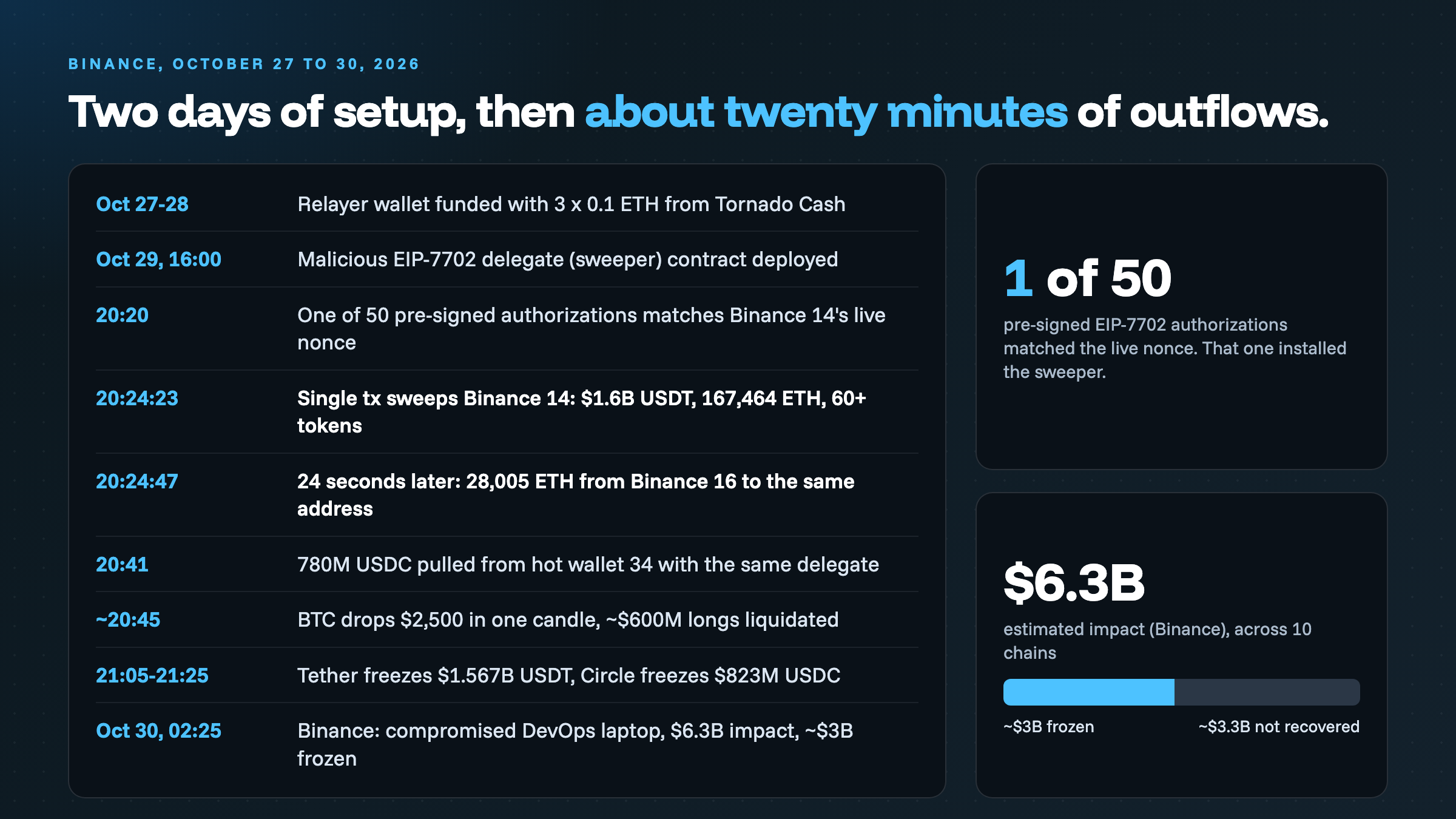
Binance 14 was a busy hot wallet, so its nonce kept moving. According to Blockaid's analysis of the drain transaction, the attacker did not know which nonce would be live at the moment of inclusion, so they brought 50 authorizations with consecutive nonces and sprayed them all in a single type-4 transaction. One matched. That one installed a sweeper contract that only the attacker's relayer could operate, and the next call drained the wallet.
Only Binance's key, or the system that holds it, can produce those signatures. Binance says it found no evidence of a key leak. That is consistent with the attacker getting Binance's own signing service to sign for them from inside a service container. The analyst Quit pointed this out within hours: an attacker holding the raw keys would not have needed a relayer or 50 guesses.
The full timeline
Sources: Binance's official posts and announcement, Blockaid, TRM Labs, Tether, Circle, Arbitrum, and on-chain analysis published on X by inno, Quit and International Cyber Digest. Developing story; times are when each event was first visible publicly.
Who froze what, and what the attacker did first
Stablecoin issuers moved faster than Binance on October 29. Tether's Paolo Ardoino announced more than 1.567B USDT frozen, Circle's Jeremy Allaire about 800M USDC, then Ripple froze RLUSD, World Liberty froze $27M of USD1, Aave froze markets, Arbitrum's Security Council seized about $30.5M, and Coinbase blocked sends to the attacker's wallets.
The attacker expected the freezes. Before the blacklists landed, they deposited about $60M USDT into Aave and borrowed roughly 19,762 ETH against it. The USDT was later frozen inside Aave, but the ETH was already gone. Issuers can freeze stablecoins and nobody can freeze ETH or BTC, which is why most of the unrecovered $3.3B is in those assets. Elon Musk's reaction was three words: "Everyday is Zeroday."
Who is behind the Binance hack
TRM Labs attributes the theft to TraderTraitor, the North Korean state-sponsored group, and says the playbook mirrors the February 2025 Bybit hack, which was also a compromised developer machine followed by a manipulated signing flow. Bybit lost about $1.5B. This is roughly four times that. Binance has not named an attacker.
What we still do not know
- How the laptop was compromised: phishing, a poisoned dependency, a malicious browser extension or something else.
- Why a service container could request signatures for a delegation to an unknown contract, 50 times, without a human or a policy engine stopping it.
- Why the authorizations were usable about two days after the setup began, and whether other hot wallets had pending authorizations too.
- The final unrecovered total. Binance says it will publish a post-mortem and an updated Proof of Reserves once remediation is complete.
Is this the biggest crypto hack ever?
Yes. Even counting only the roughly $3.3B that was not frozen, the Binance hack is more than twice the previous record, the February 2025 Bybit hack. Most of the largest thefts on the list below came through people and signing systems rather than code bugs.
Amounts in US dollars at the time of each theft. The top three were all compromises of people and signing systems. Bybit, Ronin and Binance are attributed to North Korean groups.
What both hacks have in common (our read)
We build and audit production systems for a living, including payment flows, trading tools and the AI-assisted codebases most startups now ship. Reading the two incidents side by side, we see three shared problems.
First, the money left through each company's own systems. Polymarket's withdrawals went through Polymarket's relayer, and Binance's through Binance's signer. Every control that asked "is this a valid request from our own system?" got a yes, because it was one. Those controls checked whether a request was valid and never what it was for.
Second, the entry points were the most ordinary parts of each stack: a page-speed widget and an engineer's laptop. Neither shows up on a threat model next to "smart contract audit", yet both had a direct path to customer money. The OpenAI breach through an image decoder we covered in September had the same shape, with the entry point in a dependency nobody chose on purpose.
Third, the attackers were faster than the defenders. Most of the Binance outflows happened within about twenty minutes and the Polymarket drain within an hour, and in both cases people saw it on X before the company said anything. AI-assisted tooling makes reconnaissance and exploit building cheaper every quarter, which is why we keep writing about putting AI on the defensive side too. If detection takes hours, it arrives after the money has moved.
Where your app has the same weak points
You do not need billions in a hot wallet to be exposed. Any product with a login, a payment form or an admin panel loads third-party JavaScript next to its users' sessions, and has at least one laptop with a path to production. AI-built apps are the most exposed: tools like Cursor, Lovable and Bolt paste analytics, chat and tracking snippets wherever they are asked, rarely add integrity checks, and nobody reviews which of them run on the checkout page. Six questions worth answering this week:
The cheapest fix is to add an integrity hash to every third-party script tag and move anything you cannot pin off the pages where money or credentials live.
Built your app with AI? Find these holes before an attacker does
Both October 29 hacks came through components nobody was watching: a script tag and a laptop with too much reach. AI-generated codebases are full of exactly those: unpinned third-party scripts, secrets in the wrong place, sessions that can do anything, and no alert when something does.
Our Vibe Coding Cleanup starts with a fixed-price audit from $199. A senior engineer reviews your repo across security, architecture and deployment, gives you a production-readiness score and a ranked risk map, worst first, then quotes a fixed-price cleanup if you want us to fix it.
FAQ
Was Binance hacked?
Yes. Binance confirmed on October 30, 2026 that an attacker used a compromised DevOps engineer's laptop to reach a service container and submit unauthorized withdrawal transactions from its hot wallets. The exchange estimates the impact at about $6.3 billion, with roughly $3 billion frozen on-chain, and says it will cover all losses.
How much was stolen in the Binance hack?
Binance's own estimate is about $6.3 billion in impact. TRM Labs puts it at $6.36 billion across 10 blockchains. About $3 billion was frozen by Tether, Circle, Ripple, Arbitrum and others within hours, so the unrecovered amount is roughly $3.3 billion. Either way it is the largest crypto theft on record, about four times the February 2025 Bybit hack.
Are Binance user funds safe?
Binance says user balances are unaffected because it will cover the loss from its SAFU fund and company funds, and it has promised an updated Proof of Reserves. Deposits resumed on October 30; withdrawals were paused with an expected restart within 48 hours. Rely only on official Binance channels for updates, because fake support accounts multiply during incidents like this.
How did the Polymarket hack work?
Polymarket's international site loaded a real-user monitoring script from DebugBear, a page-speed vendor. That script was replaced with a drainer at the same address. Running inside polymarket.com, it found each visitor's live trading session and wallet signer, sold or transferred their positions through Polymarket's own relayer, swapped the proceeds to POL and sent them to the attacker. About $2.7 million was taken from roughly 700 accounts in an hour.
Was either hack a smart contract bug?
No. No smart contract was exploited in either incident. Polymarket was drained through code running in its own website, and Binance through its own signing pipeline producing valid EIP-7702 authorizations. The cryptography worked as designed in both cases; the attackers used access that had already been granted.
What is EIP-7702?
EIP-7702 is an Ethereum change shipped in the Pectra upgrade that lets an ordinary wallet temporarily run smart contract code. The wallet owner signs an authorization pointing at a contract, and that authorization is valid for one specific nonce. The Binance attacker held 50 such signed authorizations with consecutive nonces, sent them all at once, and the one that matched installed a sweeper contract on the hot wallet.
Who is behind the Binance hack?
TRM Labs attributes it to TraderTraitor, a North Korean state-sponsored group, and says the operation resembles the 2025 Bybit theft. Binance has not named an attacker yet and says it is working with law enforcement on attribution.
What is the biggest crypto hack in history?
The October 29, 2026 Binance hack, at an estimated $6.3 billion in impact, is the largest crypto theft on record. The previous record was the February 2025 Bybit hack at about $1.5 billion, followed by Ronin Network at about $625 million in 2022.
Is Polymarket safe to use now?
Polymarket says it removed the compromised third-party script and the platform has been trading normally since about 19:00 UTC on October 29. The drainer used existing logged-in sessions, so affected users should still review recent activity, revoke unfamiliar approvals with a tool such as Revoke.cash, and contact Polymarket support only through official channels.
What is a supply chain attack?
A supply chain attack compromises a vendor, library or tool that a target already trusts, instead of attacking the target directly. In the Polymarket case the attacker compromised a performance-monitoring script from DebugBear, and every visitor's browser ran the malicious version as if Polymarket had written it.
Will Polymarket users get their money back?
Polymarket says everyone affected will be made whole. Some users report that the reimbursement process asks for identity verification and a broad non-disparagement agreement; Polymarket has not publicly commented on those terms.