

Code reviews – 5 ways to maximize code quality

Code review is often justified as a way to catch bugs. That framing undersells it by a factor of five. The actual code review impact on a software team compounds across at least five dimensions of quality, only one of which is bug detection. This piece walks through each of the five impacts with the numbers and team practices that produce them.
Key takeaways
- Defect detection is the smallest of the five effects, despite getting most of the attention.
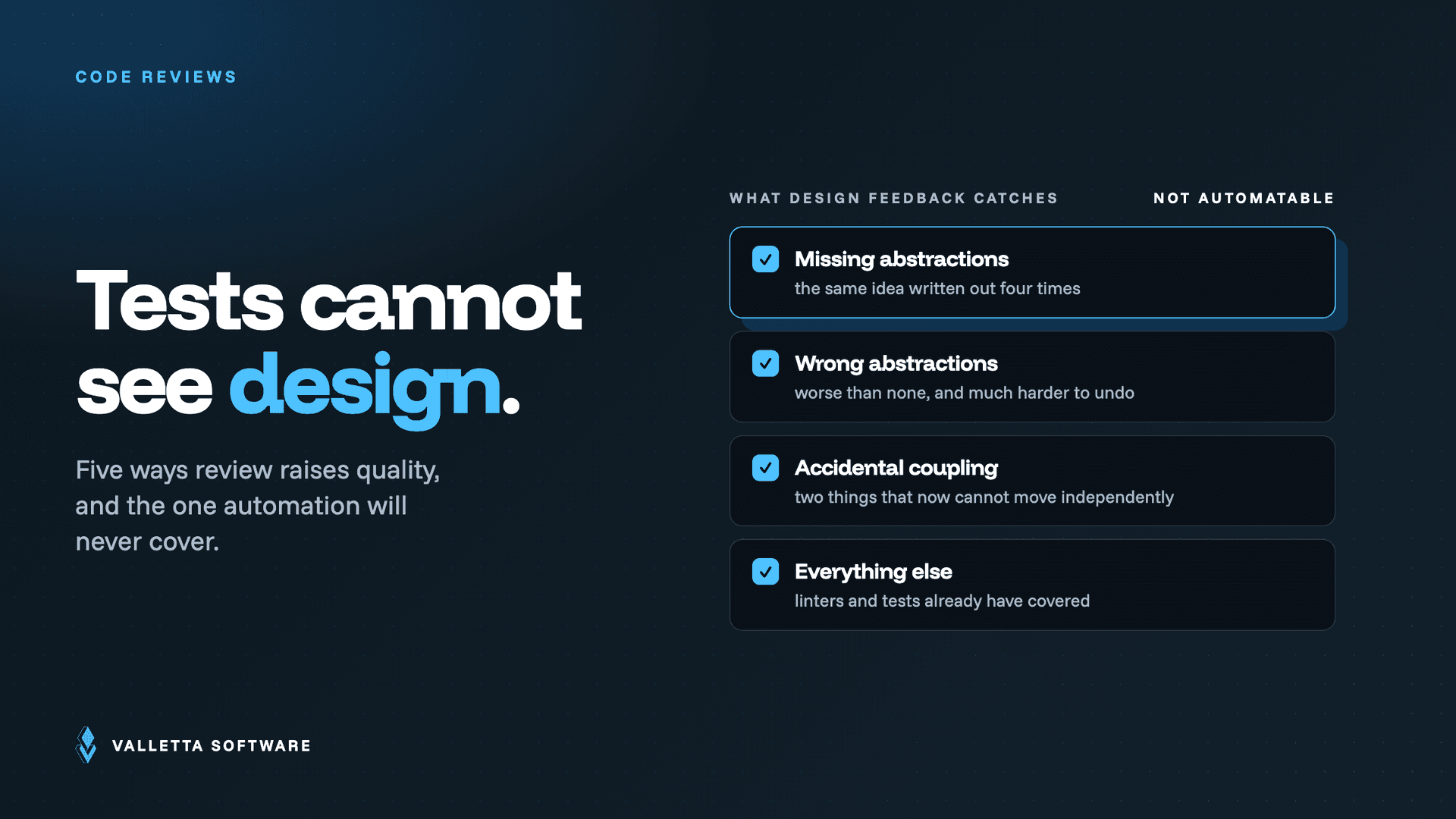
- Design feedback catches the issues that automated testing cannot: missing abstractions, wrong abstractions, and accidental coupling.
- Onboarding is roughly twice as fast for engineers in teams with rigorous code review compared to teams without it.
- Shared ownership reduces incident MTTR meaningfully; the reviewer becomes a second debug-capable person for every change.
- Team learning compounds over years; the same engineers in a strong review culture make better design decisions in their second year than in their first.
Impact 1: Defect detection
The most-cited code review impact, and also the most overstated. Industry studies consistently show that thorough code review catches between 20% and 35% of defects that would otherwise escape to production. The rest are caught by tests, by manual QA, or by users. This is meaningful, but not the largest justification for the practice.
What review catches that other techniques miss are the specific bug classes that are easy to write tests for after you know they exist, but hard to test for proactively. Off-by-one errors in pagination logic, null-handling at boundaries, race conditions in obvious-looking code, and incorrect error handling around third-party API calls. A reviewer reading the code with fresh eyes sees the assumption the author did not realize they were making.
To get this impact in practice: have at least two reviewers on changes that touch security, payment, or data-write paths. Allocate 5 to 10 minutes of review time per 100 lines of diff. Anything faster is too superficial to catch the subtle issues.
Impact 2: Design feedback
Most codebases drift toward incoherence one PR at a time. The reason is structural: each individual change makes local sense, but the cumulative effect is a tangled architecture. Code review is the cheapest place to catch this drift. A reviewer who knows the broader codebase can flag a design choice that is locally sensible but globally inconsistent.
Common design issues reviewers catch:
- Wrong abstraction layer. Business logic in a data-access class, or vice versa.
- Accidental coupling. Two services that should be independent now share state.
- Premature generalization. A "flexible" parameterized function that has one caller and unclear meaning.
- Missing abstraction. The same pattern repeated three times with subtle differences; a unifying abstraction would clarify intent.
- Inconsistent error handling. Some paths swallow errors, others propagate, no clear policy.
Catching these at review time costs 30 minutes of reviewer attention. Catching them three months later, after the pattern has spread, costs days of refactoring work.
Impact 3: Onboarding velocity
A new engineer in a team with strong code review reaches productive contribution roughly twice as fast as a new engineer in a team without it. The mechanism is straightforward: the new engineer's early PRs are read and discussed by experienced reviewers, who surface conventions, gotchas, and unwritten knowledge that no documentation would capture.
The reverse also matters. New engineers reading other people's PRs (an underused review pattern) absorb codebase conventions, business logic context, and architectural reasoning. A new engineer who spends 30 minutes a day reading recent PRs is genuinely productive in week three. Without that habit, expect six to eight weeks.
To capture this onboarding effect: require new engineers to review at least three PRs per week from their first day, even when they cannot approve them. Pair them with a designated mentor reviewer for the first month. Track time-to-first-merged-PR as an onboarding health metric.
Impact 4: Shared ownership and on-call sustainability
When a single engineer is the only person who can debug a service, that engineer's life on-call is miserable and the team's bus factor is one. Code review distributes debug-capable knowledge across the team. After reviewing a non-trivial change, the reviewer can usually read the code and understand its intent later, even if they did not write it.
The measurable effect: teams with rigorous review report consistently lower mean time to recovery (MTTR) for incidents in services where multiple engineers have reviewed code. The reviewer is the first responder; the author does not have to be paged at 2am for a service they wrote three months ago and have not touched since.
To get this effect, rotate reviewer assignments. A service that always gets reviewed by the same one person ends up with the same bus factor problem in another form.
Impact 5: Compounding team learning
This is the impact with the longest payoff and the hardest to measure. Code review is the most common channel through which engineers actually learn from each other inside a team. Patterns picked up in review (better error handling, cleaner test structure, sharper naming) propagate across the team and across years.
Teams with strong review culture compound this effect over time. The same engineers in their third year together write meaningfully better code than in their first year, not because individual skill grew uniformly, but because the team's shared notion of "what good looks like" advanced.
To accelerate this effect, encourage reviewers to leave one positive comment per PR (a pattern they liked) in addition to feedback. Recognition of good patterns spreads them faster than criticism of bad ones.
What changes when AI tools join the review loop
By 2026, AI-assisted code review tools handle the routine layer well: style, missing tests, obvious bugs, security smells. This frees the human reviewer to focus on the parts AI cannot do: design feedback, contextual judgement, knowledge transfer.
The five-impact framing does not change with AI in the loop, but the time profile does. Where a human reviewer previously spent 30% of review time on style and routine issues, AI now absorbs that. The human reviewer can spend the freed time on design and onboarding-style mentorship comments, the highest-leverage parts of the practice.
For our perspective on auditing AI-generated code specifically, read how to audit a vibe-coded app. For the practice basics, see what is code review. For broader engineering health, see our technical debt framework. The most cited industry baseline is Google's engineering practices on code review, and the long-running DORA research covers how review practices correlate with overall delivery health.
Frequently asked questions
How much time should a team spend on code review?
Roughly 10 to 15% of engineering time, including the time engineers spend being reviewed (responding to comments, splitting PRs, addressing feedback). This sounds high until you measure the cost of the bugs, design drift, and slow onboarding that result from skimping on it.
Is two reviewers always better than one?
For high-risk changes (security, payment, data-write), yes. For routine changes, one reviewer is enough and a second one rarely catches new issues. The exception is onboarding contexts, where having a junior engineer as a second reviewer is valuable for knowledge transfer even if they catch fewer defects.
What is the right PR size?
Under 400 lines of diff is the threshold above which reviewer effectiveness drops sharply. Under 200 lines is ideal. The discipline that produces small PRs (trunk-based development, feature flags, incremental refactoring) is itself a quality boost.
Can review be skipped for trivial changes?
Risky precedent. Most teams that try this end up with engineers stretching the definition of "trivial" to include things that are not. A simpler rule: review everything, but make the review proportional. A one-line config change gets two minutes of attention; a new service gets a thorough read.
How do you measure code review effectiveness?
Three useful metrics. First, defect escape rate (bugs found by users in the first week after release). Second, time-to-first-review (median wall-clock time from PR open to first reviewer comment). Third, percentage of PRs that get substantive feedback (not just an LGTM). If all three are healthy, your review process is producing value.