

IT Recruitment Guide: How to Hire Real Engineers
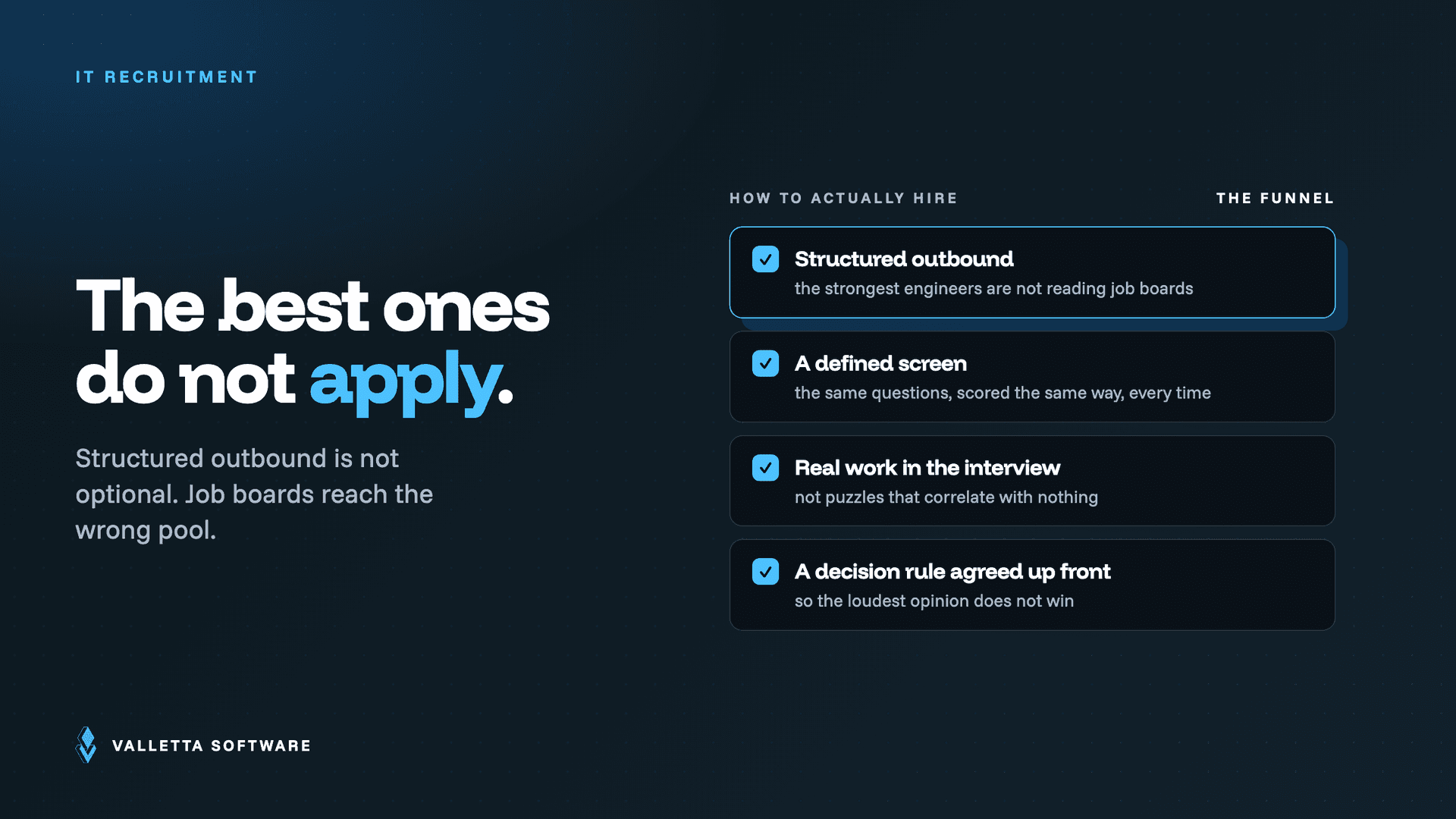

IT recruitment has not become easier in 2026, despite (or because of) AI in every part of the pipeline. The same fundamental challenge applies: in a candidate market full of resumes, GitHub profiles, and LinkedIn endorsements, how do you tell which engineer will actually deliver, fit your team, and stay? After 15 years of hiring engineers and helping clients hire engineers, the principles that work are surprisingly stable. If you need to hire engineers without burning your team's time, outsource the technical recruiting heavy lift.
Key takeaways
- Sourcing is half the work. The best engineers rarely apply through public job boards; structured outbound is non-negotiable.
- The interview pipeline should test one thing per stage. Trying to evaluate everything in one panel produces noisy decisions.
- Work-sample tests outperform algorithm puzzles for predicting on-the-job performance. The research on this has been consistent for over a decade.
- Cultural fit is real, but easy to misuse. Define it as values alignment and communication style, not as personality similarity.
- Retention starts at the offer stage. Engineers who feel misled in the interview process leave within 18 months.
The honest state of IT recruitment in 2026
The labor market for engineers has shifted three times in the past four years. In 2022 it was a candidate's market; in 2023 it tipped toward employers; by 2026 it is segmented. Senior engineers with proven product judgement and AI experience are still in short supply and command premiums. Mid-level engineers face the toughest market in a decade. Junior engineers have decent volume in the market but companies are wary of training cost.
What this means for IT recruitment in practice: the resume-based filtering that used to be a reasonable first pass is now mostly noise. AI-assisted resume polishing has narrowed the signal range. Live interviews remain the best evaluation step but consume the most time. Tooling that pretends to replace structured human evaluation has not lived up to its promises.
Sourcing: where the candidates you want actually are
Posting a job and waiting for applicants gives you the candidates who are already actively looking, which is a small and self-selecting slice of the market. Engineers worth hiring usually are not actively looking; they need to be approached.
Three sourcing channels we have measured working in 2026:
- Referrals from current engineers, paid clearly and meaningfully (USD 5k to 10k for hires that pass a 6-month mark). Generates the highest-quality lead per dollar spent.
- Structured outbound via LinkedIn or GitHub, with messages personalized to a specific project the candidate has shipped. Response rates are 5x higher than generic recruiter messages.
- Open-source contribution channels: engineers who maintain or contribute meaningfully to OSS projects in your stack. Direct signal of capability, plus a built-in conversation starter.
Channels that look good and do not work: paid job boards beyond the top three (most produce volume without quality), recruiters who source from the same handful of databases everyone else uses, and university hackathons (good for branding, poor conversion).
The interview pipeline that actually predicts performance
The best engineering interview pipelines have four stages, each testing a specific dimension, none trying to test everything at once.
- Stage 1: 30-minute screening conversation, focused on mutual fit. Does the candidate understand what the role is, and does the company understand what the candidate is looking for? Eliminates 50% of misaligned candidates fast.
- Stage 2: 60-minute technical conversation, focused on systems thinking. Walk through a past project the candidate built, asking why each technical decision was made. Reveals depth that no whiteboard problem can.
- Stage 3: Work-sample exercise, ideally 90 minutes of paid time. A realistic small task representative of the role. Open-book, paste-the-internet allowed, and review the result together.
- Stage 4: Team conversation and trade-off discussion. 45 minutes with two team members other than the hiring manager. Discuss a real engineering trade-off the team has wrestled with. Tests collaboration style and communication.
Total candidate time investment: roughly 4 hours. Total interviewer time: 6 to 8 hours. Yields a hire decision with materially better signal than the typical six-round pipeline.
Work-sample tests vs algorithm puzzles
The single biggest improvement most engineering interview pipelines could make in 2026 is to replace algorithm puzzles with work-sample tests. The research has been consistent for over a decade: work samples predict on-the-job performance roughly twice as well as algorithm problems, and they have lower false-negative rates against candidates from non-traditional backgrounds.
A good work sample looks like this: 90 minutes, realistic problem from the actual codebase or a representative substitute, candidate uses their normal tools (IDE, AI assistant, internet), and the conversation that follows is at least as important as the result. What did the candidate decide to prioritize? What trade-offs did they consider? What would they do differently with more time?
The shift away from algorithm puzzles has accelerated because AI assistants make them even less informative than before. A candidate who solves a leetcode problem with help is not demonstrating much that translates to the job.
Cultural fit, the right way
"Cultural fit" gets a bad reputation because it is often used as cover for hiring people who look and think like the existing team. That is the wrong use of the term. The right use is values alignment and communication style.
Values alignment is whether the candidate would feel comfortable speaking up in a debate, whether they share the team's stance on quality vs. speed trade-offs, whether they care about the work the company does. Communication style is whether the candidate is comfortable with async vs. synchronous, with written documentation discipline, with structured feedback. Neither of these has anything to do with whether they share the team's hobbies or background.
Retention starts before the offer
Engineers leave within 18 months when they feel the interview process misrepresented the role. Three patterns produce this experience reliably:
- Pitching the company's ideal future state rather than its actual present state. "We are about to scale to 100 engineers" while the candidate joins a team of six and the hiring pipeline is paused.
- Underselling the difficulty of specific challenges the role will face. "Tech debt is manageable" when it actually consumes 40% of sprint capacity.
- Skipping the team conversation stage. Candidates who only meet the hiring manager often discover team dynamics in the first month and find them surprising.
The antidote is honesty calibrated to the candidate's career stage. Senior engineers value transparent assessment of the role's challenges more than oversold optimism. Junior engineers value clear growth paths and explicit expectations more than vague promises.
When to outsource vs hire full-time
IT recruitment is the right answer for filling permanent roles in your core stack and product domains. It is the wrong answer for short-term capacity, specialized skills you need for one project, or scaling spikes that may reverse in 6 months. For those situations, dedicated teams or staff augmentation engagements produce faster onboarding, lower total cost, and easier scale-down.
For our framework on choosing between hiring and outsourcing, see our IT staffing guide. For the AI-development angle specifically, see AI development agency vs dedicated developers. For the honest take on technical interviews, see honest hiring. The classic research case for structured work samples over algorithm puzzles is summarized in Work Rules! by Laszlo Bock, and modern hiring benchmarks come from Greenhouse's hiring research.
Frequently asked questions
How long should the hiring process take?
Two to three weeks from first conversation to offer for most engineering roles. Longer than four weeks and good candidates accept other offers. Shorter than two weeks usually means stages have been skipped, which shows up in retention later.
Should engineers always interview engineers?
Yes for technical stages, no for the screening conversation. A recruiter or hiring manager handles the initial conversation. Engineers run the technical and work-sample stages. The team conversation stage involves engineers other than the hiring manager.
How do you screen for AI-coding capability?
Give the candidate an AI assistant during the work-sample stage and observe how they use it. Strong candidates use it as a force multiplier, validating its output. Weak candidates either ignore it (slowing themselves down) or accept its output uncritically (producing the kind of code that does not work in production).
Are coding tests still useful?
Yes, in the form of work samples (realistic small projects), not algorithm puzzles. The candidate's process matters as much as the result. Discussing the code together after is where the signal is highest.
What is the highest-leverage change most companies could make to their interviews?
Replace at least one whiteboard problem with a paid 90-minute work sample. The shift produces better hires and better candidate experience at lower interviewer cost. The reason most teams have not made the change is inertia, not evidence.
Frequently asked questions
- What is the biggest mistake in IT recruitment?
- Filtering on resume keywords. The signal is noisy; the strong candidates often lack the buzzword density that ATS systems reward. Real signal comes from work samples and references.
- How long should the technical interview process take?
- Total candidate time should stay under 6 hours across all stages. Beyond that, you lose strong candidates to faster competitors. The interview process is also a candidate-experience signal.
- Are coding challenges still useful in 2026?
- Yes, but only when they reflect real work. Algorithmic puzzles have low predictive value. Realistic small-scoped tasks with code review predict performance much better.
- How do I evaluate AI-assisted engineering skills?
- Pair a candidate with an AI coding tool on a small task. Watch how they prompt, validate output, and decide when to override the AI. The signal is in the decision-making, not the typing speed.
- When should I outsource IT recruitment?
- When you cannot dedicate 10 hours per week of senior engineer time to interviewing, or when you need specialized skills outside your hiring team's domain expertise.
Skip the Recruiting Burnout
Valletta Software places vetted EU engineers under your direction, IP-assigned, with no hidden agency markup. Dedicated team, dedicated developer, or staff augmentation engagement.