

Risks of Hiring AI Developers in 2026: A Complete Risk Register & Mitigation Guide
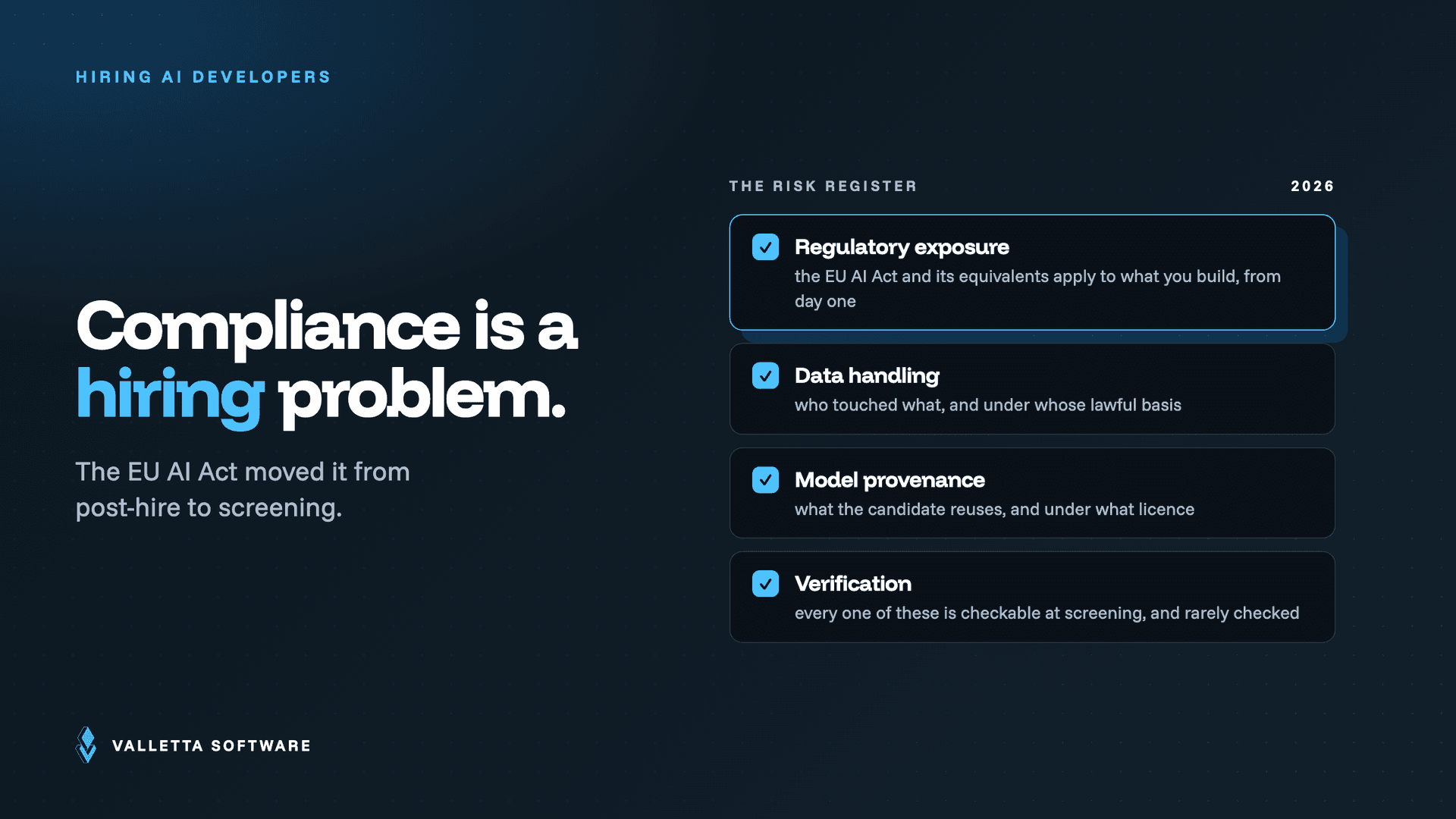

As artificial intelligence becomes foundational to modern business operations in 2026, organizations are actively seeking skilled AI developers to drive innovation and efficiency. However, hiring AI specialists introduces real risks, from intellectual property (IP) breaches and data security lapses to model misuse and regulatory exposure under the newly enforceable EU Artificial Intelligence Act. To skip these risks entirely, hire vetted AI engineers under one EU contract.
Related: our step by step guide on how to hire AI developers covers screening scripts, trial tasks and rate bands, and the Valletta bench lists vetted engineers you can start with in two weeks.
Key takeaways
- Five categories of hiring risk: IP, data security, model misuse, regulatory compliance, supply chain.
- The EU AI Act and similar 2026 regulations make compliance a hiring-stage concern, not a post-hire one.
- Mitigation tools: scoped contracts, narrow access, code signing, model provenance, full audit logging.
- Build vs buy decisions depend more on risk tolerance than on cost; the risk register inside the post maps each risk to specific controls.
The numbers are sobering. According to Gartner's 2026 cybersecurity trends research, over 57% of employees now use personal GenAI accounts for work purposes, and 33% admit inputting sensitive information into unapproved tools. Meanwhile, Gartner's AI TRiSM (Trust, Risk, and Security Management) analysis warns that through 2026, at least 80% of unauthorized AI transactions will stem from internal policy violations, not external attacks.
"Cybersecurity leaders are navigating uncharted territory this year as these forces converge, testing the limits of their teams in an environment defined by constant change," said Alex Michaels, Director Analyst at Gartner. "This demands new approaches to cyber risk management, resilience, and resource allocation."
This article provides a comprehensive risk register approach to understanding, mitigating, and assigning ownership for the major risks associated with hiring AI developers, leveraging global standards including NIST SP 800-53 (Release 5.2.0), the NIST AI Risk Management Framework, CIS Benchmarks, SLSA, OpenSSF Scorecard, and OWASP SAMM.
Understanding the Unique Risks of Hiring AI Developers in 2026
AI development introduces complexities far beyond traditional software engineering. The risks of hiring AI developers are amplified in 2026 by three converging forces: the rapid proliferation of agentic AI systems, a patchwork of global regulations entering enforcement, and the growing fragility of AI supply chains. Below, we break down the five critical risk categories every organization must address.
Intellectual Property (IP) Theft or Leakage
AI projects often involve sensitive proprietary algorithms, training datasets, and model weights. Developers may inadvertently, or maliciously, expose this IP through unsecured code repositories, unauthorized data sharing, or weak access controls.
This risk is more acute than many organizations realize. Gartner's TRiSM research projects that through 2026, at least 80% of unauthorized AI transactions will be caused by internal violations of enterprise policies, including information oversharing, unacceptable use, and misguided AI behavior, rather than malicious external attacks. In other words, the biggest IP threat often comes from within your own teams.
The Gartner survey that found 33% of employees admit inputting sensitive information into unapproved GenAI tools makes this risk especially urgent for organizations onboarding new AI developers who may default to familiar but unapproved toolchains.
Real-world impact: At Valletta Software Development, we've observed across our 1,000+ project portfolio that IP-related risks intensify during two critical phases: initial developer onboarding (when access provisioning is being configured) and handoff periods between development sprints. Our approach addresses both by enforcing strict RBAC segmentation from day one and conducting access audits at every sprint boundary.
Security Vulnerabilities
The push for rapid prototyping can lead to overlooked security practices. Vulnerabilities in code, third-party libraries, or machine learning pipelines create openings for attackers, and the scale of the problem is accelerating.
Gartner's "Predicts 2026" report on software engineering warns that prompt-to-app approaches adopted by citizen developers could increase software defects by 2,500% by 2028, triggering what it calls a "software quality and reliability crisis." For organizations hiring AI developers, this means that security vetting must extend beyond the developer's credentials to include rigorous evaluation of their AI-assisted coding practices and the tools they use.
In December 2025, NIST released its preliminary draft Cyber AI Profile (NIST IR 8596), which identifies three overlapping cybersecurity focus areas for AI systems: securing AI systems, defending with AI-enhanced cybersecurity, and thwarting AI-enabled cyberattacks. "Regardless of where organizations are on their AI journey, they need cybersecurity strategies that acknowledge the realities of AI's advancement," said Barbara Cuthill, one of the profile's authors at NIST.
This framework signals that organizations must update their security posture to address AI-specific vulnerabilities, including adversarial attacks on models, data poisoning, and model extraction, alongside traditional application security concerns.
Model Misuse or Repurposing
Without robust operational controls, deployed models may be exploited for unintended or unethical purposes, such as automating discriminatory decisions, enabling privacy violations, or generating convincing deepfakes. As AI agents gain autonomous capabilities, the risk surface widens further.
Gartner's 2026 cybersecurity trends report names agentic AI as a top concern: "Cybersecurity leaders must identify both sanctioned and unsanctioned AI agents, enforce robust controls for each, and develop incident response playbooks to address potential risks," said Michaels.
The EU AI Act's transparency obligations, enforceable from August 2, 2026, will require organizations to disclose AI interactions, label synthetic content, and implement deepfake identification mechanisms. For teams building AI systems, this transforms model governance from a best practice into a legal requirement.
Compliance Failures
The regulatory landscape for AI has shifted from advisory to enforceable in 2026. Key developments include:
- EU AI Act full enforcement (August 2, 2026): High-risk AI system obligations become legally binding, including risk management, data governance, technical documentation, record-keeping, transparency, and human oversight requirements. Non-compliance fines can reach up to €35 million or 7% of global annual turnover for prohibited practices.
- NIST SP 800-53 Release 5.2.0 (August 2025): New controls specifically address AI system security, including Control Overlays for Securing AI Systems (COSAiS).
- NIST AI Risk Management Framework: While voluntary, this framework is now widely referenced by federal regulators and international bodies as the operational standard for AI governance. NIST is expected to release RMF 1.1 guidance addenda and expanded profiles through 2026.
- Global expansion: Gartner predicts that by 2027, AI governance will become a requirement of all sovereign AI laws and regulations worldwide.
Improper documentation, insufficient risk assessments, or failure to implement these standards may result in severe penalties. Each EU member state must also establish at least one AI regulatory sandbox by August 2026 for organizations to validate compliance before market release.
Supply Chain Attacks
AI development frequently relies on open-source frameworks, pre-trained foundation models, and third-party API services. If any component in this chain is compromised, vulnerabilities or malicious code can propagate into otherwise trusted environments.
The NIST Cyber AI Profile specifically calls out the need for organizations to conduct due diligence on third-party AI tools and services, align data use and security requirements, and establish monitoring expectations for AI supply chain components. Maintaining a robust Software Bill of Materials (SBOM) and extending it to an AI Bill of Materials (AI-BOM), covering models, datasets, and vendor dependencies, has become an essential practice in 2026.
Each of these risks demands tailored mitigations, clear ownership, and continual review throughout the development lifecycle.
Risk Register for Hiring AI Developers
A risk register provides a structured, auditable framework for tracking threats, their impacts, and the controls in place. The following table summarizes the key risks of hiring AI developers, their impacts, recommended mitigation strategies, and ownership aligned with leading standards:
IP Risk Controls: Safeguarding Proprietary Assets
Strong IP controls begin at the hiring stage, well before a developer writes their first line of code. Even before onboarding, due diligence should be performed to assess candidates' histories for prior IP disputes, open-source contribution patterns that might conflict with proprietary work, and reputational risks.
Non-disclosure agreements (NDAs) must be clearly worded and regularly updated to reflect evolving project scopes. They should specifically address AI-related IP: model weights, training data, fine-tuning methodologies, and prompt engineering techniques are all proprietary assets that traditional NDAs may not adequately cover.
Industry best practices recommend segmenting sensitive codebases using robust Role-Based Access Control (RBAC) and deploying Data Loss Prevention (DLP) solutions to flag unauthorized sharing of algorithms, datasets, or model weights. For organizations adopting remote or hybrid work models, secure code collaboration tools and monitored communication channels further reduce unintentional leakage.
Regular security and IP audits, anchored in frameworks such as NIST SP 800-53 and OWASP SAMM, provide independent confirmation that controls are effective and current.
How Valletta Software Development addresses IP risk: Every Valletta engagement begins with strict NDA enforcement that explicitly covers AI-specific IP, including model architectures, training pipelines, and proprietary datasets. Codebases are RBAC-segmented from the first sprint, with access audits conducted at every handoff. For clients with heightened sensitivity, Valletta's team supports on-premises and private-hosted AI model deployments to eliminate cloud-based data leakage vectors. As Valletta's engineering team noted in their AI development blog: "When models interact with sensitive business data or proprietary code, there's a risk of information leakage, especially with cloud-based services. We mitigate this by implementing strict data sanitization, isolating test environments, and carefully managing API access."
Mitigation ownership: Legal teams draft and enforce NDAs covering AI-specific IP; security leads design access controls and DLP policies; project technical leads manage code repository permissions and conduct access reviews.
Security Risks: Ensuring the Integrity of Models and Data
AI applications are uniquely vulnerable due to their reliance on complex data pipelines, third-party model dependencies, and evolving threat vectors. Adversarial attacks, where carefully crafted inputs mislead models into producing incorrect outputs, are growing more sophisticated. Data poisoning, model extraction, and prompt injection attacks represent new categories of security risk that traditional application security practices don't address.
An experienced software development team should institute secure coding training for all AI staff that specifically covers AI/ML attack vectors, employ static and dynamic code analysis, and harden underlying infrastructure using CIS Benchmarks.
Continuous integration and deployment (CI/CD) pipelines must enforce security gates to catch misconfigurations or vulnerabilities prior to production deployment. SLSA (Supply-chain Levels for Software Artifacts) encourages tracking software and data provenance, essential for tracing security incidents back to their source. The NIST AI RMF's March 2025 update specifically emphasizes model provenance, data integrity, and third-party model assessment, recognizing that most organizations rely on external or open-source AI components.
Periodic penetration testing and red-teaming, including AI-specific adversarial testing, help reveal overlooked attack surfaces. NIST's new Cyber AI Profile recommends that organizations update asset inventories to include AI systems, review risk assessments with AI-specific threats, and tune security playbooks for potential AI-accelerated attacks.
How Valletta Software Development addresses security risk: Valletta's DevOps practice integrates security gates into every CI/CD pipeline and enforces CIS-hardened infrastructure across AWS and Azure environments. Every engagement includes 100% code review by a technical lead, with continuous monitoring and vulnerability management as standard practice. For AI-specific projects, Valletta implements data sanitization protocols, isolated test environments, and managed API access to prevent model-level security breaches.
Mitigation ownership: DevOps teams maintain secure pipelines; security specialists oversee vulnerability management and AI-specific threat modeling; development leads implement secure development lifecycles with AI-aware code review.
Preventing Model Misuse and Abuse
AI models, once deployed, can be misused by insiders or external actors to automate malicious actions, propagate biases, violate privacy, or generate convincing synthetic content. With the rise of agentic AI, systems capable of taking autonomous actions, the risk surface has expanded dramatically in 2026.
Effective model governance requires a layered approach:
- Inference logging: Record all model access, inputs, and outputs for auditability.
- Usage pattern monitoring: Detect anomalous patterns that may indicate misuse, such as bulk inference requests or off-hours access.
- Model watermarking: Embed invisible markers to trace model leaks or unauthorized redistribution.
- Model cards: Transparent documentation of intended model behaviors, limitations, and appropriate use cases, a best practice endorsed by both the OpenSSF Scorecard community and the EU AI Act.
- Agentic AI playbooks: Incident response procedures specifically designed for autonomous AI systems, as recommended by Gartner's 2026 cybersecurity trends.
With the EU AI Act's transparency rules becoming enforceable in August 2026, organizations deploying AI must now ensure synthetic content marking, AI interaction disclosure, and deepfake identification are built into their production workflows, not bolted on after deployment.
Mitigation ownership: Product owners define acceptable use policies; compliance leads operationalize audit logging and abuse monitoring; engineering teams implement technical controls including watermarking and usage monitoring.
Regulatory and Compliance Controls in 2026
The regulatory landscape for AI has undergone a seismic shift. What was advisory in 2024 has become enforceable in 2026. Organizations that delayed compliance preparation now face compressed timelines and real legal exposure.
EU Artificial Intelligence Act: August 2026 Enforcement
The EU AI Act represents the world's first comprehensive AI regulation. As of August 2, 2026, the majority of obligations for high-risk AI systems become legally binding. These include:
- Risk management systems and continuous assessment
- Data governance and quality requirements for training datasets
- Technical documentation and record-keeping
- Transparency and human oversight obligations
- Accuracy, robustness, and cybersecurity requirements
- Post-market monitoring and incident reporting
- Conformity assessment procedures
AI systems used in HR, recruitment, education, law enforcement, and critical infrastructure are classified as high-risk and face the strictest requirements. Non-compliance penalties can reach €35 million or 7% of global annual turnover for prohibited practices, with fines of up to €15 million or 3% of turnover for high-risk system violations. Critically, the Act has extraterritorial effect, non-EU businesses whose AI systems affect people in the EU are subject to its requirements.
The European Commission's Digital Omnibus proposal (November 2025) aims to simplify certain high-risk classifications, but political agreement must be reached before August 2026. Organizations should plan for the existing requirements while monitoring possible amendments.
NIST Frameworks: The Operational Layer
While the EU AI Act defines legal requirements, NIST frameworks provide the operational layer for implementation. In 2025-2026, NIST has released several significant updates:
- SP 800-53 Release 5.2.0 (August 2025): New AI-specific controls addressing secure patches, system integrity, and software assurance.
- Control Overlays for Securing AI Systems (COSAiS): Implementation-level guidance complementing the AI RMF's outcome-oriented approach.
- Cyber AI Profile (NIST IR 8596, December 2025): Guidelines for managing cybersecurity risk specifically related to AI systems, with an initial public draft expected in 2026.
- AI RMF 1.1: Expected expanded profiles and evaluation methodologies through 2026.
Multinational companies are increasingly adopting NIST as the operational framework beneath regulatory compliance, including EU AI Act preparation.
Tools like SLSA and OWASP SAMM facilitate stepwise improvement in secure software provisioning, while periodic external audits validate ongoing adherence to mandated practices.
Mitigation ownership: Compliance teams coordinate with development and QA to produce system documentation, manage regulatory reviews, and interface with auditors. Cross-functional collaboration across legal, security, and engineering is essential, as Gartner advises, organizations must "formalize collaboration across legal, business, and procurement teams to establish clear accountability for cyber risk."
Supply Chain Security: Managing Third-Party and Open-Source Risks
Modern AI developers rely heavily on open-source frameworks (TensorFlow, PyTorch, Hugging Face Transformers), pre-trained foundation models, and third-party AI API services. If any component in this chain is compromised, vulnerabilities or malicious code can propagate into otherwise trusted environments.
Effective supply chain security for AI in 2026 requires going beyond traditional dependency scanning to address AI-specific supply chain risks:
- Software Bill of Materials (SBOM): A comprehensive inventory of all software components, as recommended by CISA.
- AI Bill of Materials (AI-BOM): An extended inventory covering AI-specific assets, pre-trained models, training datasets, fine-tuning data, and vendor dependencies. The NIST AI RMF's 2025 update specifically calls for organizations to build AI-BOMs for all models, data, and vendors.
- OpenSSF Scorecard: Automated evaluation of open-source project security health, covering code review practices, dependency update policies, and vulnerability disclosure processes.
- SLSA provenance: Cryptographic verification of software artifact origins, ensuring that the code in production matches what was reviewed and approved.
- Third-party AI due diligence: The NIST Cyber AI Profile calls out the need for organizations to conduct due diligence on third-party AI tools and services, aligning data use, security requirements, and monitoring expectations.
How Valletta Software Development addresses supply chain risk: Valletta integrates automated dependency scanning and SBOM generation into every project pipeline. For AI-specific engagements, this extends to model provenance tracking and isolated review environments for third-party components. The team employs a combination of internal scanning tools, managed open-source services, and continuous supply chain monitoring to detect and address risks before code reaches production.
Mitigation ownership: Security engineers manage SBOMs, AI-BOMs, and monitoring tools; development leads oversee dependency hygiene and model provenance; compliance teams ensure supply chain documentation meets regulatory requirements.
Build vs. Buy for AI Talent: Weighing Risk
Choosing how to source AI talent involves balancing speed, control, cost, and risk exposure. Each approach carries a distinct risk profile that organizations must evaluate against their specific needs:
For organizations choosing the staff augmentation route, the risk calculus favors partners with demonstrable security practices and AI-specific experience. Valletta Software Development combines the speed advantages of outsourcing with enterprise-grade security controls: strict NDA enforcement, 100% code review by technical leads, CIS-hardened cloud infrastructure, and a track record of over 1,000 successful project deliveries across 11 industries since 2009. In fintech engagements, Valletta has implemented robust fraud detection and security measures for financial transactions processing over 200,000 loans, while healthcare projects adhere to strict data security and compliance protocols.
Expert Tips: Actionable Risk Mitigation for AI Hiring in 2026
Drawing from current research, regulatory guidance, and our experience managing AI development risks across hundreds of client engagements, here are six priority actions for 2026:
- Establish continuous risk assessments: Reevaluate developer and model risks periodically, not just at hire or deployment. Gartner recommends shifting from general security awareness training to adaptive behavioral programs that include AI-specific tasks, governance controls, and clear authorized-use policies.
- Integrate automated tooling across the AI lifecycle: Deploy DLP, vulnerability scanning, SBOM generation, and audit logging tools as standard practice. The NIST Cyber AI Profile recommends updating asset inventories, reviewing risk assessments with AI-specific threats, and setting more frequent review triggers for policies.
- Cross-train teams for AI-era compliance: Ensure legal, security, and development teams understand each other's controls and responsibilities. The EU AI Act introduces cross-functional compliance obligations that require coordinated effort across departments. Gartner advises formalizing collaboration across legal, business, and procurement teams.
- Enforce least privilege with AI agent governance: Restrict access to sensitive IP and data strictly on a need-to-know basis using RBAC. In 2026, this must extend to AI agents, Gartner's top cybersecurity trend identifies the rise of autonomous AI agents as a new challenge for identity and access management, requiring policy-driven authorization for machine actors alongside human users.
- Monitor the ecosystem continuously: Stay updated on emerging threats via OpenSSF Scorecard, CISA SBOM guidance, NIST advisories, and the EU AI Act implementation timeline. Subscribe to vulnerability feeds for the specific open-source AI frameworks your team uses.
- Prepare for EU AI Act compliance now: With high-risk AI obligations applying from August 2, 2026, organizations should map their AI systems against the Act's risk categories, begin conformity assessments, establish post-market monitoring systems, and prepare technical documentation. Each EU member state must also establish at least one AI regulatory sandbox by August 2026, consider participating to validate compliance before enforcement.
Frequently Asked Questions
What is the greatest IP risk when hiring AI developers?
The biggest risk is the exposure or theft of proprietary algorithms, training data, or model weights, either inadvertently or maliciously. Gartner's AI TRiSM research indicates that through 2026, at least 80% of unauthorized AI transactions will be caused by internal policy violations, including information oversharing and unacceptable use, rather than external attacks. A separate Gartner survey found that 33% of employees admit inputting sensitive information into unapproved GenAI tools. This makes robust onboarding protocols, AI-specific NDAs, RBAC, and DLP tools essential from the first day of engagement.
How can organizations screen AI developer candidates for security?
Screening should extend well beyond technical aptitude. Include background checks, detailed reference assessments, alignment with corporate security culture, and practical tests for secure coding knowledge, including AI-specific scenarios like adversarial input handling and data pipeline security. Assess candidates' familiarity with frameworks like NIST SP 800-53, the NIST AI RMF, OWASP SAMM, and relevant regulations (EU AI Act, GDPR). In regulated sectors such as finance and healthcare, additional clearances or sector-specific vetting may be advisable.
What regulatory frameworks are relevant for AI developer risk management in 2026?
The key frameworks now include: NIST SP 800-53 (Release 5.2.0) for security controls, the NIST AI Risk Management Framework (AI RMF 1.0) for AI governance, the NIST Cyber AI Profile (NIST IR 8596) for AI cybersecurity guidelines, CIS Benchmarks for infrastructure hardening, OpenSSF Scorecard for open-source evaluation, SLSA for supply chain integrity, OWASP SAMM for secure development lifecycle, and the EU Artificial Intelligence Act, which becomes fully enforceable for high-risk AI systems in August 2026. Multinational organizations are increasingly using NIST as the operational compliance layer beneath the EU AI Act's legal requirements.
How can companies prevent misuse of their deployed AI models?
Implement a layered governance approach: audit logging of all model access and inference requests, usage pattern monitoring for anomalous behavior, model cards documenting intended uses and limitations, and model watermarking for leak traceability. Educate staff and end-users about ethical and policy boundaries. With the EU AI Act's transparency obligations now enforceable, organizations must also implement synthetic content marking, AI interaction disclosure, and deepfake identification. For agentic AI systems, develop dedicated incident response playbooks as recommended by Gartner's 2026 cybersecurity guidance.
What are best practices for managing open-source risks in AI development?
Maintain a robust Software Bill of Materials (SBOM) and extend it to an AI Bill of Materials (AI-BOM) covering models, datasets, and vendor dependencies. Conduct automated dependency scanning, routinely assess third-party risks against the OpenSSF Scorecard, and isolate external code components for review prior to integration. The NIST AI RMF's 2025 update emphasizes model provenance, data integrity, and third-party model assessment as critical supply chain controls.
How does Valletta Software Development mitigate risks when providing AI developers?
Valletta Software Development mitigates AI hiring risks through a multi-layered security approach: strict NDA enforcement covering AI-specific IP (model weights, training data, architectures), RBAC-segmented codebases with sprint-boundary access audits, CI/CD security gates with 100% code review by technical leads, CIS-hardened infrastructure on AWS and Azure, automated dependency scanning with SBOM generation, and continuous monitoring. For sensitive engagements, Valletta supports on-premises or private-hosted AI model deployments to eliminate cloud data leakage. With over 1,000 successful projects since 2009 across fintech, healthtech, e-commerce, and regulated industries, including fraud detection systems processing 200,000+ loans and secure AI agent orchestration, Valletta delivers AI-ready teams that integrate seamlessly while maintaining enterprise-grade compliance posture. Learn more about our dedicated team services.
Conclusion
Hiring AI developers in 2026 opens doors to transformative innovation, but with this potential comes significant risk to intellectual property, security, and ethical use. The convergence of the EU AI Act entering full enforcement, NIST releasing AI-specific cybersecurity frameworks, Gartner forecasting escalating AI-related security incidents, and the growing complexity of AI supply chains means that ad-hoc risk management is no longer sufficient.
Organizations that implement structured, cross-functional risk registers, aligned with recognized standards like NIST SP 800-53, the AI RMF, SLSA, OpenSSF Scorecard, OWASP SAMM, and the EU AI Act, will remain resilient and compliant as the AI landscape evolves globally. Develop clear ownership, leverage continuous monitoring, and invest in cross-team security training to protect both your business and your clients from emerging threats.
When you need an AI-ready development partner that takes security and compliance as seriously as innovation, contact Valletta Software Development to learn how our teams can help you build with confidence.
Frequently asked questions
- What are the main risks of hiring AI developers in 2026?
- IP leakage through model fine-tuning data, missing EU AI Act compliance, security gaps in prompt and tool use, ghost talent (fake portfolios), vendor lock-in on closed APIs, runaway inference costs, and shallow MLOps practices.
- How do I check that an AI developer is real and senior?
- Ask for production deployments you can read or run, do a 4-hour paid trial on a representative problem, and reference-check at least two prior managers. Avoid resumes that list every popular LLM or vector DB without depth.
- What contract clauses protect against AI-developer risks?
- Clear IP ownership, training-data restrictions, secrets handling, output-use rights, EU AI Act compliance reps, and a security review obligation for any production deployment.
- Is EU AI Act compliance required when I hire AI developers?
- Compliance applies to the product, not the developer, but the developer must build to the act's requirements. For high-risk systems this means logging, documentation, human oversight and risk management.
- How does Valletta Software mitigate AI-developer hiring risks?
- Valletta runs vetted nearshore AI engineers under a single EU contract: IP assigned, security reviewed, MLOps and compliance handled in the engagement model.
De-Risk Your AI Hire
Valletta Software runs vetted AI engineers under a single EU contract: IP assigned, security reviewed, MLOps and EU AI Act compliance covered.