

Debunking DevOps Myths: Separating Fact from Fiction!
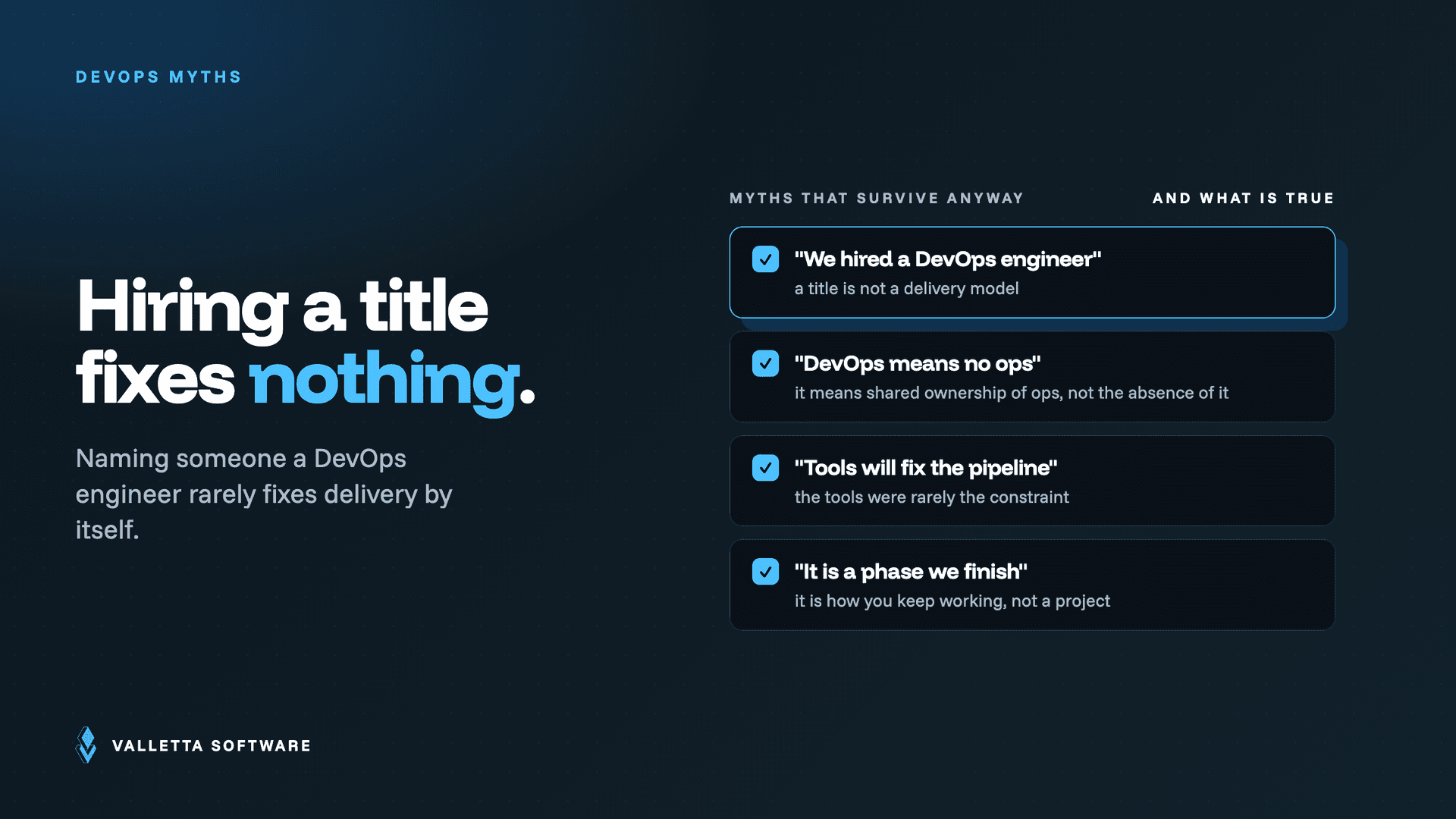

Most DevOps myths sound like best practice until you have to live with them. We have run DevOps engagements for over a hundred B2B SaaS clients, and the patterns are remarkably consistent: the same five myths show up, the same teams get burned by them, and the same fixes work. This piece walks through what the real DevOps myths are in 2026, why each one looks attractive, and what to do instead.
Key takeaways
- DevOps is not a team, it is a way of working. Naming a "DevOps engineer" rarely fixes delivery problems by itself.
- Tooling is the cheapest part of the transformation. Process and ownership are 80% of the work.
- Speed and stability are not a trade-off. The DORA research consistently shows the highest performers ship faster and recover faster.
- Full automation is not the goal; reliable feedback loops are. Automate the steps that fail silently or take more than 10 minutes of human time.
- The biggest delivery risk for most startups is not infrastructure; it is undefined deployment ownership.
Myth 1: We need a DevOps team
The most common DevOps myth is also the most expensive. Founders read about DevOps and conclude that the fix is to hire one or two engineers with that title, give them a Kubernetes cluster, and check the box. Six months later, those engineers are firefighting alone, developers still do not own their deployments, and release frequency has not moved.
DevOps is a cultural and process change, not a job title. The original idea was to dissolve the wall between dev and ops, not build a new wall around a small specialist team. In practice this means three things: developers own deployment of their own services in non-production environments, on-call rotations include software engineers (not just SREs), and operational concerns like observability and runbook completeness are part of the definition of done for every story.
What works instead: hire a platform engineer or two whose job is to build paved-road tooling that lets every developer ship without ceremony. Then enforce ownership through pull request templates, dashboard requirements, and on-call shadowing rotations. The "DevOps team" then becomes a platform team supporting the engineers who actually do the deploying.
Myth 2: More tools mean faster delivery
Tool inflation is the most visible symptom of DevOps gone wrong. A typical mid-size SaaS team in 2026 has GitHub Actions, ArgoCD, Terraform, Datadog, PagerDuty, Sentry, Snyk, an internal CLI wrapper around half of those, plus three Slack bots that no one remembers configuring. Every tool was the right answer to a real problem at the time. Together they slow everyone down because the cognitive load of understanding the pipeline becomes its own bottleneck.
The myth is that any specific tool unlocks delivery speed. The reality is that the path through your tools is what matters. A team with three boring tools and a clear deployment path beats a team with twelve clever tools and a flaky one every time. Before adding a tool, ask three questions: what tool does this replace, who owns it after the trial, and what happens to the existing tool's configuration when we cut over.
Myth 3: Speed and stability are a trade-off
The "ship fast and break things" framing convinced a generation of teams that you have to choose between release frequency and reliability. The DORA research, now running for over a decade, has shown the opposite at every measurement: elite-performing teams deploy multiple times per day and have lower change failure rates, faster recovery times, and shorter lead times for changes than low-performing teams.
The mechanism is not magic. Small, frequent deployments mean the blast radius of any one change is small. Combined with reasonable automated testing, feature flags, and progressive rollouts, the chance that a deployment causes a customer-visible incident drops sharply. Teams that batch a week of work into one Friday release have higher risk because each release contains many independent changes that can interact in unpredictable ways.
Myth 4: We need full automation before we can call it DevOps
Some teams stall their entire DevOps transition waiting for 100% automation. The myth here is that DevOps is binary: you either have it or you do not. The truth is more useful: DevOps is a set of feedback loops, and automation is one way to shorten those loops.
What works instead is to start with the highest-pain manual steps and automate those first. The criteria for "automate this first" are usually: it fails silently, it takes more than 10 minutes of human time per occurrence, or it blocks other work while it runs. A weekly database migration that requires a senior engineer to babysit it for an hour is a higher-priority candidate than a daily backup that already runs reliably without supervision.
Myth 5: Kubernetes is the answer (or the problem)
Kubernetes shows up in DevOps conversations as either a silver bullet or a cardinal sin. Both takes are wrong. Kubernetes is excellent infrastructure for teams that genuinely need to run many services across many environments with strict resource isolation. It is overkill for a four-service monolith deployed to a single environment.
The decision criteria are simpler than the noise suggests. Do you run more than 10 services? Do you need bin-packing across many compute instances? Do you have a platform engineer who can spend at least 25% of their time on it? If yes to all three, Kubernetes pays off. If no to any one of them, a managed service like AWS ECS, Google Cloud Run, or Fly.io will usually serve you better at lower total cost of ownership.
What actually moves the needle for startups
Three practices, in order of priority, give the highest return on DevOps investment for B2B SaaS startups in their first two years.
- Define deployment ownership. Every service has a named owner who is on-call for it and merges its deploys. This single change reduces incident MTTR more than any tool we have measured.
- Adopt trunk-based development with small, frequent merges. Long-lived feature branches are the source of most release-day surprises. Aim for branches under three days old at merge time.
- Build one paved road. Pick a single deployment pattern for new services and stick to it. Variability across services is what makes platform engineering expensive.
Quick diagnostic: is your DevOps actually working?
Five questions you can answer in about 20 minutes that tell you more than any tool dashboard:
- How long does it take to go from a merged commit to production in the median case? Anything over four hours signals automation gaps.
- What is your change failure rate (deploys that cause an incident or rollback)? Above 15% means you are batching too much per deploy.
- How long to recover from the average production incident? Above 60 minutes signals observability or runbook gaps.
- How many people can deploy any given service? Below two is a bus factor risk; above ten is a coordination risk.
- What percentage of deploys are blocked waiting on humans (approvals, manual tests, security signoff)? Above 20% means policy is being enforced as ceremony rather than automation.
If you want a deeper look at how to set up these feedback loops without overcomplicating them, read our guide to optimizing DevOps in startups or blue-green deployment guide. For broader infrastructure decisions, see SaaS tech stack selection.
Frequently asked questions
Do small teams need DevOps?
Yes, but most of it. Small teams need the disciplines (ownership, frequent deploys, observability) but not the tooling overhead. Five engineers and one paved-road deployment template gets you 80% of the value of a full platform team.
How long does a real DevOps transformation take?
For a 10 to 30 person engineering org, expect six to nine months to move from "we have CI" to "we deploy multiple times per day with confidence." The bottleneck is rarely tooling; it is changing how teams take ownership and how releases are reviewed.
When is Kubernetes actually worth it?
When you have more than 10 services in production, when you need real bin-packing across compute instances, and when you have an engineer or platform team dedicated to keeping it healthy. Below those thresholds, a managed container service is usually the better economic call.
What single metric matters most?
If you can only track one, track lead time for changes (median commit-to-production time). It captures most of the friction in the system: testing speed, review cycles, deployment automation, and ownership clarity all show up in this number. The DORA research confirms it correlates with most other delivery health metrics.
Can DevOps work in regulated industries?
Yes, and arguably better than waterfall release patterns. Frequent small changes are easier to audit, easier to attribute, and easier to roll back than infrequent large ones. The key is to encode compliance checks as automated policy gates rather than human approval steps, which moves audit burden onto the CI pipeline rather than the engineer.