

Unveiling the Dynamics of Client Collaboration in Outsourcing

Client collaboration in outsourcing is the single biggest predictor of whether a software project succeeds or burns goodwill on both sides. Tools, processes, and even technical skills are secondary. We have run outsourced engagements with B2B SaaS clients for over 15 years, and the patterns of what works (and what destroys relationships) are predictable. This article opens up what really happens behind the engagement contract.
Key takeaways
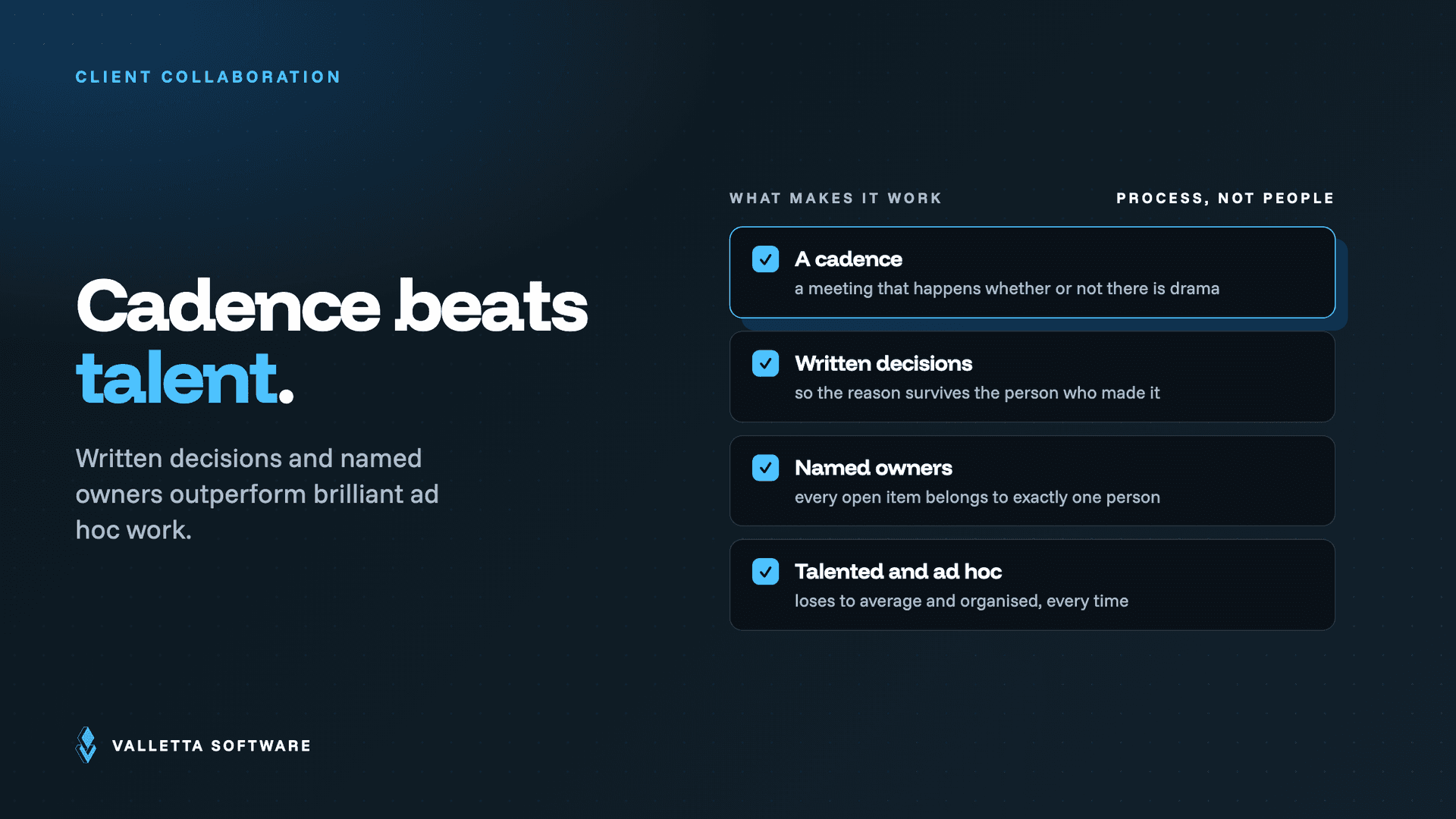
- Successful collaboration is structured, not heroic. Cadences, written decisions, and named owners outperform talented individuals working ad hoc.
- The number-one cause of outsourcing failure is unclear decision rights. Who can approve what, and how fast, is more important than any technical choice.
- A weekly written status that no one wants to read is a leading indicator of trouble. Replace it with a 15-minute live demo and a 5-line decision log.
- Time zone differences are an asset if you design around them. They become a liability if you treat them as a bug.
- Healthy engagements escalate early. The phrase "we will figure it out later" inside a project plan is a red flag every time.
What client collaboration actually looks like
From the outside, outsourcing looks like a contract, a Slack channel, and a delivery date. From the inside, it is a daily rhythm of decisions, demos, escalations, and trade-offs. The collaboration design choices that shape that rhythm are usually made in the first two weeks of an engagement and rarely revisited. That early window is where most engagements quietly succeed or quietly fail.
The healthy pattern looks like this. Daily async status notes from the delivery team summarize what shipped, what is blocked, and what decisions are pending. A weekly 30-minute call walks through a live working demo, not a slide deck. A monthly review covers metrics, scope changes, and roadmap recalibration. Decisions that change scope, budget, or timeline are written down in a decision log everyone can read. Escalations go up a defined chain within hours, not days.
Decision rights: the most underrated success factor
Most outsourcing problems trace back to a decision that needed to be made and could not be. The technical lead does not have authority to choose between two design options without product input. The product owner is in meetings all day and cannot respond to the Slack question for 18 hours. The engineering team waits. The schedule slips by a day, then by a week, then by a month.
The fix is to define decision rights explicitly at the start. Three categories cover most situations:
- Day-to-day technical decisions (library choice, internal API shape, test approach): owned by the delivery team's tech lead, no client approval required.
- Product and UX decisions (feature behavior, copy, error messages): owned by the client's product owner, with a 24-hour SLA for response.
- Scope and timeline decisions (adding features, changing dates, reallocating budget): require explicit written approval from a named decision maker on the client side.
Writing this down at week one prevents 80% of the friction in months three through twelve.
Communication cadences that actually work
The right cadence depends on engagement type. For dedicated team or staff augmentation engagements with a multi-month horizon, the pattern below scales well.
- Daily. Async status note in a shared channel: what shipped yesterday, what is in progress today, what is blocked. Two minutes to write, two minutes to read.
- Weekly. 30-minute call with a live demo of working software. No slide decks. The product owner, the tech lead, and one other stakeholder.
- Bi-weekly. Retrospective focused on process changes. What slowed us down this sprint, what do we change next sprint.
- Monthly. Metric review with the client's executive sponsor: velocity, defect rate, scope changes, budget consumption.
- Quarterly. Strategic alignment session. Are we still solving the right problem? Has the customer landscape shifted?
The trap to avoid: scheduling meetings that no one prepares for. A 30-minute weekly call with a poorly framed agenda burns more goodwill than no call at all.
Metrics that build trust
Clients want predictability. The delivery team wants room to make sensible engineering choices. The right metrics build trust across that gap. Five we use consistently:
- Velocity measured in story points per sprint, with a 3-sprint rolling average to smooth noise. Useful for capacity planning, not for cross-team comparison.
- Lead time for changes from ticket-opened to production-deployed. Tracks delivery friction independent of estimate quality.
- Defect escape rate: bugs found by users in the first week after release, normalized by features shipped. Best single quality metric.
- Scope-change velocity: number and direction of scope changes per sprint. Reveals product-management discipline as much as delivery discipline.
- Engagement NPS: a quarterly one-question survey of the client team. Catches relationship friction before it becomes a contract issue.
Time zones and distributed teams
Time zone gaps are often framed as a downside of outsourcing. They become a real advantage when the team is designed for asynchronous work from day one. Three rules make the difference.
First, define a daily overlap window (typically four hours) that both teams can rely on for synchronous interaction. For European-US engagements that is often 14:00 to 18:00 UTC. For European-Asian engagements it is the morning.
Second, treat written communication as default and verbal as exception. Decisions made on calls get summarized in writing within an hour. This sounds heavy and pays off compoundingly: in month six, no one is searching Slack for half-remembered context.
Third, use the gap deliberately. Code that ships at end of day in the delivery team's timezone gets reviewed during the overlap window the next day. Bugs reported by the client team in the morning are often fixed by their afternoon. The "overnight progress" pattern is one of the strongest arguments for distributed engagement.
Escalation paths and the cost of late escalation
The single most expensive engagement pattern is the team that "tries to handle it" without escalating. A problem that could have been resolved with a 20-minute conversation in week one becomes a contract renegotiation in week 14.
Healthy engagements have explicit escalation triggers. We use four:
- Any blocker that lasts more than 48 hours, regardless of cause, escalates to both project sponsors.
- Any decision pending for more than 72 hours escalates to the client's decision maker for that category.
- Any scope change estimated at more than 5% of the budget escalates the same day.
- Any signal of dissatisfaction in the engagement NPS or in regular conversations triggers a calibration call within a week.
What clients can do to make outsourcing succeed
The client side of the equation gets less attention than it should. Three behaviors we see in clients who get outsized value from outsourcing:
- Treat the delivery team as part of the engineering org, not as vendors. Invite them to internal product reviews, share roadmap context, and explain why decisions are being made.
- Respond fast to product questions. The 24-hour SLA is a discipline both ways. Slow product input is the most common cause of delivery slip.
- Be honest about constraints. Budget pressure, timeline pressure, competing priorities: a delivery team that knows the actual constraints makes much better trade-off decisions than one that is operating on a sanitized version.
For a deeper look at how we structure outsourced engagements, see our IT staffing guide, our outsourcing perspective for 2025, and our framework for managing scope creep. For independent research on distributed-team performance, see the long-running DORA research on software delivery and Atlassian's reports on cross-team collaboration.
Frequently asked questions
How much overlap time do distributed teams need?
Four hours of daily overlap is enough for almost all engagements when the team is designed for asynchronous work. Below two hours overlap, you need stronger written discipline to compensate. Above six hours, you are likely paying for unproductive time on at least one side.
When should we escalate concerns in an engagement?
As soon as you notice the same friction twice. The pattern we see most often is clients waiting until the third or fourth time something hurts before raising it, by which point the relationship has cooled. Early escalation is cheaper for everyone.
What is the right team size for an outsourced engagement?
Three to seven engineers is the sweet spot. Below three, the team cannot absorb absences or specialize. Above seven, coordination cost rises sharply and you need a tech lead who is fully dedicated to coordination rather than building.
How do you handle confidentiality and IP?
Contractually upfront with explicit IP assignment, NDA at the company level rather than per-engineer, and isolated development environments where the client controls access. We also recommend that source code lives in repositories the client owns from day one, even if we are the primary committers.
How do you know an engagement is going well?
Three signals. Velocity is predictable within roughly 15% of the rolling average. Defect escape rate is trending down or flat. The client team brings new ideas and problems to the delivery team unprompted, rather than only responding to delivery-team requests. The third signal is the most under-recognized; it indicates the engagement has graduated from vendor relationship to partner relationship.