

AI Developer Onboarding Checklist: Access, Environments, and MLOps Basics for Global Teams 2026

An AI developer onboarding checklist is a structured 30-day plan that covers identity provisioning, secure environment setup, CI/CD pipeline integration, and MLOps fundamentals for new machine learning engineers and AI software developers joining a team. A well-executed onboarding process for AI engineers reduces time-to-productivity by weeks and eliminates security gaps that commonly appear when access controls are configured ad hoc. If you'd rather skip the setup entirely, spin up an AI development team that ships from day one.
The demand for skilled AI developers continues to accelerate in 2026, yet effective onboarding remains a challenge, especially in globally distributed or hybrid workforces. Industry surveys consistently show that a significant majority of IT leaders say onboarding delays impact project delivery times and security posture. With AI-first development methodologies now delivering 40 to 70 percent faster project timelines and 30 to 35 percent cost reductions compared to traditional software development, the stakes for getting your machine learning team onboarding process right are higher than ever.
This guide provides an actionable, globally relevant AI engineer onboarding checklist covering day 1 through day 30 milestones, robust access controls, development environment setup, and MLOps essentials. At Valletta Software Development, we apply this structured onboarding approach across our globally distributed engineering teams working on AI-native projects spanning fintech, logistics, healthcare, and e-commerce platforms.
Day 1 to Day 7: Immediate Access, Identity, and Security Controls
The first week of any AI developer onboarding process is critical for establishing the proper digital foundation. Getting identity management, access provisioning, and compliance orientation right from the start prevents security incidents and eliminates the friction that causes new hires to lose momentum.
Identity and Access Provisioning
Modern enterprises rely on tools like Okta or Azure Active Directory for single sign-on (SSO), multi-factor authentication (MFA), and automated user provisioning. Every new AI developer should start with least-privilege access tailored to their role, with permissions scoped to specific projects rather than broad organizational access. At Valletta Software, we provision project-specific cloud accounts across AWS, GCP, and Azure depending on the client's infrastructure requirements, ensuring developers have just-in-time, need-to-know access from day one.
Secrets Management
Sensitive credentials, API keys, and tokens must be secured centrally rather than stored in code repositories or shared over messaging platforms. HashiCorp Vault is the industry standard for dynamic secrets, access policies, and centralized credential management. It supports periodic rotation and audit logging, which are essential for compliance with GDPR, SOC 2, and PCI DSS requirements. In 2026, with the EU AI Act now in enforcement, securing model training credentials and API access tokens for LLM services is also a regulatory consideration for teams operating in or serving European markets.
Initial Compliance Briefing
Developers need orientation on data privacy, regulatory compliance (GDPR, SOC 2, ISO 27001, EU AI Act), and secure coding policies during the first week. This is especially important for AI projects where training data handling, model artifact security, and API authentication mechanisms such as OAuth 2.0, JWT, and API keys are part of daily work. Completing this briefing early reduces the risk of accidental data breaches and establishes the security mindset the team needs.
Key Activities for Week One
Assign enterprise accounts and set up SSO/MFA. Provision project-specific cloud accounts on AWS, GCP, or Azure. Enable access to code repositories, wikis, and CI/CD pipelines with least-privilege controls. Introduce developers to company security and privacy frameworks including the compliance checklist and access control matrix. Brief the developer on AI-specific regulatory requirements relevant to the project's jurisdictions.
Day 8 to Day 14: Setting Up Local and Cloud Development Environments
By the second week, AI developers and machine learning engineers must establish reliable, reproducible coding and experiment environments. Standardizing development environments across a distributed AI team prevents configuration drift and ensures that model training, testing, and deployment produce consistent results regardless of where the developer is located.
Development Environment Provisioning
Standardized developer workspaces speed productivity dramatically. This means pre-configured Docker environments, conda environments for machine learning workflows, and cloud-based JupyterLab or local VS Code instances ready for frameworks like TensorFlow and PyTorch. At Valletta Software, our DevOps engineers prepare containerized development environments using Docker and Docker Compose with Kubernetes orchestration, ensuring every team member works in an identical setup regardless of their location or operating system.
Dependency Scanning and Secrets Integration
Centralization is key to secure AI development environment setup. HashiCorp Vault should inject secrets securely into development environments through environment variables and dynamic access policies. Dependency scanning with Trivy identifies vulnerabilities in containers and open-source libraries before they reach staging environments. We integrate Trivy scans into local build pipelines during this phase, catching issues at the point where they are cheapest to fix.
Data Access Controls and AI Model Supply Chain Security
AI projects require careful data governance. Introduce data access layers that expose only the necessary datasets for development, with regular audits for compliance. For ML projects, this includes managing training data versioning, ensuring data lineage tracking, and implementing storage lifecycle policies. In 2026, AI model supply chain security has become a critical concern: teams must verify the provenance of pre-trained models, validate training data sources, and ensure that third-party model weights have not been tampered with. Our teams use S3 lifecycle policies and Glacier archival for infrequently accessed training data to optimize costs while maintaining data availability.
Key Activities for Week Two
Distribute pre-configured environment templates or Docker Compose files. Integrate Trivy scans into local build pipelines. Assign environment variables and secrets via Vault integrations. Review secure data access protocols for all project datasets. Establish model provenance verification procedures for any pre-trained models or third-party AI components used in the project.
Building an AI-powered product?
Valletta Software Development helps companies launch AI-native applications 40 to 70 percent faster with our AI-first development methodology. Explore our delivered projects or start a conversation about your initiative.
Day 15 to Day 21: Code Repositories, CI/CD Pipelines, and MLOps Integration
A seamless coding and deployment pipeline is vital for rapid, high-quality AI delivery. This phase of the machine learning developer onboarding process is where engineers learn the workflows that will define their daily productivity.
Source Control Onboarding
Modern engineering teams use platforms like GitHub or GitLab with SSO integration. Developers should be introduced to the team's branching strategies, code review standards, and protected branches. At Valletta Software, our source control practices include structured branch naming conventions, mandatory peer reviews, and automated checks that run before any merge is approved.
Continuous Integration and Continuous Delivery
CI/CD onboarding for AI teams means teaching developers to deploy models and code through automated pipelines that enforce testing, security scanning, and policy compliance at every stage. Our engineering practice spans a wide range of CI/CD tooling including GitHub Actions, GitLab CI, Jenkins, Argo CD, TeamCity, CircleCI, and Azure DevOps, selected based on client infrastructure and project requirements. Developers should walk through a complete pipeline: from committing code through automated testing, vulnerability scanning with Trivy, and deployment to staging. Understanding rollback strategies and GitOps-based workflow automation with Argo CD is particularly important for ML model deployments where inference endpoint stability is critical.
MLOps Workflow Foundations
New developers should be guided through essential MLOps practices during this phase. This includes ML model versioning, artifact tracing and signing using Sigstore, and pipeline reproducibility. For teams deploying on AWS, introduction to SageMaker Pipelines, AWS Step Functions for orchestrated training jobs, and SageMaker Multi-Model Endpoints for cost-efficient inference hosting should be part of this week's curriculum. In our MLOps cost optimization projects, implementing these practices from the start reduced AWS operational costs by over 40 percent through right-sized compute, scheduled training, and multi-model endpoints.
Key Activities for Week Three
Onboard to source control with project repositories and protected branches. Walk through CI/CD workflows including demo deployments and rollbacks. Integrate Trivy scans for pipeline compliance gates. Introduce Sigstore for artifact signing and transparency logs. Review MLOps pipeline structure, model deployment patterns, and inference endpoint monitoring.
Day 22 to Day 30: Policy, Monitoring, and Developer Automation
The final onboarding phase ensures sustainable, compliant, and automated AI development practices. By the end of day 30, a properly onboarded AI developer should be fully autonomous within the team's established workflows, capable of independently committing code, deploying to staging, monitoring results, and requesting production releases.
Policy Enforcement and Compliance Monitoring
Developers must understand baseline company policies including secure coding standards, data retention rules, and software licensing compliance. Tools like Argo CD enable automated policy checks as part of deployment pipelines, ensuring that no code reaches production without passing compliance gates. For teams handling sensitive data or operating under the EU AI Act, compliance checklists covering GDPR, SOC 2, ISO 27001, and AI-specific risk classification should be reviewed and acknowledged. The OWASP Top Ten remains the essential baseline for secure coding training during this phase.
Runtime Security and Observability
Deploy runtime scanning with Trivy to monitor deployed containers for vulnerabilities. Logging and observability, using platforms such as the ELK stack (Elasticsearch, Logstash, Kibana), Prometheus, or AWS CloudWatch, offer real-time alerting for anomalies. For ML-specific monitoring, SageMaker Model Monitor tracks model drift and performance, triggering retraining only when data quality degrades rather than on a fixed schedule. This approach can reduce cloud costs by over 40 percent compared to unoptimized ML infrastructure.
Developer Autonomy and Self-Service Automation
DevOps onboarding should culminate in a "developer self-service" checklist that empowers engineers to request resources while maintaining audit trails and least-privilege access. This includes automated CI/CD pipelines using tools like AWS CodePipeline and CodeBuild for automatic model versioning, testing, and deployment. The goal is that by day 30, the developer can independently operate within the full software delivery lifecycle without requiring manual intervention from senior team members.
Key Activities for Week Four
Require secure coding training completion. Demonstrate live runtime vulnerability scanning. Provide walkthroughs of deployment and monitoring dashboards. Conduct a feedback survey to iteratively improve the AI team onboarding process for future hires.
Key Tool Functions in AI Developer Onboarding
The following table summarizes the core tooling used at each stage of a 30-day AI developer onboarding checklist. Each tool is mapped to its primary function, the onboarding week where it is introduced, and the key benefit it provides to the team.
| Tool | Purpose | Onboarding Stage | Key Benefit |
|---|---|---|---|
| Okta | SSO/MFA, Identity Provisioning | Day 1 to 7 | Secure, streamlined access control |
| HashiCorp Vault | Secrets Management | Day 1 to 14 | Protects credentials, tokens, and API keys |
| Trivy | Vulnerability Scanning | Day 8 to 30 | Proactive security across CI/CD pipelines |
| Sigstore | Artifact Signing | Day 15 to 21 | ML artifact integrity and traceability |
| Argo CD | GitOps / CI/CD Orchestration | Day 15 to 30 | Automated, compliant delivery |
| GitHub Actions | CI/CD Pipelines | Day 15 to 30 | Native integration with source control |
| AWS SageMaker | MLOps / Model Deployment | Day 15 to 30 | Scalable training and inference endpoints |
| Kubernetes | Container Orchestration | Day 8 to 14 | Reproducible, scalable environments |
Expert Tips for AI Developer Onboarding in 2026
Automate identity and secrets provisioning. Build onboarding scripts that tie Okta and Vault user creation to employee start dates for zero manual touchpoints. This eliminates the 2 to 3 day delay that most teams experience when provisioning accounts manually.
Enforce least privilege rigorously. Review and expire temporary permissions post-day 30 to prevent permission creep. Use your access control matrix to audit permissions quarterly, especially for developers who rotate between projects.
Embed security scanning from day one. Integrate Trivy and Sigstore into every pipeline so vulnerability detection and artifact tracing become habits rather than afterthoughts. At Valletta Software, security scanning is a mandatory gate in all CI/CD pipelines, from GitHub Actions through to production deployment via Jenkins, GitLab CI, or Argo CD.
Track progress with a templated checklist. Maintain a standardized onboarding checklist in your project wiki using tools like Confluence or Notion. This ensures consistent onboarding for every developer worldwide and provides a clear audit trail of completed milestones.
Address AI model supply chain risks early. In 2026, verifying the provenance of pre-trained models, scanning for adversarial weights, and documenting model lineage are becoming as important as traditional code dependency scanning. Include model provenance checks in your onboarding checklist alongside Trivy scans.
Encourage continuous upskilling. Offer regular, focused training sessions on new tools and workflows. The pace of change in AI tooling, from new LLM model families and inference optimization to evolving compliance requirements like the EU AI Act, means that onboarding is not a one-time event but an ongoing process.
Frequently Asked Questions
What is the most critical Day 1 activity for onboarding an AI developer?
Provisioning secure, least-privilege access through identity platforms such as Okta and centralizing credentials with HashiCorp Vault. These two steps ensure only authorized individuals access sensitive AI environments and datasets. For teams working across AWS, GCP, and Azure, cloud account provisioning with role-based access control should happen within the first 24 hours.
How can new AI developers securely handle sensitive secrets or API keys?
Use centralized secrets management tools like HashiCorp Vault for secure distribution and periodic rotation. Never store credentials in code repositories. CI/CD pipelines should inject secrets at build time through environment variables and dynamic access policies rather than embedding them in application code.
Why is CI/CD onboarding important for AI development teams?
CI/CD familiarity, using tools such as GitHub Actions, GitLab CI, Jenkins, or Argo CD, enables developers to deploy models and code through automated pipelines with built-in testing, security scanning, and policy compliance. For AI teams specifically, CI/CD handles model versioning, automated retraining triggers, and inference endpoint deployment at scale.
What MLOps basics should be introduced within the first month?
ML model versioning, artifact signing with Sigstore, data governance, and pipeline reproducibility. For AWS teams, SageMaker Pipelines and Model Monitor for drift detection are essential. Teams implementing MLOps practices from the start see over 40 percent reduction in operational costs compared to those that adopt them retroactively.
How do global organizations maintain consistent onboarding for remote AI developers?
Standardize onboarding guides and automate access provisioning. Use templated checklists for tracked progress, cloud-native environments like JupyterHub for consistency, and containerized development environments using Docker and Kubernetes to eliminate environment drift across geographies.
What is AI model supply chain security and why does it matter during onboarding?
AI model supply chain security refers to verifying the provenance, integrity, and safety of pre-trained models, third-party weights, and training datasets used in a project. In 2026, with growing concerns about model poisoning and adversarial manipulation, onboarding checklists should include model provenance verification alongside traditional code vulnerability scanning.
How does the EU AI Act affect AI developer onboarding in 2026?
The EU AI Act introduces risk-based classification for AI systems and requires documentation of training data, model decisions, and compliance measures. AI developer onboarding for teams serving European markets should include a compliance briefing on AI Act requirements during the first week, covering risk classification, transparency obligations, and data governance standards.
How Valletta Software Development Approaches AI Developer Onboarding
At Valletta Software Development, we apply these onboarding practices across our globally distributed teams working on AI-native projects. Our engineering practice spans the full modern stack including backend frameworks (.NET, Node.js, Python, Java), frontend technologies (React, Angular, Vue.js), mobile platforms (React Native, Flutter), and deep AI/ML capabilities covering NLP models (GPT, Claude, BERT, Llama), computer vision (YOLO-based systems), and conventional ML classification and prediction models.
Our DevOps infrastructure supports this onboarding rigor with CI/CD pipelines running on GitHub Actions, GitLab CI, Jenkins, Argo CD, and TeamCity, combined with containerization via Docker and Kubernetes, cloud deployments across AWS, Azure, and GCP, and comprehensive monitoring with CloudWatch, Prometheus, and the ELK stack. Our AI-first development methodology delivers 40 to 70 percent faster project delivery with consistent, maintainable codebases, and structured onboarding is a key enabler of that velocity.
Explore our success stories to see how our teams deliver AI-powered solutions across fintech, logistics, e-commerce, and healthcare, or contact us to discuss how we can support your next AI initiative.
Additional Resources
The Google Cloud MLOps guide provides a comprehensive overview of ML pipeline maturity levels and automation strategies. The AWS SageMaker documentation covers model deployment patterns, multi-model endpoints, and cost optimization strategies. For CI/CD best practices, the Cloud Native Computing Foundation (CNCF) maintains current guidance on GitOps, Kubernetes, and container security. The OWASP Top Ten remains the essential reference for secure coding policies, and the EU AI Act official resource provides the regulatory framework that AI teams serving European markets should understand.
Frequently asked questions
- What should an AI developer onboarding checklist cover?
- Access provisioning (repos, cloud, secrets), environment setup (local + remote GPU), CI/CD pipelines, MLOps tools (experiment tracking, model registry, observability), data access policies, and a first-week scoped task.
- How long should onboarding take for an AI developer?
- 30 days for full productivity is the right target. Day 1 covers access, day 5 covers a first PR, day 14 covers a shipped feature, day 30 covers ownership of a workstream.
- What MLOps basics should every new AI developer know?
- Experiment tracking, model registry, automated evaluation, rollout safety (canary, shadow), observability for prompts and outputs, and cost monitoring on inference.
- How do I avoid first-week security incidents?
- Use scoped credentials, default-deny access policies, secret managers (not env files in repos), and pair onboarding with a security walkthrough before any production data touches the developer's machine.
- Does Valletta Software handle AI developer onboarding?
- Yes. Valletta's dedicated AI team engagement includes a standardized onboarding protocol covering access, MLOps and security from day one.
Skip the Onboarding, Ship the Product
Valletta's dedicated AI development teams arrive with standardized MLOps, CI/CD, security and onboarding protocols. Productive from week one.
Key takeaways
- 30-day onboarding plan: access in week 1, working AI environment by week 2, first prod-bound code by week 4.
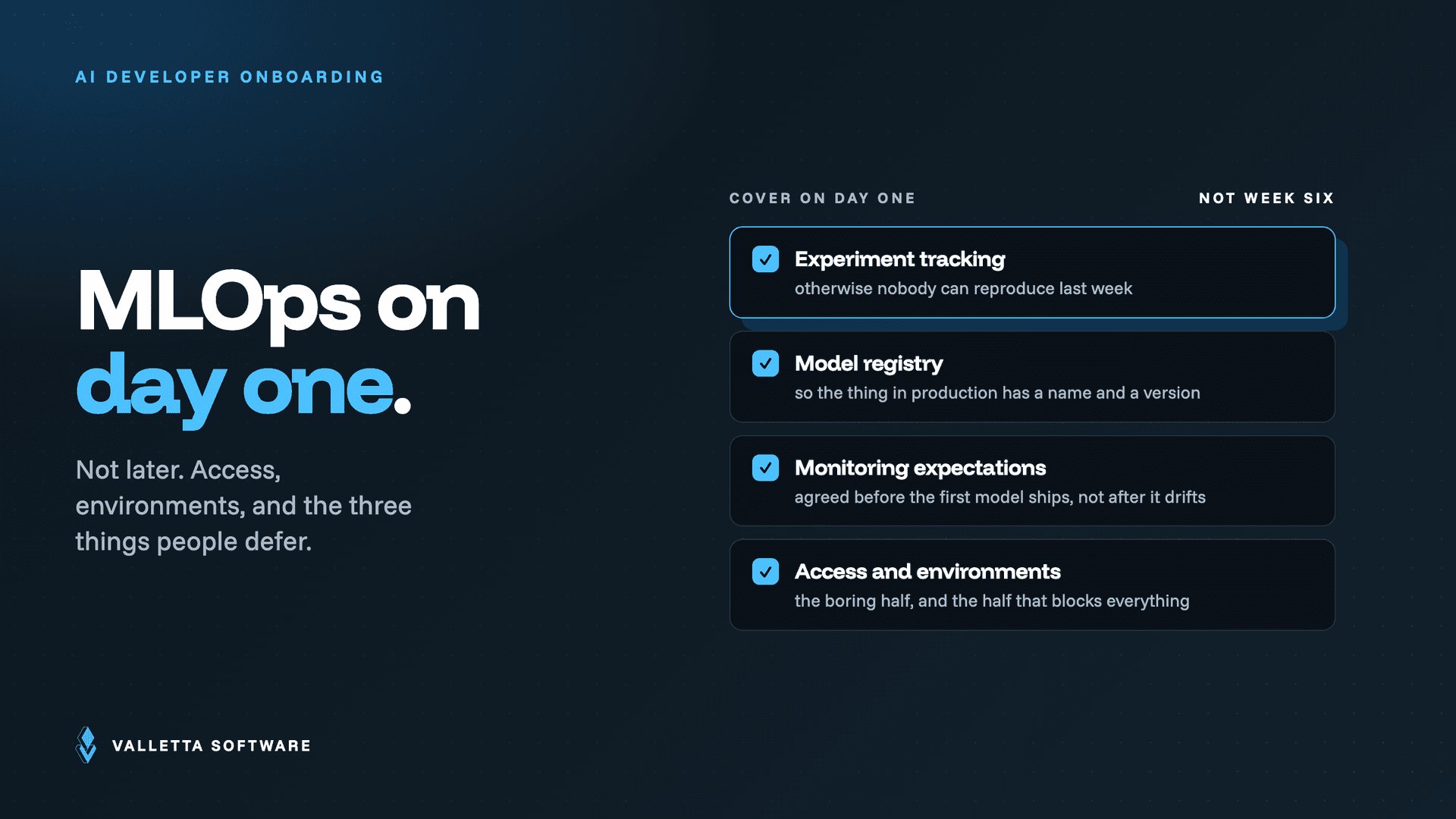
- Cover MLOps basics on day 1, not later: experiment tracking, model registry, monitoring expectations.
- Security gates non-negotiable from week 1: API key handling, data classification, EU AI Act awareness.
- Pair with a domain engineer for the first month, not just a tech-lead. Context transfer is the highest-ROI investment.